
Good as Gold
by Joseph Heller
On This Page
Description
Gold accepts a government post in Washington, considers leaving his wife, and all the while he is also searching for material to write his book on the Jewish experience in America, without realizing he is going through that experience.Tags
Recommendations





















Member Reviews
Bruce Gold is a college professor, the youngest son in a crazy Jewish family, and the next Secretary of State. Or maybe not; it's hard to tell. Every time a character says something, the next statement always contradicts it as Heller skewers academia and politics.
Heller is generally known for being a one hit wonder with Catch-22 being his only good book, but I didn't think this one was so bad. I really liked the witty wordplay which made me laugh out loud at times; however, I found I just wasn't able to keep up with the overall message of the novel because it was a little too abstract.
Heller is generally known for being a one hit wonder with Catch-22 being his only good book, but I didn't think this one was so bad. I really liked the witty wordplay which made me laugh out loud at times; however, I found I just wasn't able to keep up with the overall message of the novel because it was a little too abstract.
There are three themes in Joseph Heller’s ‘Good as Gold’, published in 1979 when the author was 56, and 18 years after his masterpiece ‘Catch-22’. The first is to describe the Jewish experience growing up in America, which Heller’s character Bruce Gold sets out to do but struggles because he’s not sure he’s had one. Instead, Heller illustrates with everything surrounding Gold: for example, his loud, opinionated, and verbally abusive father, the very blunt way he and his own daughter communicate, and the racism against Jews by elites and those in power. Gold has a constant feeling of persecution, and it’s almost always by those less intelligent than himself.
The next is to skewer the American government of the show more mid-70’s, which had just gone through Nixon, Watergate, and Vietnam. Heller takes special aim at Henry Kissinger, who his character sees as a war-mongering, self-serving egomaniac who is a traitor to his race and possibly a war criminal. I found these parts of the book to be especially good. The incompetence of those in power, the lack of qualification necessary to get cabinet posts, the talking in circles and lying, the government spying on its own citizens, politicians making money by writing books instead of serving jail time for their scandals, and the bureaucracy of it are all parodied. As he tries to get a job in government, it’s explained to him that “This president doesn’t want yes-men. What we want are independent men of integrity who will agree with all our decisions after we make them.” All of this is timely reading with Trump as president, and this reminder of the dark times America went through dealing with Nixon’s abuse of power and a number of scandals in government at the time, and yet persevered, perhaps provides solace to our current sad state of affairs.
Lastly, Heller is also describing a darkening view of life at middle-age. He doesn’t have the perfect marriage, and cheats. He wants a sexually free woman, but recoils from just how free some of them are. He sees stupidity and sadism in the recent conservative administration and in the rich, but he is also disillusioned about liberals, idealism, and mankind in general. “Either Gold had grown more conservative or civilization had grown progressively worse. Or both.” He laments urban decay on Coney Island, where he grew up. He wishes to look back at his life and his youth, but finds several times that his memories of how things were are not accurate.
I suppose this is the reason for not giving the book a higher rating – while it’s not completely dark and there is humor throughout, and while it may be a perfectly honest snapshot of Heller at this time in his life, it does feel a bit too much like a crotchety old man at times, and less enjoyable as a result. You could certainly do worse though. show less
The next is to skewer the American government of the show more mid-70’s, which had just gone through Nixon, Watergate, and Vietnam. Heller takes special aim at Henry Kissinger, who his character sees as a war-mongering, self-serving egomaniac who is a traitor to his race and possibly a war criminal. I found these parts of the book to be especially good. The incompetence of those in power, the lack of qualification necessary to get cabinet posts, the talking in circles and lying, the government spying on its own citizens, politicians making money by writing books instead of serving jail time for their scandals, and the bureaucracy of it are all parodied. As he tries to get a job in government, it’s explained to him that “This president doesn’t want yes-men. What we want are independent men of integrity who will agree with all our decisions after we make them.” All of this is timely reading with Trump as president, and this reminder of the dark times America went through dealing with Nixon’s abuse of power and a number of scandals in government at the time, and yet persevered, perhaps provides solace to our current sad state of affairs.
Lastly, Heller is also describing a darkening view of life at middle-age. He doesn’t have the perfect marriage, and cheats. He wants a sexually free woman, but recoils from just how free some of them are. He sees stupidity and sadism in the recent conservative administration and in the rich, but he is also disillusioned about liberals, idealism, and mankind in general. “Either Gold had grown more conservative or civilization had grown progressively worse. Or both.” He laments urban decay on Coney Island, where he grew up. He wishes to look back at his life and his youth, but finds several times that his memories of how things were are not accurate.
I suppose this is the reason for not giving the book a higher rating – while it’s not completely dark and there is humor throughout, and while it may be a perfectly honest snapshot of Heller at this time in his life, it does feel a bit too much like a crotchety old man at times, and less enjoyable as a result. You could certainly do worse though. show less
After reading about all the familial bullying, I was expecting to like Bruce Gold.
A lying, cheating adulterer with racist right wing views left me wondering where all the humor is supposed to lie.
And, why-OH- why did he keep returning to the detestable family dinners where everyone catered to the father?
It all became far too predictable.
Politics, notably skewering of Kissinger, was welcome old reading.
A lying, cheating adulterer with racist right wing views left me wondering where all the humor is supposed to lie.
And, why-OH- why did he keep returning to the detestable family dinners where everyone catered to the father?
It all became far too predictable.
Politics, notably skewering of Kissinger, was welcome old reading.
This is certainly a very Jewish book, there's almost two separate stories within, one being the political satire story, and the other being a middle aged man's struggle with his own family and relationships as he essentially undergoes a mid life crisis in both career and marriage.
There's some coarse language and quite a few racial epithets employed in the narrative and I found that after a while the satirical aspect became rather tiresome and rote.
Whilst it held my interest for the most part I didn't feel particularly enthralled by the narrative. The numerous unexplained Yiddish terms littered throughout the novel didn't endear me to the writing. At least the ending wrapped up the story lines nicely, you were finally able to feel show more something for a character that prior to the end did not have many (or dare I say any) redeeming features.
Overall, it's okay. show less
There's some coarse language and quite a few racial epithets employed in the narrative and I found that after a while the satirical aspect became rather tiresome and rote.
Whilst it held my interest for the most part I didn't feel particularly enthralled by the narrative. The numerous unexplained Yiddish terms littered throughout the novel didn't endear me to the writing. At least the ending wrapped up the story lines nicely, you were finally able to feel show more something for a character that prior to the end did not have many (or dare I say any) redeeming features.
Overall, it's okay. show less
Joseph Heller struck gold with "Catch -22", and sadly hasn't hit anywhere near that speed since. But This novel about the life and career shake-up than ensues when a man is offered a post as Secretary of State is quite entertaining. But the book didn't stick with me afterwards.
if you you call joseph heller a dog i shall love him. is there a finer am. writer in the last 50 yrs? 'Good as Gold' is an intense study of hypocrisy and greed. a fearless study of ethnicity that will always be relevant.
Gold's hatred towards humanity might remind us to Woody Allen's characters; however, Heller's style is much more complex and subtile. As colinflipper has said before me, he is not only cynical about academic environment but also about the White House as well as Jewish and Christians alike. It is, indeed, the perfect satire of the fight for power and wealth, influence and ranks. His is a very intelligent sense of humour and satire, full of allusions that make the text richer and worth to appreciate. Still, it has its highs and lows in as much as sometimes the plot can get a bit boring. On the whole, it is definitely worth reading, it's "message" being still quite relevant.
Members
- Recently Added By
Lists

20th Century Literature
1,161 works; 55 members

Novels from The Guardian's Great American Novelist Tournament
148 works; 24 members

The Torchlight List
95 works; 1 member

Take Four Books
130 works; 1 member
Author Information

19+ Works 54,406 Members
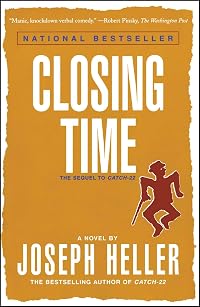
American novelist and dramatist Joseph Heller was born in Brooklyn, N.Y. on May 1, 1923. Heller started off his writing career by publishing a series of short stories, but he is most famous for his satirical novel Catch-22. Set in the closing months of World War II, Catch-22 tells the story of a bombardier named Yossarian who discovers the horrors show more of war and its aftereffects. This novel brought the phrase "catch-22," defined in Webster's Dictionary as "a situation presenting two equally undesirable alternatives," into everyday use. Heller wrote Closing Time, the sequel to Catch-22, in 1994. Other novels include As Good As Gold and God Knows. He also wrote No Laughing Matter, an account of his struggles with Guillain-Barr Syndrome, a neurological disorder, in 1986. Thirty-five years after writing his first book, Heller wrote his autobiography, entitled Now and Then: From Coney Island to Here. In his memoirs, Heller reminisces about what it was like growing up in Coney Island in the 1930s and 1940s. On December 13, 1999, Heller died of a heart attack in his home on Long Island. His last novel, Portrait of the Artist as an Old Man, was published shortly after his death. (Bowker Author Biography) show less
Some Editions
Awards and Honors
Distinctions
Notable Lists
Series
Belongs to Publisher Series
Work Relationships
Is abridged in
Common Knowledge
- Canonical title
- Good as Gold
- Original title
- Good as Gold
- Original publication date
- 1979
- People/Characters
- Bruce Gold; Maxwell Lieberman; Pomoroy; Belle Gold; Muriel Vogel; Ida Sugarman (show all 38); Rose; Esther Moscowitz; Julius Gold; Sid Gold; Harriet Gold; Victor Vogel; Irving Sugarman; Milt; Max; Gussie Gold; Ralph Newsome; Harris Rosenblatt; Dr. Murray 'Mursh' Weinrock; Lucille; Dina Gold; Joannie Fink; Jerry Fink; Andrea Biddle Conover; Mr. Epstein; Karp; Spotty Weinrock; Felicity Plum; Pugh Biddle Conover; Lionel Greenspan; Cheray; Simone; Yankel Lupewitz; Fishy Siegel; Eugene Siegel; Smokey the Fighter; Linda Book; Sheiky Siegel
- Important places
- Brooklyn, New York, USA; New York, New York, USA; Washington, D.C., USA
- Epigraph
- I've got his pecker in my pocket.
- Lyndon B. Johnson
as U.S. Senate Majority Leader
If you ever forget you're a Jew, a gentile will remind you.
- from a story by Bernard Malamud - Dedication
- I dedicate this book
to
The several gallant families
and
Numerous unwitting friends
whose
Help, conversations, and experiences
play so large a part. - First words
- Gold had been asked many times to write about the Jewish experience in America.
- Last words
- (Click to show. Warning: May contain spoilers.)Where could he begin?
- Publisher's editor*
- Osztovits, Levente
- Original language*
- English
*Some information comes from Common Knowledge in other languages. Click "Edit" for more information.
Classifications
- Genres
- General Fiction, Fiction and Literature
- DDC/MDS
- 813.54 — Literature & rhetoric American literature in English American fiction in English 1900-1999 1945-1999
- LCC
- PZ4 .H47665 .G — Language and Literature Fiction and juvenile belles lettres Fiction and juvenile belles lettres Fiction in English
- BISAC
Statistics
- Members
- 1,549
- Popularity
- 14,873
- Reviews
- 23
- Rating
- (3.39)
- Languages
- 13 — Czech, Danish, Dutch, English, Finnish, German, Hungarian, Norwegian (Bokmål), Polish, Portuguese, Slovak, Spanish, Swedish
- Media
- Paper, Audiobook, Ebook
- ISBNs
- 35
- ASINs
- 33