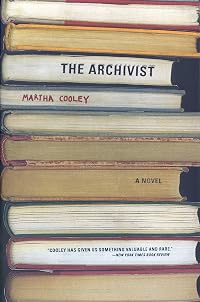
The Archivist: A Novel
by Martha Cooley
On This Page
Description
An aging librarian's memories are stirred by a young woman. The woman is researching her Jewishness after learning that her parents converted to Christianity. The librarian's wife, too, was a Jewess and she committed suicide, despairing of the Holocaust.Tags
Recommendations













Member Recommendations

Member Reviews
I did not know what to expect from the novel, but certainly nothing as emotionally charged and reflective as it was! Quiet Matt is a terrific foil to his two fiery women, Judith and Roberta, as both struggle in their own ways with their identities and their religion's meaning. I found it was a very human and astute way to look at how religion (in this case Judaism and Christianity) shape world views and sensitivities.
Judith's slow descent into insanity, as she starts to feel the world too much, absorbed by it and its cruelty, is mesmerizing and believable.
It was a bit of a tough read for me (I was looking for something lighter) but I did not regret my efforts.
Judith's slow descent into insanity, as she starts to feel the world too much, absorbed by it and its cruelty, is mesmerizing and believable.
It was a bit of a tough read for me (I was looking for something lighter) but I did not regret my efforts.
This many-leveled novel is hard to put down. Matthias is an archivist at a university library where among the treasures he is responsible for are letters from T. S. Eliot to an American woman with whom he (Eliot) was very close. Matthias is a widower whose wife, Judith, suffered from mental illness which may, in part, have come from her difficult childhood. The story begins with Matthias' story then moves to Judith's journal which forms the middle of the book. We also meet Roberta, a graduate student who comes into Matthias' life because she wants desperately to read the Eliot letters (which cannot released until 2020) because she is struggling with her recently discovered jewish background and wants to see how he dealt with religious show more conversion. Judith also struggled with her jewish heritage particularly in relation to the holocaust. The author manages to weld these themes of love, mental illness, and holocaust into a seamless whole which is challenging and delightful. show less
I finished this book a week or so ago but I wanted to mull it around a bit before I wrote about it. The Archivist was a profoundly moving novel. I was not aware until I began it of the role the Holocaust plays. It seems I cannot escape this lately.
The Archivist is the story of an archivist (duh), a scholar and a ghost. Both the scholar and the ghost are poets and have a strong interest in the work of T. S. Eliot. Eliot's poems are used throughout the book to poignant effect. The ghost is the late wife of the archivist, Matthias. Judith had killed herself twenty years prior to the opening of the novel. Judith was a poet and Jewish. Much of the book is set in the period immediately after the close of WWII. Judith is profoundly affected by show more the information regarding the Final Solution which appeared after the war ended. This seems to be the catalyst for her breakdown and suicide.
In the present day Matthias meets Roberta, a poet and scholar who wants access to the Emily Hale letters from T. S. Eliot which are in his keeping. The collection is closed until 2019 or 2020 (I did some research and both dates crop up). Roberta has only recently become aware that she is Jewish and the shock has unnerved her a bit. There are obvious parallels between Roberta and Judith and Matthias acts out of character in many ways given his relationship with Roberta.
The entire middle section of the book is the diary Judith kept while in a mental institution prior to her death. This book ultimately comes into the hands of her husband. Thus he is an archivist in many senses of the word. Prior to her incarceration, Judith had amassed a file of articles on the Holocaust which she became increasingly obsessed with. Despite the fact that she was not directly affected by the Final Solution, Judith feels she must be a witness. Judith was an archivist as well.
Here is where the book becomes very profound for me. Perhaps my lifelong obsession with the Holocaust is that I feel the need to be a witness as well. We all know there are those still who deny this even happened. The people who were eyewitnesses are dying and will soon be gone. This particular act of horror should never be forgotten. It remains to this day the worst evil perpetrated against humanity in terms of its vast, impersonal organization. We forget or ignore it at our peril. And we do not need to be Jewish (however you define that) to bear witness. 'No man is an island' whether Jewish or otherwise. show less
The Archivist is the story of an archivist (duh), a scholar and a ghost. Both the scholar and the ghost are poets and have a strong interest in the work of T. S. Eliot. Eliot's poems are used throughout the book to poignant effect. The ghost is the late wife of the archivist, Matthias. Judith had killed herself twenty years prior to the opening of the novel. Judith was a poet and Jewish. Much of the book is set in the period immediately after the close of WWII. Judith is profoundly affected by show more the information regarding the Final Solution which appeared after the war ended. This seems to be the catalyst for her breakdown and suicide.
In the present day Matthias meets Roberta, a poet and scholar who wants access to the Emily Hale letters from T. S. Eliot which are in his keeping. The collection is closed until 2019 or 2020 (I did some research and both dates crop up). Roberta has only recently become aware that she is Jewish and the shock has unnerved her a bit. There are obvious parallels between Roberta and Judith and Matthias acts out of character in many ways given his relationship with Roberta.
The entire middle section of the book is the diary Judith kept while in a mental institution prior to her death. This book ultimately comes into the hands of her husband. Thus he is an archivist in many senses of the word. Prior to her incarceration, Judith had amassed a file of articles on the Holocaust which she became increasingly obsessed with. Despite the fact that she was not directly affected by the Final Solution, Judith feels she must be a witness. Judith was an archivist as well.
Here is where the book becomes very profound for me. Perhaps my lifelong obsession with the Holocaust is that I feel the need to be a witness as well. We all know there are those still who deny this even happened. The people who were eyewitnesses are dying and will soon be gone. This particular act of horror should never be forgotten. It remains to this day the worst evil perpetrated against humanity in terms of its vast, impersonal organization. We forget or ignore it at our peril. And we do not need to be Jewish (however you define that) to bear witness. 'No man is an island' whether Jewish or otherwise. show less
Matthias Lane, a reclusive widower in his 60's, is an archivist at a university library. The jewel of his collection is a set of letters that T. S. Eliot wrote to his friend Emily Hale over a 20-year period -- letters that Hale bequeathed to the library, provided that they be kept sealed until the year 2020. This is his story and that of his wife and family. Although The Archivist takes place on an intimate stage -- no more than two or three characters are typically present in a scene -- the narrative poses large questions. Should art and religion seek to console us for the world's evils or to sharpen our awareness of them? Where do we draw the line between our obligation to remember a terrible past and our desire to rid ourselves of show more its burdens? Once one has become aware of the existence of radical evil, how should one conduct one's life?
Most of the novel is narrated by Matthias, and with utter persuasiveness Cooley captures his cautious, scrupulous, restrained and intelligent voice. This is a brilliantly imagined tale of an archivist whose interest in T. S. Eliot and her family's history dovetail into a sad but fascinating story. Some of the best writing about mental issues that I have ever read. show less
Most of the novel is narrated by Matthias, and with utter persuasiveness Cooley captures his cautious, scrupulous, restrained and intelligent voice. This is a brilliantly imagined tale of an archivist whose interest in T. S. Eliot and her family's history dovetail into a sad but fascinating story. Some of the best writing about mental issues that I have ever read. show less
Set mostly in the 1960s, this is a story of three people: Matthias Lane, an archivist at a prominent northeastern US university, Judith Lane, wife of Matthias, confined to a mental institution, and Roberta Spire, a graduate student working temporarily at the archives. The archive contains a collection of letters written by TS Eliot to his paramour, Emily Hale, while his wife, Vivienne, resided in a sanitarium. Hale has donated the letters to the archive. Roberta asks to see the letters, but they are to be kept private until the year 2020 (which was well into the future when the book was published, in 1998).
This is a character driven novel focused on relationships between detached men and depressed women. Matthias forms the focal point show more for the convergence of three storylines, all with interrelated pieces and parts, leading up to a personal revelation. The poetry of TS Eliot is used sporadically throughout the novel to illustrate key points. Each of the main characters has unresolved personal conflicts related to identity, accountability, guilt, relationships, and religion. I had one issue with an action that seems out of character for an archivist. I appreciated the delicate hand of the author and found it easy to become immersed in the story. show less
This is a character driven novel focused on relationships between detached men and depressed women. Matthias forms the focal point show more for the convergence of three storylines, all with interrelated pieces and parts, leading up to a personal revelation. The poetry of TS Eliot is used sporadically throughout the novel to illustrate key points. Each of the main characters has unresolved personal conflicts related to identity, accountability, guilt, relationships, and religion. I had one issue with an action that seems out of character for an archivist. I appreciated the delicate hand of the author and found it easy to become immersed in the story. show less
The titular character of this emotional novel is an aging academic in charge of a prestigious archive. He took the job on the day his wife died and has buried himself in books ever since trying to forget his hurt. His wife's mental illness separated them for years, destroying their marriage and permanently scarring him.
One day a mysterious young woman comes to his office demanding access to a forbidden series of letters from T. S. Eliot to his close female friend. Who is this stranger who reminds him so palpable of his wife? A heartfelt novel of loss, religion, and moral uncertainty.
One day a mysterious young woman comes to his office demanding access to a forbidden series of letters from T. S. Eliot to his close female friend. Who is this stranger who reminds him so palpable of his wife? A heartfelt novel of loss, religion, and moral uncertainty.
Started out engrossing. Lost me for the entire middle as story shifted to diary entries of the mad wife. I wanted to see how it ended and was very disappointed by the end in which the archivist destroys TS Elliot’s letters to his long time mistress. The story did not coherently lay out the case for the reason in the act. His entire mea culpa regarding his wife was that he was incapable of bearing witness to truth (the horrors of wwii) Or at least to stay firm next to her while she at least faced the truth. So the culmination of the novel is to destroy personal letters? To decide what is whose business? As if it fucking matters 100 years after everyone is dead? If this is true, what is the point of archives? Who draws the line on art show more or records and none of your business? Would he destroy hitlers love letters? Why not? Stupid novel. Too long. show less
Members
- Recently Added By
Published Reviews
Although ''The Archivist'' takes place on an intimate stage -- no more than two or three characters are typically present in a scene -- the narrative poses large questions. Should art and religion seek to console us for the world's evils or to sharpen our awareness of them? Where do we draw the line between our obligation to remember a terrible past and our desire to rid ourselves of its show more burdens? Once one has become aware of the existence of radical evil, how should one conduct one's life? ... ''The Archivist'' treats serious questions in a humane and passionate manner, and leaves one thinking about these questions long after one has read the last page. Cooley is an accomplished stylist -- there's scarcely a graceless or unintelligent sentence in the book -- and a subtle chronicler of the inner life. She has given us something valuable and rare -- a thoughtful and well-written first novel, suffused with intellectual and moral integrity. show less
added by KayCliff
Lists

novels in or about bookshops (or libraries)
59 works; 21 members

Llibres que he llegit el 2020
50 works; 1 member

fictional librarians
53 works; 19 members
Author Information

8+ Works 1,764 Members
Some Editions
Awards and Honors
Awards
Distinctions
Notable Lists
Common Knowledge
- Original publication date
- 1998
- People/Characters
- T. S. Eliot; Matthias Lane; Roberta Spire
- Important places
- New York, USA; New York, New York, USA
- Epigraph
- I keep my countenance,
I remain self-possessed
Except when a street piano, mechanical and tired
Reiterates some worn-out common song
With the smell of hyacinths across the garden
R... (show all)ecalling things that other people have desired.
Are these ideas right or wrong?
— T. S. Eliot, "Portrait of a Lady" - Dedication
- In memory of my grandmother, ELEANOR STROTHER COOLEY (1886-1986), who read me poems
- First words
- With a little effort, anything can be shown to connect with anything else: existence is infinitely cross-referenced.
- Quotations
- As an archivist I have power over other people.
- Last words
- (Click to show. Warning: May contain spoilers.)She's bold — a desirable quality in a reader. It's one of the things I liked about her. One of many.
- Blurbers
- Shreve, Anita; Bell, Madison Smartt
Classifications
Statistics
- Members
- 1,644
- Popularity
- 13,638
- Reviews
- 35
- Rating
- (3.45)
- Languages
- 9 — Catalan, Dutch, English, Estonian, French, German, Italian, Japanese, Polish
- Media
- Paper, Audiobook, Ebook
- ISBNs
- 24
- ASINs
- 8