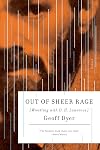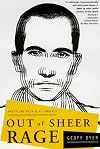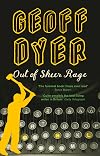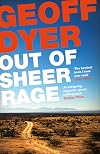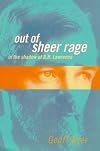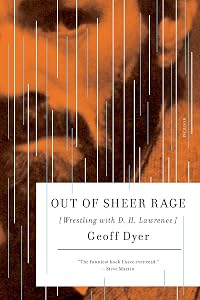
Out of Sheer Rage: Wrestling with D. H. Lawrence
by Geoff Dyer
On This Page
Description
Sitting down to write a book about his hero D. H. Lawrence, Geoff Dyer finds himself compelled to write about anything else. He is in fact compelled to do more or less anything else instead of write. In Sicily he is too preoccupied by his hatred of seafood to follow the great writer's footsteps; in Mexico he cannot get beyond a drug-induced erotic fantasy on a nudist beach . . . And yet, incredibly, this attempt to write a 'sober academic study' reveals the hold Lawrence and his work still show more exert on us today.Out of Sheer Rage is a complete one-off, a richly comic study of the combination of bad temper, procrastination and the uncanny power of obliquity. show lessTags
Recommendations


















Member Recommendations
bluepiano I'll get around to explaining the recommendation soon. I must buy some books & build shelves for them first, and that will make me forget to water my neighbour's plants, and hiding from my neighbours because I did so will take up a great lot of time, time that I could have used to explain why I recommended this.

Member Reviews
A fascinating book about a writer who wants to write a book, but somehow can't get himself to the actual writing. Part memoir, part study of Lawrence, part meditation on desire, writers block and the actual struggle that drives an artist to create, I found the book hilarious, frustrating, compelling and maddening. In short excellent.
Some time ago I picked up an interesting-looking book about Nietzsche, hoping to have my mind changed about him, only to find that not only was I not wrong about Nietzsche but I also disliked the author who was trying to change my mind about him. Now I have had the same experience around D. H. Lawrence.
The idea of the book is that Geoff Dyer wants to write a book about Lawrence, but is such a dithering procrastinator that he can only write a book, this book, about his internal struggles to complete any work toward the project at all. Any decision that he makes is instantly counteracted by second thoughts. In search of not just Lawrence, but a way into his task of writing about Lawrence, he moves to Sicily. He moves to Oxford. He moves show more to Devonshire. He visits America and the mountains of New Mexico. All the while, he is the helpless slave of his self-sabotage.
This might be funnier if he allowed himself to show any admirable qualities whatsoever, but he carries English self-deprecation to an extreme. The Woody Allen of “Annie Hall” is a Superman compared to him. He portrays himself as aging, balding, and with pipestem legs, although the author photo shows him to be much better looking than the average guy. It rankles that he seems to have no inkling of the gifts he’s been given in his life. He can live anywhere he wants (“I have a modest private income,” he admits halfway through the book, for anyone who hasn’t figured it out) and his sexy girlfriend will follow him anywhere, but his life is an agony of indecision, frustration, and having to deal with unbearable things like the town of Oxford (which he calls “Dullsford”) and tuna for lunch.
Let me just add that Dyer’s prose style, while funny in spots, leans on the same tropes for the entire length of the book. Apparently he thinks that just being on an unreasonable rant is funny, but it wears thin quick. His method for portraying his whirlpool of self-cancelling thoughts is repetition—not just of concept, but of phrase. Here, for example, is an excerpt from a single paragraph—a paragraph which in its totality is only about twice as long as the excerpt:
Oxford! Now if there is one place on earth where you cannot, where it is physically impossible to write a book about Lawrence it is here, in Oxford....If there is one person you cannot write about here, in Oxford, it is Lawrence....he is the one person you cannot write about here, in Oxford; and Oxford is the one place where you cannot write about Lawrence.
As it was said in Monty Python and the Holy Grail, three shall be the number thou shalt count, and the number of the counting shall be three. We get it. Again, a funny thing the first time…not so funny after 180 pages.
I did find it interesting the Dyer finds innumerable correspondences between himself and Lawrence. Lawrence is never satisfied, and so is Dyer. Lawrence is cranky and irritable, and so is Dyer. Oddly, I don’t doubt him in this. True or not, it makes it easier for me to wash my hands of both of them. show less
The idea of the book is that Geoff Dyer wants to write a book about Lawrence, but is such a dithering procrastinator that he can only write a book, this book, about his internal struggles to complete any work toward the project at all. Any decision that he makes is instantly counteracted by second thoughts. In search of not just Lawrence, but a way into his task of writing about Lawrence, he moves to Sicily. He moves to Oxford. He moves show more to Devonshire. He visits America and the mountains of New Mexico. All the while, he is the helpless slave of his self-sabotage.
This might be funnier if he allowed himself to show any admirable qualities whatsoever, but he carries English self-deprecation to an extreme. The Woody Allen of “Annie Hall” is a Superman compared to him. He portrays himself as aging, balding, and with pipestem legs, although the author photo shows him to be much better looking than the average guy. It rankles that he seems to have no inkling of the gifts he’s been given in his life. He can live anywhere he wants (“I have a modest private income,” he admits halfway through the book, for anyone who hasn’t figured it out) and his sexy girlfriend will follow him anywhere, but his life is an agony of indecision, frustration, and having to deal with unbearable things like the town of Oxford (which he calls “Dullsford”) and tuna for lunch.
Let me just add that Dyer’s prose style, while funny in spots, leans on the same tropes for the entire length of the book. Apparently he thinks that just being on an unreasonable rant is funny, but it wears thin quick. His method for portraying his whirlpool of self-cancelling thoughts is repetition—not just of concept, but of phrase. Here, for example, is an excerpt from a single paragraph—a paragraph which in its totality is only about twice as long as the excerpt:
Oxford! Now if there is one place on earth where you cannot, where it is physically impossible to write a book about Lawrence it is here, in Oxford....If there is one person you cannot write about here, in Oxford, it is Lawrence....he is the one person you cannot write about here, in Oxford; and Oxford is the one place where you cannot write about Lawrence.
As it was said in Monty Python and the Holy Grail, three shall be the number thou shalt count, and the number of the counting shall be three. We get it. Again, a funny thing the first time…not so funny after 180 pages.
I did find it interesting the Dyer finds innumerable correspondences between himself and Lawrence. Lawrence is never satisfied, and so is Dyer. Lawrence is cranky and irritable, and so is Dyer. Oddly, I don’t doubt him in this. True or not, it makes it easier for me to wash my hands of both of them. show less
The hardcover copy that I borrowed from the library has a yellow cover and a see through jacket. On the yellow cover is a photo of Geoff Dyer and on the see-through jacket is an image of DH Lawrence so that, when put together, their faces are laid over each other. This seems to me a perfect illustration of the book, which is a very personal take on Lawrence... a mixture of memoir, travel-writing, literary study, and existential meditation. Oh yeah, and how could I forget? Comedy: Geoff Dyer is a hilarious writer.
I have a theory that maybe all great writers and readers (for that is essentially what Dyer is here, a reader and a fan) have fully developed senses of humor. It’s so hard to think of any great writers who weren’t funny, show more though that humor can vary widely in shade. Kafka was funny. Flaubert was funny. So was Bernhard, Beckett, Musil, Chekhov, Gogol, Cortazar, Proust, Joyce, Stein. Oddly enough, I listened to an interview with Dyer recently where he claimed that Sebald was funny, though I don’t personally see it (except in small moments).
It seems to me a pity that literature classes across America are not--right this second--laughing until milk comes out of their noses instead of talking about post-feminism or whatever post- / -ism it is they like to throw around. If I walked into a literature class where everybody was dying from laughter, I would know I was in good hands, that these people got it. Dyer, for example, got it, and that is why throughout this book he is laughing: at himself, at Lawrence, at us. And making us laugh.
Though officially about Lawrence, this book could just as well have been a book about Rilke, Camus, or Bernhard. He certainly talks about the first two enough. And the latter is mentioned only in passing, but seems to be a ghost in the prose throughout the first hundred pages or so, and dropping in again towards the end. This deliberate and loving imitation of Bernhard is charming and funny, but also appropriate in a book about the vacillating indecision that grips one in the condition of living. For indecisiveness is not only a characteristic of Dyer, Lawrence, Bernhard and modernism, but also of the essay form: first try to see something this way, then try to see it from a completely different angle.
The longer I stayed the more powerful it became, this feeling that I was just passing through. I had thought about subscribing to Canal Plus as a way of making myself feel more settled but what was the point in subscribing to Canal Plus when, in all probability, I would be moving on in a few months? Obviously the way to make myself more settled was to acquire some of the trappings of permanence but there never seemed any point acquiring the aptly named trappings of permanence when in a couple of months I might be moving on, might well be moving on, would almost certainly be moving on, because there was nothing to keep me where I was. Had I acquired some of the trappings of permanence I might have stayed put but I never acquired any of the trappings of permanence because I knew that the moment these trappings had been acquired I would be seized with a desire to leave, to move on, and I would then have to free myself from these trappings. And so, lacking any of the trappings of permanence, I was perpetually on the brink of potential departure. If I felt settled I would want to leave, but if I was on the brink of leaving then I could stay, indefinitely, even though staying would fill me with still further anxiety because, since I appeared to be staying, what was the point in living as though I were not staying but merely passing through?
Most of this book is about Geoff Dyer’s inability to write a study on Lawrence, about his crippling writer’s block, and his weak-willed half-assed attempts at any kind of traditional goal-oriented pursuit. He travels around the world to see the places Lawrence stayed and wrote at, only to glean very little from these experiences but annoyance, illness, boredom, and injuries. It is extremely funny to read about, but also it is a perfect solution to not being able to write about Lawrence. Dyer seems to have taken Beckett’s oft-misunderstood maxim of "Try again. Fail again. Fail better" to heart. He sinks to the lowest of lows, and instead of fighting it, he sinks some more and revels in it. Or as D.H. Lawrence himself put it "Let a man fall to the bottom of himself, let him get to the bottom so that we can see who he really is."
Luckily, this undignified shameful approach to writing was very helpful for me, since I was also a lazy no-good son of a bitch in the middle of writing an ambitious book review on a Wittgenstein biography. I had collected so many ideas and notes. But every time I started in on it, I was overwhelmed with my inability to convey what was most important. Thankfully Dyer provided the clear-headed cop-out I was looking for: I could write about my inability to write and thus have my cake and eat it too!
Because the very thing that made it impossible to write my review was the very thing that was most important, namely the unutterable. The idea of saying something and not have any of it leak out. Likewise, in Dyer’s study of Lawrence, the very idea of gripping indecisiveness, placelessness, and constant discontent which he talks about going through are the very things that he brings out in his portrait of Lawrence. For this is not a sober study of Lawrence’s major works and themes, but rather a cherry-picked impressionistic portrait of the man himself, mostly salvaged from his letters and tossed off statements. This is the Lawrence that most interested the fanboy in Dyer, the unmediated Lawrence. This is also the Lawrence that most interests me. Literature has enough sober academic studies, what it needs is impassioned fanboys writing unprofessional failures of books, but failures that are bold enough to be human and revealing. We need to see the flesh and blood in literature! I love this sentiment:
As time goes by we drift away from the great texts, the finished works on which an author’s reputation is built, towards the journals, diaries, letters, manuscripts, jottings. This is not simply because, as an author’s stature grows posthumously, the fund of published texts becomes exhausted and we have to make do not only with previously unpublished or unfinished material but, increasingly, with matter that was never intended for publication. It is also because we want to get nearer to the man or woman who wrote these books, to his or her being. We crave an increasingly intimate relationship with the author, unmediated, in so far as possible, by the contrivances of art. A curious reversal takes place. The finished works serve as prologue to the jottings; the published book becomes a stage to be passed through -- a draft -- en route to the definitive pleasure of the notes, the fleeting impressions, the sketches, in which it had its origin.
And later, he draws the same conclusion about his own book:
If this book aspires to the condition of notes that is because, for me, Lawrence’s prose is at its best when it comes closest to notes.
I read another book recently, How Should a Person Be?, about not being able to write a book. The book was originally supposed to be a play. But was eventually turned into a personal meditation about trying to write the play (as well as many other things). But throughout she wrestled with the idea of whether it was OK to just let herself be herself, to embrace the failure, or change the definition of failure, rather than go through with something that was much more difficult. It is nice to see so many books wrestling with this idea. But I do tend to agree with Dyer that the wrestling and the failing and the owning up to it, making it your own, is the important part. “Anyone can have a breakdown, anyone.” he says on page 170, “The trick is to have a breakdown and take it in one’s stride.” show less
I have a theory that maybe all great writers and readers (for that is essentially what Dyer is here, a reader and a fan) have fully developed senses of humor. It’s so hard to think of any great writers who weren’t funny, show more though that humor can vary widely in shade. Kafka was funny. Flaubert was funny. So was Bernhard, Beckett, Musil, Chekhov, Gogol, Cortazar, Proust, Joyce, Stein. Oddly enough, I listened to an interview with Dyer recently where he claimed that Sebald was funny, though I don’t personally see it (except in small moments).
It seems to me a pity that literature classes across America are not--right this second--laughing until milk comes out of their noses instead of talking about post-feminism or whatever post- / -ism it is they like to throw around. If I walked into a literature class where everybody was dying from laughter, I would know I was in good hands, that these people got it. Dyer, for example, got it, and that is why throughout this book he is laughing: at himself, at Lawrence, at us. And making us laugh.
Though officially about Lawrence, this book could just as well have been a book about Rilke, Camus, or Bernhard. He certainly talks about the first two enough. And the latter is mentioned only in passing, but seems to be a ghost in the prose throughout the first hundred pages or so, and dropping in again towards the end. This deliberate and loving imitation of Bernhard is charming and funny, but also appropriate in a book about the vacillating indecision that grips one in the condition of living. For indecisiveness is not only a characteristic of Dyer, Lawrence, Bernhard and modernism, but also of the essay form: first try to see something this way, then try to see it from a completely different angle.
The longer I stayed the more powerful it became, this feeling that I was just passing through. I had thought about subscribing to Canal Plus as a way of making myself feel more settled but what was the point in subscribing to Canal Plus when, in all probability, I would be moving on in a few months? Obviously the way to make myself more settled was to acquire some of the trappings of permanence but there never seemed any point acquiring the aptly named trappings of permanence when in a couple of months I might be moving on, might well be moving on, would almost certainly be moving on, because there was nothing to keep me where I was. Had I acquired some of the trappings of permanence I might have stayed put but I never acquired any of the trappings of permanence because I knew that the moment these trappings had been acquired I would be seized with a desire to leave, to move on, and I would then have to free myself from these trappings. And so, lacking any of the trappings of permanence, I was perpetually on the brink of potential departure. If I felt settled I would want to leave, but if I was on the brink of leaving then I could stay, indefinitely, even though staying would fill me with still further anxiety because, since I appeared to be staying, what was the point in living as though I were not staying but merely passing through?
Most of this book is about Geoff Dyer’s inability to write a study on Lawrence, about his crippling writer’s block, and his weak-willed half-assed attempts at any kind of traditional goal-oriented pursuit. He travels around the world to see the places Lawrence stayed and wrote at, only to glean very little from these experiences but annoyance, illness, boredom, and injuries. It is extremely funny to read about, but also it is a perfect solution to not being able to write about Lawrence. Dyer seems to have taken Beckett’s oft-misunderstood maxim of "Try again. Fail again. Fail better" to heart. He sinks to the lowest of lows, and instead of fighting it, he sinks some more and revels in it. Or as D.H. Lawrence himself put it "Let a man fall to the bottom of himself, let him get to the bottom so that we can see who he really is."
Luckily, this undignified shameful approach to writing was very helpful for me, since I was also a lazy no-good son of a bitch in the middle of writing an ambitious book review on a Wittgenstein biography. I had collected so many ideas and notes. But every time I started in on it, I was overwhelmed with my inability to convey what was most important. Thankfully Dyer provided the clear-headed cop-out I was looking for: I could write about my inability to write and thus have my cake and eat it too!
Because the very thing that made it impossible to write my review was the very thing that was most important, namely the unutterable. The idea of saying something and not have any of it leak out. Likewise, in Dyer’s study of Lawrence, the very idea of gripping indecisiveness, placelessness, and constant discontent which he talks about going through are the very things that he brings out in his portrait of Lawrence. For this is not a sober study of Lawrence’s major works and themes, but rather a cherry-picked impressionistic portrait of the man himself, mostly salvaged from his letters and tossed off statements. This is the Lawrence that most interested the fanboy in Dyer, the unmediated Lawrence. This is also the Lawrence that most interests me. Literature has enough sober academic studies, what it needs is impassioned fanboys writing unprofessional failures of books, but failures that are bold enough to be human and revealing. We need to see the flesh and blood in literature! I love this sentiment:
As time goes by we drift away from the great texts, the finished works on which an author’s reputation is built, towards the journals, diaries, letters, manuscripts, jottings. This is not simply because, as an author’s stature grows posthumously, the fund of published texts becomes exhausted and we have to make do not only with previously unpublished or unfinished material but, increasingly, with matter that was never intended for publication. It is also because we want to get nearer to the man or woman who wrote these books, to his or her being. We crave an increasingly intimate relationship with the author, unmediated, in so far as possible, by the contrivances of art. A curious reversal takes place. The finished works serve as prologue to the jottings; the published book becomes a stage to be passed through -- a draft -- en route to the definitive pleasure of the notes, the fleeting impressions, the sketches, in which it had its origin.
And later, he draws the same conclusion about his own book:
If this book aspires to the condition of notes that is because, for me, Lawrence’s prose is at its best when it comes closest to notes.
I read another book recently, How Should a Person Be?, about not being able to write a book. The book was originally supposed to be a play. But was eventually turned into a personal meditation about trying to write the play (as well as many other things). But throughout she wrestled with the idea of whether it was OK to just let herself be herself, to embrace the failure, or change the definition of failure, rather than go through with something that was much more difficult. It is nice to see so many books wrestling with this idea. But I do tend to agree with Dyer that the wrestling and the failing and the owning up to it, making it your own, is the important part. “Anyone can have a breakdown, anyone.” he says on page 170, “The trick is to have a breakdown and take it in one’s stride.” show less
The hardcover copy that I borrowed from the library has a yellow cover and a see through jacket. On the yellow cover is a photo of Geoff Dyer and on the see-through jacket is an image of DH Lawrence so that, when put together, their faces are laid over each other. This seems to me a perfect illustration of the book, which is a very personal take on Lawrence... a mixture of memoir, travel-writing, literary study, and existential meditation. Oh yeah, and how could I forget? Comedy: Geoff Dyer is a hilarious writer.
I have a theory that maybe all great writers and readers (for that is essentially what Dyer is here, a reader and a fan) have fully developed senses of humor. It’s so hard to think of any great writers who weren’t funny, show more though that humor can vary widely in shade. Kafka was funny. Flaubert was funny. So was Bernhard, Beckett, Musil, Chekhov, Gogol, Cortazar, Proust, Joyce, Stein. Oddly enough, I listened to an interview with Dyer recently where he claimed that Sebald was funny, though I don’t personally see it (except in small moments).
It seems to me a pity that literature classes across America are not--right this second--laughing until milk comes out of their noses instead of talking about post-feminism or whatever post- / -ism it is they like to throw around. If I walked into a literature class where everybody was dying from laughter, I would know I was in good hands, that these people got it. Dyer, for example, got it, and that is why throughout this book he is laughing: at himself, at Lawrence, at us. And making us laugh.
Though officially about Lawrence, this book could just as well have been a book about Rilke, Camus, or Bernhard. He certainly talks about the first two enough. And the latter is mentioned only in passing, but seems to be a ghost in the prose throughout the first hundred pages or so, and dropping in again towards the end. This deliberate and loving imitation of Bernhard is charming and funny, but also appropriate in a book about the vacillating indecision that grips one in the condition of living. For indecisiveness is not only a characteristic of Dyer, Lawrence, Bernhard and modernism, but also of the essay form: first try to see something this way, then try to see it from a completely different angle.
Luckily, this undignified shameful approach to writing was very helpful for me, since I was also a lazy no-good son of a bitch in the middle of writing an ambitious book review on a Wittgenstein biography. I had collected so many ideas and notes. But every time I started in on it, I was overwhelmed with my inability to convey what was most important. Thankfully Dyer provided the clear-headed cop-out I was looking for: I could write about my inability to write and thus have my cake and eat it too!
Because the very thing that made it impossible to write my review was the very thing that was most important, namely the unutterable. The idea of saying something and not have any of it leak out. Likewise, in Dyer’s study of Lawrence, the very idea of gripping indecisiveness, placelessness, and constant discontent which he talks about going through are the very things that he brings out in his portrait of Lawrence. For this is not a sober study of Lawrence’s major works and themes, but rather a cherry-picked impressionistic portrait of the man himself, mostly salvaged from his letters and tossed off statements. This is the Lawrence that most interested the fanboy in Dyer, the unmediated Lawrence. This is also the Lawrence that most interests me. Literature has enough sober academic studies, what it needs is impassioned fanboys writing unprofessional failures of books, but failures that are bold enough to be human and revealing. We need to see the flesh and blood in literature! I love this sentiment:
I have a theory that maybe all great writers and readers (for that is essentially what Dyer is here, a reader and a fan) have fully developed senses of humor. It’s so hard to think of any great writers who weren’t funny, show more though that humor can vary widely in shade. Kafka was funny. Flaubert was funny. So was Bernhard, Beckett, Musil, Chekhov, Gogol, Cortazar, Proust, Joyce, Stein. Oddly enough, I listened to an interview with Dyer recently where he claimed that Sebald was funny, though I don’t personally see it (except in small moments).
It seems to me a pity that literature classes across America are not--right this second--laughing until milk comes out of their noses instead of talking about post-feminism or whatever post- / -ism it is they like to throw around. If I walked into a literature class where everybody was dying from laughter, I would know I was in good hands, that these people got it. Dyer, for example, got it, and that is why throughout this book he is laughing: at himself, at Lawrence, at us. And making us laugh.
Though officially about Lawrence, this book could just as well have been a book about Rilke, Camus, or Bernhard. He certainly talks about the first two enough. And the latter is mentioned only in passing, but seems to be a ghost in the prose throughout the first hundred pages or so, and dropping in again towards the end. This deliberate and loving imitation of Bernhard is charming and funny, but also appropriate in a book about the vacillating indecision that grips one in the condition of living. For indecisiveness is not only a characteristic of Dyer, Lawrence, Bernhard and modernism, but also of the essay form: first try to see something this way, then try to see it from a completely different angle.
The longer I stayed the more powerful it became, this feeling that I was just passing through. I had thought about subscribing to Canal Plus as a way of making myself feel more settled but what was the point in subscribing to Canal Plus when, in all probability, I would be moving on in a few months? Obviously the way to make myself more settled was to acquire some of the trappings of permanence but there never seemed any point acquiring the aptly named trappings of permanence when in a couple of months I might be moving on, might well be moving on, would almost certainly be moving on, because there was nothing to keep me where I was. Had I acquired some of the trappings of permanence I might have stayed put but I never acquired any of the trappings of permanence because I knew that the moment these trappings had been acquired I would be seized with a desire to leave, to move on, and I would then have to free myself from these trappings. And so, lacking any of the trappings of permanence, I was perpetually on the brink of potential departure. If I felt settled I would want to leave, but if I was on the brink of leaving then I could stay, indefinitely, even though staying would fill me with still further anxiety because, since I appeared to be staying, what was the point in living as though I were not staying but merely passing through?Most of this book is about Geoff Dyer’s inability to write a study on Lawrence, about his crippling writer’s block, and his weak-willed half-assed attempts at any kind of traditional goal-oriented pursuit. He travels around the world to see the places Lawrence stayed and wrote at, only to glean very little from these experiences but annoyance, illness, boredom, and injuries. It is extremely funny to read about, but also it is a perfect solution to not being able to write about Lawrence. Dyer seems to have taken Beckett’s oft-misunderstood maxim of "Try again. Fail again. Fail better" to heart. He sinks to the lowest of lows, and instead of fighting it, he sinks some more and revels in it. Or as D.H. Lawrence himself put it "Let a man fall to the bottom of himself, let him get to the bottom so that we can see who he really is."
Luckily, this undignified shameful approach to writing was very helpful for me, since I was also a lazy no-good son of a bitch in the middle of writing an ambitious book review on a Wittgenstein biography. I had collected so many ideas and notes. But every time I started in on it, I was overwhelmed with my inability to convey what was most important. Thankfully Dyer provided the clear-headed cop-out I was looking for: I could write about my inability to write and thus have my cake and eat it too!
Because the very thing that made it impossible to write my review was the very thing that was most important, namely the unutterable. The idea of saying something and not have any of it leak out. Likewise, in Dyer’s study of Lawrence, the very idea of gripping indecisiveness, placelessness, and constant discontent which he talks about going through are the very things that he brings out in his portrait of Lawrence. For this is not a sober study of Lawrence’s major works and themes, but rather a cherry-picked impressionistic portrait of the man himself, mostly salvaged from his letters and tossed off statements. This is the Lawrence that most interested the fanboy in Dyer, the unmediated Lawrence. This is also the Lawrence that most interests me. Literature has enough sober academic studies, what it needs is impassioned fanboys writing unprofessional failures of books, but failures that are bold enough to be human and revealing. We need to see the flesh and blood in literature! I love this sentiment:
As time goes by we drift away from the great texts, the finished works on which an author’s reputation is built, towards the journals, diaries, letters, manuscripts, jottings. This is not simply because, as an author’s stature grows posthumously, the fund of published texts becomes exhausted and we have to make do not only with previously unpublished or unfinished material but, increasingly, with matter that was never intended for publication. It is also because we want to get nearer to the man or woman who wrote these books, to his or her being. We crave an increasingly intimate relationship with the author, unmediated, in so far as possible, by the contrivances of art. A curious reversal takes place. The finished works serve as prologue to the jottings; the published book becomes a stage to be passed through -- a draft -- en route to the definitive pleasure of the notes, the fleeting impressions, the sketches, in which it had its origin.And later, he draws the same conclusion about his own book:
If this book aspires to the condition of notes that is because, for me, Lawrence’s prose is at its best when it comes closest to notes.I read another book recently, [b:How Should a Person Be?|9361377|How Should a Person Be?|Sheila Heti|http://ecx.images-amazon.com/images/I/41TKKIkSDUL._SL75_.jpg|14244846], about not being able to write a book. The book was originally supposed to be a play. But was eventually turned into a personal meditation about trying to write the play (as well as many other things). But throughout she wrestled with the idea of whether it was OK to just let herself be herself, to embrace the failure, or change the definition of failure, rather than go through with something that was much more difficult. It is nice to see so many books wrestling with this idea. But I do tend to agree with Dyer that the wrestling and the failing and the owning up to it, making it your own, is the important part. “Anyone can have a breakdown, anyone.” he says on page 170, “The trick is to have a breakdown and take it in one’s stride.” show less
http://wineandabook.com/2011/11/10/review-out-of-sheer-rage-wrestling-with-d-h-l...
So, I may have a small intellectual crush on Geoff Dyer.
Hear me out.
Out of Sheer Rage is a memoir of sorts as Dyer writes a book about his attempt to write a book on D.H. Lawrence, and it’s far less a study of Lawrence and far more an analysis of the author himself. Unexpectedly though, as I read, I felt myself regressing to a deluded, giggly school girl, gushing every few pages “it’s, like, he TOTALLY gets me!” There were times as I read where I wondered where Dyer obtained the transcript of my inner monologue (though his way with words is far more eloquent than my silent ramblings). Check out some of Dyer’s eerily accurate brilliance:
On show more getting in our own way/the lies we tell ourselves:
“The perfect life, the perfect lie…is one which prevents you from doing that which you would ideally have done (painted, say, or written unpublishable poetry) but which, in fact, you have no wish to do. People need to feel that they have been thwarted by circumstances from pursuing the life which, had they led it, they would not have wanted; whereas the life they really want is precisely a compound of all those thwarting circumstances. It is a very elaborate, extremely simple procedure, arranging this web of self-deceit: contriving to convince yourself that you were prevented from doing what you wanted. Most people don’t want what they want: people want to be prevented, restricted….That’s why children are so convenient: you have children because you’re struggling to get by as an artist- what is actually what being an artist means- or failing to get on with your career. Then you can persuade yourself that your children prevented you from having this career that had never looked like working out. So it goes on: things are always forsaken in the name of an obligation to someone else, never as a failing, a falling short of yourself.” (page 126-127)
On freedom:
“Unless, like Thelma and Louise, you plunge off the side of a canyon, there is no escaping the everyday. What Lawrence’s life demonstrates so powerfully is that it actually takes a daily effort to be free. To be free is not the result of a moment’s decisive action but a project to be constantly renewed. More than anything else, freedom requires tenaciousness.” (page 138)
On personal credo:
“You’ll regret it: there are worse mottoes to live by. Successful people say that it is stupid to regret things but the futility of regret only increases its power…Looking back through my diary is like reading a vast anthology of regret and squandered opportunity. Oh well, I find myself thinking, life is there to be wasted.” (page 169)
Just the tip of the iceberg. Funny, personal yet universal, clever, intelligent, challenging: I couldn’t put this book down and, given the massive fine I’ve incurred with the NYPL, I’ll probably have spent the equivalent of two copies by the time I return it. I regret nothing.
With its focus on process, this memoir serves as almost a pseudo-AA meeting of sorts for the aspiring author: by reading Dyer’s account of his struggles with writing made me, at least, feel as if I wasn’t the only one having the same day to day issues just trying to write, and to be the version of myself I want to be.
Rubric rating: 8. I’ve already scoured the library for everything Dyer’s written. So excited to start The Ongoing Moment, where Dyer tackles photography and photographers. show less
So, I may have a small intellectual crush on Geoff Dyer.
Hear me out.
Out of Sheer Rage is a memoir of sorts as Dyer writes a book about his attempt to write a book on D.H. Lawrence, and it’s far less a study of Lawrence and far more an analysis of the author himself. Unexpectedly though, as I read, I felt myself regressing to a deluded, giggly school girl, gushing every few pages “it’s, like, he TOTALLY gets me!” There were times as I read where I wondered where Dyer obtained the transcript of my inner monologue (though his way with words is far more eloquent than my silent ramblings). Check out some of Dyer’s eerily accurate brilliance:
On show more getting in our own way/the lies we tell ourselves:
“The perfect life, the perfect lie…is one which prevents you from doing that which you would ideally have done (painted, say, or written unpublishable poetry) but which, in fact, you have no wish to do. People need to feel that they have been thwarted by circumstances from pursuing the life which, had they led it, they would not have wanted; whereas the life they really want is precisely a compound of all those thwarting circumstances. It is a very elaborate, extremely simple procedure, arranging this web of self-deceit: contriving to convince yourself that you were prevented from doing what you wanted. Most people don’t want what they want: people want to be prevented, restricted….That’s why children are so convenient: you have children because you’re struggling to get by as an artist- what is actually what being an artist means- or failing to get on with your career. Then you can persuade yourself that your children prevented you from having this career that had never looked like working out. So it goes on: things are always forsaken in the name of an obligation to someone else, never as a failing, a falling short of yourself.” (page 126-127)
On freedom:
“Unless, like Thelma and Louise, you plunge off the side of a canyon, there is no escaping the everyday. What Lawrence’s life demonstrates so powerfully is that it actually takes a daily effort to be free. To be free is not the result of a moment’s decisive action but a project to be constantly renewed. More than anything else, freedom requires tenaciousness.” (page 138)
On personal credo:
“You’ll regret it: there are worse mottoes to live by. Successful people say that it is stupid to regret things but the futility of regret only increases its power…Looking back through my diary is like reading a vast anthology of regret and squandered opportunity. Oh well, I find myself thinking, life is there to be wasted.” (page 169)
Just the tip of the iceberg. Funny, personal yet universal, clever, intelligent, challenging: I couldn’t put this book down and, given the massive fine I’ve incurred with the NYPL, I’ll probably have spent the equivalent of two copies by the time I return it. I regret nothing.
With its focus on process, this memoir serves as almost a pseudo-AA meeting of sorts for the aspiring author: by reading Dyer’s account of his struggles with writing made me, at least, feel as if I wasn’t the only one having the same day to day issues just trying to write, and to be the version of myself I want to be.
Rubric rating: 8. I’ve already scoured the library for everything Dyer’s written. So excited to start The Ongoing Moment, where Dyer tackles photography and photographers. show less
A book purportedly about D.H. Lawrence, Out of Sheer Rage is about Geoff Dyer trying, and failing miserably, to write a biography of D.H. Lawrence. The result is a hilarious account of writer's block, an examination of the process of creation, and-Whoops!- one of the best books written about D.H. Lawrence.
Amusing, idiosyncratic yet always relatable, Dyer's rants form the basis for this story of writing, procrastination, and depression and search for meaning. I very much like Dyer's writing style, especially his deliberate repetitions. Yet the ending is a bit too pat for me, at least it deserved a few more rants.
> If I felt settled I would want to leave, but if I was on the brink of leaving then I could stay, indefinitely
> ‘I can’t bear it any longer,’ I would say to myself in the way that people always say ‘I can’t bear it any longer’ to themselves, as a way, that is, of enabling them to go on bearing the unbearable.
> I would like a lightweight modern automatic camera, the kind you can slip into a shirt pocket, the sort that show more doesn’t dig in, but it is too late get one now. In the last five years I have been to all kinds of eminently photographable places but I’ve never had a camera with me. To get a camera now would make a mockery of all those camera-less, unrecorded expeditions.
> Faced with the choice I was half tempted to abandon the Lawrence Experience in favour of the Ikea Experience: it’s a recurring problem this urge to abandon what I’ve set out to do in favour of something else, not because this other option is more enjoyable but simply because it is something else. It’s something I have half a mind to address – not just in this book, but now, immediately, even though this ambition is itself symptomatic of the condition it seeks to diagnose, a diversion from the task I’d originally set myself – whatever that was.
> Basically I don’t like tea but what else is there? Life is really no more than a search for a hot drink one likes. Compared with cold drinks (beer, fruit juices, sodas, varieties of mineral water) there is a dearth of hot drinks, I thought to myself, sipping my cup of – as it happened – rather nice tea in the White Peacock Café.
> And yet, at the same time that I was wishing they would not come to an end, I was hurrying through these books because however much you are enjoying a book, however much you want it never to end, you are always eager for it to end. However much you are enjoying a book you are always flicking to the end, counting to see how many pages are left, looking forward to the time when you can put the book down and have done with it.
> This is one of the pleasures of the letters: one has the very first touch of a poem. It is like watching a fire and seeing the first lick of flame along a log: you think it is about to catch but then it vanishes. You watch and wait for the flame to come back. It doesn’t – and then, after you have stopped looking, the flame flickers back again and the log catches.
> That’s what I’m doing: shaking my fist at the world. I won’t let even the smallest grievance escape me. I’m going to seize on the most insignificant inconvenience, annoyance, hindrance, set-back, disappointment and am going to focus all my rage, anger, bitterness and frustration on it. ‘I shall turn my head away,’ wrote Nietzsche. ‘Henceforth that will be my sole negation.’ Not me. I’m going to glare right back at it. It? Anything that gets my goat or pisses me off. Nothing will escape me.
> ‘Lawrence was angry even in his sleep, Frieda declared, and proved it by taking Mabel in to witness the spectacle of Lawrence mumbling and groaning in his sleep.’ Now this is the Lawrence I love. Frieda too, I suspect.
> Nothing is wholesale. The problem of truth is: How can we most deeply live? And the answer is different in every case.’
> I cannot accept myself as I am but, ultimately, I am resigned to accepting this inability to accept myself as I am.
> Life is bearable even when it’s unbearable: that is what is so terrible, that is the unbearable thing about it.
> I had not been to the Théâtre for twenty years and I had no intention of going again now. It was not even a question of liking or disliking the theatre. The important thing was the pleasure that came from not being interested in the theatre. I am interested in all sorts of things but it is lovely to not be interested in the theatre. Not being interested in the theatre means a whole area of life and culture means nothing to me: there are entire sections of listings magazines that I don’t need to consult, vast areas of conversation I don’t need to take part in, great wads of cash that I don’t need to consider parting with. It is bliss, not being interested in the theatre. Not being interested in the theatre provides me with more happiness than all the things I am interested in put together. There is a moral here. To be interested in something is to be involved in what is essentially a stressful relationship with that thing, to suffer anxiety on its behalf.
> Lawrence said that one sheds one’s sickness in books; I would say that one sheds one’s interest. Once I have finished this book on Lawrence, depend upon it, I will have no interest in him whatsoever. One begins writing a book about something because one is interested in that subject; one finishes writing a book in order to lose interest in that subject: the book itself is a record of this transition
> The more I ponder these questions the more I am persuaded that the real subject of this book, the one that writing it was an attempt to evade, is despair. My greatest urge in life is to do nothing. It’s not even an absence of motivation, a lack, for I do have a strong urge: to do nothing.
> Now that dodge – getting out of depression by becoming interested in depression – only works once. I’ve got no interest in depression now. There might be more to learn about it but I’m not interested. The only thing that interests me about depression is staying well clear of it. And since the only way to avoid giving into depression and despair is to do something, even something you hate, anything in fact, I force myself to keep bashing away at something, anything.
> Nietzsche wrote that the thought of suicide had got him through many a bad night, and thinking of giving up is probably the one thing that’s kept me going. I think about it on a daily basis but always come up against the problem of what to do when I’ve given up. Give up one thing and you’re immediately obliged to do something else. The only way to give up totally is to kill yourself but that one act requires an assertion of will equal to the total amount that would be expanded in the rest of a normal lifetime.
> Still, at some point, whether it was a good buy or not, I would not simply grow tired of listening to this new CD but would actually become heartily sick of the idea of listening to CDs and would think to myself that sitting around listening to CDs is a much more enjoyable activity, a much more enjoyable inactivity, if it is a relief from something else – anything else. And so, after squandering a day working through this demoralising routine that I have worked through innumerable days before, I would resign myself, would in fact abandon myself to not giving up, to picking up my pen and trying once again, if for no other reason than to render listening to my CDs a little less dispiriting, to make some progress with my study of D. H. Lawrence.
> One way or another we all have to write our studies of D. H. Lawrence. Even if they will never be published, even if we will never complete them, even if all we are left with after years and years of effort is an unfinished, unfinishable record of how we failed to live up to our own earlier ambitions, still we all have to try to make some progress with our books about D. H. Lawrence. The world over, from Taos to Taormina, from the places we have visited to countries we will never set foot in, the best we can do is to try to make some progress with our studies of D. H. Lawrence. show less
> If I felt settled I would want to leave, but if I was on the brink of leaving then I could stay, indefinitely
> ‘I can’t bear it any longer,’ I would say to myself in the way that people always say ‘I can’t bear it any longer’ to themselves, as a way, that is, of enabling them to go on bearing the unbearable.
> I would like a lightweight modern automatic camera, the kind you can slip into a shirt pocket, the sort that show more doesn’t dig in, but it is too late get one now. In the last five years I have been to all kinds of eminently photographable places but I’ve never had a camera with me. To get a camera now would make a mockery of all those camera-less, unrecorded expeditions.
> Faced with the choice I was half tempted to abandon the Lawrence Experience in favour of the Ikea Experience: it’s a recurring problem this urge to abandon what I’ve set out to do in favour of something else, not because this other option is more enjoyable but simply because it is something else. It’s something I have half a mind to address – not just in this book, but now, immediately, even though this ambition is itself symptomatic of the condition it seeks to diagnose, a diversion from the task I’d originally set myself – whatever that was.
> Basically I don’t like tea but what else is there? Life is really no more than a search for a hot drink one likes. Compared with cold drinks (beer, fruit juices, sodas, varieties of mineral water) there is a dearth of hot drinks, I thought to myself, sipping my cup of – as it happened – rather nice tea in the White Peacock Café.
> And yet, at the same time that I was wishing they would not come to an end, I was hurrying through these books because however much you are enjoying a book, however much you want it never to end, you are always eager for it to end. However much you are enjoying a book you are always flicking to the end, counting to see how many pages are left, looking forward to the time when you can put the book down and have done with it.
> This is one of the pleasures of the letters: one has the very first touch of a poem. It is like watching a fire and seeing the first lick of flame along a log: you think it is about to catch but then it vanishes. You watch and wait for the flame to come back. It doesn’t – and then, after you have stopped looking, the flame flickers back again and the log catches.
> That’s what I’m doing: shaking my fist at the world. I won’t let even the smallest grievance escape me. I’m going to seize on the most insignificant inconvenience, annoyance, hindrance, set-back, disappointment and am going to focus all my rage, anger, bitterness and frustration on it. ‘I shall turn my head away,’ wrote Nietzsche. ‘Henceforth that will be my sole negation.’ Not me. I’m going to glare right back at it. It? Anything that gets my goat or pisses me off. Nothing will escape me.
> ‘Lawrence was angry even in his sleep, Frieda declared, and proved it by taking Mabel in to witness the spectacle of Lawrence mumbling and groaning in his sleep.’ Now this is the Lawrence I love. Frieda too, I suspect.
> Nothing is wholesale. The problem of truth is: How can we most deeply live? And the answer is different in every case.’
> I cannot accept myself as I am but, ultimately, I am resigned to accepting this inability to accept myself as I am.
> Life is bearable even when it’s unbearable: that is what is so terrible, that is the unbearable thing about it.
> I had not been to the Théâtre for twenty years and I had no intention of going again now. It was not even a question of liking or disliking the theatre. The important thing was the pleasure that came from not being interested in the theatre. I am interested in all sorts of things but it is lovely to not be interested in the theatre. Not being interested in the theatre means a whole area of life and culture means nothing to me: there are entire sections of listings magazines that I don’t need to consult, vast areas of conversation I don’t need to take part in, great wads of cash that I don’t need to consider parting with. It is bliss, not being interested in the theatre. Not being interested in the theatre provides me with more happiness than all the things I am interested in put together. There is a moral here. To be interested in something is to be involved in what is essentially a stressful relationship with that thing, to suffer anxiety on its behalf.
> Lawrence said that one sheds one’s sickness in books; I would say that one sheds one’s interest. Once I have finished this book on Lawrence, depend upon it, I will have no interest in him whatsoever. One begins writing a book about something because one is interested in that subject; one finishes writing a book in order to lose interest in that subject: the book itself is a record of this transition
> The more I ponder these questions the more I am persuaded that the real subject of this book, the one that writing it was an attempt to evade, is despair. My greatest urge in life is to do nothing. It’s not even an absence of motivation, a lack, for I do have a strong urge: to do nothing.
> Now that dodge – getting out of depression by becoming interested in depression – only works once. I’ve got no interest in depression now. There might be more to learn about it but I’m not interested. The only thing that interests me about depression is staying well clear of it. And since the only way to avoid giving into depression and despair is to do something, even something you hate, anything in fact, I force myself to keep bashing away at something, anything.
> Nietzsche wrote that the thought of suicide had got him through many a bad night, and thinking of giving up is probably the one thing that’s kept me going. I think about it on a daily basis but always come up against the problem of what to do when I’ve given up. Give up one thing and you’re immediately obliged to do something else. The only way to give up totally is to kill yourself but that one act requires an assertion of will equal to the total amount that would be expanded in the rest of a normal lifetime.
> Still, at some point, whether it was a good buy or not, I would not simply grow tired of listening to this new CD but would actually become heartily sick of the idea of listening to CDs and would think to myself that sitting around listening to CDs is a much more enjoyable activity, a much more enjoyable inactivity, if it is a relief from something else – anything else. And so, after squandering a day working through this demoralising routine that I have worked through innumerable days before, I would resign myself, would in fact abandon myself to not giving up, to picking up my pen and trying once again, if for no other reason than to render listening to my CDs a little less dispiriting, to make some progress with my study of D. H. Lawrence.
> One way or another we all have to write our studies of D. H. Lawrence. Even if they will never be published, even if we will never complete them, even if all we are left with after years and years of effort is an unfinished, unfinishable record of how we failed to live up to our own earlier ambitions, still we all have to try to make some progress with our books about D. H. Lawrence. The world over, from Taos to Taormina, from the places we have visited to countries we will never set foot in, the best we can do is to try to make some progress with our studies of D. H. Lawrence. show less
Members
- Recently Added By
Lists

Books Read in 2021
5,361 works; 113 members

A Good Read (Radio 4)
287 works; 1 member
Author Information

32+ Works 6,069 Members
Geoff Dyer was born in Cheltenham in 1958. He currently lives in London.
Awards and Honors
Awards
Notable Lists
Series
Belongs to Publisher Series
The Canons (14)
Common Knowledge
- Original publication date
- 1997
- People/Characters
- D. H. Lawrence
- Epigraph
- per - you see I can speak Italian - Valeria
'Out of sheer rage I've begun my book on Thomas Hardy. It will be about anything but Thomas Hardy I am afraid - queer stuff - but not bad.'
D.H. Lawrence, 5 September, 1914
'Endless explanations of irrelevancies, and none whatever of things indispensable to the subject.'
Gustave Flaubert on Victor Hugo's Les Miserables
'It must all be considered as though spoken by a character in a novel.'
Roland Barthes - First words
- Looking back it seems, on the one hand, hard to believe that I could have wasted so much time, could have exhausted myself so utterly, wondering when I was going to begin my study of D.H. Lawrence; on the other, it seems equa... (show all)lly hard to believe that I ever started it, for the prospect of embarking on this study of Lawrence accelerated and intensified the psychological disarray it was meant to delay and alleviate.
Classifications
Statistics
- Members
- 661
- Popularity
- 43,843
- Reviews
- 20
- Rating
- (3.94)
- Languages
- Danish, Dutch, English, German
- Media
- Paper, Audiobook, Ebook
- ISBNs
- 14
- ASINs
- 4