On This Page
Description
A dense, lyrical meditation on history, alchemy, and memory.Tags
Recommendations









Member Reviews
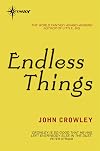
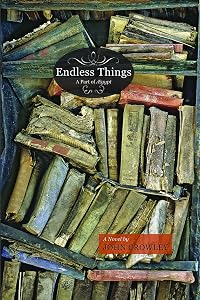
Months before Rowling's fans were able to blog their disappointment or outrage over the terminal Harry Potter book, my Other Reader was expressing her rue and quiet lamentation over Endless Things, the fourth and final volume of John Crowley's Aegypt. These books have been published over a twenty-year period, and I read the first volume myself in the late 1980s, taking in the second and third each within a year of their issuance. In light of my intelligent wife's evident dissatisfaction, it was with some trepidation that I finally embarked upon the last of them.
Crowley's prose is gorgeous as always, and littered with wonderful observations. The scholars of esotericism who have so informed the writing of the three previous books show more actually begin to intrude as characters in this one; the brief appearances of Frances Yates and Gilles Quispel were special treats for those who are familiar with the academic underpinnings of Aegypt. And protagonist Pierce's gnostic attainment in the antepenultimate chapter is a very wise and beautiful passage.
But it's not a happy ending--not as I reckon them anyhow. How can you expect a happy ending from a work with an explicit structure that works its way through the astrological houses from Birth to the Prison? Crowley metafictionally tips his hand in describing a manuscript within the novel that does not provide linear or cyclic resolution, nor even the sense of a completed part of an adumbrated whole: "It was without end but it was finished." Finishing Aegypt involves a great deal of calculated disenchantment that can feel like betrayal to those of us who have been so under the spell of the earlier volumes. Once or twice too often for my taste, the numinous is reduced to the neurotic.
At a couple of points in Endless Things, Crowley seems to intimate that genuine, world-transforming magic was only possible during the 1970s. Perhaps that was really true for him, although it would be a genuine shame if so. After reading the exercise in disenchantment of Endless Things, on behalf of 21st-century magicians, conventicled and unconventicled, I feel I may--in all readerly friendliness--rebuke him as a deserter. show less
Crowley's prose is gorgeous as always, and littered with wonderful observations. The scholars of esotericism who have so informed the writing of the three previous books show more actually begin to intrude as characters in this one; the brief appearances of Frances Yates and Gilles Quispel were special treats for those who are familiar with the academic underpinnings of Aegypt. And protagonist Pierce's gnostic attainment in the antepenultimate chapter is a very wise and beautiful passage.
But it's not a happy ending--not as I reckon them anyhow. How can you expect a happy ending from a work with an explicit structure that works its way through the astrological houses from Birth to the Prison? Crowley metafictionally tips his hand in describing a manuscript within the novel that does not provide linear or cyclic resolution, nor even the sense of a completed part of an adumbrated whole: "It was without end but it was finished." Finishing Aegypt involves a great deal of calculated disenchantment that can feel like betrayal to those of us who have been so under the spell of the earlier volumes. Once or twice too often for my taste, the numinous is reduced to the neurotic.
At a couple of points in Endless Things, Crowley seems to intimate that genuine, world-transforming magic was only possible during the 1970s. Perhaps that was really true for him, although it would be a genuine shame if so. After reading the exercise in disenchantment of Endless Things, on behalf of 21st-century magicians, conventicled and unconventicled, I feel I may--in all readerly friendliness--rebuke him as a deserter. show less
After re-reading for the umpteenth time two all time favorite Crowleys: Engine Summer (wrongly, I think, considered the last of his minor books instead of the first of his major ones), and the almost universally acclaimed Little, Big, I was still hungry for more. Sadly, I can't love what I've now read of the Aegypt quartet with the same passion as ES and LB; there are too many languors, too many tropes that are just a little too twee (all those heavily symbolic car names and fanciful place names, all that portentous italicization) and IMHO the unengaging, benighted intellectual Pierce Moffitt is simply not up to the job of central consciousness for this massive work (we do get breaks from him, thankfully, but not enough). And yet, all show more that said, Crowley still has the power to transfix with his narrative skills, his complex arcane histories, his epiphanies that arise believably out of the things of this world, and the often astoundingly lovely lyricism of his prose. He comes to the inevitable writer's conclusion that only stories offer the real possibility of transforming this world; it's his final abandonment of the mystery and magic he's so capable of calling into being that has disappointed a lot of readers of Aegypt--and while I get the rationale, I'm one of them, I hate to say. show less
"Endless things" is certainly an appropriate title for this, the 4th book of the Aegypt cycle and the culmination of 30 years of Crowley's work. This is the most self-conscious and self-referential of the four books: all along, the reader has had the sense that the unfinished book by Fellowes Kraft and the unstarted book by Pierce Moffet are actually the books of the Aegypt cycle, and Endless Things confirms that suspicion, even offering some criticism of itself. And, like the unfinished books within the book and like the lives of the characters in the book, it doesn't really have an end as such. We have had four volumes of Crowley's amazing writing to get to know the characters in depth. They seem so real that it would be corny if show more their story came to a story-book conclusion with a happily ever after. Instead of ending, with a conclusion that wraps everything up and makes sense of the previous four volumes, the story simply stops at a relatively settled and peaceful moment in everyone's lives.
I was hoping that this volume would make sense of the previous three books, and tie together their rambling and desperate plot-lines into a more unified whole. It doesn't, but I don't think I'm disappointed by that. Crowley's writing is such a delight to read: he uses simple vocabulary and simple sentences, and yet he can pack more meaning and emotion into a simple turn of phrase than any other author I know. Over four volumes, he has managed to tell us so much about Pierce and the other characters, and to make them so real: it is like getting to know a really close friend and learning their entire life history. I found the whole series incredibly enjoyable, even if I wasn't sure what (if anything) Crowley was trying to say.
I think, like all of Crowley's books, I need to re-read these over the years. I think I will uncover more and more layers of complexity the more I revisit them. show less
I was hoping that this volume would make sense of the previous three books, and tie together their rambling and desperate plot-lines into a more unified whole. It doesn't, but I don't think I'm disappointed by that. Crowley's writing is such a delight to read: he uses simple vocabulary and simple sentences, and yet he can pack more meaning and emotion into a simple turn of phrase than any other author I know. Over four volumes, he has managed to tell us so much about Pierce and the other characters, and to make them so real: it is like getting to know a really close friend and learning their entire life history. I found the whole series incredibly enjoyable, even if I wasn't sure what (if anything) Crowley was trying to say.
I think, like all of Crowley's books, I need to re-read these over the years. I think I will uncover more and more layers of complexity the more I revisit them. show less
A very disappointing, and nonmagical, conclusion to a beloved series. It's as though Prospero not only burned his books but denied that magic ever existed.
A coda and wrap-up following the turbulent Demonomania, this is a meadering wistful reminder that Crowley wrote the cycle over 20 years, and aged alongside his characters and his concerns.
Please see review on my blog: Underground Man:
http://undergroundmangeomatt.blogspot.com/2009/10/book-review-endless-things-par...
http://undergroundmangeomatt.blogspot.com/2009/10/book-review-endless-things-par...
Ratings
Members
- Recently Added By
Author Information

46+ Works 12,780 Members
John Crowley was a recipient of the American Academy & Institute of Arts & Letters Award for Literature. He lives in the hills above the Connecticut River in northern Massachusetts with his wife & twin daughters. (Bowker Author Biography)
Awards and Honors
Awards
Series

Work Relationships
Is contained in
Common Knowledge
- Canonical title
- Endless Things
- Original title
- Endless Things
- Original publication date
- 2007-05
- People/Characters
- Pierce Moffett
- Epigraph
- "But then," I said, feeling a bit bemused, "would we have to eat again from the Tree of Knowledge, in order to fall back into the state of innocence?"
"Of course," he answered. "That is the final chapter of history of the ... (show all)world."—Heinrich von Kleist, "On the Marionette Theatre" - First words
- Y-tag was the designation that Hitler and the German High Command gave to the day—it was September 2, 1939—on which they had determined to send their forces across the border into Poland.
- Original language
- English
Classifications
Statistics
- Members
- 429
- Popularity
- 71,760
- Reviews
- 6
- Rating
- (4.17)
- Languages
- English
- Media
- Paper, Ebook
- ISBNs
- 4
- ASINs
- 6