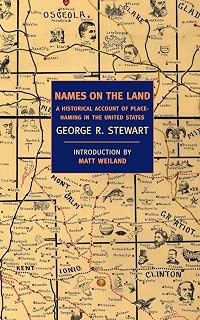
Names on the Land: A Historical Account of Place-Naming in the United States
by George R. Stewart
On This Page
Description
"[F]ascinating and fantastically detailed panorama of language in action ... it will engage anyone who has ever wondered at the curious names scattered across the American map."Tags
Recommendations


























Member Recommendations


Sticklers, sideburns and bikinis: The military origins of everyday words and phrases by Graeme Donald
Joles If you enjoy reading where names of places come from, you may enjoy where some of our words and phrases in everyday use come from, as well. Those that come from the military can be found in Sticklers, Sideburns & Bikinis.
Member Reviews
Names on the Land is a remarkable book. It is a history of the United States in names. Beginning with Pre-Columbian Indians and continuing to the modern day (c. 1956, when the book was last revised), Stewart documents the men and women who left their mark on the country by giving it its names, along with the kinds of names they gave. The amount of detail in the book is amazing and never boring. He provides plenty of examples for each trend and no state is left untouched. You can watch names change with the times, as people move in and move on. Each chapter is like a different thread in the the overall narrative, so it is easy to pick up and put down without missing anything. Stewart is clearly in his element here and you can feel his show more enthusiasm for the subject. The only sticking points are appendices on Alaska and, especially, Hawaii, which feel as tacked on as they actually were. The rest of the book is perfect and if you have any interest in the flow of people and ideas in American history, you should certainly read this book. show less
Gosh this book's fun. I'm not sure what I expected when I purchased this book, as it sat on a shelf for a decade before I picked it up. But what I found was an extremely readable and obviously-researched collection of stories--about how places got named in (mostly) the continental United States. The stories are tied together with useful and compelling analysis. I read the book cover-to-cover and nearly everything was interesting; moreover, I expect I'll follow some of its leads into more reading. What more can you expect from what seems to be a reference book?
I also expect that some of the research and analysis is dated, or otherwise faulty; these things happen in such comprehensive studies, so I don't exactly take everything at face show more value. Nonetheless, for those places I'm familiar with Stewart's stories are reasonably accurate.
==========
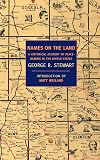
Irrelevant, mostly, but pertinent to me: When I started to read it I finally looked at the book's cover, which turns out to be a portion of Frank Galbraith's Michigan railroad map, published in 1897. As cropped, the map ends a few hundred yards north of where I live. 'Twas a bit of a thrill. show less
I also expect that some of the research and analysis is dated, or otherwise faulty; these things happen in such comprehensive studies, so I don't exactly take everything at face show more value. Nonetheless, for those places I'm familiar with Stewart's stories are reasonably accurate.
==========
Irrelevant, mostly, but pertinent to me: When I started to read it I finally looked at the book's cover, which turns out to be a portion of Frank Galbraith's Michigan railroad map, published in 1897. As cropped, the map ends a few hundred yards north of where I live. 'Twas a bit of a thrill. show less
A brilliant, imaginative, and maddeningly informative book. Fun too. Stewart tells the story of how places all across the country got their name. Grand. From Indians to modern-day Americans, all nationalities and ethnicities are represented here, and on the face of the land. The stories range from epic to trivial, but always entertaining. Included in the new 2008 paperback are the original illustrations (which are way too few) the book's several forewords and a brand new introduction. My only wish is that Stewart took the time to more rigorously cite his works, but, with a little legwork, you can track down his sources; the "endnotes" provided are the first of the modern type, due to war-time restrictions on paper - and they provide show more enough material to make this an excellent scholarly source. show less
A brilliant, imaginative, and maddeningly informative book. Fun too. Stewart tells the story of how places all across the country got their name. Grand. From Indians to modern-day Americans, all nationalities and ethnicities are represented here, and on the face of the land. The stories range from epic to trivial, but always entertaining. Included in the new 2008 paperback are the original illustrations (which are way too few) the book's several forewords and a brand new introduction. My only wish is that Stewart took the time to more rigorously cite his works, but, with a little legwork, you can track down his sources; the "endnotes" provided are the first of the modern type, due to war-time restrictions on paper - and they provide show more enough material to make this an excellent scholarly source. show less
This is not the first time I have read Stewart's opus about place naming in North America. In college I took a course in historical geography. I remember two things about the course: that the classroom was near the seismograph in Cramer Hall (one of my favorite places to wander past), and this book. The way that people express their cultural shape through naming has always intrigued me. Much of Stewart's theory was foundational enough that it stuck with me during the decade between that class and my recent re-reading: the types of place naming (transplantation of old names, adopting forms of native names, names describing events or attributes, biographical naming); trends in naming (colonial towns almost universally named after British show more counterparts, then post-Revolution rejection of English terms, then embracing of down-home American naming and Romantic notions). He traces the linguistic roots of name pieces (town-name-emes?) that we take for granted: -hurst, -glen, -ville.
A book that could easily have read like a laundry list of towns and rivers is instead an adventure. Stewart comes across as one of the last of a dying breed: born in the 19th century, he projects an aura of pith helmets and wooden drawers full of collected specimens. He recaps centuries of expanding frontiers from a vantage (the first edition came out between the wars) where those frontiers had finally bumped up against oceans. The age of heady exploration and gentlemanly academic pursuit was waning. Stewart's tone is both poetic and wistful. It imparts an engaging enthusiasm.
Names on the Land, though a carefully-researched (and vast-flung) labor of love, does suffer from its age. I noted a few inaccuracies, including his claim for how Pompey's Pillar (Montana) got named. Modern accounts explain that Pompey was the nickname of Sacagawea's son. Stewart, however, posits that "The [then] current classical furor and the love of the republican heroes may account for Pompey's Pillar." Much discussion is had over the origin of the naming of Oregon, and Stewart leans toward a sloppy map engraver misspelling or transposing a version of "Wisconsin." This theory is still in the mix, but has fallen slightly out of favor.
Stewart is masterful at weaving the stories of the cultures that influenced the names on our land. He traces the Spanish era of California and the Southwest. He gives a romp of an account of the French explorers Jolliet and Marquette, who, in the course of a summer's paddling trip, established some of the greatest names of the central continent: Missouri, Kansas, Iowa, Omaha, Arkansas, others. He follows the ebbs and flows of popularity: pro-French naming after the Revolution, classical revival, mellifluous and "proper" names of the Victorian era. He shows a soft spot for the rustic and honest names of the mountains and the west.
Take this sentence as an epitome of the book's character: "Deathball Creek in Oregon originated from the attempt of an amateur cook to make biscuits." You can sense Stewart's tongue-in-cheek affection for the rough-and-tumble pioneer naming style, yet once again a slight inaccuracy is unearthed: McArthur's Oregon Geographic Names (a source I'll call more reliable with respect to Oregon-specific names) cites the feature as Deathball Rock (not Creek).
This book sticks with you if you are of the right inclination. It has a strong sui generis feel to it. It will always maintain a safe, revered position on my bookshelf. show less
A book that could easily have read like a laundry list of towns and rivers is instead an adventure. Stewart comes across as one of the last of a dying breed: born in the 19th century, he projects an aura of pith helmets and wooden drawers full of collected specimens. He recaps centuries of expanding frontiers from a vantage (the first edition came out between the wars) where those frontiers had finally bumped up against oceans. The age of heady exploration and gentlemanly academic pursuit was waning. Stewart's tone is both poetic and wistful. It imparts an engaging enthusiasm.
Names on the Land, though a carefully-researched (and vast-flung) labor of love, does suffer from its age. I noted a few inaccuracies, including his claim for how Pompey's Pillar (Montana) got named. Modern accounts explain that Pompey was the nickname of Sacagawea's son. Stewart, however, posits that "The [then] current classical furor and the love of the republican heroes may account for Pompey's Pillar." Much discussion is had over the origin of the naming of Oregon, and Stewart leans toward a sloppy map engraver misspelling or transposing a version of "Wisconsin." This theory is still in the mix, but has fallen slightly out of favor.
Stewart is masterful at weaving the stories of the cultures that influenced the names on our land. He traces the Spanish era of California and the Southwest. He gives a romp of an account of the French explorers Jolliet and Marquette, who, in the course of a summer's paddling trip, established some of the greatest names of the central continent: Missouri, Kansas, Iowa, Omaha, Arkansas, others. He follows the ebbs and flows of popularity: pro-French naming after the Revolution, classical revival, mellifluous and "proper" names of the Victorian era. He shows a soft spot for the rustic and honest names of the mountains and the west.
Take this sentence as an epitome of the book's character: "Deathball Creek in Oregon originated from the attempt of an amateur cook to make biscuits." You can sense Stewart's tongue-in-cheek affection for the rough-and-tumble pioneer naming style, yet once again a slight inaccuracy is unearthed: McArthur's Oregon Geographic Names (a source I'll call more reliable with respect to Oregon-specific names) cites the feature as Deathball Rock (not Creek).
This book sticks with you if you are of the right inclination. It has a strong sui generis feel to it. It will always maintain a safe, revered position on my bookshelf. show less
I recently read two books by George R. Stewart -- Names on the Land and Earth Abides. The former is a lyrical history of how places in the United States got their names. The latter is a novel that considers humanity's place in the world following a catastrophic plague.
Despite their obvious differences, these two books share some common themes. Names on the Land looks at one way in which humans attempt to control nature -- a constant theme in the book is that people name places in order to manifest their ownership of them. Earth Abides, by comparison, portrays an Earth where place names cease to have meaning in the absence of humanity. Both books compellingly demonstrate Stewart's fascination with man's imprint on his world and the show more world's indifference to it.
In Names on the Land, a constant theme is that, more often than not, place-names are impermanent and contingent on human events. Stewart takes pains to show that history's winners are generally responsible for the longest-lived names, though names contain something of the losers' stories as well. His account of how America was named is always fascinating, and all the more so for his breathtaking prose style.
Earth Abides in a way examines the question of man's legacy from the Earth's point of view. Stewart follows one survivor, Ish Williams, through to his death of old age. In the process, he demonstrates in lyrical passages that resemble the prose in Names on the Land how the Earth quickly erases the works of man. The novel, though unique and effective in many ways, shows that Stewart's true talent lay in description. The dialogue is fairly stilted and the story a bit predictable, but Stewart's account of the Earth reclaiming itself is breathtaking.
Names on the Land is unlike any other book I've ever read, and is a wonderful addition to NYRB's reprint series. Earth Abides is not wholly successful as a novel, but is interesting for its stunning prose passages and for its window into the concerns of post-WWII Americans. show less
Despite their obvious differences, these two books share some common themes. Names on the Land looks at one way in which humans attempt to control nature -- a constant theme in the book is that people name places in order to manifest their ownership of them. Earth Abides, by comparison, portrays an Earth where place names cease to have meaning in the absence of humanity. Both books compellingly demonstrate Stewart's fascination with man's imprint on his world and the show more world's indifference to it.
In Names on the Land, a constant theme is that, more often than not, place-names are impermanent and contingent on human events. Stewart takes pains to show that history's winners are generally responsible for the longest-lived names, though names contain something of the losers' stories as well. His account of how America was named is always fascinating, and all the more so for his breathtaking prose style.
Earth Abides in a way examines the question of man's legacy from the Earth's point of view. Stewart follows one survivor, Ish Williams, through to his death of old age. In the process, he demonstrates in lyrical passages that resemble the prose in Names on the Land how the Earth quickly erases the works of man. The novel, though unique and effective in many ways, shows that Stewart's true talent lay in description. The dialogue is fairly stilted and the story a bit predictable, but Stewart's account of the Earth reclaiming itself is breathtaking.
Names on the Land is unlike any other book I've ever read, and is a wonderful addition to NYRB's reprint series. Earth Abides is not wholly successful as a novel, but is interesting for its stunning prose passages and for its window into the concerns of post-WWII Americans. show less
 This review was written for LibraryThing Early Reviewers.
Names on the Land is a positively charming account of the great place-naming process begun with the exploration of the New World. European place names were so old that they had lost virtually all meaning, so the explorers were faced with a large and unfamiliar undertaking. Names were descriptive, borrowed from the native populations, or given in honor of a wealthy landowner or patron monarch.
George Stewart's tone throughout is friendly and gently humorous. While it is easy to tell that Names on the Land was written over 60 years ago, there is nothing stilted or boring about it—the writing feels instead comfortable and pleasant, perfectly apt for telling the stories of exploration and building up of the new continent along with its show more folklore.
Many of the stories had become, for me, only vague recollections from middle school US history classes. It was fascinating to re-read the stories of Joliett, La Salle, and Lewis and Clark and—instead of hearing the usual accounts of meeting with natives and surveying new territories—hear about the lasting marks they had left on these lands, in the form of town, river and state names. A great pick for New York Review Books to bring back into print. show less
George Stewart's tone throughout is friendly and gently humorous. While it is easy to tell that Names on the Land was written over 60 years ago, there is nothing stilted or boring about it—the writing feels instead comfortable and pleasant, perfectly apt for telling the stories of exploration and building up of the new continent along with its show more folklore.
Many of the stories had become, for me, only vague recollections from middle school US history classes. It was fascinating to re-read the stories of Joliett, La Salle, and Lewis and Clark and—instead of hearing the usual accounts of meeting with natives and surveying new territories—hear about the lasting marks they had left on these lands, in the form of town, river and state names. A great pick for New York Review Books to bring back into print. show less
This review was written for LibraryThing Early Reviewers.Members
- Recently Added By
Author Information

48+ Works 7,229 Members
George R. Stewart (1895-1980) was a professor of English at the University of California, Berkeley
Some Editions
Awards and Honors
Distinctions
Series
Belongs to Publisher Series
Common Knowledge
- Canonical title
- Names on the Land: A Historical Account of Place-Naming in the United States
- Original publication date
- 1945
- Important places
- USA
- Epigraph
- Name, though it seems but a superficial and outward matter, yet it carrieth much impression and enchantment.-Francis Bacon.
- Dedication
- To Saxe Commins
- First words
- Once, from eastern ocean to western ocean, the land stretched away without names.
- Last words
- (Click to show. Warning: May contain spoilers.)So, again, I come to the end, and can only declare the business unfinished still---at eleven-thirty-one on the morning of the thirtieth of January, in the year 1957 A.D.---as good as any other time at which to halt.
Classifications
Statistics
- Members
- 665
- Popularity
- 43,267
- Reviews
- 15
- Rating
- (4.20)
- Languages
- English
- Media
- Paper
- ISBNs
- 2
- ASINs
- 10