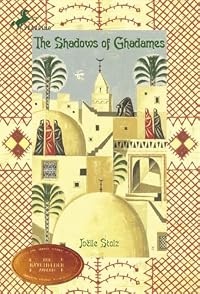
The Shadows of Ghadames
by Joelle Stolz
On This Page
Description
At the end of the nineteenth century in Libya, eleven-year-old Malika simultaneously enjoys and feels constricted by the narrow world of women, but an injured stranger enters her home and disrupts the traditional order of things.Tags
Recommendations
















Member Recommendations
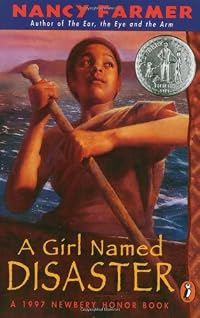
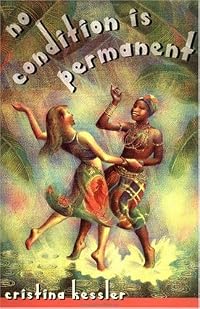
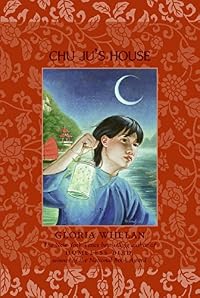
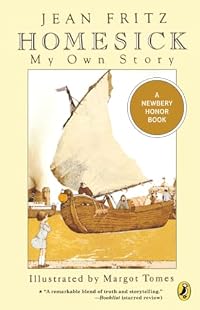
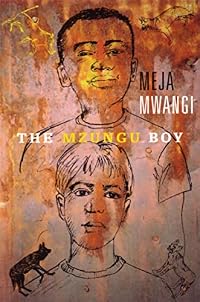
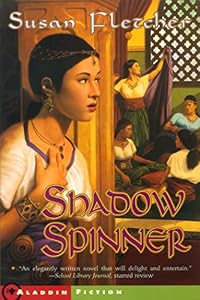
missmaddie Shadows is for a younger audience, but it deals with some of the same themes and cultural ideas as the more adult Persepolis.
Member Reviews
I enjoyed “The Shadows of Ghadames” by Joelle Stolz because it incorporates descriptive language and pushes many thought provoking topics. Stolz tells the story of Malika a 12-year-old Muslim girl in Libya who is arranged to be married, and wants to learn to read, but due to traditional and religious standards she struggles to find the freedom to live her life and be herself without dishonoring her family, culture, religion, and customs. Stolz uses descriptive language to describe the external conflict that Malika is faced with when she tries to go against tradition. Malik is constantly met with opposition even from her mother who “more than anyone else insists on a strict adherence to traditional practices”. She battles with show more her hearts desires and the belief that “ [she is] just a girl and [her] place is with the women. The book pushes reader to think about issues such as tradition vs. individuality and finding the balance between the two, and childhood innocence vs. adult responsibility. show less
In 19th century Ghadames, Libya, Malika is on the verge of young womanhood. The strict Muslim society will circrumscribe her life as a woman, restricting her to her home and the rooftops where the other women of the community congregate. Malika wants to see the world much as her father does on his travels for business. She also wants to learn how to read. She's not ready to leave her freedom as a girl behind quite yet. One night, while Malika's father is out traveling a young man injured in a chase on the streets ends up unconscious outside Malika's house. Society dictates that no man is allowed in a house of women when the husband is gone but because of his injuries, Bilkusa brings him in for first aid. Bilkusa, Meriem and Mailika keep show more the man hidden in the pantry while he recovers even if he is revolted by women caring for him. Eventually he begins to teach Malika her Arabic letters. Both their worlds open: Malika's as she learns to read and Abdelkarim's as he comes to see women not as the inferior beings he believed them to be. show less
This is the coming-of-age story of rebellious 11-year-old Malika, who questions the restrictions young women face as they grow up in 19th-century Libya. As the story unfolds, Malika learns about the strength of women, who are secluded from the men’s world but have a powerful community of their own. The author knits the sights and sounds of life in Ghadames into the story and creates a cast of characters that each display strengths and weaknesses. The story is told with rich, gripping details, providing not only a glimpse into 19th-century Libya but also an exploration of universal truths about what it means to be human. This short book is an excellent tool for promoting international understanding and communication.
Personal Response: After reading this book, I have become interested in Libya and Ghadames. Stolz's description of the city of Ghadames are incredible: the palm grove, secret beams in passages, rooftop markets, etc. The central character, Malika, is a thoughful, intelligent girl who has begun to question many aspects of her life such as religion, gender norms, and marriage customs.
Curricular Connection: This book would be an excellent choice for a fourth or fifth grade classroom. The text could be read aloud by the students. After reading the book, students could use recycled objects to build model cities of Ghadames. Items such as cardboard, plastic bottles, and old fabric could be used to construct the houses and rooftops.Students show more could share their structures with the class and discuss where instances of the story took place in their models. show less
Curricular Connection: This book would be an excellent choice for a fourth or fifth grade classroom. The text could be read aloud by the students. After reading the book, students could use recycled objects to build model cities of Ghadames. Items such as cardboard, plastic bottles, and old fabric could be used to construct the houses and rooftops.Students show more could share their structures with the class and discuss where instances of the story took place in their models. show less
The old city of nineteenth century Ghadames comes alive in this historical fiction set in North Africa’s Libya. Malika at the awkward age of twelve straddles the world of grown-ups and children. Her brother Jasim shares the same awkwardness and will soon be banished to the ground level of Ghadames. In this Muslim country which edges the Sahara desert men use the ground floor passageways while the women travel on the rooftops. For fun the children decide they will race on the rooftop like when they were little. Aware this race may be his last Jasim is quick to claim the side closest the ground. Younger sister, Malika, is forced to take the steeper, three story side. As she mounts the four inch wide edge she experiences slight vertigo. show more So, she takes off her sash and ties it over her eyes to block the view. With a quiet whisper, “Oh help me, great goddess Tanit,” Malika is off. This is a well written tale that brings both culture and country into focus. One experiences the confined spirit of these women which looks like Malika’s unfortunate destiny. This book will be a collection must have for the everyday life of average Muslims. show less
A lyrical coming of age story, sensitively handled. A young girl in a traditional Muslim family at the cusp of womanhood, life changes when a stranger is cared for in her home.
Gillian Engberg (Booklist, Dec. 1, 2004 (Vol. 101, No. 7))
In the Libyan city of Ghadames at the end of the nineteenth century, Malika is dreading her twelfth birthday. That is the time when, according to her family's Berber customs, she will be close to marriageable age and confined to the world of women. In Ghadames that means restriction to the rooftops, "a city above the city, an open sunny town for women only, where . . . they never talk to men." Malika longs to live beyond the segregated city and travel, like her father, a trader. But the wider world comes to Malika after her father's two wives agree to harbor, in secret, a wounded stranger. The story of an outsider who unsettles a household and helps a young person to grow is show more certainly nothing new, and some of the lessons here are purposeful. But Stolz invigorates her tale with elegant prose and a deft portrayal of a girl verging on adolescence. The vivid backdrop is intoxicating, but the story's universal concerns will touch readers most: sibling jealously, confusion about adult customs, and a growing interest in a world beyond family. Category: Books for Older Readers--Fiction. 2004, Delacorte, $15.95, $17.99. Gr. 6-10. Starred Review
Elizabeth D. Schafer (Children's Literature)
Eleven-year-old Malika aspires to travel when her father journeys to faraway markets. Instead, she is confined to her late nineteenth-century Libyan home and the rooftops where women thrive in a vibrant community while men control the streets. After her father’s departure, Malika’s life is complicated when Bilkisu, her father’s second wife, boldly rescues a wounded man, Abdelkarim, who entered the city to preach rivals’ religious beliefs. Enraged citizens attacked him for not conforming. Malika’s mother, Meriem, reluctantly agrees to hide Abdelkarim in their rooftop pantry. They nurse his wounds, while worrying others will find and hurt him. Because their actions are contrary to cultural customs and gender roles, they risk public disdain and punishment. While Abdelkarim is hidden, he teaches Malika to read and write. She gains a greater awareness and tolerance of ideas and customs foreign to her community. Helping Abdelkarim escape disguised as a woman, Malika experiences a liberating nighttime festival when females are allowed to move freely past the city’s gates. Malika’s father gives her a telescope, encouraging her to see beyond Ghadames, stargaze, and dream. This novel’s females are independent, strong, and resourceful, mentoring each other, questioning rules, and adjusting societal expectations. Novels with exotic settings featuring girls who gain autonomy and power within restrictive cultures include Susan Fletcher’s Shadow Spinner (1998), and Gloria Whelan’s Homeless Bird (2000). 2004 (orig. 1999), Delacorte, $15.95. Ages 11 up.
CCBC (Cooperative Children’s Book Center Choices, 2005)
Eleven-year-old Malika lives in Ghadames, Libya, at the end of the 19th century. As a Muslim girl just entering puberty, she understands that she will soon have to accept some limitations in her day to day life. She will no longer be able to run outside to greet her merchant father, for example, when he returns from one of his journeys. Instead, she must stay with the other women of her walled city who never travel further that the interconnected rooftops to which they are confined. But life among the women has its own pleasures, Malika begins to discover. She learns about some of the women’s rituals from her mother and her father’s second wife, Bilkisu, an independent free spirit who serves as a role-model for Malika. Bilkisu, in fact, lets Malika in on a secret: she is hiding a stranger, an injured man whom Bilkisu and Malika’s mother are nursing back to health, and he has agreed to teach Malika to read. French author Joëlle Stolz pulls readers into a fascinating time and place in a this superb novel peopled with memorable characters. CCBC categories: Fiction for Children. 2004, Delacorte Press, 119 pages, $15.95 and $17.99. Ages 10-13.
Kirkus (Kirkus Reviews, October 1, 2004 (Vol. 72, No. 19))
A Muslim child poised on the threshold of adulthood comes to understand that her world is less constrained than she supposes. Bolstered by centuries of custom, the streets of the Libyan city of Ghadames are considered men's territory, while, with limited exceptions, the women are confined to the connected rooftops. Though Malika has the freedom of those rooftops, she yearns for more: to travel with her merchant father, to learn to read, to see what lies beyond the heavy veils and limited roles that women are expected to assume. But she gets startling insight into just how powerful and complex that woman's world is when, with her father away on business, his two wives defy law and morality by sheltering a wounded fugitive in the house. Setting her tale at the end of the 19th century, Stolz not only weaves the sights, sounds, and daily rhythms of life in Ghadames into a vivid tapestry, she creates a cast of distinct characters, each of which displays a unique blend of strengths and weaknesses, as well as sometimes unexpected intelligence and compassion. 2004, Delacorte, 128p, $15.95. Category: Fiction. Ages 11 to 13. © 2004 Kirkus Reviews/VNU eMedia, Inc. All rights reserved.
Nancy Gooch (Library Media Connection, January 2005)
Malika, 12 years old and soon to be of marriageable age, must learn to live within her secluded, limited environment of a Muslim harem. While Malika's father is gone on a caravan expedition, one of the women of the harem rescues a young man who has been injured and left to die. As they nurse him, they learn about the world outside their walls. Malika desires to learn to read more than ever. This story gives a small glimpse of the Muslim world. To read about this in detail, read Latifia's My Forbidden Face (Miramax, 2002), a nonfiction work. Additional Selection. 2004, Delacorte Press (Random House), 128pp., $15.95 hc. Ages 8 to 12.
Hope Morrison (The Bulletin of the Center for Children's Books, November 2004 (Vol. 58, No. 3))
In the Libyan city of Ghadames in the late nineteenth century, the women exist in a world of rooftops, a world where conversations, daily chores, and planning for the future all take place several stories above street level. In this coming-of-age tale, twelve-year-old Malika, on the brink of permanent restriction to this rooftop world, has mixed feelings about the strict gender roles enforced by local Muslim tradition. While Mahmoud, Malika's father, is away on a trade journey, Malika, her mother, and Mahmoud's second wife secretly take in an injured man, Abdelkarim, and nurse him back to health. There is little in the way of plot development; the secrecy surrounding their care of Abdelkarim, who was in fact injured while running from the town's authorities, offers some semblance of tension, but it is a thread that never comes to its full potential. A friendship between Malika and Abdelkarim, and their mutual confusion about the role of men and women in the present day, is similarly connoted without being developed. This remains, however, a beautifully written story about a seldom-described world, and the lyrical descriptions of the town and its traditions offer perspective of a culture unknown by many. The mystical world of the women, the role of the revered healer Aïshatou, and the secrets that are just beginning to be revealed to Malika are similarly beguiling if insubstantial. Young readers themselves approaching adulthood may appreciate this window into another girl's experience in a faraway time and place. (Reviewed from galleys) Review Code: Ad -- Additional book of acceptable quality for collections needing more material in the area. (c) Copyright 2004, The Board of Trustees of the University of Illinois. 2004, Delacorte, 128p, $15.95 and $17.99. Grades 5-7.
Horn Book (The Horn Book Guide, Spring 2005)
In Libya in the late nineteenth century, eleven-year-old Malika longs to experience life beyond the rooftop confines of women. Her mother is cautious and obedient, but her father's other wife risks being disowned to shelter an injured young man preaching Muslim fundamentalism, who then teaches Malika to read. This French import tells an engaging story of changing visions of people and places. Category: Intermediate Fiction. 2004, Delacorte, 120pp, 15.95, 17.99. Ages 9 to 12. Rating: 2: Superior, well above average. show less
In the Libyan city of Ghadames at the end of the nineteenth century, Malika is dreading her twelfth birthday. That is the time when, according to her family's Berber customs, she will be close to marriageable age and confined to the world of women. In Ghadames that means restriction to the rooftops, "a city above the city, an open sunny town for women only, where . . . they never talk to men." Malika longs to live beyond the segregated city and travel, like her father, a trader. But the wider world comes to Malika after her father's two wives agree to harbor, in secret, a wounded stranger. The story of an outsider who unsettles a household and helps a young person to grow is show more certainly nothing new, and some of the lessons here are purposeful. But Stolz invigorates her tale with elegant prose and a deft portrayal of a girl verging on adolescence. The vivid backdrop is intoxicating, but the story's universal concerns will touch readers most: sibling jealously, confusion about adult customs, and a growing interest in a world beyond family. Category: Books for Older Readers--Fiction. 2004, Delacorte, $15.95, $17.99. Gr. 6-10. Starred Review
Elizabeth D. Schafer (Children's Literature)
Eleven-year-old Malika aspires to travel when her father journeys to faraway markets. Instead, she is confined to her late nineteenth-century Libyan home and the rooftops where women thrive in a vibrant community while men control the streets. After her father’s departure, Malika’s life is complicated when Bilkisu, her father’s second wife, boldly rescues a wounded man, Abdelkarim, who entered the city to preach rivals’ religious beliefs. Enraged citizens attacked him for not conforming. Malika’s mother, Meriem, reluctantly agrees to hide Abdelkarim in their rooftop pantry. They nurse his wounds, while worrying others will find and hurt him. Because their actions are contrary to cultural customs and gender roles, they risk public disdain and punishment. While Abdelkarim is hidden, he teaches Malika to read and write. She gains a greater awareness and tolerance of ideas and customs foreign to her community. Helping Abdelkarim escape disguised as a woman, Malika experiences a liberating nighttime festival when females are allowed to move freely past the city’s gates. Malika’s father gives her a telescope, encouraging her to see beyond Ghadames, stargaze, and dream. This novel’s females are independent, strong, and resourceful, mentoring each other, questioning rules, and adjusting societal expectations. Novels with exotic settings featuring girls who gain autonomy and power within restrictive cultures include Susan Fletcher’s Shadow Spinner (1998), and Gloria Whelan’s Homeless Bird (2000). 2004 (orig. 1999), Delacorte, $15.95. Ages 11 up.
CCBC (Cooperative Children’s Book Center Choices, 2005)
Eleven-year-old Malika lives in Ghadames, Libya, at the end of the 19th century. As a Muslim girl just entering puberty, she understands that she will soon have to accept some limitations in her day to day life. She will no longer be able to run outside to greet her merchant father, for example, when he returns from one of his journeys. Instead, she must stay with the other women of her walled city who never travel further that the interconnected rooftops to which they are confined. But life among the women has its own pleasures, Malika begins to discover. She learns about some of the women’s rituals from her mother and her father’s second wife, Bilkisu, an independent free spirit who serves as a role-model for Malika. Bilkisu, in fact, lets Malika in on a secret: she is hiding a stranger, an injured man whom Bilkisu and Malika’s mother are nursing back to health, and he has agreed to teach Malika to read. French author Joëlle Stolz pulls readers into a fascinating time and place in a this superb novel peopled with memorable characters. CCBC categories: Fiction for Children. 2004, Delacorte Press, 119 pages, $15.95 and $17.99. Ages 10-13.
Kirkus (Kirkus Reviews, October 1, 2004 (Vol. 72, No. 19))
A Muslim child poised on the threshold of adulthood comes to understand that her world is less constrained than she supposes. Bolstered by centuries of custom, the streets of the Libyan city of Ghadames are considered men's territory, while, with limited exceptions, the women are confined to the connected rooftops. Though Malika has the freedom of those rooftops, she yearns for more: to travel with her merchant father, to learn to read, to see what lies beyond the heavy veils and limited roles that women are expected to assume. But she gets startling insight into just how powerful and complex that woman's world is when, with her father away on business, his two wives defy law and morality by sheltering a wounded fugitive in the house. Setting her tale at the end of the 19th century, Stolz not only weaves the sights, sounds, and daily rhythms of life in Ghadames into a vivid tapestry, she creates a cast of distinct characters, each of which displays a unique blend of strengths and weaknesses, as well as sometimes unexpected intelligence and compassion. 2004, Delacorte, 128p, $15.95. Category: Fiction. Ages 11 to 13. © 2004 Kirkus Reviews/VNU eMedia, Inc. All rights reserved.
Nancy Gooch (Library Media Connection, January 2005)
Malika, 12 years old and soon to be of marriageable age, must learn to live within her secluded, limited environment of a Muslim harem. While Malika's father is gone on a caravan expedition, one of the women of the harem rescues a young man who has been injured and left to die. As they nurse him, they learn about the world outside their walls. Malika desires to learn to read more than ever. This story gives a small glimpse of the Muslim world. To read about this in detail, read Latifia's My Forbidden Face (Miramax, 2002), a nonfiction work. Additional Selection. 2004, Delacorte Press (Random House), 128pp., $15.95 hc. Ages 8 to 12.
Hope Morrison (The Bulletin of the Center for Children's Books, November 2004 (Vol. 58, No. 3))
In the Libyan city of Ghadames in the late nineteenth century, the women exist in a world of rooftops, a world where conversations, daily chores, and planning for the future all take place several stories above street level. In this coming-of-age tale, twelve-year-old Malika, on the brink of permanent restriction to this rooftop world, has mixed feelings about the strict gender roles enforced by local Muslim tradition. While Mahmoud, Malika's father, is away on a trade journey, Malika, her mother, and Mahmoud's second wife secretly take in an injured man, Abdelkarim, and nurse him back to health. There is little in the way of plot development; the secrecy surrounding their care of Abdelkarim, who was in fact injured while running from the town's authorities, offers some semblance of tension, but it is a thread that never comes to its full potential. A friendship between Malika and Abdelkarim, and their mutual confusion about the role of men and women in the present day, is similarly connoted without being developed. This remains, however, a beautifully written story about a seldom-described world, and the lyrical descriptions of the town and its traditions offer perspective of a culture unknown by many. The mystical world of the women, the role of the revered healer Aïshatou, and the secrets that are just beginning to be revealed to Malika are similarly beguiling if insubstantial. Young readers themselves approaching adulthood may appreciate this window into another girl's experience in a faraway time and place. (Reviewed from galleys) Review Code: Ad -- Additional book of acceptable quality for collections needing more material in the area. (c) Copyright 2004, The Board of Trustees of the University of Illinois. 2004, Delacorte, 128p, $15.95 and $17.99. Grades 5-7.
Horn Book (The Horn Book Guide, Spring 2005)
In Libya in the late nineteenth century, eleven-year-old Malika longs to experience life beyond the rooftop confines of women. Her mother is cautious and obedient, but her father's other wife risks being disowned to shelter an injured young man preaching Muslim fundamentalism, who then teaches Malika to read. This French import tells an engaging story of changing visions of people and places. Category: Intermediate Fiction. 2004, Delacorte, 120pp, 15.95, 17.99. Ages 9 to 12. Rating: 2: Superior, well above average. show less
Members
- Recently Added By
Lists

A Child's Book Tour of North Africa ::: Algeria, Morocco, Sahara
27 works; 3 members

The Story of the World: Activity Book Four: The Modern Age
333 works; 2 members
Author Information
3 Works 176 Members
Awards and Honors
Awards
Distinctions
Common Knowledge
- Original title
- Les ombres de Ghadamès
- People/Characters
- Malika
- Important places
- Ghadames, Libya; Libya
Classifications
Statistics
- Members
- 173
- Popularity
- 188,402
- Reviews
- 10
- Rating
- (3.76)
- Languages
- English, French
- Media
- Paper, Ebook
- ISBNs
- 6
- ASINs
- 2