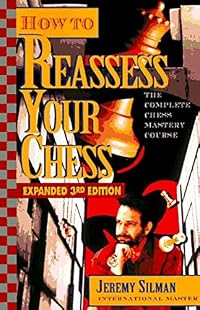
How to Reassess Your Chess
by Jeremy Silman
On This Page
Description
How to Reassess Your Chess has long been considered a modern classic. This 4th edition takes Silman's groundbreaking concept of imbalances to a whole new level. Designed for players in the 1400 to 2100 rating range and for teachers looking for a ready-made chess curriculum, the author shares a mind-expanding journey that takes the reader through imbalance-basics, ensures that every detail of all the imbalances are mastered, and leaves the player/lover of chess with something he always wanted show more but never believed he could achieve: a master-level positional foundation. Hundreds of games brought to life by instruction-rich prose, and stories that offer humor while highlighting various lessons, vividly illustrate all the book's topics in a manner that's both personal and fun. Jeremy Silman is an International Master and a world-class teacher, writer, and player who has won the American Open, the National Open, and the U.S. Open. show lessTags
Recommendations
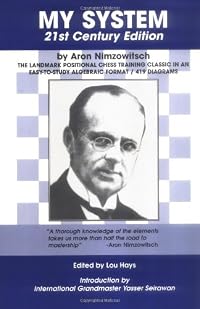


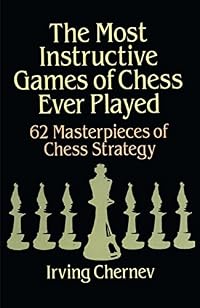
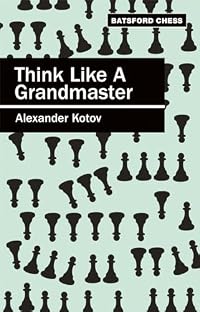
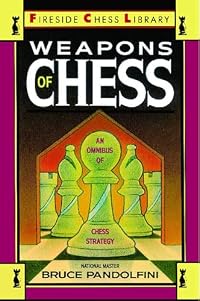



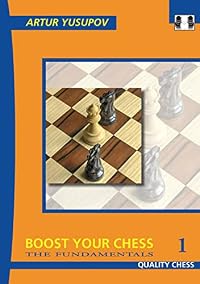
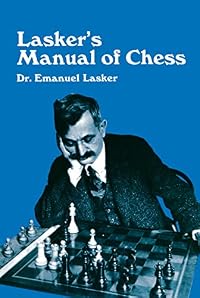
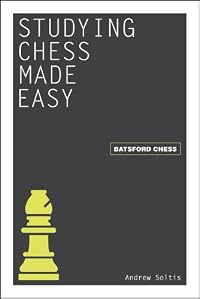
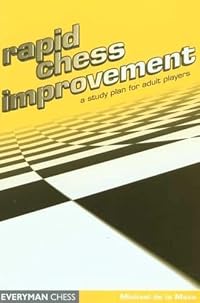
Member Recommendations
Member Reviews
This is a great book, but not one that you should read, this is a book that should be studied. Many of the ideas are in algebraic chess notation, and unless you are particularly good at visualizing the board, you should probably have one handy. Personally, I suck at visualization of the board, but I digress.
Silman has split this particular edition that I have into sixteen parts, each of which is thematically connected. Most of these parts are further subdivided into chapters. For instance, the first part is all about endgames. The first chapter talks about the King, the idea of Opposition and Outflanking. The second chapter of the first part is about King and Pawn endgames and the third chapter of the first part is about King and Rook show more endgames. It isn't exhaustive by any means, but it does cover the basics.
As I said, each part covers a theme. The first part covers endgames, the second part covers Silman's Thinking Technique and the list of Imbalances, the third covers Calculation and Combinations, the Fourth covers Minor Pieces in the middle game and so on. The fifteenth part covers solutions to problems in the book and the Sixteenth is a Recommended Reading List.
Since this is a book that must be studied if you hope for improvement, it isn't something that you read cover to cover mindlessly. It would probably be best to have some kind of board handy so you can play through the games, since all of the possible lines that are mentioned get confusing for me. It has scenarios from actual games and attempts to peer into the mind of the master at crucial points, so it is also helpful in that regard. show less
Silman has split this particular edition that I have into sixteen parts, each of which is thematically connected. Most of these parts are further subdivided into chapters. For instance, the first part is all about endgames. The first chapter talks about the King, the idea of Opposition and Outflanking. The second chapter of the first part is about King and Pawn endgames and the third chapter of the first part is about King and Rook show more endgames. It isn't exhaustive by any means, but it does cover the basics.
As I said, each part covers a theme. The first part covers endgames, the second part covers Silman's Thinking Technique and the list of Imbalances, the third covers Calculation and Combinations, the Fourth covers Minor Pieces in the middle game and so on. The fifteenth part covers solutions to problems in the book and the Sixteenth is a Recommended Reading List.
Since this is a book that must be studied if you hope for improvement, it isn't something that you read cover to cover mindlessly. It would probably be best to have some kind of board handy so you can play through the games, since all of the possible lines that are mentioned get confusing for me. It has scenarios from actual games and attempts to peer into the mind of the master at crucial points, so it is also helpful in that regard. show less
I decided to give Silman a second chance, largely because of this book's rep. It would be great if it had been written by any even slightly less annoying. Try to read it while ignoring the text entirely. You'll hate yourself less for having bought it.
Ratings
Members
- Recently Added By
Author Information

73 Works 3,477 Members
International Chess Master Jeremy Silman is a world-class teacher, writer and player who has won the American Open, the National Open and the U.S. Open. For the past several years Mr. Silman has been the coach of the United States delegation to the World Junior Championship, taking his team to Brazil, Germany, Slovakia, Hungary and Spain.
Some Editions
Series
Belongs to Publisher Series
Common Knowledge
- Canonical title
- How to Reassess Your Chess
Classifications
- Genres
- Nonfiction, General Nonfiction
- DDC/MDS
- 794.12 — Arts & recreation Recreation, sports, and performing arts Chess, Computer Games / Card Games Chess Theory and instruction
- LCC
- GV1449.5 .S553 — Geography, Anthropology and Recreation Recreation. Leisure Recreation. Leisure Games and amusements Indoor games and amusements Board games. Move games
- BISAC
Statistics
- Members
- 663
- Popularity
- 43,228
- Reviews
- 2
- Rating
- (4.20)
- Languages
- 5 — Dutch, English, French, German, Italian
- Media
- Paper, Ebook
- ISBNs
- 10
- ASINs
- 4