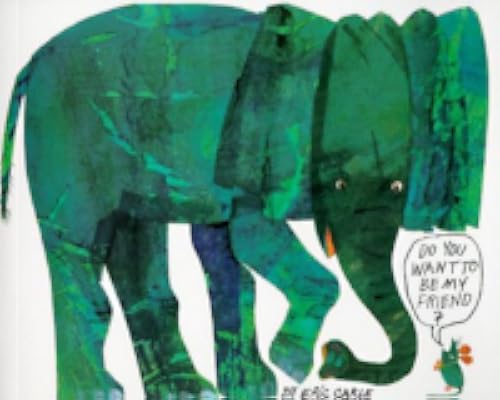
Do You Want to Be My Friend?
by Eric Carle
On This Page
Description
A mouse searches everywhere for a friend.Tags
Recommendations









Member Reviews
I really enjoyed reading "Do You Want to Be My Friend"! The illustrations throughout the story were simple to follow, colorful, and provided the necessary foundation for readers to explore deeper. I also really enjoyed looking into the deeper message of what seems to be such a simple story. "Do You Want to Be My Friend" really highlights social interactions, vulnerability, as well as finding a true friendship. I think this would be a perfect book for young readers who are on the shyer side and are wanting to explore the idea of making new friends!
In my opinion, "Do You Want To Be My Friend," is a great book for younger readers. This book was a lot different from other books because the only words in the whole things are "do you want to be my friend?," and "yes." Since there aren't many words in this book at all, it allows students to visualize what is going on in the story and do what they want in their minds with the illustrations given. This also allows for creativity and a different experience than most books give. Another thing I like about this book are the illustrations. They are unique because they have a collage feeling with very bright colors which is uncommon yet refreshing. For example, the monkey on one of the pages has different patterns and textures with a similar show more color palate on different parts of its body, giving an abstract and artistic feel. The big idea of this story was also something I really liked because the mouse ended up finding a friend who was another mouse; someone similar to him. It showed overall that while finding a friend may seem hard at first, there will always be someone out there who is like you and will be your friend. show less
A wonderful puzzle of a picture book, this wordless wonder would work well in story time. Pose the question of the title, then encourage the audience to study each tail and figure out what animal the friend-seeking mouse will find on the next page. I love how the green grass (spoiler alert!) morphs into a snake and the mouse finds a friend just in time to retreat together.
With only eight words, Eric Carle is able to captivate young readers once again with his paint brush. A mouse in search of a friend, doesn't know the danger that lies ahead. The layout of the book helps the young reader "read" from left to right. The mouse encounters a tail on the right side of the page, turn the page and the rest of the animal, a horse, appears on the left side of the page. When the mouse realizes the animal doesn't want to be his friend, he see's another tail ,on the right side of the page,and tries again. And so the book goes, continuing with an alligator, a lion, a hippo, and more. The pictures of the animals are very large, while the mouse is appropriately much smaller in size. Other than a few brush strokes of show more grass the horse is eating, the only other object on each page besides the mouse and the animal he is trying to befriend is that of a straight, broad greenish brush stroke. It isn't until the mouse finds the tail of another mouse, who agrees to be his friend that the straight brush stroke now takes on some curves around a tree. In this picture, the reader sees a burrow at the base of the tree and the green curve seems to beckon the reader to turn the page. The curve now becomes a loop, and returns to its original straight form. The mice are see safe in the burrow, looking out , delighted to be where they are. Upon turning the page, the author reveals the green line is not just a colorful brush stroke across the page, for the sole purpose of adding color, but is an antagonistic snake seeking a meal. The final page shows the mice below ground, safe in their burrow. The possibilities are endless with this book. The reader can narrate to the young child; as the child becomes familiar with the pages, he/she can begin to make up his/her own story; discussion on finding the right friend can occur; pointing out the importance of making good friend choices, avoiding people who might not be good to call your friend, are all ideas that make this book an excellent tool for the young reader. show less
This is essentially a wordless picture book about a mouse looking for a friend amongst all the other inhabitants of the animal kingdom. The book begins with the mouse asking, "Do you want to be my friend?" and only contains three other lines of text, including "the end." This makes the book a good tool for exercising creativity - the adult reader can come up with their own text to tell a specific story they want to share with their children, or the adult can prompt the children to tell their own story based on the pictures in the book. The book's "note to parents and teachers" gives additional advice on how to use the book in this way.
This is an excellent book for young readers. The story is almost wordless and is a fun read for children as the mouse follows each tail to the next page because you can guess what the next animal will be. The message of the story may be above a kindergarten reader due to the amount of inferencing that needs to be done since there are not many words. Rather, enjoy the illustrations and the fun of guessing which animal comes next. I love how the snake begins on the end-page and travels throughout the entire book!
The book "Do you want to be my friend" was an okay book. It is a wordless picture book. I liked the illustrations, and that it pushes its readers to be creative with what the words could be from the pictures. I like the illustrations because they are very colorful. For example, the animals are not all one color, they are different shades of the colors to create a sense of differentiation. The book definitely pushes readers to have an imagination because there are not words except for "do you want to be my friend?" When I was going through the book I was thinking about what if the elephant liked the mouse, how would the world react to that? And in the end I don't think that it would really change anything because you can be friends with show more anyone as long you try. I believe that the big picture of this book was just that; you can be friends with anyone if you just try, even if it's someone who looks like you or doesn't look like you, act like you, etc. show less
Members
- Recently Added By
Lists

Honey For a Child's Heart
1,152 works; 25 members

Early Picture Books
467 works; 9 members

Written and Illustrated By
805 works; 1 member
Author Information

585+ Works 195,173 Members
Eric Carle is an award-winning, children's picture book author and illustrator whose most recognized work is The Very Hungry Caterpillar Board Book. Carle was born to German parents in 1929 in Syracuse, New York. The family returned to Germany in 1935, moving to a suburb of Stuttgart. Carle disliked high school, quitting at the age of 16 before show more graduation. He was admitted as the youngest student to the Akademie der bildenden Kunste, an art school. After finishing at the Akademie, he worked as a poster designer for the U.S. Information Center in Germany until 1952, when he moved back to New York City. He was a graphic designer at the New York Times and later worked as an art director at L.W. Frohlich & Co. In 1963, Bill Martin, Jr. saw a poster of a red lobster that Carle had designed and asked him to illustrate Brown Bear, Brown Bear, What Do You See?, thus launching his freelance career. Among his many children's books are Dream Snow, Hello, Red Fox, The Very Clumsy Click Beetle, and Pancakes, Pancakes! His title The Artist Who Painted a Blue Horse made Publisher's Weekly Best Seller List for 2011. His title Brown Bear Brown Bear What to You See? made The New York Times Best Seller List for 2012. In 2015 he made The New Zealand Best Seller List with Love from the Very Hungry Caterpillar. Eric Carle, beloved children's book author and illustrator, died on May 23, 2021. He was 91. (Bowker Author Biography) show less
Awards and Honors
Series
Belongs to Publisher Series
Boektoppers (7)
Work Relationships
Common Knowledge
Classifications
Statistics
- Members
- 3,079
- Popularity
- 5,736
- Reviews
- 56
- Rating
- (3.69)
- Languages
- 10 — Arabic, Czech, Dutch, English, French, German, Japanese, Polish, Portuguese, Spanish
- Media
- Paper
- ISBNs
- 54
- ASINs
- 18