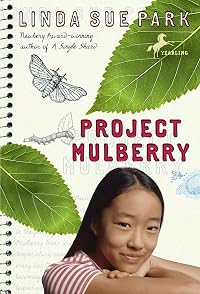
Project Mulberry
by Linda Sue Park
On This Page
Description
While working on a project for an after-school club, Julia, a Korean American girl, and her friend Patrick learn not just about silkworms, but also about tolerance, prejudice, friendship, patience, and more. Between the chapters are short dialogues between the author and main character about the writing of the book.Tags
Recommendations



Member Reviews
This book is about two friends who raise silkworms for a Wiggle Club (like 4H, I think) project. Layered into the story are other, wonderful elements -- lots of non-fiction science information, a good, hard look at race and racism, and what it means to grow up different from everyone else, issues of love and loyalty to friends and annoying younger brothers, and musings about the ethics of raising and caring for animals: using animals for food, respecting animals and earth, being aware of our food supply, and farming sustainably. There's even a peek into the writing process, as the author and Julia, the young protagonist, talk to each other. Julia gets to ask Ms. Park why things are going certain ways in the book, complains about the show more life she's writing for her, and comes to identify elements from the author's own experience in the story. I loved this book.
Curriculum: there are so many ways this book can tie in to curricular content, including integrated and applied science, demonstrating the inquiry process, multicultural studies, and the writing process (between each chapter there is a conversation between the protagonist and the author about the decisions the author is making).
Park, L. (2005). Project Mulberry : a novel. New York: Clarion Books. show less
Curriculum: there are so many ways this book can tie in to curricular content, including integrated and applied science, demonstrating the inquiry process, multicultural studies, and the writing process (between each chapter there is a conversation between the protagonist and the author about the decisions the author is making).
Park, L. (2005). Project Mulberry : a novel. New York: Clarion Books. show less
At least as charming as I remembered from my first read, who knows when. I really like that, besides the main story, it asks some hard questions about racism, but in a mostly gentle way. It reads like a light casual novel, but there's a lot in it. I'd love to teach it in a classroom.
As I read this story, I became quite excited about the prospect of recommending this story as a read-aloud for Grade 4 and 5 classrooms. Silkworms are an important part of Korean culture for a couple of reasons. One, boiled silkworms are a treat. Two, embroidery is a traditional art practiced in Korea. The identity issue that our main character struggles with as a Korean living in the United States, is one that many of my students can identify with. I also enjoyed reading the dialogue between author and main character in different parts of the book.
Unique format with interstitial interviews between main character and the author. It helps to demystify how stories are crested. The themes of racism, phobias, and identity are tenderly, bravely addressed in this middle grade novel.
Tons of curricular connections here: we've got science in several ways including life cycles and ecology, we've got the writing process, and we've got racial relationships. The treatment of race is particularly interesting because I don't think we see much in chidren's literature about the rocky relationships between different minorities - there are many books about specific minorities and their relationships to the dominant culture, but I can't recall many (or even any?) that address the interaction of multiple minorities as Project Mulberry addresses the relationships between Koreans and African-Americans. While I did find the many issues interesting, I think Park tried to cram a little too much in here - the story could end up show more getting lost in the myriad problems tackled. It does make a nice change that our heroine is not a fan of reading. show less
Park, L. S. (2005). Project mulberry. New York: NY. Clarion Books.
Julia Song is a young Korean-American girl. She and her best friend Patrick are part of the WGGL (Work-Grow-Give-Live) Club. The club focuses on teaching kids about sustainable farming. They decide to enter the state fair. They are unsure what topic to select until Julia’s mom suggests that they raise silkworms. Even though Patrick seems absolutely thrilled about the idea, Julia is not. She feels like the project is “too foreign” or “too Korean.” Although they finally decide to raise silkworms, she tries to sabotage their project, so that they will have to choose an American topic.
Mulberry Project definitely illuminates the problems and issues of being show more “American.” Julia considers herself Korean and American. Her family uses some Korean phrases when they speak; her parents remember the Korean War; and they eat at every meal a Korean vegetable called kimchee.
The story transcends the contemporary setting by tactfully raising the issues of racism and prejudice. In Project Mulberry, Julia wonders if her mom is a racist, because she seems uncomfortable with Julia getting mulberry leaves from Mr. Dixon. Mr. Dixon is black. Julia reaches the conclusion that “it doesn’t matter whether what you [think] is good or bad. Not knowing…And not bothering to find out because you didn’t know. That [is] the problem” (p. 141). The story implies that people should be aware of their prejudice and make efforts to know other people from different cultures and ethnicities. At the end of the book, Park mentions that she hopes that her book will bring reconciliation between different races.
One interesting part about the book is that there is a "behind-the-scenes" story after each chapter. They consist of dialogues between the author and the main character. I found these "behind-the scenes" stories distracting, so I mostly focused on the main story.
Park brings up the delicate issue of race in an honest way. The book also avoids stereotyping Korean Americans, because Julia’s character is fully realized. I really enjoyed reading the book. While it deals with the issue of race, Park interweaves humor, making the story not too heavy. The book is appropriate for upper elementary children in helping them understand other diverse cultures. show less
Julia Song is a young Korean-American girl. She and her best friend Patrick are part of the WGGL (Work-Grow-Give-Live) Club. The club focuses on teaching kids about sustainable farming. They decide to enter the state fair. They are unsure what topic to select until Julia’s mom suggests that they raise silkworms. Even though Patrick seems absolutely thrilled about the idea, Julia is not. She feels like the project is “too foreign” or “too Korean.” Although they finally decide to raise silkworms, she tries to sabotage their project, so that they will have to choose an American topic.
Mulberry Project definitely illuminates the problems and issues of being show more “American.” Julia considers herself Korean and American. Her family uses some Korean phrases when they speak; her parents remember the Korean War; and they eat at every meal a Korean vegetable called kimchee.
The story transcends the contemporary setting by tactfully raising the issues of racism and prejudice. In Project Mulberry, Julia wonders if her mom is a racist, because she seems uncomfortable with Julia getting mulberry leaves from Mr. Dixon. Mr. Dixon is black. Julia reaches the conclusion that “it doesn’t matter whether what you [think] is good or bad. Not knowing…And not bothering to find out because you didn’t know. That [is] the problem” (p. 141). The story implies that people should be aware of their prejudice and make efforts to know other people from different cultures and ethnicities. At the end of the book, Park mentions that she hopes that her book will bring reconciliation between different races.
One interesting part about the book is that there is a "behind-the-scenes" story after each chapter. They consist of dialogues between the author and the main character. I found these "behind-the scenes" stories distracting, so I mostly focused on the main story.
Park brings up the delicate issue of race in an honest way. The book also avoids stereotyping Korean Americans, because Julia’s character is fully realized. I really enjoyed reading the book. While it deals with the issue of race, Park interweaves humor, making the story not too heavy. The book is appropriate for upper elementary children in helping them understand other diverse cultures. show less
Jules, a sixth grade Korean-American girl, and her friend, Patrick, work together on a state fair science project - raising silkworms. Jules does not want to raise silkworms because she feels the project calls attention to her background. However, as the worms start to grow, Jules becomes more involved in the project and probably a little too invested in the well-being of the silkworms. The book also brings up prejudice and racism - Jules' mom does not like her to spend time at the neighbor's house when she is collecting the mulberry leaves and Jules believes it may be because Mr. Dixon is black. I wish she had confronted her mom, but she never does. The only complaint I have about the book is the intrusion of the author- throughout the show more book the protagonist has brief conversations with the author. An interesting idea but it made the book feel choppy for me. A good book for 4-6th graders, girls especially. show less
Members
- Recently Added By
Lists

4th Grade Books
312 works; 5 members

Unshelved Book Clubs
579 works; 5 members

Research/Inquiry - mentor texts
43 works; 2 members

AR Level 4 in cloudLibrary
244 works; 1 member
Author Information

62+ Works 23,553 Members
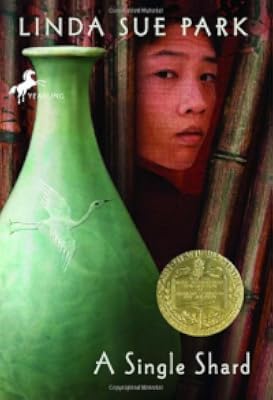
Linda Sue Park was born in Urbana, Illinois on March 25, 1960. She received a B.A. in English from Stanford University. After graduating, she worked as a public-relations writer for a major oil company for two years. She obtained advanced degrees in literature from Trinity College, Dublin in Ireland and from the University of London. Before show more becoming a full-time author, she held numerous jobs including working for an advertising agency, teaching English as a second language to college students, and working as a food journalist. Her first book, Seesaw Girl, was published in 1999. Her other books include The Kite Fighters, Tap Dancing on the Roof: Sijo (Poems), and A Single Shard, which won the 2002 Newbery Medal. She also wrote Storm Warning, which is the ninth book in the 39 Clues series. Her title A Long Walk to Water made the New York Times bestseller list. (Bowker Author Biography) show less
Awards and Honors
Awards
Notable Lists
Common Knowledge
- Original publication date
- 2005
- People/Characters
- Julia Song; Patrick; Mr. Dixon
- Important places
- Julia's patio, Mr. Dixon's backyard
- Dedication
- To Julie, Julie, Julia, and Julia
- First words
- Patrick and I became friends because of a vegetable.
- Quotations
- Here I'd been thinking he was a white guy, and I hadn't said anything one way or the other to my mom, but I was sure she assumed he was white, too, and then he turned out to black, and there he was thinking we would be white,... (show all) but we where Asian, except for Patrick.
I'd humiliated him. On purpose. What a lousy thing thing to do as a friend. All because the silkworm project was too Korean.
So in a way, it didn't matter whether you what you were thinking was good or bad. Not knowing. And not knowing--or not caring--that you didn't know. And not bothering to find out because you didn't know you didn't know. Th... (show all)at was the problem.
"It was too Korean," I said at last. "I didn't want to do the project because it seemed so, well, foreign. I wanted to do a really American project." - Last words
- (Click to show. Warning: May contain spoilers.)Me: Fine. I'll meet you outside.
Classifications
- Genres
- Kids, Tween, Fiction and Literature, Children's Books
- DDC/MDS
- 813.6 — Literature & rhetoric American literature in English American fiction in English 2000-
- LCC
- PZ7 .P2213 .P — Language and Literature Fiction and juvenile belles lettres Fiction and juvenile belles lettres Juvenile belles lettres
- BISAC
Statistics
- Members
- 1,017
- Popularity
- 25,607
- Reviews
- 37
- Rating
- (3.76)
- Languages
- English
- Media
- Paper, Audiobook, Ebook
- ISBNs
- 19
- UPCs
- 1
- ASINs
- 5