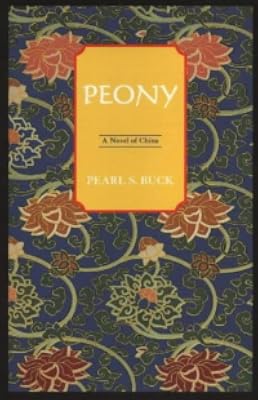
Peony
by Pearl S. Buck
On This Page
Description
The Nobel Prizewinning author's perceptive fable of cross-cultural passions in nineteenth-century ChinaIn 1850s China, a young girl, Peony, is sold to work as a bondmaid for a rich Jewish family in Kaifeng. Jews have lived for centuries in this region of the country, but by the mid-nineteenth century, assimilation has begun taking its toll on their small enclave. When Peony and the family's son, David, grow up and fall in love with one another, they face strong opposition from every side. show more Tradition forbids the marriage, and the family already has a rabbi's daughter in mind for David.Long celebrated for its subtle and even-handed treatment of colliding traditions, Peony is an engaging coming-of-age story about love, identity, and the tragedy and beauty found at the intersection of two disparate cultures. This ebook features an illustrated biography of Pearl S. Buck including rare images from the author's estate. show lessTags
Recommendations

























Member Reviews
"Would he keep himself separate, dedicated to a faith that made him solitary among whatever people he lived, or would he pour the stream of his life into the rich ocean of all human life about him?"
Many of my favorite books are ones with a story that pulls you in and holds you firmly in its grip while teaching you important stuff. “Peony” did both of these things.
This book is historical fiction, romance, and religious philosophy all wrapped into one beautiful package.
It’s the story about a prominent Jewish family living in China in the 1800s, and specifically about the love that one of their bondmaids has for the son she was bonded with. You learn a lot about the Chinese and Jewish cultures and people living during this time. In show more fact, it’s the first book with an explanation of the Jewish plight that makes total sense to me.
It’s not a typical romance, but it’s an authentic one given the cultures and norms of the time period coupled with real love. You’ll need at least one box of tissues!
I couldn’t put the book down and when I was done, I missed Peony. She’s an amazing character that will live with me forever.
My only complaint is the major shift in the writing style toward the end of the book. It’s almost as though Pearl realized (or was told) that the book was going to be too long if she kept up with the earlier depth and detail. With this shift, the story became more summarial with Pearl glossing over major happenings and many years very quickly without the emotional depth that made the rest of the book so amazing.
Nevertheless, Peony made my all-time favorites list and I highly recommend it to historical fiction buffs, especially those who love being pulled into an emotional story! show less
Many of my favorite books are ones with a story that pulls you in and holds you firmly in its grip while teaching you important stuff. “Peony” did both of these things.
This book is historical fiction, romance, and religious philosophy all wrapped into one beautiful package.
It’s the story about a prominent Jewish family living in China in the 1800s, and specifically about the love that one of their bondmaids has for the son she was bonded with. You learn a lot about the Chinese and Jewish cultures and people living during this time. In show more fact, it’s the first book with an explanation of the Jewish plight that makes total sense to me.
It’s not a typical romance, but it’s an authentic one given the cultures and norms of the time period coupled with real love. You’ll need at least one box of tissues!
I couldn’t put the book down and when I was done, I missed Peony. She’s an amazing character that will live with me forever.
My only complaint is the major shift in the writing style toward the end of the book. It’s almost as though Pearl realized (or was told) that the book was going to be too long if she kept up with the earlier depth and detail. With this shift, the story became more summarial with Pearl glossing over major happenings and many years very quickly without the emotional depth that made the rest of the book so amazing.
Nevertheless, Peony made my all-time favorites list and I highly recommend it to historical fiction buffs, especially those who love being pulled into an emotional story! show less
In a little blurb at the beginning of the novel, Buck explains that periodically throughout history, groups of Jews have immigrated to China, where they were eventually integrated into society to the point where they became more Chinese than Jewish. This is the story of one of these families, seen through the eyes of one of their servants, Peony. The mother is dead-set on preserving all of the Jewish traditions and on returning to the Holy Land some day. The father has adapted to more Chinese customs that she has. Their son, David, is caught between the two, and must decide which path he will follow. The novel is also about a love story, as David must decide whether he loves Leah, the daughter of the Rabbi who his mother wants him to show more marry, Kueilan, the daughter of his father’s Chinese business partner, or Peony, who has been his companion since childhood, but who is far below his station.
Buck does a magnificent job of portraying Asian culture, as usual. Most of the stories I’ve read about immigration and the immigrants’ struggles to integrate into their new culture are about people who immigrate to America, so I found it really interesting to see an example from another culture. I also love Buck’s subtle (or maybe not so subtle) commentaries on religion and society. When the Chinese see the Jewish temple and all the sayings that are carved in it, they realize that the Jews believe a lot of the same things that they do. They see no difference, and thus, accept the Jews into their culture. The strictly observant Jews, like the Rabbi and David’s mother, insist on arguing that they are better than the Chinese because their god is the one true god and that they are his chosen people. David comes to realize that these feelings of superiority are the reason why the Jews have been persecuted throughout history and that the Buddhist and Confucian teachings really are pretty similar to those of Judaism. I think Buck makes a very good argument for the idea that despite all the different races, religions, and cultures of humans, we really have more similarities to each other than differences. If we could just realize this and get along, the world would be a better place for everyone. show less
Buck does a magnificent job of portraying Asian culture, as usual. Most of the stories I’ve read about immigration and the immigrants’ struggles to integrate into their new culture are about people who immigrate to America, so I found it really interesting to see an example from another culture. I also love Buck’s subtle (or maybe not so subtle) commentaries on religion and society. When the Chinese see the Jewish temple and all the sayings that are carved in it, they realize that the Jews believe a lot of the same things that they do. They see no difference, and thus, accept the Jews into their culture. The strictly observant Jews, like the Rabbi and David’s mother, insist on arguing that they are better than the Chinese because their god is the one true god and that they are his chosen people. David comes to realize that these feelings of superiority are the reason why the Jews have been persecuted throughout history and that the Buddhist and Confucian teachings really are pretty similar to those of Judaism. I think Buck makes a very good argument for the idea that despite all the different races, religions, and cultures of humans, we really have more similarities to each other than differences. If we could just realize this and get along, the world would be a better place for everyone. show less
Historical fiction at its best. Published in 1948, and set in the 1800s, this book is a fascinating exploration of a relatively unknown piece of history: a Jewish community living in Kaifeng, China. Buck employs a single family, that of Ezra ben Israel, his wife Naomi, his son David, and bondmaid Peony, to represent the descendants of the Jews that initially settled in China many generations before, showing how difficult it can be to retain the ancient traditions in an environment of acceptance. Peony and David grew up together, and form close bonds, which eventually lead to strong feeling for each other, but are prohibited from forming a relationship due to class and religious restrictions.
It is an evenly paced novel, mostly show more character-driven through inner dialogues, and includes a memorable journey to Peking. It succeeds where many contemporary historical fiction novels fail: the setting and era are integral to the storyline, and the characters act in accordance with the culture, customs, and ways of life of the era. The sights, sounds, smells, textures, and tastes provide an aura of authenticity. The reader feels immersed into the historical environment. For example:
“The coming of the caravan each year was an event for the whole city. The news of it ran from mouth to mouth, and when the long line of camels came padding down the dusty path at the side of the stone-paved streets, the doors of every house and shop were open and crowded with people. Upon a proud white camel at the head of the caravan sat Kao Lien, the trusted business partner of the House of Ezra. Behind him came guards armed with swords and old foreign muskets, and behind them plodded the loaded camels. All were weary with the long journey westward through Turkestan and back again through the mountain passes, but for the final homecoming the men had decked themselves in their best, and even the camels held their heads high and moved with majesty.”
Buck lived in China for many years, and it shows in her storytelling. She writes beautifully – clear, descriptive, and emotionally charged. Her prose is effective in showing the quandary of the Jewish people in China as they attempt to keep their traditions while simultaneously feeling accepted and assimilated into their host country. This is one region of the world where they were not persecuted but treated with kindness.
After reading this book, I was inspired to research the history of Jews in China, and aside from literary license in condensing timelines, it seems historically accurate. It provides opportunities to learn about different cultures and a piece of largely forgotten history and poses thought-provoking philosophical questions of the interplay between the head and the heart. Highly recommended to fans of authentic historical fiction and character-driven family sagas. show less
It is an evenly paced novel, mostly show more character-driven through inner dialogues, and includes a memorable journey to Peking. It succeeds where many contemporary historical fiction novels fail: the setting and era are integral to the storyline, and the characters act in accordance with the culture, customs, and ways of life of the era. The sights, sounds, smells, textures, and tastes provide an aura of authenticity. The reader feels immersed into the historical environment. For example:
“The coming of the caravan each year was an event for the whole city. The news of it ran from mouth to mouth, and when the long line of camels came padding down the dusty path at the side of the stone-paved streets, the doors of every house and shop were open and crowded with people. Upon a proud white camel at the head of the caravan sat Kao Lien, the trusted business partner of the House of Ezra. Behind him came guards armed with swords and old foreign muskets, and behind them plodded the loaded camels. All were weary with the long journey westward through Turkestan and back again through the mountain passes, but for the final homecoming the men had decked themselves in their best, and even the camels held their heads high and moved with majesty.”
Buck lived in China for many years, and it shows in her storytelling. She writes beautifully – clear, descriptive, and emotionally charged. Her prose is effective in showing the quandary of the Jewish people in China as they attempt to keep their traditions while simultaneously feeling accepted and assimilated into their host country. This is one region of the world where they were not persecuted but treated with kindness.
After reading this book, I was inspired to research the history of Jews in China, and aside from literary license in condensing timelines, it seems historically accurate. It provides opportunities to learn about different cultures and a piece of largely forgotten history and poses thought-provoking philosophical questions of the interplay between the head and the heart. Highly recommended to fans of authentic historical fiction and character-driven family sagas. show less
Historical fiction at its best. Published in 1948, and set in the 1800s, this book is a fascinating exploration of a relatively unknown piece of history: a Jewish community living in Kaifeng, China. Buck employs a single family, that of Ezra ben Israel, his wife Naomi, his son David, and bondmaid Peony, to represent the descendants of the Jews that initially settled in China many generations before, showing how difficult it can be to retain the ancient traditions in an environment of acceptance. Peony and David grew up together, and form close bonds, which eventually lead to strong feeling for each other, but are prohibited from forming a relationship due to class and religious restrictions.
It is an evenly paced novel, mostly show more character-driven through inner dialogues, and includes a memorable journey to Peking. It succeeds where many contemporary historical fiction novels fail: the setting and era are integral to the storyline, and the characters act in accordance with the culture, customs, and ways of life of the era. The sights, sounds, smells, textures, and tastes provide an aura of authenticity. The reader feels immersed into the historical environment. For example:
“The coming of the caravan each year was an event for the whole city. The news of it ran from mouth to mouth, and when the long line of camels came padding down the dusty path at the side of the stone-paved streets, the doors of every house and shop were open and crowded with people. Upon a proud white camel at the head of the caravan sat Kao Lien, the trusted business partner of the House of Ezra. Behind him came guards armed with swords and old foreign muskets, and behind them plodded the loaded camels. All were weary with the long journey westward through Turkestan and back again through the mountain passes, but for the final homecoming the men had decked themselves in their best, and even the camels held their heads high and moved with majesty.”
Buck lived in China for many years, and it shows in her storytelling. She writes beautifully – clear, descriptive, and emotionally charged. Her prose is effective in showing the quandary of the Jewish people in China as they attempt to keep their traditions while simultaneously feeling accepted and assimilated into their host country. This is one region of the world where they were not persecuted but treated with kindness.
After reading this book, I was inspired to research the history of Jews in China, and aside from literary license in condensing timelines, it seems historically accurate. It provides opportunities to learn about different cultures and a piece of largely forgotten history and poses thought-provoking philosophical questions of the interplay between the head and the heart. Highly recommended to fans of authentic historical fiction and character-driven family sagas. show less
It is an evenly paced novel, mostly show more character-driven through inner dialogues, and includes a memorable journey to Peking. It succeeds where many contemporary historical fiction novels fail: the setting and era are integral to the storyline, and the characters act in accordance with the culture, customs, and ways of life of the era. The sights, sounds, smells, textures, and tastes provide an aura of authenticity. The reader feels immersed into the historical environment. For example:
“The coming of the caravan each year was an event for the whole city. The news of it ran from mouth to mouth, and when the long line of camels came padding down the dusty path at the side of the stone-paved streets, the doors of every house and shop were open and crowded with people. Upon a proud white camel at the head of the caravan sat Kao Lien, the trusted business partner of the House of Ezra. Behind him came guards armed with swords and old foreign muskets, and behind them plodded the loaded camels. All were weary with the long journey westward through Turkestan and back again through the mountain passes, but for the final homecoming the men had decked themselves in their best, and even the camels held their heads high and moved with majesty.”
Buck lived in China for many years, and it shows in her storytelling. She writes beautifully – clear, descriptive, and emotionally charged. Her prose is effective in showing the quandary of the Jewish people in China as they attempt to keep their traditions while simultaneously feeling accepted and assimilated into their host country. This is one region of the world where they were not persecuted but treated with kindness.
After reading this book, I was inspired to research the history of Jews in China, and aside from literary license in condensing timelines, it seems historically accurate. It provides opportunities to learn about different cultures and a piece of largely forgotten history and poses thought-provoking philosophical questions of the interplay between the head and the heart. Highly recommended to fans of authentic historical fiction and character-driven family sagas. show less
An insightful look at the tension between assimilation and maintaining one's heritage in a Jewish family that has lived for 4 generations in China. Ironically, told with compassion and understanding by the daughter of Christian missionaries. Pearl Buck tells this story through the eyes of Peony, a slave purchased for the family's son, David, at a young age so that he would have a playmate. They have grown up as good friends but it is now time for David to be married. Should he marry someone Jewish to keep the family line "pure"? Or should he marry whomever he likes? David himself does not know. Peony for the first time finds herself unable to help him but she must act for her own self-interest. The result is a beautiful narrative based show more on the true history of the Chinese welcoming the Jews into their cities. Despite finding refuge in China, the families are torn between intermarriage and cultural purity. Should we all just get along as one human race and each risk the loss of our special heritage? Are the 2 ideals compatible? A lovely, lovely novel. show less
Six-word review: Love and duty bind Chinese slave.
Extended review:
In a large city in mid-nineteenth-century China, a woman named Peony is bound in service to an old, established Jewish family. Her pivotal role in the life of the family bridges two ancient traditions, each with its observances and taboos. Peony's devoted service to the old master, Ezra, and his controlling wife masks a consuming but forbidden love for their son David, once her childhood companion, now destined for a place in the religious community.
This richly atmospheric novel delivers fascinating details of life in the China of about 1850 and especially in a Jewish household within that setting. The synagogue in the city was by then already some 800 or 900 years old. show more As depicted, Jews who had migrated to China by way of the Silk Road centuries earlier remained aloof in the wider community but were cheerfully tolerated by their liberal-minded Chinese hosts, who knew nothing of European antisemitism. A comfortable symbiosis prevailed between the merchant classes of both cultures, and intermarriage among their offspring increasingly blurred the differences.
For Peony, however, the barrier is insurmountable: it is not because she's Chinese but because she is a bondswoman, inescapably restrained by her inferior social status and her utter dependence on her owners, that there is no hope of a union between her and David. So her love must find other expressions. To serve him, she becomes a schemer and manipulator of events and circumstances. In Peony we see a complex characterization fraught with secrets, conflicts, and hidden motivations, at once rigid and yielding, resourceful, clever, loyal, and yet hopelessly yearning. Among all the principals we see above all else a depiction of love in its many forms, bringer of pain and grief as much as of joy.
From the Pulitzer- and Nobel-winning author of The Good Earth, Peony the novel, deep, moving, satisfying, poignant, wise, and culturally rich, is certain to be one of my highest-rated reading experiences of the year.
(Kindle edition) show less
Extended review:
In a large city in mid-nineteenth-century China, a woman named Peony is bound in service to an old, established Jewish family. Her pivotal role in the life of the family bridges two ancient traditions, each with its observances and taboos. Peony's devoted service to the old master, Ezra, and his controlling wife masks a consuming but forbidden love for their son David, once her childhood companion, now destined for a place in the religious community.
This richly atmospheric novel delivers fascinating details of life in the China of about 1850 and especially in a Jewish household within that setting. The synagogue in the city was by then already some 800 or 900 years old. show more As depicted, Jews who had migrated to China by way of the Silk Road centuries earlier remained aloof in the wider community but were cheerfully tolerated by their liberal-minded Chinese hosts, who knew nothing of European antisemitism. A comfortable symbiosis prevailed between the merchant classes of both cultures, and intermarriage among their offspring increasingly blurred the differences.
For Peony, however, the barrier is insurmountable: it is not because she's Chinese but because she is a bondswoman, inescapably restrained by her inferior social status and her utter dependence on her owners, that there is no hope of a union between her and David. So her love must find other expressions. To serve him, she becomes a schemer and manipulator of events and circumstances. In Peony we see a complex characterization fraught with secrets, conflicts, and hidden motivations, at once rigid and yielding, resourceful, clever, loyal, and yet hopelessly yearning. Among all the principals we see above all else a depiction of love in its many forms, bringer of pain and grief as much as of joy.
From the Pulitzer- and Nobel-winning author of The Good Earth, Peony the novel, deep, moving, satisfying, poignant, wise, and culturally rich, is certain to be one of my highest-rated reading experiences of the year.
(Kindle edition) show less
Pearl Buck at her sloppiest is still Pearl Buck (and this at least isn't _Mandala_). Anachronisms abound, some of them quite outrageous to someone who knows Chinese history (and not entirely surprising if you know Buck's distinctly populist ideas about the proper role and form of fiction), and several characters feel ever so slightly recycled (the titular serving girl Peony is apparently putting in a return appearance from _A House Divided_, in which she married a somewhat fictionalized Zhou En-Lai), but Buck's psychological insight is as exact as her everything else is sloppy. Don't prioritize this over _The Good Earth_, _Pavilion of Women_, or _Sons_, but don't write it off as worthless either.
Members
- Recently Added By
Lists

Best Fiction Set in China
43 works; 27 members

Top Five Books of 2014
1,064 works; 397 members

Books Read in 2024
4,623 works; 126 members
Author Information

434+ Works 37,123 Members
Pearl S. Buck, June 26, 1892 - March 6, 1973 Pearl Sydenstricker Buck was an American author, best know for her novels about China. Buck was born on June 26, 1892, in Hillsboro, West Virginia, but as the daughter of Presbyterian missionaries she was taken to China in infancy. She received her early education in Shanghai, but returned to the United show more States to attend college, and graduated from Randolph-Macon Woman's College in Virginia in 1914. Buck became a university teacher there and married John Lossing Buck, an agricultural economist, in 1917. Buck and her husband both taught in China, and she published magazine articles about life there. Her first novel East Wind, West Wind was published in 1930. Buck achieved international success with The Good Earth, which won the Pulitzer Prize in 1932. This story of a Chinese peasant family's struggle for survival was later made into a MGM film. Buck resigned from the Presbyterian Board of Foreign Missions after publishing an article that was critical of missionaries. She returned to the United States because of political unrest in China. Buck's novels during this period include Sons, A House Divided, and The Mother. She also wrote biographies of her father (Fighting Angel) and her mother (The Exile). She won the Nobel Prize for Literature in 1938. During her career, Buck published over 70 books: novels, nonfiction, story collections, children's books, and translations from the Chinese. She also wrote under the pseudonym John Sedges. In the United States, Buck was active in the civil rights and women's rights movements. In 1942 she founded the East and West Association to promote understanding between Asia and the West. In 1949, Buck established Welcome House, the first international interracial adoption agency. In 1964, she established the Pearl S. Buck foundation to sponsor support for Amerasian children who were not considered adoptable. Pearl Buck died in Danbury, Vermont, on March 6, 1973. (Bowker Author Biography) show less
All Editions
Some Editions
Awards and Honors
Distinctions
Series
Belongs to Publisher Series
Work Relationships
Common Knowledge
- Canonical title
- Peony
- Original title
- Peony
- Alternate titles
- The Bondmaid (UK) (UK)
- Original publication date
- 1948
- People/Characters
- Peony; Ezra ben Israel
- Important places
- K'aifeng, Honan, China; China
- Epigraph
- At various times in history colonies of Jews have gone to China and lived there. The city of K'aifeng, in the province of Honan, was a center for them. In China they have never been persecuted, and if they have suffered har... (show all)dships, these were only the hardships of life in the community where they were.
In its basis, therefore, this novel may be said to be historically true, although the characters, with unimportant exceptions, are the creatures of my imagination. The story takes place at the period, about a century ago, when the Chinese had accepted the Jews, and when, indeed, most Jews had come to think of themselves as Chinese. Today even the memory of their origin is gone. They are Chinese. - First words
- It was spring in the city of K'aifeng, a late spring in the northern Chinese province of Honan.
- Last words
- (Click to show. Warning: May contain spoilers.)"They are no more and yet they live forever."
- Original language
- English
- Disambiguation notice
- Published in the UK as The Bondmaid.
Classifications
Statistics
- Members
- 1,021
- Popularity
- 25,452
- Reviews
- 24
- Rating
- (3.94)
- Languages
- 12 — Dutch, English, Finnish, French, German, Hungarian, Indonesian, Italian, Polish, Portuguese, Spanish, Swedish
- Media
- Paper, Audiobook, Ebook
- ISBNs
- 38
- ASINs
- 36