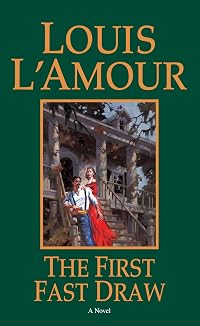
The First Fast Draw
by Louis L'Amour
On This Page
Description
East Texas wasn’t much of a home for Cullen Baker. Few liked him, and some even tried to kill him. Yet after three hard years of wandering, he’s come back to farm the land that’s rightfully his. Only Cullen’s in for an unwelcome homecoming: his neighbors have long memories, the Reconstructionists have greedy hearts, and his worst enemy has teamed up with a vicious outlaw. But Cullen isn’t about to back down. Instead, he’s intent on perfecting a new way of gunfighting: the fast show more draw. And now, with enemies closing in on three sides and threatening the woman he loves, he’ll have to be faster than lightning—and twice as deadly—just to survive.. show less
Tags
Recommendations








Member Reviews
Louis L'Amour’s First Fast Draw is a classic western, despite sloughs replacing deserts and Spanish moss replacing cactus. The story takes place between the Sulphur River and the Big Thicket in my part of Texas. Like the start of the Old West, the story opens after the Civil War, though the author avoids the fallout, specifically the civil rights issues, because he is concentrating on entertainment. L’Amour threads the needle of celebrating the uniqueness of manhood while portraying strong female leads, though I concede some points are dated.
After the Civil War in which he only participated in one guerrilla raid, Cullen Baker returned to his father's farm in northern Texas. Knowing that there were people there who would harm him, he tried to keep his farming activities quiet. When his enemies found out he was back, they tried to take him out by lynching but it was prevent by a woman who refused to leave the scene.
After many escapes from bondage and jail, he and some friends faced his enemies, killed the lot and fled west to a land where they were unknown and could live in peace. This is a slower L'Amour effort but there is still a lot of action.
After many escapes from bondage and jail, he and some friends faced his enemies, killed the lot and fled west to a land where they were unknown and could live in peace. This is a slower L'Amour effort but there is still a lot of action.
Quality dime novel style western. L’Amour had a near
Read like the standard b-grade western; nothing outstanding, and became pretty dull after about 1/3 of the novel--stereotypical rigidity. Be that as it may, it won't stop me from reading L'Amour's other novels.
Ratings
Members
- Recently Added By
Author Information

871+ Works 99,994 Members
Born in Jamestown, North Dakota on March 22, 1908, Louis L'Amour's adventurous life could have been the subject of one of his novels. Striking out on his own in 1923, at age 15, L'Amour began a peripatetic existence, taking whatever jobs were available, from skinning dead cattle to being a sailor. L'Amour knew early in life that he wanted to be a show more writer, and the experiences of those years serve as background for some of his later fiction. During the 1930s he published short stories and poetry; his career was interrupted by army service in World War II. After the war, L'Amour began writing for western pulp magazines and wrote several books in the Hopalong Cassidy series using the pseudonym Tex Burns. His first novel, Westward the Tide (1950), serves as an example of L'Amour's frontier fiction, for it is an action-packed adventure story containing the themes and motifs that he uses throughout his career. His fascination with history and his belief in the inevitability of manifest destiny are clear. Also present and typical of L'Amour's work are the strong, capable, beautiful heroine who is immediately attracted to the equally capable hero; a clear moral split between good and evil; reflections on the Native Americans, whose land and ways of life are being disrupted; and a happy ending. Although his work is somewhat less violent than that of other western writers, L'Amour's novels all contain their fair share of action, usually in the form of gunfights or fistfights. L'Amour's major contribution to the western genre is his attempt to create, in 40 or more books, the stories of three families whose histories intertwine as the generations advance across the American frontier. The novels of the Irish Chantry, English Sackett, and French Talon families are L'Amour's most ambitious project, and sadly were left unfinished at his death. Although L'Amour did not complete all of the novels, enough of the series exists to demonstrate his vision. L'Amour's strongest attribute is his ability to tell a compelling story; readers do not mind if the story is similar to one they have read before, for in the telling, L'Amour adds enough small twists of plot and detail to make it worth the reader's while. L'Amour fans also enjoy the bits of information he includes about everything from wilderness survival skills to finding the right person to marry. These lessons give readers the sense that they are getting their money's worth, that there is more to a L'Amour novel than sheer escapism. With over 200 million copies of his books in print worldwide, L'Amour must be counted as one of the most influential writers of westerns in this century. He died from lung cancer on June 10, 1988. (Bowker Author Biography) Louis L'Amour, truly America's favorite storyteller, was the first fiction writer ever to receive the Congressional Gold Medal from the United States Congress in honor of his life's work, & was also awarded the Medal of Freedom. There are over 260 million copies of his books in print worldwide. (Publisher Provided) show less
Common Knowledge
- Canonical title
- The First Fast Draw
- Original title
- The First Fast Draw
- Original publication date
- 1959-02
- People/Characters
- Bob Lee; Cullen Baker; Sam Barlow; Bill Longley; Chance Thorne; Cap'n Weaver (show all 30); Katy Thorne; Joel Reese; John Tower; Bicekrstaff; Amon Belser; Lacy; Will Thorne; Haas; Gibson; Aunt Florence; Jack English; Bickerstaff; Tom Blaine; Lacy Petraine; Matt Kirby; Andre Petraine; Thomas Warren; Buck Tinney; Dud Butler; Wesley; Jane Watson; Terence O'Donnell; Seth Rames; Caddo Mike
- Important places
- Northeast Texas, USA; Sulphur River; Boston, Texas, USA; Jefferson, Texas, USA; Willow Bluff, Sulphur River, Texas, USA; Texas, USA
- Important events
- Reconstruction
- Epigraph
- [None]
- Dedication
- [None]
- First words
- When the shelter was finished, thatched heavy with pine boughs, I went inside and built myself a hatful of fire.
- Last words
- (Click to show. Warning: May contain spoilers.)Tonight John Tower will drive out from town and we will walk down to the corrals together to watch the horses, two tall old men who long ago stood side by side in a green sunlit meadow on the banks of the Sulphur River, but that was long, long ago, and in another world than this, another time.
Classifications
Statistics
- Members
- 698
- Popularity
- 41,057
- Reviews
- 5
- Rating
- (3.62)
- Languages
- English, Norwegian (Bokmål), Russian
- Media
- Paper, Audiobook, Ebook
- ISBNs
- 21
- ASINs
- 16