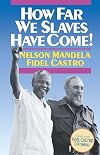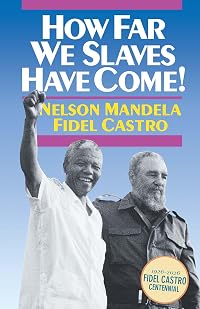
How Far We Slaves Have Come!: South Africa and Cuba in Today's World
by Nelson Mandela, Fidel Castro
33 Members (3.00)
On This Page
Description
Speaking together in Cuba in 1991, Mandela and Castro discuss the unique relationship and example of the struggles of the South African and Cuban peoples. Talaye PorsooTags
Recommendations





Member Reviews
Members
- Recently Added By
Author Information

75+ Works 8,976 Members
Nelson Mandela was born Rolihlahla Mandela on July 18, 1918 in Mvezo, South Africa. His teacher later named him Nelson as part of a custom to give all schoolchildren Christian names. He briefly attended University College of Fort Hare but was expelled after taking part in a protest with Oliver Tambo, with whom he later operated the nation's first show more black law firm. He eventually completed a bachelor's degree through correspondence courses and studied law at the University of Witwatersrand in Johannesburg. He left without graduating in 1948. Mandela was part of the African National Congress (ANC) and spent many years as a freedom fighter. When the South African government outlawed the ANC after the Sharpeville Massacre, he went underground to form a new military wing of the organization. In 1964, he was sentenced to life in prison for sabotage and conspiracy to overthrow the government. Instead of testifying at the trial, he opted to give a speech that was more than four hours long and ended with a defiant statement. While in prison, he received a bachelor's degree in law in absentia from the University of South Africa. In 1990, Mandela was released from prison after 27 years. He served as President of South Africa from 1994 to 1999, and was the first South African president to be elected in a fully representative democratic election. He was awarded the Nobel Peace Prize with former South African President F.W. de Klerk in 1993 for transitioning the nation from a system of racial segregation. After leaving the presidency, Mandela retired from active politics, but continued championing causes such as human rights, world peace and the fight against AIDS. He died on November 5, 2013 at the age of 95. (Bowker Author Biography) show less

378+ Works 2,308 Members
Fidel Alejandro Castro Ruz was born on August 13, 1926 in province of Oriente, Cuba. He entered the University of Havana's law school in 1945 and became involved in radical politics. After receiving his law degree, Castro briefly represented the poor, often bartering his services for food. In 1952, he ran for Congress as a candidate for the show more opposition Orthodox Party. However, the election was rushed because of a coup staged by Fulgencio Batista. Castro's initial response to the Batista government was to challenge it with a legal appeal, claiming that Batista's actions had violated the Constitution. The attempt failed. On July 26, 1953, Castro led a group of radical students in an attack on the Moncada barracks in Santiago de Cuba. Many of the rebels were killed. He was arrested and sentenced to 15 years in prison. To show the people that he was not a dictator, Batista released Castro and his followers in an amnesty after the 1954 presidential election. Once Castro returned to Cuba after an exile in Mexico, he began a campaign of harassment and guerrilla warfare against Batista. Batista fled Cuba on January 1, 1959. Under Castro's rule, more than 500 Batista-era officials were brought before courts-martial and special tribunals, convicted, and shot to death. Castro cut ties with the United States after President Dwight D. Eisenhower cut the American sugar quota and turned to the Soviet Union for assistance, eventually becoming a Communist. The Escambray Revolt, led by peasants and anti-Communist insurgents against the Castro government, lasted from 1959 to 1965, before it was crushed by Castro's army. Cuban exiles arrived in the United States by the thousands. The Central Intelligence Agency helped train an exile army to retake Cuba by force. On April 17, 1961, 1,500 Cuban fighters landed at the Bay of Pigs. Castro was waiting for them and most of the invaders were either captured or killed. Castro was the leader of Cuba until stepping down in 2006 due to diverticulitis. He died on November 25, 2016 at the age of 90. (Bowker Author Biography) show less
Common Knowledge
- Canonical title*
- Mai più schiavi! Sudafrica e Cuba nel mondo di oggi
- Original title
- How Far We Slaves Have Come! South Africa and Cuba in Today's World
- Important places
- Cuba; South Africa
*Some information comes from Common Knowledge in other languages. Click "Edit" for more information.
Classifications
- Genres
- Nonfiction, Politics and Government, History
- DDC/MDS
- 327.6807291 — Society, government, & culture Political science International Relations: Spies Africa South Africa and Africa, Southern
- LCC
- DT1805 .C9 .M36 — History of Europe, Asia, Africa and Oceania Africa History of Africa South Africa History
Statistics
- Members
- 33
- Popularity
- 856,234
- Rating
- (3.00)
- Languages
- English, Italian, Farsi/Persian
- Media
- Paper
- ISBNs
- 3