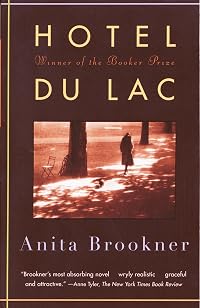
Hotel du Lac
by Anita Brookner
On This Page
Description
In the novel that won her the Booker Prize and established her international reputation, Anita Brookner finds a new vocabulary for framing the eternal question "Why love?" It tells the story of Edith Hope, who writes romance novels under a psudonym. When her life begins to resemble the plots of her own novels, however, Edith flees to Switzerland, where the quiet luxury of the Hotel du Lac promises to resore her to her senses. But instead of peace and rest, Edith finds herself sequestered at show more the hotel with an assortment of love's casualties and exiles. She also attracts the attention of a worldly man determined to release her unused capacity for mischief and pleasure. Beautifully observed, witheringly funny, Hotel du Lac is Brookner at her most stylish and potently subversive. show lessTags
Recommendations






































Member Recommendations

cbl_tn Brookner uses the phrase "excellent women" a couple of times in this novel, and it seems to be a conscious reference to Pym's novel.
40
Member Reviews
Whenever I read a certain kind of woman's novel where the protagonist is either middle-aged, tired and/or disgraced, I tend to worry about, what I call, "The Awakening" effect where a woman may find, when there are no other options available to her, that there's only one way out of a bad situation.
Hotel Du Lac, written nearly 100 years after Chopin's "The Awakening" and set in the 1980's proves to be a document as to how far women have come.
Romance writer, Edith Hope, has been advised by her friends to get out of town, regroup and think about the dreadful thing she's done. Exile at Hotel Du Lac at first repulses Edith and also perhaps the reader. Edith describes everything in her room the color of cooked veal, a misty shroud show more encompasses the lake and surrounding mountains. Edith and the reader are trapped! Although the story unfolds at a snails pace and some may even toss it aside one should look at Edith's story more as a character study of those also staying at the hotel. The other women at Du Lac are also in some type of exile and in them Edith reflects on who she is and who she might become if she chooses to remain on the path she's been traveling. She may find it necessary to fall into line with old school thought or she may discover she has options.
Hotel Du Lac in September and Edith, both dignified, solid and out of season are empowering and well worth a quick read. show less
Hotel Du Lac, written nearly 100 years after Chopin's "The Awakening" and set in the 1980's proves to be a document as to how far women have come.
Romance writer, Edith Hope, has been advised by her friends to get out of town, regroup and think about the dreadful thing she's done. Exile at Hotel Du Lac at first repulses Edith and also perhaps the reader. Edith describes everything in her room the color of cooked veal, a misty shroud show more encompasses the lake and surrounding mountains. Edith and the reader are trapped! Although the story unfolds at a snails pace and some may even toss it aside one should look at Edith's story more as a character study of those also staying at the hotel. The other women at Du Lac are also in some type of exile and in them Edith reflects on who she is and who she might become if she chooses to remain on the path she's been traveling. She may find it necessary to fall into line with old school thought or she may discover she has options.
Hotel Du Lac in September and Edith, both dignified, solid and out of season are empowering and well worth a quick read. show less
A magnificent book. This won the 1984 Booker Prize.
Playing on feminist themes and Thomas Mann's The Magic Mountain, Edith Hope goes to Switzerland not to heal her body, but to hide away awhile after damaging her reputation. She goes in the offseason. The summer tourists have left, the clouds more often obscure the sun, leaving everything gray and hazy. The hotel on the lake is half empty, with a smaller underused staff. There are guests. They tend toward wealth and loneliness, widows and unmarried women, with a few men from a nearby conference. But what does Hope care. She's an author, a writer of "romantic fiction", who just needs to pass the time and get some writing done. She has landed in a cozy isolation. So, of course, she gets show more involved with the other guests.
When asked to sex up her books for the liberated women readers, Edith tells her editor that's not what they want. "...they prefer the old myths, when it comes to the crunch. They want to believe that they are going to be discovered, looking their best, behind closed doors, just when they thought all was lost, by a man who has battled across continents, abandoning whatever he may have had in his in-tray, to reclaim them."
Edith makes friends with a widow and her grown unmarried daughter, and with another gorgeous bird-like woman, alone with her dog, who gossips about the widow. She develops a connection with a deaf elderly woman, left here alone by her son. And she meets a man in gray who takes an interest in her. He may have battled across continents. Edith will get involved in all the hotel's vanity, listening, learning about rivalries and caressed personal histories. Meanwhile she writes long letters to her married lover. Her book progress is lingering.
She does think a lot about writing. In one fun line she thinks, "The sensation of being entertained by words was one she encountered all too rarely. People expect writers to entertain _them_, she reflected. They consider that writers should be gratified simply by performing their task to the audience's satisfaction. Like sycophants at court in the Middle Ages, dwarves, jongleurs. And what about _us_? Nobody thinks about entertaining _us_.”
There a many different themes built in this book, on love, stories, social performance, meaning, selfishness and happiness. It's all heightened by the luxurious atmosphere, forcing the language to rise, and made playful by Edith's wry perspectives and interactions, and Brookner's. Brookner is, I think, I highly underappreciated author. She can manage all this stuff - the themes, humor, language and story tension - and the combination of it all makes this book really shine. It's something of a classic, by far Brookner's most famous book, and it deserves that attention.
I've read one other Brookner, A Closed Eye, which is an excellent novel doing many complicated things, and bringing in the readers emotions and thinking, and mixing these together. This book sits on a higher level because it combines these skills with the heightened language and playfulness suitable to the book's atmosphere. It makes this book far more vibrant.
Recommended to everyone, especially those looking for underappreciated authoresses.
2025
https://www.librarything.com/topic/372264#8972217 show less
Playing on feminist themes and Thomas Mann's The Magic Mountain, Edith Hope goes to Switzerland not to heal her body, but to hide away awhile after damaging her reputation. She goes in the offseason. The summer tourists have left, the clouds more often obscure the sun, leaving everything gray and hazy. The hotel on the lake is half empty, with a smaller underused staff. There are guests. They tend toward wealth and loneliness, widows and unmarried women, with a few men from a nearby conference. But what does Hope care. She's an author, a writer of "romantic fiction", who just needs to pass the time and get some writing done. She has landed in a cozy isolation. So, of course, she gets show more involved with the other guests.
When asked to sex up her books for the liberated women readers, Edith tells her editor that's not what they want. "...they prefer the old myths, when it comes to the crunch. They want to believe that they are going to be discovered, looking their best, behind closed doors, just when they thought all was lost, by a man who has battled across continents, abandoning whatever he may have had in his in-tray, to reclaim them."
Edith makes friends with a widow and her grown unmarried daughter, and with another gorgeous bird-like woman, alone with her dog, who gossips about the widow. She develops a connection with a deaf elderly woman, left here alone by her son. And she meets a man in gray who takes an interest in her. He may have battled across continents. Edith will get involved in all the hotel's vanity, listening, learning about rivalries and caressed personal histories. Meanwhile she writes long letters to her married lover. Her book progress is lingering.
She does think a lot about writing. In one fun line she thinks, "The sensation of being entertained by words was one she encountered all too rarely. People expect writers to entertain _them_, she reflected. They consider that writers should be gratified simply by performing their task to the audience's satisfaction. Like sycophants at court in the Middle Ages, dwarves, jongleurs. And what about _us_? Nobody thinks about entertaining _us_.”
There a many different themes built in this book, on love, stories, social performance, meaning, selfishness and happiness. It's all heightened by the luxurious atmosphere, forcing the language to rise, and made playful by Edith's wry perspectives and interactions, and Brookner's. Brookner is, I think, I highly underappreciated author. She can manage all this stuff - the themes, humor, language and story tension - and the combination of it all makes this book really shine. It's something of a classic, by far Brookner's most famous book, and it deserves that attention.
I've read one other Brookner, A Closed Eye, which is an excellent novel doing many complicated things, and bringing in the readers emotions and thinking, and mixing these together. This book sits on a higher level because it combines these skills with the heightened language and playfulness suitable to the book's atmosphere. It makes this book far more vibrant.
Recommended to everyone, especially those looking for underappreciated authoresses.
2025
https://www.librarything.com/topic/372264#8972217 show less
Romance novelist Edith Hope has escaped from her life at a quiet Swiss hotel at the end of its season. Her life in London consists chiefly of making others happy – her publisher by writing not-quite-bestseller romances, and her friends by making up numbers at dinner parties and saying what’s expected of her. She is more isolated than ever in her retreat, and to occupy her mind she analyzes her fellow guests almost as if they are characters in one of her books. The only eligible male guest attaches himself to her and he seems to offer a permanent escape from the difficulties she left behind.
This novel appears to be a response to Barbara Pym’s Excellent Women. Brookner uses this phrase twice in the novel, and this seems deliberate. show more Pym’s Mildred Lathbury ends her loneliness through marriage to an anthropologist, to whom she can be useful. Brookner’s Edith Hope makes a different choice, rejecting marriage to a man she doesn’t love and who doesn’t love her to continue as mistress to a man she loves who will never leave his wife for her. She has realized just in time that marriage to such a man will not end her loneliness. It would be interesting to pair these novels in a reading group and see where the discussion goes. show less
This novel appears to be a response to Barbara Pym’s Excellent Women. Brookner uses this phrase twice in the novel, and this seems deliberate. show more
I'd always wanted to read Hotel Du Lac, and have finally managed to get around to it. Why? Well there's something about old, slightly stuffy, family owned European hotels that appeals to me. Also, the book has been so frequently blurbed in the end pages of other books I've read, that I thought I really should read it. Finally, the title reminds me of The White Hotel by D.M Thomas (NOTE: This book bears absolutely no resemblance to The White Hotel. It would be hard to think of two more dissimilar books).
My first thoughts were how much writing styles have changed in the last 35 years. This was published in 1984, won the Booker that year, and even though a review of the short list reveals that 1984 was hardly a vintage year, compared to show more other novels on the list, such as Flaubert's Parrot, let alone the 1985 winner, The Bone People, this feels like a literary throwback, a restrained, drawing room novel of manners and mild romantic intrigue that could have been published at almost any time in the preceding 50 years. In fact its unclear when it is set; there are cars - but they tend to be chauffeur driven; there is airline travel - but people seem to be generally unfamiliar with airports; there is television - in the TV room; people are disparaged for being "in trade" - was that really still a term in use in the mid 1980s? Perhaps it was. Most importantly, though, Edith Hope, our protaganist is banished to the end of season Hotel du Lac for an embarrassing incident that frankly, wasn't really that embarrassing for anyone other than her. 1980s Edith would have been encouraged by her friends to move on, rather than bolt for the Continent. So the timing is unclear,
All of which sounds as if I didn't enjoy the book, but actually I did. Edith, as a novelist, has a sharp eye for detail, and a waspish tone to her analysis of her fellow guests. Her description of the furnishings as "veal coloured" is exactly right. Her portraits of her fellow guests, are decorously insulting. She brings to life beautifully the turgid boredom of holidays in bad weather, near the end of season, in resorts that have no attractions other than shopping, the hairdresser, and the long walk.
A quiet pleasure then this novel, much like the Hotel du Lac itself. The plot, such as it is, is easy to summarise. Edith is a moderately successful romance writer, under a nom de plume. She conducts a moderately successful affair with an auctioneer, David, who the modern reader will probably think is taking advantage of her. He gets sex, comfort food, and no pressure to leave his wife, She gets to see him once or twice a month. Her life is bland, vaguely unsatisfying, and she fails to see a way to change anything. Until the "embarrassing incldent" leads to the purgatory of the Hotel du Lac
Once at the Hotel du Lac, other guests try to drag her into their own petty dramas. Monica has an eating disorder and a not coincidentally fat pet dog. The Puseys, mother and daughter, float by propelled by comfortable wealth and a total lack of imagination as to what to do with it, the smooth Mr Neville believes he understands Edith but might find he is completely wrong.
As I say, its all very readable, with a mild twist which the observant reader would have seem coming 50 pages earlier, if he / she hasn't dozed off in a comfortable armchair. Its that sort of novel; comfortable. show less
My first thoughts were how much writing styles have changed in the last 35 years. This was published in 1984, won the Booker that year, and even though a review of the short list reveals that 1984 was hardly a vintage year, compared to show more other novels on the list, such as Flaubert's Parrot, let alone the 1985 winner, The Bone People, this feels like a literary throwback, a restrained, drawing room novel of manners and mild romantic intrigue that could have been published at almost any time in the preceding 50 years. In fact its unclear when it is set; there are cars - but they tend to be chauffeur driven; there is airline travel - but people seem to be generally unfamiliar with airports; there is television - in the TV room; people are disparaged for being "in trade" - was that really still a term in use in the mid 1980s? Perhaps it was. Most importantly, though, Edith Hope, our protaganist is banished to the end of season Hotel du Lac for an embarrassing incident that frankly, wasn't really that embarrassing for anyone other than her. 1980s Edith would have been encouraged by her friends to move on, rather than bolt for the Continent. So the timing is unclear,
All of which sounds as if I didn't enjoy the book, but actually I did. Edith, as a novelist, has a sharp eye for detail, and a waspish tone to her analysis of her fellow guests. Her description of the furnishings as "veal coloured" is exactly right. Her portraits of her fellow guests, are decorously insulting. She brings to life beautifully the turgid boredom of holidays in bad weather, near the end of season, in resorts that have no attractions other than shopping, the hairdresser, and the long walk.
A quiet pleasure then this novel, much like the Hotel du Lac itself. The plot, such as it is, is easy to summarise. Edith is a moderately successful romance writer, under a nom de plume. She conducts a moderately successful affair with an auctioneer, David, who the modern reader will probably think is taking advantage of her. He gets sex, comfort food, and no pressure to leave his wife, She gets to see him once or twice a month. Her life is bland, vaguely unsatisfying, and she fails to see a way to change anything. Until the "embarrassing incldent" leads to the purgatory of the Hotel du Lac
Once at the Hotel du Lac, other guests try to drag her into their own petty dramas. Monica has an eating disorder and a not coincidentally fat pet dog. The Puseys, mother and daughter, float by propelled by comfortable wealth and a total lack of imagination as to what to do with it, the smooth Mr Neville believes he understands Edith but might find he is completely wrong.
As I say, its all very readable, with a mild twist which the observant reader would have seem coming 50 pages earlier, if he / she hasn't dozed off in a comfortable armchair. Its that sort of novel; comfortable. show less
An excellent story with exceptional character depictions. The writing is so well done that you might close your eyes and imagine yourself in the Hotel du Lac. At first I wondered, tried guessing, why Edith was there, in an obscure hotel on Lake Geneva just before they close up for winter. Alone, with fellow guests with whom she has nothing in common. They cannot even supply grist for her writing. This is a subtle story where very word is to be savoured, every description relished. Highly recommended.
Anonymous female author arrives at country hotel, peruses grey landscape, ignores novel-in-progress, and instead writes breezy, boring letter to David, her former lover
whose family they betrayed, as well as the fiance she deserted. It would have been welcome to have Geoffrey Long come alive with spirit.
Mild mystery evolves about why she has banished herself from her home and friends.
This is undercut by her near-total self absorption ("melancholy of exile") and her relating of the hair styles, fashion, shopping
and concerns of rich and privileged women.
The most exciting main character is the weather on the lake and mountain during the a new season.
The meek, depressed author never changes into a person with enough character to be guided by show more her own feelings and
not always by other's expectations.
Worse still, the ending hinges on a plot twist which makes the strongest human character, Mr. Neville, a ridiculous liar.
One great resounding quote: "Naturally reclusive, she found it unsurprising that people left her to her fate." show less
whose family they betrayed, as well as the fiance she deserted. It would have been welcome to have Geoffrey Long come alive with spirit.
Mild mystery evolves about why she has banished herself from her home and friends.
This is undercut by her near-total self absorption ("melancholy of exile") and her relating of the hair styles, fashion, shopping
and concerns of rich and privileged women.
The most exciting main character is the weather on the lake and mountain during the a new season.
The meek, depressed author never changes into a person with enough character to be guided by show more her own feelings and
not always by other's expectations.
Worse still, the ending hinges on a plot twist which makes the strongest human character, Mr. Neville, a ridiculous liar.
One great resounding quote: "Naturally reclusive, she found it unsurprising that people left her to her fate." show less
Edith Hope, an English writer of romance novels, arrives at the titular hotel in Switzerland after a mysterious faux pas. The nature of this faux pas is not revealed until later in the storyline, keeping the reader interested in finding out why she would be staying at a remote hotel just before the hotel will be closed for the off season. What could this seemingly conventional and inconspicuous woman have done?
The narrative covers Edith’s interactions with the unusual hotel guests, including wealthy domineering widow, Mrs. Pusey, her daughter Jennifer, and the enigmatic Mr. Neville (who has his own agenda). Edith gets to know them well, avoiding work on her latest novel, and is slowly drawn into their lives.
The storyline is show more character-driven and slow in developing. Edith is gradually revealed to be a woman of greater complexity than meets the eye. The narrative includes beautiful prose, irony, and subtle humor. It is not for anyone looking for action. It is more about the desires of an individual to be her own person. show less
The narrative covers Edith’s interactions with the unusual hotel guests, including wealthy domineering widow, Mrs. Pusey, her daughter Jennifer, and the enigmatic Mr. Neville (who has his own agenda). Edith gets to know them well, avoiding work on her latest novel, and is slowly drawn into their lives.
The storyline is show more character-driven and slow in developing. Edith is gradually revealed to be a woman of greater complexity than meets the eye. The narrative includes beautiful prose, irony, and subtle humor. It is not for anyone looking for action. It is more about the desires of an individual to be her own person. show less
Members
- Recently Added By
Lists

Booker Prize
491 works; 62 members

Boarding House and Hotel Fiction
73 works; 25 members

Read the book and saw the movie
1,170 works; 195 members

500 Great Books by Women
507 works; 60 members
Booker Prize Shortlist: Titles Read
103 works; 10 members

Books Read in 2014
2,344 works; 86 members

Books Read in 2023
5,638 works; 147 members

Man Booker Prize Longlist 1984
6 works; 1 member

Best books made into television
66 works; 4 members

Books Read in 2016
4,666 works; 199 members

I Could Live There
185 works; 12 members

Allie's Wishlist
217 works; 2 members

Books Read in 2019
4,052 works; 108 members
Author Information

35+ Works 12,855 Members
Anita Brookner was born in London, England on July 16, 1928. She received a BA in history from King's College London in 1949 and a doctorate in art history from the Courtauld Institute of Art in 1953. She went on to lecture in art at Reading University and the Courtauld Institute, where she specialized in eighteenth- and nineteenth-century French show more art. She became the first woman to be named as Slade Professor of Art at Cambridge University in 1967. Her first novel, A Start in Life, was published in 1981. Some of her other works include The Bay of Angels, The Next Big Thing, The Rules of Engagement, Latecomers, Leaving Home, Incidents in the Rue Laugier, Look at Me, and Strangers. Hotel du Lac won the Booker Prize for Fiction in 1984 and was adapted for television in 1986. She has also written scholarly works about Jacques Louis David, Jean Baptiste Greuze, and Jean-Antoine Watteau. She died on March 10, 2016 at the age of 87. (Bowker Author Biography) show less
Some Editions
Awards and Honors
Awards
Distinctions
Series
Belongs to Publisher Series
Work Relationships
Is contained in
Has the adaptation
Has as a student's study guide
Common Knowledge
- Canonical title
- Hotel du Lac
- Original title
- Hotel du Lac
- Original publication date
- 1984
- People/Characters
- Edith Hope; Mrs. Iris Pusey; Jennifer Pusey; Monica; Phillip Neville; David
- Important places
- Switzerland
- Related movies
- Hotel du Lac (1986 | IMDb)
- Dedication
- For Rosamund Lehmann
- First words
- From the window all that could be seen was a receding area of grey.
- Quotations
- A mild and scholarly man who looked like a country doctor, he disliked the more sociable aspects of his calling, but had nevertheless booked a table in a cathedral-like restaurant, where the patrons cowered in worship before ... (show all)the marvels to be set in front of them, and had gamely tackled the intricately coiled fillet of fish which had seemed to be the simplest item on the menu.
There here and now, the quotidian, as beginning to acquire substance. The dimension of terror that this realization brought with it - as if knowing the place too well might give her presence there some reality, some validity... (show all) - was quickly palliated by the extraordinary accumulation of facts
And as most of Mrs. Pusey's sentences began with the words 'Of course', they had a range of tranquil confidence which somehow occluded any attempt to introduce an opinion of her own.
Mrs. Pusey's disposition to flirt, even when there was no one around to flirt with, was, to Edith, somehow disturbing, although it was done with such lack of inhibition that it should have appeared harmless. On those rare oc... (show all)casions when Mrs. Pusey was sitting alone, Edith had observed her in all sorts of attention-catching ploys, creating a small locus of busyness that inevitably invited someone to come to her aid. She would not be still or be quiet until she had captured the attention of whomever she judged to be necessary for her immediate purpose.
The sensation of being entertained by words was one which she encountered all too rarely. People expect writers to entertain them, she reflected.
It is not true that Satan makes work for idle hands to do; that is just what he doesn't. Satan should be at hand with all manner of glittering distractions, false but irresistible promises, inducements to reprehensible behav... (show all)iour. Instead of which one is simply offered a choice between overwork and half-hearted idleness. And that is scarcely a choice at all. One cannot even reay on Satan to fulfil his obligations.
My patience with this little comedy is wearing a bit thin. - Last words
- (Click to show. Warning: May contain spoilers.)But, after a moment, she thought that this was not entirely accurate and, crossing out the words 'Coming home,' wrote simply, 'Returning.'
- Blurbers
- Glendinning, Victoria ; Grumbach, Doris; O'Brien, Edna
- Original language*
- Engels
*Some information comes from Common Knowledge in other languages. Click "Edit" for more information.
Classifications
Statistics
- Members
- 3,127
- Popularity
- 5,652
- Reviews
- 111
- Rating
- (3.62)
- Languages
- 15 — Catalan, Danish, Dutch, English, Estonian, Finnish, French, German, Hungarian, Italian, Polish, Portuguese, Spanish, Swedish, Turkish
- Media
- Paper, Audiobook, Ebook
- ISBNs
- 62
- ASINs
- 11