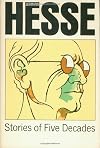
Stories of Five Decades
by Hermann Hesse
On This Page
Description
Twenty-three stories arranged in chronological order that are primarily concerned with the authors own secret.Tags
Recommendations

































Member Reviews
A collection of stories which revolve around the themes of spiritual enlightenment, self-discovery, and the search for meaning in life. In it, you will catch glimpses of the seeds which became his widely known titles such as, “Siddhartha,” “Steppenwolf,” and “The Glass Bead Game.” These shorts, as are all Hesse’s works, are deeply influenced by Eastern philosophy, particularly Buddhism and Hinduism, and resonate at a baser level with readers. They are marked by his exploration of profound philosophical and spiritual themes, making his works relevant today as they were in the early 1900’s. Whether you’re interested in the journey of self-discovery or the complexities of the human psyche, Hesse's writings are rich show more material for contemplation. show less
1241. Stories of Five Decades, by Hermann Hesse (11 Sep 1973) I read these stories with considerable though varying enjoyment. I read six books by Hesse in the summer of 1972 and decided to read more by him. His prose is--at least in translation--so crystalline it is a joy. Predictably I enjoyed his early stories more than those written later. "Walter Kompff" (1908) tells of a man who runs his father's shop and goes mad. "The Homecoming" (1909) tells of a man who returns to his home town, courts a widow, leaves, and returns for her: a happy ending. Many of the stories are sheerly beautiful.
Ratings
Members
- Recently Added By
Author Information

1,020+ Works 94,135 Members
Hermann Hesse (July 2, 1877 -- August 9, 1962) was a German poet, novelist, essayist and painter. His best-known works included Steppenwolf, Siddhartha, and The Glass Bead Game, each of which explores an individual's search for authenticity, self-knowledge and spirituality. In 1946, he received the Nobel Prize in Literature. Hess publicly show more announced his views on the savagery of World War I, and was considered a traitor. He moved to Switzerland where he eventually became a naturalized citizen. He warned of the advent of World War II, predicting that cultureless efficiency would destroy the modern world. His theme was usually the conflict between the elements of a person's dual nature and the problem of spiritual loneliness. His first novel, Peter Camenzind, was published in 1904. His masterpiece, Death and the Lover (1930), contrasts a scholarly abbot and his beloved pupil, who leaves the monastery for the adventurous world. Steppenwolf (1927), a European bestseller, was published when defeated Germany had begun to plan for another war. It is the story of Haller, who recognizes in himself the blend of the human and wolfish traits of the completely sterile scholarly project. During the 1960s Hesse became a favorite writer of the counter culture, especially in the United States, though his critical reputation has never equaled his popularity. Hermann Hesse died in 1962. (Bowker Author Biography) show less
Some Editions
Work Relationships
Common Knowledge
- First words
- A long-arching wave lifted the rounded bow of my skiff and set it down on the shingle. = = The Island Dream (1899) - Ralph Manheim translation
In my life as in the lives of most men there was a critical point ... (show all)of transformation from the universal to the particular, a place of terror and darkness, of confusion and loneliness, a day of unspeakable torpor and emptiness, whose evening brought forth new stars in the sky and new eyes within me. = = Incipit vita nova (1899) - Ralph Manheim translation
In the most secluded chamber in my castle, under the vaulting of the narrow window, you often sit, you, the friendliest among my dead. = = To Frau Gertrud (1899) - Ralph Manheim translation
A black, cloudy November night lay over Tübingen. = = November Night - A Recollection of Tübingen (1901) - Ralph Manheim translation
It was one of those summers when the fine weather is reckoned not in days but in weeks. = = The Marble Works (1904) - Ralph Manheim translation
In the middle of the tight-huddled old town there is an unbelievably big building with innumerable little windows and sadly worn piers and stairways, a place both venerable and absurd, and that is the impression it made on Karl Bauer, a school boy of sixteen, who passed through its portals every morning and afternoon with his schoolbag. = = The Latin Scholar (1906) - Ralph Manheim translation
Never had there been so cruelly cold and long a winter in the French mountains. = = The Wolf (1907) - Ralph Manheim translation
There is little to be said of old Hugo Kömpff except that he was a genuine product of Gerbersau, in the better sense. = = Walter Kömpff (1908) - Ralph Manheim translation
In the days when paganism was dying in Egypt and gradually giving way to the new religion, when Christian communities were springing up in every town and village, the devils retreated to the Theban desert. = = The Field Devil (1908) - Ralph Manheim translation
For quite some time the cream of chivalry had been camped in magnificent tents before the walls of Kanvoleis, the chief city of the land of Valois. = = Chagrin d'Amour (1908) - Ralph Manheim translation
There once was a young man by the name of Ziegler, who lived on Brauergasse. = = A Man by the Name of Ziegler (1908) - Ralph Manheim translation
The people of Gerbersau are not averse to travel, and it is traditional for the young men to see a bit of the world and foreign ways before establishing themselves, marrying, and submitting to the rule of local custom. = = The Homecoming (1909) - Ralph Manheim translation
"Now we're getting somewhere," cried the engineer when the second train carrying people, coal, tools, and food arrived over the stretch of track that had been laid only the day before. = = The City (1910) - Ralph Manheim translation
In the course of the eighteenth century a new type of Christianity and Christian endeavor grew up in England, expanding rather quickly from a negligible root into a large exotic tree. = = Robert Aghion (1913) - Ralph Manheim translation
In the mid-nineties I was doing volunteer work in a small factory in my home town, which I was to leave forever before the year was out. = = The Cyclone (1913) - Ralph Manheim translation
Cesco!" cried his mother's voice from upstairs. = = From the Childhood of Saint Francis of Assisi (1919) - Ralph Manheim translation
There was a man by the name of Friedrich; he was a thinker; and he knew a good deal. = = Inside and Outside (1920) - Ralph Manheim translation
When the editor-in-chief was told that Johannes the compositor had been waiting for an hour in the anteroom and would on no account be turned away or put off, he nodded with a smile of melancholy resignation and swung around in his office chair to meet his silently entering visitor. = = Tragic (1923) - Denver Lindley translation
He was a man who followed the not very highly regarded profession of popular writer but who belonged, nevertheless, to that smaller circle of authors who take their professions with the greatest seriousness and are honored by certain enthusiasts just as true poets used to be honored in earlier times when poets and poetry still existed. = = Dream Journeys (1927) - Denver Lindley translation
The enterprising owner of a small menagerie had succeeded in signing up Harry, the famous Steppenwolf, for a short engagement. = = Harry, the Steppenwolf (1928) - Ralph Manheim translation
Dr. Faust was sitting at his dining table with his friend Dr. Eisenbart (the great-grandfather, it might be said, of the physician who was later to become so famous). = = An Evening with Dr. Faust (1929) - Ralph Manheim translation
Edmund was a gifted young man of good family. = = Edmund (1934) - Ralph Manheim translation
It seems as though I were under the necessity in my late years not only of turning back to my childhood memories as all old people do, but also, by way of atonement as it were, of resuming the questionable art of storytelling under radically different conditions. = = The Interrupted Class (1948) - Ralph Manheim translation
0 - Last words
- (Click to show. Warning: May contain spoilers.)From a thousand comforting eyes it looked gloriously down upon my slow voyage home. == The Island Dream (1899) - Ralph Manheim translation
(Click to show. Warning: May contain spoilers.)I became a new man, still a miracle to myself, at once passive and active, the most precious of which is perhaps still unknown to me. == Incipit vita nova (1899) - Ralph Manheim translation
(Click to show. Warning: May contain spoilers.)Today that evening lies before me; once again our soft voices mingle with the distant music, and I do not know whether that evening or this one is real and illumined by the moon of this earth. == To Frau Gertrud (1899) - Ralph Manheim translation
(Click to show. Warning: May contain spoilers.)"Just imagine, Herr Lauscher, it's so awful! A student killed himself last night!" == November Night - A Recollection of Tübingen (1901) - - Ralph Manheim translation
(Click to show. Warning: May contain spoilers.)And shaken with dread, I entered the room for the last time. == The Marble Works (1904) - Ralph Manheim translation
(Click to show. Warning: May contain spoilers.)With all his heart he wished her well, and for himself he could wish for nothing better than that one day he would love and be loved as blessedly as this poor girl and her betrothed. == The Latin Scholar (1906) - Ralph Manheim translation
(Click to show. Warning: May contain spoilers.)None of them saw the beauty of the snow-covered forest, or the radiance of the high plateau, or the red moon which hovered over the Chasseral, and whose faint light shimmered on their rifle barrels, on the crystalline snow, and on the blurred eyes of the dead wolf. == The Wolf (1907) - Ralph Manheim translation
(Click to show. Warning: May contain spoilers.)And few realized how close we all of us are to the darkness in whose shadow Walter Kömpff had lost himself. ... Walter Kömpff (1908) - Ralph Manheim translation
(Click to show. Warning: May contain spoilers.)Praying loudly, they left the body lying and fled. = = The Field Devil (1908) - Ralph Manheim translation
(Click to show. Warning: May contain spoilers.)They are still sung. = = Chagrin d'Amour (1908) - Ralph Manheim translation
(Click to show. Warning: May contain spoilers.)But when he threw away his hat, took off his shoes and his tie, and shaken with sobs pressed against the bars of the elk's cage, a crowd collected, the guards seized him, and he was taken to an insane asylum. = = A Man by the Name of Ziegler (1908) - Ralph Manheim translation
(Click to show. Warning: May contain spoilers.)"Well, thank the Lord, that's that. But the house is being sold this fall, or do you absolutely insist on staying in this hole?" = = The Homecoming (1909)
(Click to show. Warning: May contain spoilers.)"Now we're getting somewhere!" cried a woodpecker who was hammering at the trunk, and looked with satisfaction at the spreading forest and magnificent green progress that was covering the earth. = = The City (1910) - Ralph Manheim translation
(Click to show. Warning: May contain spoilers.)" . . . When that happens, come and see me, we will still disagree about a good many things, but then we'll see eye to eye." = = Robert Aghion (1913) - Ralph Manheim translation
(Click to show. Warning: May contain spoilers.)The tenderness and folly of the years gone by fell away from me and soon afterward I left the town to become a man, to stand up against life, whose first shadows had grazed me in these days. = = The Cyclone (1913) - Ralph Manheim translation
(Click to show. Warning: May contain spoilers.)She made the sign of the cross over him in the darkness and in her heart called him by the name which he was later to give himself: Poverello. = = From the Childhood of Saint Francis of Assisi (1919) - Ralph Manheim translation
(Click to show. Warning: May contain spoilers.)That is magic. = = Inside and Outside (1920)
(Click to show. Warning: May contain spoilers.)Accordingly he struck out the headline and replaced it with the words "Regrettable Demise," suddenly found this, too, empty and inadequate, became annoyed, pulled himself together, and wrote over his notice the final headline "One of the Old Guard." = = Tragic (1923) - Denver Lindley translation
(Click to show. Warning: May contain spoilers.)Only at long last he abandoned these wishes and efforts and realized that he must content himself with being a true poet, a dreamer, a seer, only in his soul, and that his handiwork must remain that of a simple man of letters. = = Dream Journeys (1927) - Denver Lindley translation
(Click to show. Warning: May contain spoilers.)Is the Steppenwolf, in the last analysis, an animal or a man? = = Harry, the Steppenwolf (1928) - Ralph Manheim translation
(Click to show. Warning: May contain spoilers.)" . . . I should say that he handles it very nicely." = = An Evening with Dr. Faust (1929) - Ralph Manheim translation
(Click to show. Warning: May contain spoilers.)He mumbled the words of the magic formula---mar pegil trafu gnoki---and saw neither living no dead professors, but limitless expanse of the world and of life, which lay open before him. = = Edmund (1934) - Ralph Manheim translation
(Click to show. Warning: May contain spoilers.)Once on the street, when I saw his other in the distance, I made a long detour - no detour could have been too long - to avoid meeting her. = = The Interupted Class (1948) - Ralph Manheim translation - Original language
- German
Classifications
Statistics
- Members
- 342
- Popularity
- 92,982
- Reviews
- 2
- Rating
- (4.04)
- Languages
- English, German
- Media
- Paper, Ebook
- ISBNs
- 10
- UPCs
- 1
- ASINs
- 8