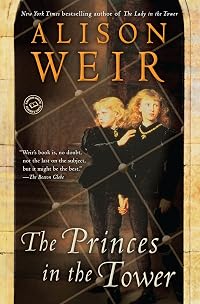
The Princes in the Tower
by Alison Weir
On This Page
Description
Despite five centuries of investigation by historians, the sinister deaths of the boy king Edward V and his younger brother Richard, Duke of York, remain one of the most fascinating murder mysteries in English history. Did Richard III really kill the young princes, as is commonly believed, or was the murderer someone else entirely? Carefully examining every shred of contemporary evidence as well as the dozens of modern accounts, Weir reconstructs the entire chain of events leading to the show more double murder to arrive at a conclusion Sherlock Holmes himself could not dispute. show lessTags
Recommendations
















Member Recommendations
Scotland Fields work is largely a discertation against Weir's book. I will leave it up to the readers on who interprets history more accurately.
20

Member Reviews
The Princes in the Tower is an analysis of what happened to the sons of Edward IV. After Edward IV’s death, in 1483, his brother, Richard, Duke of Gloucester (later Richard III) was named Lord Protector with responsibility for his nephew, young Edward, Prince of Wales (Edward V) in his minority. He was twelve years old at the time. Richard III has, for a very long time, been the prime suspect in ordering the murder of Edward V and his brother, Richard of Shrewsbury, Duke of York, age ten at the time. They were imprisoned in the Tower and not seen again after early September 1483.
Alison Weir examines the extant evidence, such as the writings of Thomas More, the Croyland Chronicles, and the records of Dominic Mancini. She draws on her show more deep knowledge of the period and assesses the evidence, indicating her logical conclusions. She assembles the most likely scenario of what happened to the princes. Her prime motivation is to debunk the recent spate of “conspiracy theories,” which, she contends, have little basis in fact.
I picked up this book because I am interested in English history. I am certainly no expert and have no preconceived notions on this topic. My initial reaction after finishing is that she has a few very good points. One of her most compelling arguments is that the princes were not seen in public even after a furor arose over Richard III’s alleged order of their murder – it would have been easy for him to disprove these allegations, but he did not. There is, of course, a motive and a great deal of circumstantial evidence, which is also discussed.
This book is a very good read for those interested in history’s mysteries. It is engaging and interesting. I flew through it. I do think it is helpful to be somewhat familiar with English history before embarking on this one. It’s not terribly complicated but there are many similar names, and multiple titles for the same person. A brief review of the houses of York, Lancaster, and Tudor of the 1400s to early 1500s would be helpful, as would a rudimentary knowledge of the Wars of the Roses. There is a basic family tree provided in the back of the book, which would be a good starting point (I wish I had seen it when I started).
4.5 show less
Alison Weir examines the extant evidence, such as the writings of Thomas More, the Croyland Chronicles, and the records of Dominic Mancini. She draws on her show more deep knowledge of the period and assesses the evidence, indicating her logical conclusions. She assembles the most likely scenario of what happened to the princes. Her prime motivation is to debunk the recent spate of “conspiracy theories,” which, she contends, have little basis in fact.
I picked up this book because I am interested in English history. I am certainly no expert and have no preconceived notions on this topic. My initial reaction after finishing is that she has a few very good points. One of her most compelling arguments is that the princes were not seen in public even after a furor arose over Richard III’s alleged order of their murder – it would have been easy for him to disprove these allegations, but he did not. There is, of course, a motive and a great deal of circumstantial evidence, which is also discussed.
This book is a very good read for those interested in history’s mysteries. It is engaging and interesting. I flew through it. I do think it is helpful to be somewhat familiar with English history before embarking on this one. It’s not terribly complicated but there are many similar names, and multiple titles for the same person. A brief review of the houses of York, Lancaster, and Tudor of the 1400s to early 1500s would be helpful, as would a rudimentary knowledge of the Wars of the Roses. There is a basic family tree provided in the back of the book, which would be a good starting point (I wish I had seen it when I started).
4.5 show less
So, I've finally finished this one. If I was hoping for something at least semi-objective, I was mistaken. From the outset Weir lets you know firmly which camp her tent is pitched in - and the book then follows this course.
What I find disconcerting is all her arguments against Richard III could equally be applied to Henry VII - however I personally don't believe that she achieved this. Weir sets out from the start with the aim of proving Richard's guilt without, I think, examining more the role of the other protagonists.
Her arguments are based mainly on the works of Thomas More, whose work she freely admits contains much detail, though is erroneous when it comes to
The chapter on the scientific / forensic evidence is a mere four pages - it rests solely on the evidence of bones (belonging to children) and a piece of velvet (claimed only worn by the highest nobility). Ergo juvenile bones and a scrap of rag equal incontrovertible proof.
I was not expecting much - as I mentioned Weir is not my favourite author - and this really maintains my belief. A more evenhanded approach would have been nice - but who am I kidding.
Oh, and for all those Edward II buffs - page 165 - para 2 - line 13 (she should really proof read her work - especially in relation to theories she has espoused in this area in the past!).
(7/10) "... only one man could have been responsible for their deaths: Richard III."
If you are expecting an unbiased account of the disappearance of Edward V and his brother then this is not the book for you. Weir makes her point abundantly clear throughout and presents a very wide range of evidence to back up her conclusions. At times I did feel we wandered off topic a little into a general recounting of major events of the period, not something I really want to criticise as I love history and found the diversions very educational.
As a history nerd I really enjoyed this book, it's about a new topic for me and I feel I should read some of the revisionist arguments before drawing my own conclusions as to whether Richard murdered his show more nephews or not. Regardless, I found this book really interesting, well researched and most importantly engaging, there really is nothing worse than a history book that sends you to sleep! show less
If you are expecting an unbiased account of the disappearance of Edward V and his brother then this is not the book for you. Weir makes her point abundantly clear throughout and presents a very wide range of evidence to back up her conclusions. At times I did feel we wandered off topic a little into a general recounting of major events of the period, not something I really want to criticise as I love history and found the diversions very educational.
As a history nerd I really enjoyed this book, it's about a new topic for me and I feel I should read some of the revisionist arguments before drawing my own conclusions as to whether Richard murdered his show more nephews or not. Regardless, I found this book really interesting, well researched and most importantly engaging, there really is nothing worse than a history book that sends you to sleep! show less
Rating: 4 out of 5
I started reading this book right on the heels of finishing The Wars of the Roses by Dan Jones. That is to say, I am relatively uninitiated to the controversy surrounding Richard III’s historical legacy. Accordingly, I can only review this book as a source of casual learning and entertainment, and cannot speak to the validity of its historical arguments and methodology with any veracity.
Weir is most certainly not a member of the Richard III Society. She consistently draws a negative moral portrait of Richard, and is relentless in her attacks on the ‘revisionists’ claims. To my uninformed eye, Weir’s data and argumentation appeared very solid, giving me little cause to doubt what she asserts.
There is one show more caveat to this, and that is Richard’s ‘deformity’. The Princes in the Tower was written before the discovery of Richard’s body in 2012. Weir is adamant that Richard wasn’t physically deformed. After Richard’s death, many of his portraits were altered to show that one of his shoulders was higher than the other. Some post-contemporary chroniclers talk about Richard’s ‘withered’ arm. Weir contends that this was probably moralizing on the part of people writing after Richard’s death. At the time it was commonplace to link physical issues to moral issues, and this motif was used by Tudor propogandists to further discredit the former King. Weir, after examining the sources, concludes that Richard’s deformity was propaganda and dismisses it. While (once again to my uninformed eye) this reasoning appears to be correct by the methodology of source examination, it is factually incorrect. When Richard’s body was exhumed in 2012, it was discovered that he had adolescent scoliosis, which, while not ‘withering’ any of his limbs, would have given him a shoulder that was higher than the other. I just found it fascinating that what should be nothing more than a propagandized legend was actually true.
Overall, The Princes in the Tower was a very good book to read. While not quite as thrilling as a suspense novel, I kept turning pages. Weir’s writing style is excellent, and manages to build credibility with the reader without becoming a dry slog. show less
I started reading this book right on the heels of finishing The Wars of the Roses by Dan Jones. That is to say, I am relatively uninitiated to the controversy surrounding Richard III’s historical legacy. Accordingly, I can only review this book as a source of casual learning and entertainment, and cannot speak to the validity of its historical arguments and methodology with any veracity.
Weir is most certainly not a member of the Richard III Society. She consistently draws a negative moral portrait of Richard, and is relentless in her attacks on the ‘revisionists’ claims. To my uninformed eye, Weir’s data and argumentation appeared very solid, giving me little cause to doubt what she asserts.
There is one show more caveat to this, and that is Richard’s ‘deformity’. The Princes in the Tower was written before the discovery of Richard’s body in 2012. Weir is adamant that Richard wasn’t physically deformed. After Richard’s death, many of his portraits were altered to show that one of his shoulders was higher than the other. Some post-contemporary chroniclers talk about Richard’s ‘withered’ arm. Weir contends that this was probably moralizing on the part of people writing after Richard’s death. At the time it was commonplace to link physical issues to moral issues, and this motif was used by Tudor propogandists to further discredit the former King. Weir, after examining the sources, concludes that Richard’s deformity was propaganda and dismisses it. While (once again to my uninformed eye) this reasoning appears to be correct by the methodology of source examination, it is factually incorrect. When Richard’s body was exhumed in 2012, it was discovered that he had adolescent scoliosis, which, while not ‘withering’ any of his limbs, would have given him a shoulder that was higher than the other. I just found it fascinating that what should be nothing more than a propagandized legend was actually true.
Overall, The Princes in the Tower was a very good book to read. While not quite as thrilling as a suspense novel, I kept turning pages. Weir’s writing style is excellent, and manages to build credibility with the reader without becoming a dry slog. show less
We now know that Richard did indeed suffer from scoliosis in his spine, and that his body remained at the Greyfriars in Leicester until rediscovered in 2012. But we still don't conclusively know whether he had his nephews murdered or not. Or if in general he was a Bad Thing, or indeed a Bad King (vide 1066 and All That).
However, rereading this book has convinced me that the overwhelming probability is that he did have them killed. Weir looks at contemporary accounts, noting that they often corroborate one another even when the sources are completely in ignorance of each other. And the common talk in 1483, well before the accession of Henry VII, was that the boys had been done away with. So why did Richard not produce and parade them to show more contradict rumours?
Richard also had a history of acquisitiveness and violence, even if much was not premeditated but opportunistic. There was also a tradition of "weak" monarchs being dethroned and then secretly done away with.
Weir is also pretty convinced that the bones discovered deep at the foot of a stair in the Tower in 1674 are indeed those of the poor kids.
So, sorry all you romantic Ricardian revisionists. He may not have been the scheming hunchback of later Tudor embellishments, but he was a ruthless opportunist and not a very nice guy. As she points out, the reason the argument rages still is that we don't want to believe, even after more than 500 years, that such a pitiful crime was committed. show less
However, rereading this book has convinced me that the overwhelming probability is that he did have them killed. Weir looks at contemporary accounts, noting that they often corroborate one another even when the sources are completely in ignorance of each other. And the common talk in 1483, well before the accession of Henry VII, was that the boys had been done away with. So why did Richard not produce and parade them to show more contradict rumours?
Richard also had a history of acquisitiveness and violence, even if much was not premeditated but opportunistic. There was also a tradition of "weak" monarchs being dethroned and then secretly done away with.
Weir is also pretty convinced that the bones discovered deep at the foot of a stair in the Tower in 1674 are indeed those of the poor kids.
So, sorry all you romantic Ricardian revisionists. He may not have been the scheming hunchback of later Tudor embellishments, but he was a ruthless opportunist and not a very nice guy. As she points out, the reason the argument rages still is that we don't want to believe, even after more than 500 years, that such a pitiful crime was committed. show less
Alison Weir writes an engaging account of the end of the War of the Roses and the last of the Yorkist kings, addressing the two big questions:
* What happened to young Edward V and his brother the Duke of York, and
* Were the bodies discovered during construction at the Tower in 1674 and reexamined in 1933 theirs?
Although Ms. Weir considers a surprising variety of alternatives, her answers are the historically accepted ones: (1) They were murdered on orders from their uncle, Richard III, and (2) Yes.
Perhaps the first three-quarters of the book are an analysis of the military and political situation. Although written with Weir’s usual facility, the really interesting part comes with the discussion of the young princes. I hadn’t show more realized there were so many theories: they died natural deaths; they were still in the Tower after Bosworth Field and were murdered by Henry VII; one or both escaped and appeared later as Lambert Simnel or Perkin Warbeck; and one or both escaped from the tower and lived incognito in Tudor England.
As Weir points out, since there was no CSI: Late Medieval London, Richard III could never be convicted of anything in a modern court. Nevertheless, he had opportunity, means, and motive. His modern supporters generally use contemporary accounts stating that Richard was a good king as evidence against his culpability; however, it’s perfectly possible to be a good king and a despicable human being, and that seems the case with Richard III. Ambassadors and other foreign residents in England, with nothing to lose or gain, generally believed that Richard III killed his nephews; everybody, even his fans, agrees that Richard III eliminated anyone who blocked path to the throne, including his former supporter Hastings (summarily executed in the middle of a council meeting); and there’s no report of the princes being seen alive after August 1483. (Based on the movements of the various parties, Weir thinks they were murdered on the night of September 3).
For the argument that Henry VII was the murderer - certainly Henry VII’s claim to the throne was based on the rickety foundation that his grandmother, Katherine of Valois, widow of Henry V, may or may not have married her wardrobe master Owen Tudor before having a child by him leading to Henry VII’s paternal line, and that his great-great grandfather, John of Gaunt, may or may not have married his mistress Katherine Swynford before she originated his maternal ancestors, the Beauforts. Henry would, therefore, have been discomfited to find the princes still alive in the Tower after Bosworth. Since there’s no physical evidence, Weir has to base her argument on logic, and it’s pretty sound. If the princes were still alive, Richard III had a great deal of incentive to produce them; his claim to the throne was not based on the argument that Edward V was dead but that he was illegitimate, and showing him would have diffused a lot of the hostility toward Richard (although it may have led to complications later, Richard presumably would have been able to deal with those).
The argument that the 1674 bodies were the princes is more tenuous but still plausible. Although there are likely to be a lot of bodies buried here and there around the Tower, these two skeletons were at the base of a stairway, right where legend said they should be; both the 1674 and 1933 examinations suggested they were about the right age; the workman who found them in 1674 said there were scraps of velvet on the bodies (a rare and princely material in 1483); and a 1964 disinterment of their cousin Anne Mowbray showed facial similarities to the skulls described in 1933. A reopening of the urn in Westminster Abbey and examination of the remains with modern technology might or might not settle things, but the Deans of the abbey have so far refused to apply to the Queen for the necessary permission.
As usual for Ms, Weir, fascinating history. show less
* What happened to young Edward V and his brother the Duke of York, and
* Were the bodies discovered during construction at the Tower in 1674 and reexamined in 1933 theirs?
Although Ms. Weir considers a surprising variety of alternatives, her answers are the historically accepted ones: (1) They were murdered on orders from their uncle, Richard III, and (2) Yes.
Perhaps the first three-quarters of the book are an analysis of the military and political situation. Although written with Weir’s usual facility, the really interesting part comes with the discussion of the young princes. I hadn’t show more realized there were so many theories: they died natural deaths; they were still in the Tower after Bosworth Field and were murdered by Henry VII; one or both escaped and appeared later as Lambert Simnel or Perkin Warbeck; and one or both escaped from the tower and lived incognito in Tudor England.
As Weir points out, since there was no CSI: Late Medieval London, Richard III could never be convicted of anything in a modern court. Nevertheless, he had opportunity, means, and motive. His modern supporters generally use contemporary accounts stating that Richard was a good king as evidence against his culpability; however, it’s perfectly possible to be a good king and a despicable human being, and that seems the case with Richard III. Ambassadors and other foreign residents in England, with nothing to lose or gain, generally believed that Richard III killed his nephews; everybody, even his fans, agrees that Richard III eliminated anyone who blocked path to the throne, including his former supporter Hastings (summarily executed in the middle of a council meeting); and there’s no report of the princes being seen alive after August 1483. (Based on the movements of the various parties, Weir thinks they were murdered on the night of September 3).
For the argument that Henry VII was the murderer - certainly Henry VII’s claim to the throne was based on the rickety foundation that his grandmother, Katherine of Valois, widow of Henry V, may or may not have married her wardrobe master Owen Tudor before having a child by him leading to Henry VII’s paternal line, and that his great-great grandfather, John of Gaunt, may or may not have married his mistress Katherine Swynford before she originated his maternal ancestors, the Beauforts. Henry would, therefore, have been discomfited to find the princes still alive in the Tower after Bosworth. Since there’s no physical evidence, Weir has to base her argument on logic, and it’s pretty sound. If the princes were still alive, Richard III had a great deal of incentive to produce them; his claim to the throne was not based on the argument that Edward V was dead but that he was illegitimate, and showing him would have diffused a lot of the hostility toward Richard (although it may have led to complications later, Richard presumably would have been able to deal with those).
The argument that the 1674 bodies were the princes is more tenuous but still plausible. Although there are likely to be a lot of bodies buried here and there around the Tower, these two skeletons were at the base of a stairway, right where legend said they should be; both the 1674 and 1933 examinations suggested they were about the right age; the workman who found them in 1674 said there were scraps of velvet on the bodies (a rare and princely material in 1483); and a 1964 disinterment of their cousin Anne Mowbray showed facial similarities to the skulls described in 1933. A reopening of the urn in Westminster Abbey and examination of the remains with modern technology might or might not settle things, but the Deans of the abbey have so far refused to apply to the Queen for the necessary permission.
As usual for Ms, Weir, fascinating history. show less
Contrary to its title, this book focuses almost completely on Richard III not the life and death of the two princes. Correctly, I think, as the two princes were just innocent pawns in a murderous game about the English crown. Weir shows how the power struggle among the English nobles, an extended family feud, often ended with the losing side decapitated. It was a violent age of might made right. Richard III's main fault was his death in battle. Had he been victorious, his crimes would have been accepted, explained away as they are in the case of Henry VIII. The contrast in the public perception of Henry VIII and Richard III is astounding.
As far as the murder of the two princes is concerned, I think we can never know with certainty how show more the crime happened. Weir's finger-pointing at James Tyrell looks fishy. Despite Henry VII's "looking forward, not backward" policy, a prosecution of Tyrell would have been in order if the case were as clear as presented by Weir. What is certain, however, is Richard III's control of the Tower and that he was the chief beneficiary of the princes' death ("cui bono"). The medieval acceptance of starving prisoners to death but horror from shedding blood is as strange as the current US practice of offering life-saving procedures to death row inmates in order to kill them properly. The poor princes were just some of the casualties of Richard III's murderous decent. He could only stay in power by eliminating more and more of his former allies - until not even a horse was left. The renaissance is full of those princes of darkness from Vlad Tepes to Charles the Bold and Henry VIII. In fairness to Richard III, one should not condemn him more than his peers. But do we have to be fair? No. show less
As far as the murder of the two princes is concerned, I think we can never know with certainty how show more the crime happened. Weir's finger-pointing at James Tyrell looks fishy. Despite Henry VII's "looking forward, not backward" policy, a prosecution of Tyrell would have been in order if the case were as clear as presented by Weir. What is certain, however, is Richard III's control of the Tower and that he was the chief beneficiary of the princes' death ("cui bono"). The medieval acceptance of starving prisoners to death but horror from shedding blood is as strange as the current US practice of offering life-saving procedures to death row inmates in order to kill them properly. The poor princes were just some of the casualties of Richard III's murderous decent. He could only stay in power by eliminating more and more of his former allies - until not even a horse was left. The renaissance is full of those princes of darkness from Vlad Tepes to Charles the Bold and Henry VIII. In fairness to Richard III, one should not condemn him more than his peers. But do we have to be fair? No. show less
Members
- Recently Added By
Lists

Non-Fiction Worth Reading
1,016 works; 255 members

The Wars of the Roses (Nonfiction)
7 works; 2 members

Books Read in 2017
4,249 works; 130 members

Books Set in London
49 works; 3 members
Author Information

75+ Works 37,471 Members
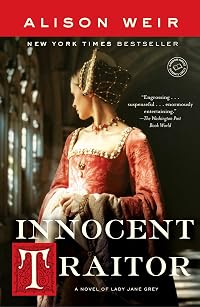
Alison Weir was born in London, England on July 8, 1951. She received training to be a teacher with a concentration in history from the North Western Polytechnic. Before becoming a full-time writer, she worked as a civil servant and ran her own school for children with learning difficulties from 1991 to 1997. Her first book, Britain's Royal show more Families, was published in 1989. Her other books include The Six Wives of Henry VIII; Children of England; Eleanor of Aquitaine; Henry VIII: King and Court; Mary, Queen of Scots; and Isabella. Her first novel, Innocent Traitor, was published in 2006. Her other novels include The Lady Elizabeth, The Lady in the Tower: The Fall of Anne Boleyn, The Captive Queen, A Dangerous Inheritance, and Katherine of Aragon, the True Queen. (Bowker Author Biography) show less
All Editions
Work Relationships
Has as a student's study guide
Common Knowledge
- Original publication date
- 1992-01-01
- People/Characters
- Edward V, King of England; Richard, Duke of York (child); Richard, Duke of York; Richard III, King of England; Edward IV, King of England; Elizabeth Woodville, Queen Consort of England (show all 9); Anne Neville, Queen Consort of England; Henry VII, King of England; Elizabeth of York
- Important places
- Tower of London, London, England, UK; London, England, UK
- Important events
- Wars of the Roses (1455 | 1485)
- Dedication
- This book is dedicated to my cousin, Christine Armour, and in loving memory of Joan Barbara Armour
- First words
- Modern writers on the subject of the Princes in the Tower have tended to fall into two categories: those who believe Richard III guilty of the murder of the Princes but are afraid to commit themselves to any confident conclus... (show all)ions, and those who would like to see Richard more or less canonised.
- Last words
- (Click to show. Warning: May contain spoilers.)And if that is the case, given all the other evidence already discussed in previous chapters, then only one man could have been responsible for their deaths: Richard III.
- Blurbers
- McCrumb, Sharyn; Marston, Edward; Hibbert, Christopher; Kellerman, Faye; Rendell, Ruth
- Original language
- English
Classifications
- Genres
- History, Nonfiction, General Nonfiction, Biography & Memoir
- DDC/MDS
- 942.044092 — History & geography History of Europe England and Wales England Lancaster and York 1400-85 Edward IV 1461-83
- LCC
- DA259 .W45 — History of Europe, Asia, Africa and Oceania Great Britain History of Great Britain England History By period Early and medieval to 1485 1154-1485. Angevins. Plantagenets.
- BISAC
Statistics
- Members
- 2,226
- Popularity
- 9,070
- Reviews
- 50
- Rating
- (3.58)
- Languages
- English
- Media
- Paper, Ebook
- ISBNs
- 12
- ASINs
- 17