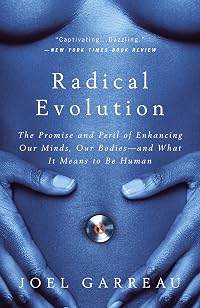
Radical Evolution: The Promise and Peril of Enhancing Our Minds, Our Bodies -- and What It Means to Be Human
by Joel Garreau
On This Page
Description
Journalist Garreau shows us that we are at an inflection point in history: we are engineering the next stage of human evolution. Through advances in genetics, robotics, information and nanotechnologies, we are altering our minds, our memories, our metabolisms, our personalities, our progeny--and perhaps our very souls. Taking us behind the scenes, Garreau reveals that superpowers--from revved-up reflexes and speed, to enhanced mental acuity and memory capabilities--already exist, or are in show more development in labs and research facilities. These enhancements will soon become part of our everyday lives. Will technology's promise to make us smarter, vanquish illness and extend our lives be the answer to our prayers? Or will unrestrained technology bring about the ultimate destruction of our species? With the insights of gifted thinkers and scientists who are making science fiction a reality, Garreau explores how these developments, in our lifetime, will affect everything from the way we date to the way we work, from how we think and act to how we fall in love.--From publisher description show lessTags
Recommendations













Member Reviews
Well-researched, and beautifully written, Joe Garreau brings his well-honed journalism skills to bear on the most vexing question humankind has ever faced: what to do now that our genetic, robotics, information and nano technologies have begun to give us the ability to enhance our own evolution?
Garreau offers a glimpse at the mind-boggling technologies DARPA is already developing in support of our national defense, then convincingly extrapolates how the ever-quicking pace of technological innovation will likely lead to a Singularity event when humans invent something more intelligent than themselves. The remainder of the book considers whether the Singularity will lead to a Heaven state (technological nirvana), a Hell state show more (destruction or degradation of humankind) or a Prevail state, in which humans develop control mechanisms to avoid becoming slaves to technology.
The Heaven and Hell scenarios are set up as obvious strawmen for Garreau to knock down en route to the more likely middle outcome. Yet his analysis of the Prevail scenario loses focus, as the discussion veers off on a number of philosophical tangents and seems to conclude that adopting an iHippy group-love mentality will prove the key to our survival.
While I found this to be a stimulating read and especially liked how Garreau organized his material around key thinkers in the relevant technical fields, I wish he had more fully explored some practical ways of containing threatening technology, such as the adoption of more powerful international governing bodies with the regulatory teeth to outlaw certain technologies and the use of new media tools to blacklist undesirable practices. (The current push to be green, in reaction to the Global Warming crisis, shows the possibility of forming international positions on key issues.) I don't mean to suggest that it's possible to define the Prevail endstate with any real specifics, but I came away with the impression that Garreau turned away from his considerable analytical ability in the later parts of the book. show less
Garreau offers a glimpse at the mind-boggling technologies DARPA is already developing in support of our national defense, then convincingly extrapolates how the ever-quicking pace of technological innovation will likely lead to a Singularity event when humans invent something more intelligent than themselves. The remainder of the book considers whether the Singularity will lead to a Heaven state (technological nirvana), a Hell state show more (destruction or degradation of humankind) or a Prevail state, in which humans develop control mechanisms to avoid becoming slaves to technology.
The Heaven and Hell scenarios are set up as obvious strawmen for Garreau to knock down en route to the more likely middle outcome. Yet his analysis of the Prevail scenario loses focus, as the discussion veers off on a number of philosophical tangents and seems to conclude that adopting an iHippy group-love mentality will prove the key to our survival.
While I found this to be a stimulating read and especially liked how Garreau organized his material around key thinkers in the relevant technical fields, I wish he had more fully explored some practical ways of containing threatening technology, such as the adoption of more powerful international governing bodies with the regulatory teeth to outlaw certain technologies and the use of new media tools to blacklist undesirable practices. (The current push to be green, in reaction to the Global Warming crisis, shows the possibility of forming international positions on key issues.) I don't mean to suggest that it's possible to define the Prevail endstate with any real specifics, but I came away with the impression that Garreau turned away from his considerable analytical ability in the later parts of the book. show less
Basically, Joel Garreau has turned complex scientific developments into a human interest story. Throughout, the author examines GRIN technologies: genetic, robotic, information, and nano. He interviews several prominent people in the various fields, asking--What happens when we not only use these technologies to affect the world around us, but turn them on ourselves?
He outlines three main scenarios--Heaven, Hell, and Prevail, focusing on the work of Ray Kurzweil, Bill Joy, and Jaron Lanier, respectively. Before this, Garreau visits DARPA (Defense Advanced Research Projects Agency) to convince us that he's not talking about science fiction here. To prove his point, he present, past, and future projects being investigated by DARPA; some show more of them quite incredible. All of these scenarios are potentially plausible and all of these scenarios have their own followings (and opposition) within and without the scientific community. And, according to Garreau and those he interviews, one of these scenarios will dominate within the next few decades.
In Heaven, the human race uses these powerful technologies to completely redefine and actively reshape the human race, to the point that people today might not even consider their future selves human. In Hell, we have lost control of these technologies, effectively destroying the human race if not all life on the planet. In Prevail, humans will pick and choose among developing technologies, successfully moderating their use and halting more dangerous projects. (I may be rather pessimistic and show very little faith in humans as a whole, but I think I lean toward the Hell scenario as being the most likely. Granted, I should probably read more into the subject before giving up all hope.)
Joel Garreau, in addition to being an author, is a journalist from the Washington Post. So, while the book is very readable, it is perhaps a bit meandering and unfocused at times. Like most non-academic non-fiction books I've read, I absolutely despise how references and end-notes were dealt with. ("Lets not actually indicate our citations in the main text, because it makes it so unreadable." Sigh.) However, in this case, he certainly makes up for quite a bit with the fantastic Suggested Readings section he has included at the end. Garreau also maintains a list of related news items and articles on his website.
Experiments in Reading show less
He outlines three main scenarios--Heaven, Hell, and Prevail, focusing on the work of Ray Kurzweil, Bill Joy, and Jaron Lanier, respectively. Before this, Garreau visits DARPA (Defense Advanced Research Projects Agency) to convince us that he's not talking about science fiction here. To prove his point, he present, past, and future projects being investigated by DARPA; some show more of them quite incredible. All of these scenarios are potentially plausible and all of these scenarios have their own followings (and opposition) within and without the scientific community. And, according to Garreau and those he interviews, one of these scenarios will dominate within the next few decades.
In Heaven, the human race uses these powerful technologies to completely redefine and actively reshape the human race, to the point that people today might not even consider their future selves human. In Hell, we have lost control of these technologies, effectively destroying the human race if not all life on the planet. In Prevail, humans will pick and choose among developing technologies, successfully moderating their use and halting more dangerous projects. (I may be rather pessimistic and show very little faith in humans as a whole, but I think I lean toward the Hell scenario as being the most likely. Granted, I should probably read more into the subject before giving up all hope.)
Joel Garreau, in addition to being an author, is a journalist from the Washington Post. So, while the book is very readable, it is perhaps a bit meandering and unfocused at times. Like most non-academic non-fiction books I've read, I absolutely despise how references and end-notes were dealt with. ("Lets not actually indicate our citations in the main text, because it makes it so unreadable." Sigh.) However, in this case, he certainly makes up for quite a bit with the fantastic Suggested Readings section he has included at the end. Garreau also maintains a list of related news items and articles on his website.
Experiments in Reading show less
This book was recommended to me by my mentor at Seton Hill University, and the recommendation was sealed when he said, "Everyone who writes science fiction should read this book."
So I literally went DIRECTLY to Barnes & Noble and bought this. And started reading. And while I don't agree with all the ideas and scenarios presented in this book, it's certainly fodder for an SF-inclined mind, and certainly interesting to everyone else. So yes, I agree with my mentor: all SF writers should read this. Just cause it makes you think about the future of the human race.
The book focuses on the evolution and transcendence of the human race through what Garreau terms as GRIN technologies: genetic, robotic, information, and nano technologies. He show more talks about various things the human race might achieve through such technologies, including things that are deemed magical and/or impossible based on today's standards and understanding of science (telepathy, anyone?). Scarily enough, it makes sense from a certain point of view, but unlike some of the people interviewed in the book, I'm more inclined to believe some of these scenarios (Garreau divides them into three categories: Heaven, Hell, and Prevail) are simply going to take TIME. And yes, I can easily identify my thoughts and fears with some of the categories of people named in this book (if you read it, know that I consider the "Heaven Scenario" absolute hell), but if there's one thing I know for certain, it's that the human race is a strange complex thing that easily defies labels and categories and neat theories. So by this book's standards, I don't believe in heaven, and hell sure is familiar, since that's all Hollywood gives us, but prevail makes the most sense, because it accounts for the biggest variable of them all: the human race itself.
It's a good book. Smooth read, easy to get into because the scenarios sound so fictional, despite the talk that backs them up. The greatest thing about this book is the sheer size of the list of resources and notes, which provides anyone wanting to more research into any of the subjects mentioned in this book a great diving board for research.
So if you write SF, read this book. Like me, you may not agree or even adhere to the visions and ideas presented, but it makes damn good fodder for fiction. Exploit it while you can, folks. :) And everyone else, this is worth the read: I should note how this book discusses the betterment of the human race by helping people with disease live better and fuller lives through technology, and that's not even the half of it. Interesting stuff, trust me. :) show less
So I literally went DIRECTLY to Barnes & Noble and bought this. And started reading. And while I don't agree with all the ideas and scenarios presented in this book, it's certainly fodder for an SF-inclined mind, and certainly interesting to everyone else. So yes, I agree with my mentor: all SF writers should read this. Just cause it makes you think about the future of the human race.
The book focuses on the evolution and transcendence of the human race through what Garreau terms as GRIN technologies: genetic, robotic, information, and nano technologies. He show more talks about various things the human race might achieve through such technologies, including things that are deemed magical and/or impossible based on today's standards and understanding of science (telepathy, anyone?). Scarily enough, it makes sense from a certain point of view, but unlike some of the people interviewed in the book, I'm more inclined to believe some of these scenarios (Garreau divides them into three categories: Heaven, Hell, and Prevail) are simply going to take TIME. And yes, I can easily identify my thoughts and fears with some of the categories of people named in this book (if you read it, know that I consider the "Heaven Scenario" absolute hell), but if there's one thing I know for certain, it's that the human race is a strange complex thing that easily defies labels and categories and neat theories. So by this book's standards, I don't believe in heaven, and hell sure is familiar, since that's all Hollywood gives us, but prevail makes the most sense, because it accounts for the biggest variable of them all: the human race itself.
It's a good book. Smooth read, easy to get into because the scenarios sound so fictional, despite the talk that backs them up. The greatest thing about this book is the sheer size of the list of resources and notes, which provides anyone wanting to more research into any of the subjects mentioned in this book a great diving board for research.
So if you write SF, read this book. Like me, you may not agree or even adhere to the visions and ideas presented, but it makes damn good fodder for fiction. Exploit it while you can, folks. :) And everyone else, this is worth the read: I should note how this book discusses the betterment of the human race by helping people with disease live better and fuller lives through technology, and that's not even the half of it. Interesting stuff, trust me. :) show less
(Alistair) Well, this will be something of a split review, I think. You see -
OK, first let me sum up the actual book. Radical Evolution, subtitled "The Promise and Peril of Enhancing Our Minds, Our Bodies, and What It Means To Be Human", written by the "cultural revolution correspondent" (really?) at the Washington Post, is essentially a gentle introduction to emerging transhumanism-enabling technologies and the possible futures resulting from them - broken into the best - "Heaven", the worst - "Hell", just muddling through - "Prevail", and the pure-Singularitarian scenario - "Transcend".
I must confess, it didn't blow me away, but then, I'm exactly the wrong audience for this book, inasmuch as my brain's been comfortable with being show more stuffed full of Future Shock Level Three ideas for a long time, and really, FSL 4 doesn't shock me any more either. But, really, "not highly recommended for long-term transhumanists" is not exactly a bad review, since what it is, and what I read it for, is a well-written look at a broad selection of opinions about these emerging transhumanism-enabling technologies, entertaining and informative. And considered from that perspective, it was indeed a good book.
So while I would go so far as to say "not highly recommended for long-term transhumanists", I would also go so far as to recommend it to open-minded, thoughtful readers outside that particular narrow demographic.
( http://weblog.siliconcerebrate.com/cerebrate/2009/01/radical_evolution_joel_garr... ) show less
OK, first let me sum up the actual book. Radical Evolution, subtitled "The Promise and Peril of Enhancing Our Minds, Our Bodies, and What It Means To Be Human", written by the "cultural revolution correspondent" (really?) at the Washington Post, is essentially a gentle introduction to emerging transhumanism-enabling technologies and the possible futures resulting from them - broken into the best - "Heaven", the worst - "Hell", just muddling through - "Prevail", and the pure-Singularitarian scenario - "Transcend".
I must confess, it didn't blow me away, but then, I'm exactly the wrong audience for this book, inasmuch as my brain's been comfortable with being show more stuffed full of Future Shock Level Three ideas for a long time, and really, FSL 4 doesn't shock me any more either. But, really, "not highly recommended for long-term transhumanists" is not exactly a bad review, since what it is, and what I read it for, is a well-written look at a broad selection of opinions about these emerging transhumanism-enabling technologies, entertaining and informative. And considered from that perspective, it was indeed a good book.
So while I would go so far as to say "not highly recommended for long-term transhumanists", I would also go so far as to recommend it to open-minded, thoughtful readers outside that particular narrow demographic.
( http://weblog.siliconcerebrate.com/cerebrate/2009/01/radical_evolution_joel_garr... ) show less
Garreau explores the potentials for radical human enhancement via what he calls the GRIN technologies -- genetics, robotics, information, and nanotechnology. I found the book entertaining for its profiles of the main players, but was disappointed at the lack of depth.
Are we headed for a fantastic new stage in human evolution? Posthumanists and singularity enthusiasts say yes. Garreau presents their views as the "Heaven" scenario, a representative character being Raymond Kurzweil. Others, such as Bill Joy and Francis Fukuyama, have been more critical (the "Hell" scenario) -- they say the risks of out-of-control bio- or nano-technologies are too great. Garreau himself claims to take a more middle-of-the-road view (the "Prevail" show more scenario).
The strongest parts of the book come when Garreau is profiling people -- particularly Raymond Kurzweil, Bill Joy, and Jaron Lanier -- their personal histories and how they came to hold the views they hold. But when it comes to weighing their arguments, Garreau sides mostly with the post-humanists without much critical analysis. At times, such as in an early chapter about DARPA, he seems wholly under the spell of the scientists and the writing devolves into breathless techno-porn.
The book is valuable for its profiles of these important thinkers and as a launching pad for further reading. For the real goods you'll want to check out the original sources and more in-depth analyses, such as (for the "Hell" side): Bill Joy's Wired essay and Bill McKibben's Enough.
(Reviewed at Question Technology: http://www.questiontechnology.org/blog/2005/08/radical_evoluti.html) show less
Are we headed for a fantastic new stage in human evolution? Posthumanists and singularity enthusiasts say yes. Garreau presents their views as the "Heaven" scenario, a representative character being Raymond Kurzweil. Others, such as Bill Joy and Francis Fukuyama, have been more critical (the "Hell" scenario) -- they say the risks of out-of-control bio- or nano-technologies are too great. Garreau himself claims to take a more middle-of-the-road view (the "Prevail" show more scenario).
The strongest parts of the book come when Garreau is profiling people -- particularly Raymond Kurzweil, Bill Joy, and Jaron Lanier -- their personal histories and how they came to hold the views they hold. But when it comes to weighing their arguments, Garreau sides mostly with the post-humanists without much critical analysis. At times, such as in an early chapter about DARPA, he seems wholly under the spell of the scientists and the writing devolves into breathless techno-porn.
The book is valuable for its profiles of these important thinkers and as a launching pad for further reading. For the real goods you'll want to check out the original sources and more in-depth analyses, such as (for the "Hell" side): Bill Joy's Wired essay and Bill McKibben's Enough.
(Reviewed at Question Technology: http://www.questiontechnology.org/blog/2005/08/radical_evoluti.html) show less
Boring unenlightened shallow speculative pop dribble that will appeal to scientifically illiterate technophiles and technophobes who take their science fiction a bit too seriously. There's some under-boobs on the cover to get you to buy it, so that's worth a star.
Brilliant exploration of the GRIN technologies. A must read for all transhumanists, whatever your flavour of end-point.
Members
- Recently Added By
Lists

Futurism Works
25 works; 6 members
Author Information

5+ Works 1,332 Members
Common Knowledge
- People/Characters
- Ray Kurzweil; Bill Joy; Jaron Lanier
Classifications
Statistics
- Members
- 422
- Popularity
- 73,290
- Reviews
- 11
- Rating
- (3.62)
- Languages
- English, Italian
- Media
- Paper, Ebook
- ISBNs
- 4
- ASINs
- 4