On This Page
Description
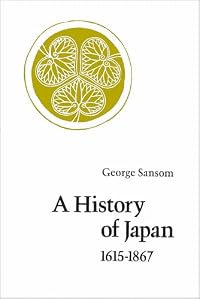
This is the concluding volume of a three-volume work that culminates the life study of the West's most distinguished scholar of Japanese history. A straightforward narrative of the development of Japanese civilization to 1867, the three volumes constitute the first large-scale comprehensive history of Japan. Unlike the renowned Short Cultural History, it is concerned mainly with political and social phenomena and only incidentally touches on religion, literature, and the arts. The treatment show more is primarily descriptive and factual, but the author offers some pragmatic interpretations and suggests comparisons with the history of other peoples. A History of Japan: 1615-1867 describes the political and social development of Japan during the two and half centuries of rule by the Tokugawa Shoguns, a period of remarkable development in almost ever aspects of the national life. Under Ieyasu, the first Tokugawa Shogun, a system of checks and balances to keep the great feudatories in order began to be devised. His successors continued this policy, and indeed the essential features of government by the Tokugawa Shoguns was a determination to keep the peace. Freed from civil war, the energies of the nation were devoted to increasing production of goods in agriculture, manufacturers, and mining. Breaches in the traditional policy of isolation began to occur with the arrival of foreign ships in Japanese waters, the first intruders being the Russian in the 1790s. Thereafter, the government struggled to keep foreign ships away from Japanese ports, but before long the pressure of the Western powers, strengthened by the arrival of warships under the command of Commodore Perry in 1853, forced Japan to take part in international affairs. show lessTags
Recommendations

















Member Reviews
Sansom's third book in his History of Japan series covers the time from Ieyasu's Shogunate to the Meiji revolution, in which the Tokugawa bakufu was overthrown and the emperor restored to power. The timeframe under discussion involves the slow change from a feudal, militarized society to one which was much more mercantile and agrarian in nature. The role of the warrior diminished and that of the merchant and farmer, and thus of the common man, increases.
Perhaps this is why this book loses some of the vigour of its predecessors. Sansom concentrates much more on the changes in the structure of society than on events and personalities. The price of rice, while admittedly a very important factor in political events in Tokugawa Japan, show more receives so much attention that we are almost lost in the details of production and pricing. Sansom recovers some of his spirit as the tale draws to a close with the opening of Japan by Perry and the increasing encroachment of the West. Sansom's view of how the opening of Japan led to the restoration of the Emperor is quite revealing.
All told, this book, much shorter than the previous two, is definitely also the weakest. It contains, as do the others excellent maps, charts and pictures as well as tables of rice production and the occasional family tree. There is only one appendix, on rural family structure and the bibliography, while annotated, is very brief. I would still recommend buying the whole set but the first two books are much superior to this as reading material. This excellent series ends with a bit of a whimper. show less
Perhaps this is why this book loses some of the vigour of its predecessors. Sansom concentrates much more on the changes in the structure of society than on events and personalities. The price of rice, while admittedly a very important factor in political events in Tokugawa Japan, show more receives so much attention that we are almost lost in the details of production and pricing. Sansom recovers some of his spirit as the tale draws to a close with the opening of Japan by Perry and the increasing encroachment of the West. Sansom's view of how the opening of Japan led to the restoration of the Emperor is quite revealing.
All told, this book, much shorter than the previous two, is definitely also the weakest. It contains, as do the others excellent maps, charts and pictures as well as tables of rice production and the occasional family tree. There is only one appendix, on rural family structure and the bibliography, while annotated, is very brief. I would still recommend buying the whole set but the first two books are much superior to this as reading material. This excellent series ends with a bit of a whimper. show less
Department of History, University of Hong Kong
Ratings
Members
- Recently Added By
Author Information
11+ Works 1,089 Members
Born in London in 1883, George B. Sansom went on to serve in the great British diplomatist scholar tradition. As a youngster, he was educated at a lycee in France. Later he attended Giessen and Marburg universities. In the years following 1903, he held various posts in the consular and diplomatic service of Great Britain, from the early 1920s to show more 1940 serving as a key adviser in the British embassy in Tokyo.During this time, he amassed a great amount of knowledge about Japanese history and culture, and during and after World War II he acted in numerous advisory positions on Pacific affairs. Following the war he became Professor of Japanese studies at Columbia University and from 1949 to 1955 was director of the East Asian Institute. Sansom's dense but attractively written work on the great sweep of Japanese history influenced two generations of readers and students. In particular, his Japan: A Short Cultural History (1931) was the first text of choice for both the generation before and the generation after the war. His grand histories were the first in Western languages to draw heavily on the extensive historical literature in Japanese, and many of the questions he first raised more than a half century ago remain of critical interest today. Sansom's work continues to be of interest for the richness of writing and the quality of insight. (Bowker Author Biography) show less
Series

Work Relationships
Is contained in
Common Knowledge
- Original publication date
- 1963, Stanford University Press
- Important places
- Japan
- Original language
- Inglese
Classifications
Statistics
- Members
- 211
- Popularity
- 154,253
- Reviews
- 2
- Rating
- (4.11)
- Languages
- English
- Media
- Paper, Ebook
- ISBNs
- 4
- ASINs
- 1