
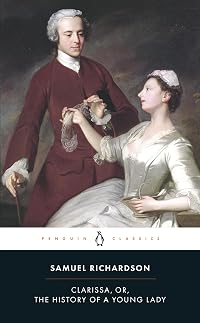
Clarissa; or, The History of a Young Lady
by Samuel Richardson
On This Page
Description
Immerse yourself in the epic sweep of what some critics regard as one of the most culturally significant novels ever written. Clarissa Harlowe is a virtuous young woman whose nouveau riche family wants desperately to be able to lay claim to the aristocracy. They plan to do this by marrying off Clarissa to a wealthy heir, but there's just one catch: Clarissa despises the fellow they've set their sights on and will do anything to escape this fate. When another beau comes into the picture, show more Clarissa thinks she's been saved—but does this new suitor have her best interest at heart?. show less
Tags
Recommendations











Member Recommendations
Member Reviews
Yes, it's the longest novel ever written (in the English language). Read it with a small group back in grad school for a class on Libertine literature, but as far as I know, Brian Bates and myself were the only ones to stick to it and finish it, and the others were not even apologetic about it. I could say a lot about this novel, but nothing that others have not already noted. I liked the book, and felt a kind of catharsis at having made it to the end (and not in way as a reaction to the narrative). Alongside it, I read Terry Eagleton's The Rape of Clarissa, and remember my professor saying once that people in her field were offended that Eagleton had "dive bombed" in their territory. I'm still awestruck by the how Richardson show more represented Clarissa's trauma through fragmented sentences scattered on the page. But overall, the book is disturbing for how Richardson attempts some ambiguity concerning the role Clarissa plays in her own rape, and there is much haunting subtext concerning the material and monetary cost of Lovelaces' attempts to seduce Clarissa-- where the rape becomes "cutting losses." I'll never read it again, of course. show less
My worst intellectual flaw is my poor memory. I have been reading all my life and can still tell you what I've read and haven't, but few details from any of it remain permanently lodged (thus the personal value of writing reviews). The plot of this 1,500 page novel is simple enough I'll retain that much, but the ocean of emotions, the flood of quotable bits, those are going to escape me. What I'll be able to hang onto is how it has made me feel: very, very full. Resuming my reading each time was, emotionally speaking, like plugging back into an electrical socket.
Most impressive is that it was a memorable and fascinating experience even though not much actually happens for all the size of this behemoth. The ratio in length between the show more hugeness of this novel and a summary of its action is frankly ridiculous: the back cover of my edition managed it shamelessly in one short sentence. You'll benefit from knowing the overarching story in advance, but to avoid spoilers and only speak metaphorically: it is about the tempting of an angel by a devil, where the angel is reluctant to believe anyone is truly evil and the devil is convinced he can prove or make every angel a fallen creature.
Although it could have been condensed to a fifth of its length or less, here is a case where sheer size lends a work its greatness. Small events are made momentous through being viewed and considered from every conceivable angle. These characters have an opinion to share on everything, and every position is brilliantly argued. Back-and-forth correspondence and the artfulness of rhetoric and self-deceptions won me over early on, convincing me to persevere and soon to enjoy. Suspense is often built on the back of nothing greater than wondering how someone will reply to some modest proposal or other, and yet I felt that suspense. Much of the driving thrust of most novels, 'what action happens next?', is replaced here with 'how will X possibly respond to Y?' or 'When will Y realize the deception of X?' Characters are written into corners and write their way back out brilliantly, over the course of 537 letters all told. There's nothing cold about this exercise; almost every letter tweaks the heart, be it to feel empathy and compassion, chuckle at a spot of humour, or experience outrage and demand justice.
There is one problem towards the end:the exhortation by virtually everyone for Clarissa to get over herself and marry her rapist, as if that would be a happy ending . At least Clarissa herself wears something closer to our 21st century views, even if she can't frame it that way.
Samuel Johnson, a contemporary of Samuel Richardson, said of this work "If you were to read Richardson for the story, your impatience would be so much fretted that you would hang yourself. But you must read him for the sentiment, and consider the story as only giving occasion to the sentiment." The good doctor has summarized my own sentiment perfectly. show less
Most impressive is that it was a memorable and fascinating experience even though not much actually happens for all the size of this behemoth. The ratio in length between the show more hugeness of this novel and a summary of its action is frankly ridiculous: the back cover of my edition managed it shamelessly in one short sentence. You'll benefit from knowing the overarching story in advance, but to avoid spoilers and only speak metaphorically: it is about the tempting of an angel by a devil, where the angel is reluctant to believe anyone is truly evil and the devil is convinced he can prove or make every angel a fallen creature.
Although it could have been condensed to a fifth of its length or less, here is a case where sheer size lends a work its greatness. Small events are made momentous through being viewed and considered from every conceivable angle. These characters have an opinion to share on everything, and every position is brilliantly argued. Back-and-forth correspondence and the artfulness of rhetoric and self-deceptions won me over early on, convincing me to persevere and soon to enjoy. Suspense is often built on the back of nothing greater than wondering how someone will reply to some modest proposal or other, and yet I felt that suspense. Much of the driving thrust of most novels, 'what action happens next?', is replaced here with 'how will X possibly respond to Y?' or 'When will Y realize the deception of X?' Characters are written into corners and write their way back out brilliantly, over the course of 537 letters all told. There's nothing cold about this exercise; almost every letter tweaks the heart, be it to feel empathy and compassion, chuckle at a spot of humour, or experience outrage and demand justice.
There is one problem towards the end:
Samuel Johnson, a contemporary of Samuel Richardson, said of this work "If you were to read Richardson for the story, your impatience would be so much fretted that you would hang yourself. But you must read him for the sentiment, and consider the story as only giving occasion to the sentiment." The good doctor has summarized my own sentiment perfectly. show less
Reading Clarissa is essentially a part-time project; it took me four months and many hours, but it is an excellent novel despite Richardson conveying way too much tangential information - especially the last 30 or 40 letters which are almost blatantly unneccesary in my opinion. The absoulte gutpunch that are Letters 457-93 provided a much more effective conclusion than the actual conclusion did. Such emotional vivacity! Richardson was an expert at hyperbolic description, and Belford, Norton & to an extent Lovelace's reactions to the climax of the story are beautifully written even if Lovelace is one of the most despicable characters in the canon.
The novel itself is well composed, brilliantly plotted and though the execution can be a show more little messy, the gargtuan complexity that it builds to is very impressive. The politics of it are constantly debated but for an upper-class male writer in the 18th century, having Clarissa not only being sympathised with by the narrative framing, but displayed as a victim of wider systematic misogyny is pretty surprising. Like in Pamela, Clarissa does end up forgiving her abuser, but from a position of personal philosophy rather than of being in love with him. She spends the entire story defying patriarchal expectations, refusing to adhere to societal standards, and then eulogised as a martyr. I have seen arguments that Richardson frames this as a punishment for her anti-passivity but I cannot see any compelling evidence except for the contrary - her final rebellion is a punishment for Lovelace and for her family, who only relent to her side because of the pleadings and anger of a man (Morden). Richardson is definitely pushing against sexist attitudes towards women to at least some extent here. You could definitely argue that portraying societal change as only necessary when men shun a woman out of her familial house and into martyrdom is in itself a misogynistic ideal, but once again for a novel published in 1748 it definitely makes good strides. Hopefully A Vindication of the Rights of Woman consolidated Richardson's faults for the 18th-century readership.
An incredibly fascinating novel to read and dicuss - and itself an incredible novel, even if it took a pretty large portion of the last year of my life to read. show less
The novel itself is well composed, brilliantly plotted and though the execution can be a show more little messy, the gargtuan complexity that it builds to is very impressive. The politics of it are constantly debated but for an upper-class male writer in the 18th century, having Clarissa not only being sympathised with by the narrative framing, but displayed as a victim of wider systematic misogyny is pretty surprising. Like in Pamela, Clarissa does end up forgiving her abuser, but from a position of personal philosophy rather than of being in love with him. She spends the entire story defying patriarchal expectations, refusing to adhere to societal standards, and then eulogised as a martyr. I have seen arguments that Richardson frames this as a punishment for her anti-passivity but I cannot see any compelling evidence except for the contrary - her final rebellion is a punishment for Lovelace and for her family, who only relent to her side because of the pleadings and anger of a man (Morden). Richardson is definitely pushing against sexist attitudes towards women to at least some extent here. You could definitely argue that portraying societal change as only necessary when men shun a woman out of her familial house and into martyrdom is in itself a misogynistic ideal, but once again for a novel published in 1748 it definitely makes good strides. Hopefully A Vindication of the Rights of Woman consolidated Richardson's faults for the 18th-century readership.
An incredibly fascinating novel to read and dicuss - and itself an incredible novel, even if it took a pretty large portion of the last year of my life to read. show less
Well, after finishing U.S.A. at 1,300 pages or so, what better way to follow it up than to write a review of a novel that's even bigger?
What surprised me most about this novel is how readable it is. For its size and the era in which it was written, this is one of the most readable novels I've tackled. That is very definitely something to be thankful for.
The story basically revolves around the eponymous heroine Clarissa who, being the sole inheritor of her grandfather's estate, finds herself the victim of family plotting when they attempt to force her to marry a man she has absolutely no feelings for.
Resolutely standing her ground only results in Clarissa being completely isolated by her so-called family who virtually imprison her in show more solitary confinement within the family home.
Fearing that she will be dragged to the alter and committed against her will, she seeks escape and the supposed safe house offered by Lovelace, a man who comes across as a valiant aide in time of trouble. We readers however, are aware of his ulterior motives as Richardson relates his tale entirely in letters between various of the characters.
Clarissa's frying pan becomes Clarissa's fire as she discovers Lovelace's true purpose. And while this plot is enough to drive the novel on for well over 1,000 pages, quite unbelievably, it culminates in a living room scene that is as damp as a damp squib can be. I honestly thought I'd perhaps missed segment of the audio version I listened to on Librivox (which I recommend actually). Quite inexplicable.
Still, Richardson's novel is a masterful study of misogyny. Lovelace (the pronunciation of whose name is no coincidence) writes some absolutely writhing letters to his friends in which you can't help but see Richardson's criticism of his contemporary "rake." It's scathing.
And through it all, of course, Clarissa's virtue remains a bastion of impregnability. If this had been written by a woman, it would be a seminal feminist text. But it wasn't, so it isn't. Too bad. show less
What surprised me most about this novel is how readable it is. For its size and the era in which it was written, this is one of the most readable novels I've tackled. That is very definitely something to be thankful for.
The story basically revolves around the eponymous heroine Clarissa who, being the sole inheritor of her grandfather's estate, finds herself the victim of family plotting when they attempt to force her to marry a man she has absolutely no feelings for.
Resolutely standing her ground only results in Clarissa being completely isolated by her so-called family who virtually imprison her in show more solitary confinement within the family home.
Fearing that she will be dragged to the alter and committed against her will, she seeks escape and the supposed safe house offered by Lovelace, a man who comes across as a valiant aide in time of trouble. We readers however, are aware of his ulterior motives as Richardson relates his tale entirely in letters between various of the characters.
Clarissa's frying pan becomes Clarissa's fire as she discovers Lovelace's true purpose. And while this plot is enough to drive the novel on for well over 1,000 pages, quite unbelievably, it culminates in a living room scene that is as damp as a damp squib can be. I honestly thought I'd perhaps missed segment of the audio version I listened to on Librivox (which I recommend actually). Quite inexplicable.
Still, Richardson's novel is a masterful study of misogyny. Lovelace (the pronunciation of whose name is no coincidence) writes some absolutely writhing letters to his friends in which you can't help but see Richardson's criticism of his contemporary "rake." It's scathing.
And through it all, of course, Clarissa's virtue remains a bastion of impregnability. If this had been written by a woman, it would be a seminal feminist text. But it wasn't, so it isn't. Too bad. show less
This was 1533 pages worth of a total slog, during which I admit to a lot of skimming. It is SO repetitive.
Plot spoilers ahead, but really, you're not going to read all 1500 pages and it's all pretty predictable, so no worries . . .
Young, beautiful, virtuous Clarissa is being pressured by her family to marry a man she has no love for and can't respect so that they can get their hands on the money she inherited from her grandfather. Instead she falls into the hands of the young and handsome Lovelace, who helps her escape from her family, though everyone (Clarissa included) knows he is not to be trusted. This proves to be true to an amazing extent as he kidnaps Clarissa, keeps her isolated, tries to force her into marrying him, and show more ultimately rapes her twice.
This novel is all told in the form of letters. And, like I said earlier, it's incredibly repetitive. The whole thing could have easily happened, even with a lot of detail and development, in about 200 pages. I know this is a considered an important work in the development of the novel, but I did not enjoy reading it. show less
Plot spoilers ahead, but really, you're not going to read all 1500 pages and it's all pretty predictable, so no worries . . .
Young, beautiful, virtuous Clarissa is being pressured by her family to marry a man she has no love for and can't respect so that they can get their hands on the money she inherited from her grandfather. Instead she falls into the hands of the young and handsome Lovelace, who helps her escape from her family, though everyone (Clarissa included) knows he is not to be trusted. This proves to be true to an amazing extent as he kidnaps Clarissa, keeps her isolated, tries to force her into marrying him, and show more ultimately rapes her twice.
This novel is all told in the form of letters. And, like I said earlier, it's incredibly repetitive. The whole thing could have easily happened, even with a lot of detail and development, in about 200 pages. I know this is a considered an important work in the development of the novel, but I did not enjoy reading it. show less
More than any other book I write about, I feel in no way qualified to give an opinion on Samuel Richardson's Clarissa. Where do I start?
Firstly, this is a long novel. The Penguin Classics edition is 1,499 pages long. The font is very small and the pages are quite large. This reproduces Richardson's original version of Clarissa as first published in several volumes in 1747 and 1748. Richardson seemed to revise this original text quite heavily and some later editions have another 200 pages added. I think the free ebook versions use the longer, later texts but I'm not sure.
Secondly, if you decide to read Clarissa you'll need to get rid of all our 21st century and 20th century ideas about what a novel is or should be. This book is long show more and, most of the time, nothing happens. Even when something does happen, you don't get to read about it happening: Clarissa is an epistolary novel (written in the form of letters) so you only get to read about events through the characters' letters after they've happened.
Thirdly, do not attempt the Pearl rule* (or, if you do, you'll need to increase the Pearl rule by at least a factor of 10). I found it took me quite a long time to adapt to the style of writing and the pace and I struggled most in the first 500 pages. I found it really started to get going somewhere around the 700 page mark and the last 500 pages flew by.
Perhaps the best thing to do is to quote Samuel Johnson who said Clarissa was 'the first book in the world for the knowledge it displays of the human heart'. With all the books published in the 250+ years since Clarissa was first brought out I can see there could be some uncertainty about Clarissa still being the first book but I would definitely argue for it being in the top ten. The characters are not all pleasant, but they are all real and they all have different voices and styles in the letters they write. I think that must be difficult enough to do in what we think of as a normal length novel, surely it must be harder when you have to sustain this across almost 1,500 pages?
Finally, I should note that Clarissa is not going to be a book for everyone (and that's ok). It's long and not much happens. Clarissa herself spends most of the novel in various unpleasant situations and that's difficult to read about - most of my struggles at the beginning of the novel were because it felt very emotionally claustrophobic. It is often described as boring and there is justification for that. I disagree (quite strongly I think) but I can understand why people find it boring. To quote Samuel Johnson again, 'if you were to read Richardson for the story, your impatience would be so much fretted that you would hang yourself'. That's (thankfully) a bit of an exaggeration but there was a lot of frustration expressed on the group read thread.
I felt rather uncertain about rating Clarissa. In the end I gave it 5 stars because it's so memorable - I'm sure the book and the characters will stay with me for a long time and also because on finishing it, I found myself thinking that this would really reward rereading (not going to happen soon though) and it's rare that I think that on finishing a book. I would definitely say I enjoyed my experience of reading Clarissa, although there were points when I struggled. I'm pleased and sad to have finished reading it and I don't think there's higher praise to give a novel than to say I felt sad to have no more left to read. Recommended, with caution.
*The Pearl rule, courtesy of Nancy Pearl, says "If you still don't like a book after slogging through the first 50 pages, set it aside. If you're more than 50 years old, subtract your age from 100 and only grant it that many pages." show less
Firstly, this is a long novel. The Penguin Classics edition is 1,499 pages long. The font is very small and the pages are quite large. This reproduces Richardson's original version of Clarissa as first published in several volumes in 1747 and 1748. Richardson seemed to revise this original text quite heavily and some later editions have another 200 pages added. I think the free ebook versions use the longer, later texts but I'm not sure.
Secondly, if you decide to read Clarissa you'll need to get rid of all our 21st century and 20th century ideas about what a novel is or should be. This book is long show more and, most of the time, nothing happens. Even when something does happen, you don't get to read about it happening: Clarissa is an epistolary novel (written in the form of letters) so you only get to read about events through the characters' letters after they've happened.
Thirdly, do not attempt the Pearl rule* (or, if you do, you'll need to increase the Pearl rule by at least a factor of 10). I found it took me quite a long time to adapt to the style of writing and the pace and I struggled most in the first 500 pages. I found it really started to get going somewhere around the 700 page mark and the last 500 pages flew by.
Perhaps the best thing to do is to quote Samuel Johnson who said Clarissa was 'the first book in the world for the knowledge it displays of the human heart'. With all the books published in the 250+ years since Clarissa was first brought out I can see there could be some uncertainty about Clarissa still being the first book but I would definitely argue for it being in the top ten. The characters are not all pleasant, but they are all real and they all have different voices and styles in the letters they write. I think that must be difficult enough to do in what we think of as a normal length novel, surely it must be harder when you have to sustain this across almost 1,500 pages?
Finally, I should note that Clarissa is not going to be a book for everyone (and that's ok). It's long and not much happens. Clarissa herself spends most of the novel in various unpleasant situations and that's difficult to read about - most of my struggles at the beginning of the novel were because it felt very emotionally claustrophobic. It is often described as boring and there is justification for that. I disagree (quite strongly I think) but I can understand why people find it boring. To quote Samuel Johnson again, 'if you were to read Richardson for the story, your impatience would be so much fretted that you would hang yourself'. That's (thankfully) a bit of an exaggeration but there was a lot of frustration expressed on the group read thread.
I felt rather uncertain about rating Clarissa. In the end I gave it 5 stars because it's so memorable - I'm sure the book and the characters will stay with me for a long time and also because on finishing it, I found myself thinking that this would really reward rereading (not going to happen soon though) and it's rare that I think that on finishing a book. I would definitely say I enjoyed my experience of reading Clarissa, although there were points when I struggled. I'm pleased and sad to have finished reading it and I don't think there's higher praise to give a novel than to say I felt sad to have no more left to read. Recommended, with caution.
*The Pearl rule, courtesy of Nancy Pearl, says "If you still don't like a book after slogging through the first 50 pages, set it aside. If you're more than 50 years old, subtract your age from 100 and only grant it that many pages." show less
Talk about Rape Culture. This book had me FURIOUS! Furious with antiquated men who created impossible laws and cultural structures that made it impossible for women to not take the blame for anything. So many people in this book should have been prosecuted for abuse. It was just sick.
That being said... Clarissa wasn't perfect either. The end reminded me of an opera. There's always the woman with consumption who sings for 20 minutes before she dies. Such was Clarissa.
That being said... Clarissa wasn't perfect either. The end reminded me of an opera. There's always the woman with consumption who sings for 20 minutes before she dies. Such was Clarissa.
Members
- Recently Added By
Lists

1001 Books You Must Read Before You Die
1,448 works; 1,133 members

The Guardian's 1000 Novels Everyone Must Read
1,005 works; 550 members

1898 C.K. Shorter List of Best 100 Novels
100 works; 34 members
501 Must-Read Books
529 works; 72 members

Favorite Long Books
330 works; 42 members

Literature About Social Class
134 works; 19 members

Recommend the 20 best books you've read in the last five years
2,168 works; 606 members

100 Books to Read in a Lifetime (That Are Older Than 200 Years)
415 works; 175 members

The Guardian's 100 greatest novels of all time
100 works; 16 members

18th Century
42 works; 12 members

The Top Ten: Writers Pick Their Favorite Books
240 works; 31 members

50 Tough Books for Extreme Readers
71 works; 40 members
Didactic Fiction
29 works; 3 members

Epistolary Books
105 works; 27 members

Most difficult novels
68 works; 27 members

Harold Bloom - The Western Canon: B. The Aristocratic Age
231 works; 13 members
Folio Society
831 works; 53 members

The Guardian's 100 Best Novels Written in English
105 works; 13 members

1,001 BYMRBYD Concensus
723 works; 27 members

The Greatest Books
99 works; 5 members

Bibliography for How to be a Heroine
148 works; 12 members

SHOULD Read Books!
354 works; 9 members

United Kingdom
82 works; 5 members

Fiction with Women's Names in the Title
378 works; 15 members
Trinity College Booklist (1951): Class Ten, English Literature
358 works; 5 members

University literature
145 works; 5 members

Feminism
167 works; 4 members

Greatest Books, allegedly
484 works; 9 members

Favorite Epistolary Fiction
143 works; 144 members
Books You Read For University
184 works; 3 members

Juggernauts (fiction)
21 works; 3 members

Recommended Reading : 600 Classics Reviewed, Editors of Salem Press, 2015
634 works; 6 members

The 150 Greatest Novels of All Time
150 works; 6 members

DigitalDreamDoor top 300
300 works; 4 members
School Made Us Read It
380 works; 196 members
.
396 works; 1 member
Talk Discussions
Past Discussions
Group read - Clarissa by Samuel Richardson in 75 Books Challenge for 2012 (December 2012)
Author Information

96+ Works 5,625 Members
A printer and bookseller who wrote love letters for servant girls as an apprentice, studied nights to improve himself, and married the boss's daughter, Samuel Richardson undertook at age 50 to write a book of sample courtesy notes, marriage proposals, job applications, and business letters for young people. While imagining situations for this show more book, he recalled an old scandal and developed it into Pamela, or Virtue Rewarded (1740--44), a novel about a servant girl whose firmness, vitality, literacy, and superior intelligence turn her master's lust into a decorous love that leads to their marriage. All of Pamela's virtues of fresh characterization, immediacy (what Richardson called "writing to the moment" of the character's consciousness), and the involvement of the reader in the character's intense and fluctuating fantasies, together with a much more focused seriousness, a more varied and differentiated cast of letter writers, and a more fundamental examination of moral and social issues, make his second novel, Clarissa Hawlowe (1747--48), a masterpiece. Although anyone who reads this huge novel for its plot may hang himself (as Richardson's friend Samuel Johnson said), readers have been fascinated by the complex conflict between Clarissa Harlowe and Robert Lovelace, two of the most fully realized characters, psychologically and socially, in all of literature. Like such great successors as Rousseau (see Vol. 3), an acknowledged follower of Richardson, Dostoevsky (see Vol. 2), and D. H. Lawrence, Richardson understands and shows us, in Diderot's (see Vols. 2 and 4) appreciative image, the black recesses of the cave of the mind. Although Richardson's last novel, Sir Charles Grandison (1753--54), like Pamela Part II , mainly undertakes comic delineation of manners, it also examines the serious issues of love between a Protestant and a Catholic, and experiments technically with flashbacks, with stenographic reports, and most assertively with a pure hero, a male Clarissa of irresistible charm and power. At its best, Richardson's work fuses the epistolary technique, the use of dramatic scenes, the traditions of religious biography, and the elements of current romantic fiction to achieve precise analysis, an air of total verisimilitude, and a vision of a world of primal psychological forces in conflict. (Bowker Author Biography) show less
All Editions
Some Editions
Awards and Honors
Notable Lists
Daniel S. Burt's Novel 100 (049 – 49)
Series
Belongs to Publisher Series
Work Relationships
Is contained in
Contains
Has the adaptation
Is abridged in
Common Knowledge
- Canonical title
- Clarissa; or, The History of a Young Lady
- Original title
- Clarissa, or, the History of a Young Lady: Comprehending the Most Important Concerns of Private Life, And particularly showing, The Distresses that may attend the Misconduct Both of Parents and Children, In Relation to Marriage
- Alternate titles*
- Clarissa, or, The History of a Young Lady
- Original publication date
- 1747
- People/Characters
- Clarissa Harlowe; Robert Lovelace; James Harlowe; Mrs. Harlowe; James Harlowe, Jr.; Arabella Harlowe (show all 18); John Harlowe; Anthony Harlowe; William Morden; Anna Howe; Mrs. Howe; Mrs. Sinclair; John Belford; Judith Norton; Mrs. Hervey; Dolly Hervey; Patrick M'Donald; Colonel Tomlinson
- Important places
- London, England, UK
- Related movies
- Clarissa (1991 | IMDb)
- First words
- I am extremely concerned, my dearest friend, for the disturbances that have happened in your family.
- Quotations
- The person who will bear much shall have much to bear, all the world through.
But what will not these men say to obtain belief, and a power over one?
Why was such a woman as this thrown in my way, whose very fall will be her glory, and perhaps not only my shame, but my destruction?
Marriage, with these women, thou seest, Jack, is an atonement for all we can do to them.
There is a good and a bad light in which everything that befalls us may be taken. If the human mind will busy itself to make the worst of every disagreeable occurrence, it will never want woe. - Disambiguation notice
- ISBN 0140432159 is NOT a Signet Classic abridgment edition
*Some information comes from Common Knowledge in other languages. Click "Edit" for more information.
Classifications
Statistics
- Members
- 1,592
- Popularity
- 14,245
- Reviews
- 29
- Rating
- (3.51)
- Languages
- 5 — Dutch, English, French, German, Italian
- Media
- Paper, Ebook
- ISBNs
- 79
- UPCs
- 1
- ASINs
- 38