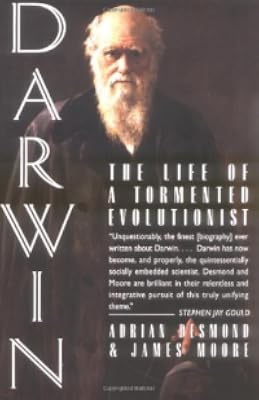
Darwin: The Life of a Tormented Evolutionist
by Adrian Desmond, James Moore
On This Page
Description
"It is like confessing a murder." These are the words Charles Darwin uttered when he revealed to the world what he knew to be true: that humans are descended from headless hermaphrodite squids. How could a wealthy gentleman, a stickler for respectability, attack the foundations of his religion and Anglican society? Authors Adrian Desmond and James Moore, in what has been hailed as the definitive biography of Charles Darwin, not only explain the paradox of the man but bring us the full sweep show more of Victorian science, theology, and mores." "The authors unveil the battle over the mind and soul that raged around the student Darwin as well as his drunken high-life in prostitute-ridden Cambridge. They vividly re-create Darwin's five-year voyage on the Beagle and his struggle to develop his theory of evolution. Then, they follow Darwin through his decades of torment. Fully aware that his ideas could bring ruin and social ostracism to his beloved family, Darwin kept his thoughts secret for twenty years. Seeming to lead an ideal squire's life in rural Kent, he was actually a man "living in Hell," plagued by trembling, vomiting, and violent cramps and confronted by personal tragedy that left him grief-stricken for the rest of his life." "But even more than Marx and Freud, this anguished man was to transform the way we see ourselves on this planet. Desmond and Moore's rich, comprehensive, and unparalleled portrait of his life contains a wealth of newly transcribed and unpublished letters, a thorough understanding of all available Darwin research, and ninety photographs, many never published before. Its lively and accessible style makes each chapter as gripping to read as a novel, yet the legitimacy and importance of this seminal work is never diminished--providing the whole story of how Darwin came to his world-changing conclusions and how, when the Origin of Species was finally published, its consequences were far more dramatic than Darwin's worst fears ... and wildest dreams."-- show lessTags
Recommendations









Member Reviews
Desmond & Moore's hefty 1991 biography of Charles Darwin was a landmark book linking the history of a major scientist with wider social and political change in mid-nineteenth century Britain. Some contemporaries were irritated by this interest in the times as much as the life but not this reader.
The book is nearly 680 pages long. Perhaps the more casual reader might have liked some cuts to make it more manageable but the length is justified by the authors interweaving of three closely related stories - that of a personality, that of a scientist and thinker and that of his times.
The personality is fascinating in its own right but what comes across as equally interesting is the subversion of his own class - that of the well-heeled but show more capable gentleman naturalist - by his alliance with the new men of professional science, self made and seeking 'jobs' in institutions.
This is where personality ties in with wider social change. What drove this rather timorous man with a life time of seriously unpleasant psychosomatic illnesses to defy convention at some social risk and, quite late in the day, allow the publication of his radical thoughts on evolution and natural selection?
Although Desmond and Moore do not quite answer this question directly, a personality that could do nothing but investigate and think on what it investigated - a classical case of scientific curiosity as core to personality - eventually had to break ranks to express its 'truth'.
His biography (excepting a rather unprepossessing country gent early life and the last days of being lionised and loving every minute of it) can be roughly broken down into three phases - the days on 'The Beagle', those living his theory discreetly in the country and those once his theory was in play.
The first phase is of a very young man with a considerable capacity for hard work who built up sufficient reputation from his specimen collecting to become accepted as part of a family of naturalists and scientists exploring the difficult terrain between nature and revealed religion.
The second phase has him highly respected within a respectable world but finding that his 'thinking' was taking existing evolutionary thought and extending it into something that could and would 'in the wrong hands' completely undermine the very social order on which he and his family depended.
We have to remember that Darwin was never in want of funds. He was connected to both the Darwin and Wedgewood dynasties and the valuation of his estate at £250,000 (roughly £23m in today's money) at the end of his life did not arise from his writings or scientific work.
This was a man from a comfortable Whig family. It may have been in class opposition to aristocratic Tory squires and parsons but it was, like Labour and Tory today, essentially part of a struggle in which both sides competed for advantage within a system they both maintained as 'sound'.
During this second phase (as the book makes clear) Darwin's 'thinking' led him into troubled waters because its logic was that of a challenge to the very ideological fundamentals that held the mob at bay in the years following the Chartist threat to property.
Working and middle class radicals were very interested in evolution for ideological reasons although they preferred the ideas of Lamarck, a preference of the Left that was to prove highly problematic in the Soviet Union under Stalin.
To undermine the ideology of God's grace creating a perfectly structured and benign nature (as proposed by the Anglican Paley) with the 'truth' of an evolutionary natural order with God (if present at all) very distant could imply that radical solutions to social problems were potentially correct.
The secret to Darwin's triumph lies not in him being 'right' (which he mostly was) but in what he proposed arriving at just the right time to buttress rising social forces that endorsed a new imperial order that, in turn, buttressed the order of property more effectively than religion.
The trigger of course was that Darwin could see that his ideas were in danger of being trumped with the less experimental or consistent thought of others, notably by the younger socialist (in a confused sort of way) Alfred Russell Wallace. He had to publish or lose his edge.
It should be made clear here though that Darwin and Wallace were not competing as scientific equals and that Darwin had earned the right to leadership in the field. Darwin never treated Wallace badly and Wallace never regarded Darwin as having done so.
Darwin is a complex character. The biography restores emotion to the Victorians but, for all the usual faults that lie in the character of the time (his imperialism, his casual racism, his patronising attitudes to the working class), he was by mid-Victorian lights ethical and broadly compassionate.
So, Darwin has to publish to be the one who gets credit for a truth that is brutal in its vision of nature as a war of all against all in the battle of survival and of the survival of those who are fittest. These then, it seems, go on to drive species, racial and all other forms of 'progress'.
We can see straight away how useful this was to the rising middle class professionals in the scientific community but also to a new imperial society being born out of the expansion of trade and industrialisation. It 'explained' hegemony. It 'countered' socially radical alternatives.
'Property' (all things being equal) might have been happy to continue with the old Tory paternalist ideology of a settled and benign Nature and of traditionalist values that placed everyone in their assigned role and relied on squires to protect the poor and parsons to comfort them.
Science was always going to unsettle this view because science is what it is - the truth of the matter. Unfortunately, Nature is actually mindlessly brutal with God increasingly (if he even exists) pushed further back by reality into being little more than the designer of general laws.
The initial challenge had come from two equally opposed sources. We have mentioned the radical challenge which became a socialist one in due course. This emphasised the possibility of social improvement on Lamarckian lines but the more important challenge at this point was the Whig one.
Whig intellectuals took up Malthus which led, after the 1832 Reform Act, to the cruelest triumph of Liberal Progressivism - the Poor Laws. Prior to Darwin's publications over a quarter of a century later, 'existential struggle' was already being brutally imposed on the working classes.
It is part of the centre-left myth of its own trajectory that Victorian Liberalism was a good thing and the Tories were a bad thing but nothing is so simple. For totally different reasons, yet both thinking in compassionate terms, Tories and radicals challenged the Malthusian ideology of this new elite.
Victorian Liberalism was intent on a form of managed revolution in the interests of its own class alliances - wealthy industrialists and dissenters, evangelical Christians, Malthusians, the new professional class, self-made men, the first propertied feminists.
This was a culture of trade and empire and of assumptions of worth epitomised by the Self-Help doctrine of Samuel Smiles. The way to handle too many working people was to force them to export themselves to colonies where the imperial authorities subjugated inferior peoples to fit them in.
In a weak form, these are attitudes about cultural superiority, social control, ideological conformity and the handling of the working class that are still embedded in American progressives and what was once called 'New Labour'. It is the ideological original sin of the Anglosphere Centre-Left.
Darwin straddled this main ideological divide. He was of free-thinking stock where the money had been made in industrial enterprise. He was 'liberal' in the best sense in his dealings with people but, on the other hand, he was also a village country squire and responsible for a parish and good order.
The third phase in his life and in the book is what happens when he deals with his internal conflicts and publishes 'The Origin of Species' (1859) and later 'The Descent of Man' (1871) (as well as very many other works) dropping a lighted match into the oil dump of elite ideological tensions.
Darwin's work becomes the weaponry to be used by a self-consciously engaged network of 'professional' (or aspirantly professional) elite scientists actively seeking to overturn the old order and transform the existing 'gentlemanly' institutions of the scientific community.
Darwin's technique is interesting. He knows what he is doing and he wants to promote the scientific revolution but he also wants to retain his aura of respectability. He does this by standing back and providing the guns and bullets for his shock troops but avoiding the front line himself.
His health shifts from being the psychosomatic result of intense stress at the potential revolution that he might create to its being the excuse for not engaging in revolutionary acts by attending events and for not commenting on the ideological, social or political ramifications of his theories.
He sits like a spider at the centre of an ideological web as Huxley in particular (but not only Huxley) takes on those who refuse to abandon religion as the core of Victorian ideology (men such as Bishop Wilberforce and the Duke of Argyll) and builds up a shock troop of like-minded scientists.
This is why the book is so valuable. It not only gives us an insight into Victorian elite society at a key point in its history between the troubles of the 1840s and the High Imperialism of the 1880s but it helps to explain why change happened and suggests how change might happen today or tomorrow.
By the time of Darwin's death in 1882, the 'revolution' is completed. The thesis of Tory Anglicanism and the antithesis of Liberalism are synthesised into the sanctimonious hypocrisy of Darwin's interment in Westminster Abbey (fixed by Huxley and the gang).
As Desmond and Moore indicate, Darwin had become a secular saint but his interment in the Abbey as provider of a neat indirect justification of British imperial superiority ('survival of the fittest') was a symbolic negation of the alternative of his interment in a family vault as local patriarch.
In essence Gladstonian Imperial Liberalism 'won' and old-style Tory Paternalism lost but the Anglican Church was vouchsafed a place in maintaining social order and the Lamarckian socialists were 'dished' by the weight of evidence that Darwin had provided.
Alongside the British story there is, of course, the story of 'Darwinism' (the -ism helps indicate the ideological aspect of this new way of seeing the world) as both Social Darwinism (a more overt ideological system with no serious evidential base) and as its reception overseas.
Darwin cannot entirely be absolved of responsibility for Social Darwinism although he did not actively promote it or anything like it. It emerged as, if you like, its own 'bourgeois necessity'. However, he shared the baseline thinking - the struggle for existence with winners and losers in life's race.
What becomes interesting is the rapid German intellectual adoption of Darwinism with an enthusiasm and excitability that sometimes comes across as at the edge of comical if we were not reminded of some of the eventual darker consequences of its adoption in the next century.
The authors are only interested in how the Germans related to Darwin personally but we can see the lineaments of an interpretation that is similar to that we have seen in relation to the British Empire - an idea, strengthened by its apparent truth, met a newly necessary ideological need.
This is the Germany of Bismarck. The defeat of 'effete' France by Prussia saw most of the British elite preferring modernising Germany to France with its perceived tin pot Napoleon III. Germany looked dynamic, the fittest, both to itself in potential and to the wider world.
With Haeckel playing the role of Huxley, Darwinism appealed because it weakened the role of the churches in restricting the authority of the State and it suggested ideas of natural selection that were not uninfluential on philosophers like Nietzsche.
As my mentor at university, the late Norman Stone, pointed out to me, national socialism was the consequence of a lot of young people being taught half-baked ideological theories by half-educated schoolmasters in small towns. Darwinismus would have been part of their tool kit.
One day the path by which two decent men's ideas (those of Darwin and Marx who only interacted briefly in writing once) becomes socially transmuted away from their actual intentions into mass murder and genocide will be traced with more insight than we have seen to date.
From this perspective, Desmond (who was an historian of evolution prior to the 'Origin of Species') and Moore (whose previous work was on the controversies in Victorian London triggered by Darwin's work) provide important material on the ideologisation of 'truth' and the role of intellectuals.
We should add here that the authors concentrate as much if not more on the man as on his ideas and environment. This makes the book, based on deep research into available letters and papers, extremely readable as a human life that unfolds over more than seventy years.
There are two critical death scenes (of Darwin's daughter Annie and of Darwin himself) that should move anyone - in both cases the available evidence gives us scenes of horror that few biographies tend to provide. It is important to understand what death entailed for Victorians.
Similarly the account of the Voyage of the Beagle is a deft summary of Darwin's own writings that allows us to picture a young sea sick man prepared to put up with a great deal of hardship and risk to find out how the world might work and do his job of collecting specimens for home.
For all the social and ideological aspects and consequences of the case, Darwin comes across as a basically decent human being who loved his family and especially his long-suffering wife Emma, was loyal and supportive to his friends and worked immensely hard because that is who he was.
His 'genius' was not based on one just idea or the books for which most people remember him but on a major body of research work involving demanding and committed experimentation and the ability to worry at a problem and follow the logic of his experimental discoveries.
How his material was used was not really his fault because he was only telling the truth as he saw it. His truth almost entirely (with the odd speculation overtaken by history) stands up as exceptional science that just happened to be very convenient to powerful people who then weaponised it.
Fortunately we have long since moved past the ideological accretions. Scientists eventually returned to the science and built on it. One hopes that, at some stage, the same can be done with those aspects of the work of Marx that still hold 'truths' that it has now become all too convenient to deny. show less
The book is nearly 680 pages long. Perhaps the more casual reader might have liked some cuts to make it more manageable but the length is justified by the authors interweaving of three closely related stories - that of a personality, that of a scientist and thinker and that of his times.
The personality is fascinating in its own right but what comes across as equally interesting is the subversion of his own class - that of the well-heeled but show more capable gentleman naturalist - by his alliance with the new men of professional science, self made and seeking 'jobs' in institutions.
This is where personality ties in with wider social change. What drove this rather timorous man with a life time of seriously unpleasant psychosomatic illnesses to defy convention at some social risk and, quite late in the day, allow the publication of his radical thoughts on evolution and natural selection?
Although Desmond and Moore do not quite answer this question directly, a personality that could do nothing but investigate and think on what it investigated - a classical case of scientific curiosity as core to personality - eventually had to break ranks to express its 'truth'.
His biography (excepting a rather unprepossessing country gent early life and the last days of being lionised and loving every minute of it) can be roughly broken down into three phases - the days on 'The Beagle', those living his theory discreetly in the country and those once his theory was in play.
The first phase is of a very young man with a considerable capacity for hard work who built up sufficient reputation from his specimen collecting to become accepted as part of a family of naturalists and scientists exploring the difficult terrain between nature and revealed religion.
The second phase has him highly respected within a respectable world but finding that his 'thinking' was taking existing evolutionary thought and extending it into something that could and would 'in the wrong hands' completely undermine the very social order on which he and his family depended.
We have to remember that Darwin was never in want of funds. He was connected to both the Darwin and Wedgewood dynasties and the valuation of his estate at £250,000 (roughly £23m in today's money) at the end of his life did not arise from his writings or scientific work.
This was a man from a comfortable Whig family. It may have been in class opposition to aristocratic Tory squires and parsons but it was, like Labour and Tory today, essentially part of a struggle in which both sides competed for advantage within a system they both maintained as 'sound'.
During this second phase (as the book makes clear) Darwin's 'thinking' led him into troubled waters because its logic was that of a challenge to the very ideological fundamentals that held the mob at bay in the years following the Chartist threat to property.
Working and middle class radicals were very interested in evolution for ideological reasons although they preferred the ideas of Lamarck, a preference of the Left that was to prove highly problematic in the Soviet Union under Stalin.
To undermine the ideology of God's grace creating a perfectly structured and benign nature (as proposed by the Anglican Paley) with the 'truth' of an evolutionary natural order with God (if present at all) very distant could imply that radical solutions to social problems were potentially correct.
The secret to Darwin's triumph lies not in him being 'right' (which he mostly was) but in what he proposed arriving at just the right time to buttress rising social forces that endorsed a new imperial order that, in turn, buttressed the order of property more effectively than religion.
The trigger of course was that Darwin could see that his ideas were in danger of being trumped with the less experimental or consistent thought of others, notably by the younger socialist (in a confused sort of way) Alfred Russell Wallace. He had to publish or lose his edge.
It should be made clear here though that Darwin and Wallace were not competing as scientific equals and that Darwin had earned the right to leadership in the field. Darwin never treated Wallace badly and Wallace never regarded Darwin as having done so.
Darwin is a complex character. The biography restores emotion to the Victorians but, for all the usual faults that lie in the character of the time (his imperialism, his casual racism, his patronising attitudes to the working class), he was by mid-Victorian lights ethical and broadly compassionate.
So, Darwin has to publish to be the one who gets credit for a truth that is brutal in its vision of nature as a war of all against all in the battle of survival and of the survival of those who are fittest. These then, it seems, go on to drive species, racial and all other forms of 'progress'.
We can see straight away how useful this was to the rising middle class professionals in the scientific community but also to a new imperial society being born out of the expansion of trade and industrialisation. It 'explained' hegemony. It 'countered' socially radical alternatives.
'Property' (all things being equal) might have been happy to continue with the old Tory paternalist ideology of a settled and benign Nature and of traditionalist values that placed everyone in their assigned role and relied on squires to protect the poor and parsons to comfort them.
Science was always going to unsettle this view because science is what it is - the truth of the matter. Unfortunately, Nature is actually mindlessly brutal with God increasingly (if he even exists) pushed further back by reality into being little more than the designer of general laws.
The initial challenge had come from two equally opposed sources. We have mentioned the radical challenge which became a socialist one in due course. This emphasised the possibility of social improvement on Lamarckian lines but the more important challenge at this point was the Whig one.
Whig intellectuals took up Malthus which led, after the 1832 Reform Act, to the cruelest triumph of Liberal Progressivism - the Poor Laws. Prior to Darwin's publications over a quarter of a century later, 'existential struggle' was already being brutally imposed on the working classes.
It is part of the centre-left myth of its own trajectory that Victorian Liberalism was a good thing and the Tories were a bad thing but nothing is so simple. For totally different reasons, yet both thinking in compassionate terms, Tories and radicals challenged the Malthusian ideology of this new elite.
Victorian Liberalism was intent on a form of managed revolution in the interests of its own class alliances - wealthy industrialists and dissenters, evangelical Christians, Malthusians, the new professional class, self-made men, the first propertied feminists.
This was a culture of trade and empire and of assumptions of worth epitomised by the Self-Help doctrine of Samuel Smiles. The way to handle too many working people was to force them to export themselves to colonies where the imperial authorities subjugated inferior peoples to fit them in.
In a weak form, these are attitudes about cultural superiority, social control, ideological conformity and the handling of the working class that are still embedded in American progressives and what was once called 'New Labour'. It is the ideological original sin of the Anglosphere Centre-Left.
Darwin straddled this main ideological divide. He was of free-thinking stock where the money had been made in industrial enterprise. He was 'liberal' in the best sense in his dealings with people but, on the other hand, he was also a village country squire and responsible for a parish and good order.
The third phase in his life and in the book is what happens when he deals with his internal conflicts and publishes 'The Origin of Species' (1859) and later 'The Descent of Man' (1871) (as well as very many other works) dropping a lighted match into the oil dump of elite ideological tensions.
Darwin's work becomes the weaponry to be used by a self-consciously engaged network of 'professional' (or aspirantly professional) elite scientists actively seeking to overturn the old order and transform the existing 'gentlemanly' institutions of the scientific community.
Darwin's technique is interesting. He knows what he is doing and he wants to promote the scientific revolution but he also wants to retain his aura of respectability. He does this by standing back and providing the guns and bullets for his shock troops but avoiding the front line himself.
His health shifts from being the psychosomatic result of intense stress at the potential revolution that he might create to its being the excuse for not engaging in revolutionary acts by attending events and for not commenting on the ideological, social or political ramifications of his theories.
He sits like a spider at the centre of an ideological web as Huxley in particular (but not only Huxley) takes on those who refuse to abandon religion as the core of Victorian ideology (men such as Bishop Wilberforce and the Duke of Argyll) and builds up a shock troop of like-minded scientists.
This is why the book is so valuable. It not only gives us an insight into Victorian elite society at a key point in its history between the troubles of the 1840s and the High Imperialism of the 1880s but it helps to explain why change happened and suggests how change might happen today or tomorrow.
By the time of Darwin's death in 1882, the 'revolution' is completed. The thesis of Tory Anglicanism and the antithesis of Liberalism are synthesised into the sanctimonious hypocrisy of Darwin's interment in Westminster Abbey (fixed by Huxley and the gang).
As Desmond and Moore indicate, Darwin had become a secular saint but his interment in the Abbey as provider of a neat indirect justification of British imperial superiority ('survival of the fittest') was a symbolic negation of the alternative of his interment in a family vault as local patriarch.
In essence Gladstonian Imperial Liberalism 'won' and old-style Tory Paternalism lost but the Anglican Church was vouchsafed a place in maintaining social order and the Lamarckian socialists were 'dished' by the weight of evidence that Darwin had provided.
Alongside the British story there is, of course, the story of 'Darwinism' (the -ism helps indicate the ideological aspect of this new way of seeing the world) as both Social Darwinism (a more overt ideological system with no serious evidential base) and as its reception overseas.
Darwin cannot entirely be absolved of responsibility for Social Darwinism although he did not actively promote it or anything like it. It emerged as, if you like, its own 'bourgeois necessity'. However, he shared the baseline thinking - the struggle for existence with winners and losers in life's race.
What becomes interesting is the rapid German intellectual adoption of Darwinism with an enthusiasm and excitability that sometimes comes across as at the edge of comical if we were not reminded of some of the eventual darker consequences of its adoption in the next century.
The authors are only interested in how the Germans related to Darwin personally but we can see the lineaments of an interpretation that is similar to that we have seen in relation to the British Empire - an idea, strengthened by its apparent truth, met a newly necessary ideological need.
This is the Germany of Bismarck. The defeat of 'effete' France by Prussia saw most of the British elite preferring modernising Germany to France with its perceived tin pot Napoleon III. Germany looked dynamic, the fittest, both to itself in potential and to the wider world.
With Haeckel playing the role of Huxley, Darwinism appealed because it weakened the role of the churches in restricting the authority of the State and it suggested ideas of natural selection that were not uninfluential on philosophers like Nietzsche.
As my mentor at university, the late Norman Stone, pointed out to me, national socialism was the consequence of a lot of young people being taught half-baked ideological theories by half-educated schoolmasters in small towns. Darwinismus would have been part of their tool kit.
One day the path by which two decent men's ideas (those of Darwin and Marx who only interacted briefly in writing once) becomes socially transmuted away from their actual intentions into mass murder and genocide will be traced with more insight than we have seen to date.
From this perspective, Desmond (who was an historian of evolution prior to the 'Origin of Species') and Moore (whose previous work was on the controversies in Victorian London triggered by Darwin's work) provide important material on the ideologisation of 'truth' and the role of intellectuals.
We should add here that the authors concentrate as much if not more on the man as on his ideas and environment. This makes the book, based on deep research into available letters and papers, extremely readable as a human life that unfolds over more than seventy years.
There are two critical death scenes (of Darwin's daughter Annie and of Darwin himself) that should move anyone - in both cases the available evidence gives us scenes of horror that few biographies tend to provide. It is important to understand what death entailed for Victorians.
Similarly the account of the Voyage of the Beagle is a deft summary of Darwin's own writings that allows us to picture a young sea sick man prepared to put up with a great deal of hardship and risk to find out how the world might work and do his job of collecting specimens for home.
For all the social and ideological aspects and consequences of the case, Darwin comes across as a basically decent human being who loved his family and especially his long-suffering wife Emma, was loyal and supportive to his friends and worked immensely hard because that is who he was.
His 'genius' was not based on one just idea or the books for which most people remember him but on a major body of research work involving demanding and committed experimentation and the ability to worry at a problem and follow the logic of his experimental discoveries.
How his material was used was not really his fault because he was only telling the truth as he saw it. His truth almost entirely (with the odd speculation overtaken by history) stands up as exceptional science that just happened to be very convenient to powerful people who then weaponised it.
Fortunately we have long since moved past the ideological accretions. Scientists eventually returned to the science and built on it. One hopes that, at some stage, the same can be done with those aspects of the work of Marx that still hold 'truths' that it has now become all too convenient to deny. show less
There's a tongue-in-cheek quality to this biography that leaves you rather uncertain as to what the authors really thought of Darwin. The writing style is breezy, postmodern, very much a look back at Darwin from the 21st century point of view. That makes this chunky book quite easy to read, but it did grate on me sometimes.
I did like the way in which this book placed Darwin's life at the center of so many others, and showed the links between his thinking and that of his contemporaries. He comes across as a man always anxious to preserve the status quo and avoid the extreme views both of the religious conservatives and of the atheist scientists. And yet his work was the catalyst for a total upheaval in the way people thought; Darwin was show more right at the center of the late nineteenth century shift towards secularism that is still playing out today. By the end of his life he was practically regarded as a saint by many, as a devil by others. But the picture I'm left with is of a sickly, fussy, obsessive worker who, after the Beagle voyage that made his name, was happiest in his comfortable yet modest home with his experiments, his devoted wife, and his children. show less
I did like the way in which this book placed Darwin's life at the center of so many others, and showed the links between his thinking and that of his contemporaries. He comes across as a man always anxious to preserve the status quo and avoid the extreme views both of the religious conservatives and of the atheist scientists. And yet his work was the catalyst for a total upheaval in the way people thought; Darwin was show more right at the center of the late nineteenth century shift towards secularism that is still playing out today. By the end of his life he was practically regarded as a saint by many, as a devil by others. But the picture I'm left with is of a sickly, fussy, obsessive worker who, after the Beagle voyage that made his name, was happiest in his comfortable yet modest home with his experiments, his devoted wife, and his children. show less
A great biography of Charles Darwin. This is a very thorough investigation into the life of a man whose ideas have changed the world.
I was fascinated by Darwin's background, motivation and fear of the consequences of publishing On The Origin Of Species.
Informative and sometimes very moving.
I was fascinated by Darwin's background, motivation and fear of the consequences of publishing On The Origin Of Species.
Informative and sometimes very moving.
A very thought biography about one of the most important scientist ever lived. Everything you wanted to know about Darwin...
A wonderfully written life of Darwin.
Read in Samoa June 2002.
Read in Samoa June 2002.
Adrian Desmond & James Moore: Darwin: 1992: eerste druk 1991: 677 blz: Penguin
Darwins vader was een welgestelde plattelandsarts, zodoende hoefde Charles en zijn oudere broer Erasmus nooit te werken om hun geld te verdienen. In zijn jeugd was Charles niet opvallend, hij hield van jagen en was een verwoed keververzamelaar. Op zijn 22e verjaardag kreeg hij een uitnodiging om mee te gaan met de reis van de Beagle om de wereld. Op deze reis die 5 jaar duurde en waarop hij herhaaldelijk ernstig zeeziek was gaf hij zijn ogen goed de kost en deed hij de ideeën op die zouden leiden tot de Origin of Species. Na afloop van de reis schreef hij 3 boeken over de geologie van Z-Amerika en een verslag van de tocht. Intussen trouwde hij nadat hij de show more voordelen van het trouwen had afgewogen tegen de nadelen. Hij kreeg 10 kinderen waarvan er 3 in de kinderjaren stierven. In 1842 schreef hij een eerste versie van het boek dat de Origin zou worden. Hij hield het bestaan van het manuscript geheim en bleef er tot 1859 aan werken. In de tussenliggende tijd schreef hij een dikke pil over eendemossels. In 1859 kreeg Darwin een brief van Alfred Wallace die een soort samenvatting van zijn evolutietheorie was. Darwin was geschokt en besloot om snel tot gelijktijdige publikatie met Wallace over te gaan. "On the Origin of Species by means of Natural Selection" werd goedverkocht en zou de grondslag vormen voor de wetenschap van de biologie. Tijdens zijn latere jaren schreef Darwin nog een aantal gespecialiseerde boeken. Hij werd na zijn dood in Westminster Abbey begraven.
Afgezien van het feit dat "Darwin" een erg dik boek is, is het goed geschreven, leest het vlot en is het inhoudelijk erg boeiend.
Uitgelezen: zondag 6 oktober 2002, waardering **** show less
Darwins vader was een welgestelde plattelandsarts, zodoende hoefde Charles en zijn oudere broer Erasmus nooit te werken om hun geld te verdienen. In zijn jeugd was Charles niet opvallend, hij hield van jagen en was een verwoed keververzamelaar. Op zijn 22e verjaardag kreeg hij een uitnodiging om mee te gaan met de reis van de Beagle om de wereld. Op deze reis die 5 jaar duurde en waarop hij herhaaldelijk ernstig zeeziek was gaf hij zijn ogen goed de kost en deed hij de ideeën op die zouden leiden tot de Origin of Species. Na afloop van de reis schreef hij 3 boeken over de geologie van Z-Amerika en een verslag van de tocht. Intussen trouwde hij nadat hij de show more voordelen van het trouwen had afgewogen tegen de nadelen. Hij kreeg 10 kinderen waarvan er 3 in de kinderjaren stierven. In 1842 schreef hij een eerste versie van het boek dat de Origin zou worden. Hij hield het bestaan van het manuscript geheim en bleef er tot 1859 aan werken. In de tussenliggende tijd schreef hij een dikke pil over eendemossels. In 1859 kreeg Darwin een brief van Alfred Wallace die een soort samenvatting van zijn evolutietheorie was. Darwin was geschokt en besloot om snel tot gelijktijdige publikatie met Wallace over te gaan. "On the Origin of Species by means of Natural Selection" werd goedverkocht en zou de grondslag vormen voor de wetenschap van de biologie. Tijdens zijn latere jaren schreef Darwin nog een aantal gespecialiseerde boeken. Hij werd na zijn dood in Westminster Abbey begraven.
Afgezien van het feit dat "Darwin" een erg dik boek is, is het goed geschreven, leest het vlot en is het inhoudelijk erg boeiend.
Uitgelezen: zondag 6 oktober 2002, waardering **** show less
Sep 3, 2009Dutch
Ratings
Members
- Recently Added By
Published Reviews
ThingScore 50
Desmond and Moore reveal Darwin’s inner life indirectly, through his responses to outside events, so it is no surprise that the authors offer no summary assessment of Darwin’s character. Instead of a portrait we get a gallery of sketches: Darwin the heartbroken father, the calculating suitor; the grumpy recluse, the jolly companion; the impressionable youth, the grand old genius; the hater show more of Owen, the magnanimous rival of Wallace; the brave man of science, going forward alone; the timid Darwin, hanging on the approval of friends. Here are more enigmas. Desmond and Moore let them hang. What of Darwin’s science? It is true that Desmond and Moore show (for example) Darwin developing the principle of “division of labour” by analogy with industrial workshops, and the bloody Crimean war informing his chapter on the Struggle for Existence. But the “enigma” that this book helps us to grasp is emotional and social, not intellectual. What “tortured” Darwin were not the implications of believing his theory of evolution (Lyell suffered the most from this kind of torture), but the implications of publicizing it. If this is what the authors want us to grasp then the book is an outstanding success, even if it leaves some of the interpretative work in the hands of the reader. show less
added by John_Vaughan
In other words, what we have in Desmond and Moore’s biography is a Darwin carefully crafted to accord with a preconceived view of scientific history, one which needs to be viewed “with extreme caution” and “contested at almost every sentence” (Levine 1994, p. 194). That their Darwin won, among other awards, the 1997 British Society for the History of Science Dingle Prize “for the show more best book of the decade in communicating the history of science to a wide audience” is a measure of how successful Desmond and Moore have been in promoting both their portrait of Darwin and their social constructivist view of the origins of his evolutionary theory. But close reading of the text, such as those by well informed and conscientious historians like Grene and Levine which reveal the authors’ dubious techniques of persuasion, indicates that the book does not merit the accolades it has received. show less
added by jimroberts
Lists

The Great Courses: The Darwinian Revolution
50 works; 1 member
Author Information

10+ Works 1,617 Members
4 Works 1,067 Members
Awards and Honors
Series
Belongs to Publisher Series
Common Knowledge
- Canonical title
- Darwin: The Life of a Tormented Evolutionist
- Original publication date
- 1991
- People/Characters
- Thomas Bell; Charles Darwin [Charles Robert: 1809-1882]; Emma Wedgwood Darwin; Robert Fitzroy; Joseph Dalton Hooker; Charles Lyell
- Epigraph
- What a book a Devil's Chaplain might
write on the clumsy, wasteful, blundering
low & horridly cruel works of nature!
Charles Darwin in 1856, about to
start the Origin of Species - First words
- CHARLES DARWIN'S grandfather Erasmus had a lacerating wit and a loathing of meddling gods.
- Quotations
- What need of Christianity when men can sup 'the milk of science'? Did not the priestess of Nature explain all things? - even Creation itself?
Nurs'd by warm sun-beams in primeval caves
Organic Life began beneath the... (show all) waves . . .
Hence without parent by spontaneous birth
Rise the first specks of animated earth.
There spoke Erasmus (Erasmus Darwin - Charles' grandfather, in his poem 'The Temple of Nature' published posthumously in 1803), a hard-headed freethinker, like so many in the sun-lit years of the Enlightenment.
Walking with Darwin … In his (Robert Edmond Grant) talks he had presented the sponge as the 'parent' of higher animals. ... Even dry-as-dust (Robert) Jameson penned an anonymous paper in 1826 praising 'Mr Lama... (show all)rck' for explaining how the higher animals had 'evolved' from the 'simplest worms.' (This was the first use of the word 'evolved' in a modern sense.)
Grant assumed that, as the primal earth cooled, changing conditions drove life towards higher, hotter-blooded forms. A progressive sequence of fossils stood as proof. He explained it as they strode along, and Darwin listened ... (show all)in 'silent astonishment.'
... before moving to Shrewsbury on 15 June (1842). Taking advantage of the seclusion, he finally fleshed-out a thirty-five-page sketch of his evolutionary theory in pencil. ... It looked good on paper, pieced together for the... (show all) first time.
(1855) From infinitesimal variations, common rabbits and pigeons had been stretched to the extent of emulating whole new genera.
Darwin believed that similar imperceptible variations held the key to Nature's own Malthusia... (show all)n selection. Weak, ill-adapted variants were discarded by Nature, as they were by the fancier. The good ones thrived and over the generations particular trends were encouraged. Adaptive features were drawn out, as if by an invisible breeder. 'Artificial selection' showed the craftsman sculpting nature; Nature's own 'selecting' hand was infinitely superior.
('after' Christmas Day 1857) Wallace ... wrote from the Malay archipelago to ask whether Natural Selection would delve into human origins. ... 'I think I shall avoid the whole subject, as so surrounded with prejudices,... (show all)' Darwin replied, 'though I fully admit that it is the highest & most interesting problem for the naturalist.'
At the eleventh hour - on 30 June (1858) - Hooker and Lyell inserted the Darwin-Wallace papers on to the agenda (of the Linnean Society meeting). The next evening the Secretary read them to thirty-odd nonplussed fellows; ... ... (show all)He had finally gone public. After twenty years of fret and frustration, he had exposed himself.
He took his ailing children and stomach off to the Isle of Wight for sea air, and here, at the King's Head Hotel in Sandown on 20 July (1858), he began an 'abstract' of Natural Selection. At first he simply anticipated... (show all) a paper, condensed 'to the utmost,' intended for the Society's Journal. But ... the condensation (of his already partly completed 'big book') expanded out of all proportion ... and inevitably it turned back into a book. ... the stock of 1250 copies was oversubscribed when the book went on sale to the trade on 22 November (1859).
Darwin had wanted to add a chapter on the subject to Variation but the book was now so 'horridly, disgustingly big' ... (by) March 1867, Darwin had decided to turn his man chapter into a separate 'short essay,' concent... (show all)rating on ape ancestry, sexual selection, and human expression. He would finally speak out, tired of being 'taunted that I concealed my views' on human origins.
(in 1868 - physisist John) Tyndall's appeal was universal, which made him dangerous. In these combative years he initiated the Association's (the British Association for the Advancement of Science) working-class talks, and ou... (show all)trageously. Faces were agog with teasing talk of babies built from chemicals, and the thinking capacity of robots.
... Tyndall's 'new creed - "I believe in One Force".' The 'terrible "Darwinismus" was being hitched to a pantheistic superstructure and underwritten by its aggressive middle-class exponents. Darwin could only watch in wonder.
(On the February 1871 publication of The Descent of Man) The early response was astonishing. 'Everybody is talking about it without being shocked.' ... the book was 'raising a storm of mingled wrath, wonder, and admira... (show all)tion' among the populace. They grudgingly admitted some sort of evolution but denied that man's 'spiritual powers' were selected from brute instincts ... - Last words
- (Click to show. Warning: May contain spoilers.)Such men, on the up-and-up, were paying their dues, for Darwin had naturalized Creation and delivered human nature and human destiny into their hands.
Society would never be the same. The 'Devil's Chaplain' had done his work. - Original language
- English
Classifications
Statistics
- Members
- 693
- Popularity
- 41,447
- Reviews
- 6
- Rating
- (4.04)
- Languages
- 6 — Dutch, English, German, Italian, Portuguese, Turkish
- Media
- Paper, Ebook
- ISBNs
- 13
- ASINs
- 12