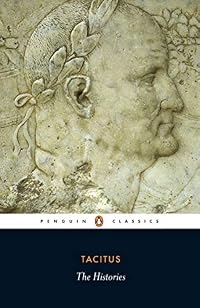
The Histories
by P. Cornelius Tacitus
On This Page
Description
Tacitus, a Roman orator and public official, is considered one of the greatest historians as well as one of the greatest prose stylists of the Latin language. In The Histories, he describes and interprets the period in which he lived, beginning with the political situation that followed Nero's death in 69 and ending with the death of Domitian in 96 and the close of the Flavian dynasty. The five books of the history still extant are part of an original work of twelve to fourteen books. The show more narrative as it now exists, with its magnificent introduction, is a powerfully sustained piece of writing. Because Tacitus was a conscious literary stylist, both his thought and his manner of expression gave life to his work. He wrote in the grand style, helped by the solemn and poetic usage of the Roman tradition, and he exploited the Latin qualities of strength, rhythm, and color. show lessTags
Recommendations









Member Reviews
The death of Nero begins a Roman bloodletting that Augustus had thought he had completely ended as four men will within a year claim the title Emperor. The Histories by Tacitus follows the aftermath of Nero’s death as a succession of men claimed the throne until the Flavians emerge to return the Pax Romana.
Tacitus begins his work with those who had prospered under Nero worrying for themselves while the rest of the populace celebrated and setting the stage for the eventual assassination for Galba and the rise of Otho, who the former had passed over as his chosen successor. Yet at the time of his death Galba was facing a mutiny on the German frontier that had installed Vitellius as their choice as emperor, a task that Otho took to quash show more and retain his own throne. The invasion of Italy by Vitellius’ legions brought war to the core of empire for the first time in almost a century and witnessed the defeat of Otho’s forces before he committed suicide. The rise of Vitellius brought Vespasian, the leader of the legions fighting the Jewish War, into the fray as he accepted the proclamation of his legions as emperor and soon found the supporters of Otho and others joining him. After the crushing defeat of his forces, Vitellius attempted to abdicate but the Guards wouldn’t let him resulting in his death by Vespasian’s soldiers. On top of civil war in Italy and the final phase of the Jewish War under Titus, a Gallo-German uprising at first claiming support for Vespasian became an invasion and rebellion that took numerous legions to suppress and the aftermath would be alluded to in Tacitus’ own Germany.
Although The Histories are incomplete, from the beginning Tacitus brings his aristocratic ideology and politics in focus early by showing only someone with political realism and firm hand on the legions can prevent civil wars and the rioting of the masses. The writing is quick-paced, going hand in hand with the rapid succession of events but Tacitus does give excellent portraits on the prime actors in this historical drama the played across the Roman world. The only thing a historian would have against Tacitus would be the twisting of the chronology to suit his own purposes. Yet like Agricola and Germany, my biggest complaint is how Oxford World Classics edition is structured with the Notes at the very end of the piece and making the reader use two bookmarks so they could go back and forth.
The Histories, the first of Tacitus’ two large scale historical works, shows the horrors of civil war and the according to Tacitus the dangers of leader who cannot control the legions and masses. Even though the we are missing over two-thirds of the overall work, the portion we have that covers the Year of Four Emperors shows the breakdown of society in vacuum of strong leadership that is important not only in that time but throughout all of history including down to our own time. show less
Tacitus begins his work with those who had prospered under Nero worrying for themselves while the rest of the populace celebrated and setting the stage for the eventual assassination for Galba and the rise of Otho, who the former had passed over as his chosen successor. Yet at the time of his death Galba was facing a mutiny on the German frontier that had installed Vitellius as their choice as emperor, a task that Otho took to quash show more and retain his own throne. The invasion of Italy by Vitellius’ legions brought war to the core of empire for the first time in almost a century and witnessed the defeat of Otho’s forces before he committed suicide. The rise of Vitellius brought Vespasian, the leader of the legions fighting the Jewish War, into the fray as he accepted the proclamation of his legions as emperor and soon found the supporters of Otho and others joining him. After the crushing defeat of his forces, Vitellius attempted to abdicate but the Guards wouldn’t let him resulting in his death by Vespasian’s soldiers. On top of civil war in Italy and the final phase of the Jewish War under Titus, a Gallo-German uprising at first claiming support for Vespasian became an invasion and rebellion that took numerous legions to suppress and the aftermath would be alluded to in Tacitus’ own Germany.
Although The Histories are incomplete, from the beginning Tacitus brings his aristocratic ideology and politics in focus early by showing only someone with political realism and firm hand on the legions can prevent civil wars and the rioting of the masses. The writing is quick-paced, going hand in hand with the rapid succession of events but Tacitus does give excellent portraits on the prime actors in this historical drama the played across the Roman world. The only thing a historian would have against Tacitus would be the twisting of the chronology to suit his own purposes. Yet like Agricola and Germany, my biggest complaint is how Oxford World Classics edition is structured with the Notes at the very end of the piece and making the reader use two bookmarks so they could go back and forth.
The Histories, the first of Tacitus’ two large scale historical works, shows the horrors of civil war and the according to Tacitus the dangers of leader who cannot control the legions and masses. Even though the we are missing over two-thirds of the overall work, the portion we have that covers the Year of Four Emperors shows the breakdown of society in vacuum of strong leadership that is important not only in that time but throughout all of history including down to our own time. show less
Imagine that an American historian documented the years 1861 to 1885, the quarter century during which the Republican Party controlled the presidency and enjoyed nearly unbroken control of Congress. Now imagine this work was lost except for the part covering 1861, including the election of Lincoln, the formation of the Confederacy, and the first battles of the Civil War.
This is Tacitus’s “Histories.” In its full form, it covered the 27-year reign of the Flavian Dynasty, from its rise in the shambles of Nero’s suicide to its collapse with Domitian’s assassination. The only books which survive are those covering the Year of the Four Emperors — and what a year it was.
What makes this especially valuable is that Tacitus has two show more advantages: the eye of a critical historian and the fact that the Flavians are dead. The former allows him to sift conflicting sources from an era of civil war and rival agendas, and the latter allows him to write without fear that a sitting emperor might take offense and banish him to the tender embrace of Pluto.
That’s not to say Tacitus writes without bias. He’s no friend of the late dynasty; and is an aristocrat of a traditionalist bent, equally contemptuous of undisciplined soldiers, scheming generals, and slimy politicians. As far as he’s concerned, everything went wrong when Rome’s greatness dissolved the ancient republican virtues that gave it greatness:
“The old ingrained human passion for power matured and burst into prominence with the growth of the empire. With straiter resources equality was easily preserved. But when once we had brought the world to our feet and exterminated every rival state or king, we were left free to covet power without fear of interruption.”
This sort of irony is red meat to Tacitus, and he piles it high as rival generals from the picket lines of Germania and the war zone of Judea converge on Rome, and as barbarian tribes erupt from the receding tide of Roman distraction. Tacitus loves jarring contrasts and competing opposites. No one appreciates the sardonic twists of Fate’s knife quite as much as he does.
This picturesque chronicle of imperial chaos leaves me regretful that we don’t have the rest of the “Histories,” but what we do have is invaluable. Tacitus offers a salutary reminder that the blessings of civil peace are not small. When a great nation turns on itself, vicious men prosper over virtuous, and brave soldiers die the death of cowards. Irony is fun to read about, but much less fun to live through. show less
This is Tacitus’s “Histories.” In its full form, it covered the 27-year reign of the Flavian Dynasty, from its rise in the shambles of Nero’s suicide to its collapse with Domitian’s assassination. The only books which survive are those covering the Year of the Four Emperors — and what a year it was.
What makes this especially valuable is that Tacitus has two show more advantages: the eye of a critical historian and the fact that the Flavians are dead. The former allows him to sift conflicting sources from an era of civil war and rival agendas, and the latter allows him to write without fear that a sitting emperor might take offense and banish him to the tender embrace of Pluto.
That’s not to say Tacitus writes without bias. He’s no friend of the late dynasty; and is an aristocrat of a traditionalist bent, equally contemptuous of undisciplined soldiers, scheming generals, and slimy politicians. As far as he’s concerned, everything went wrong when Rome’s greatness dissolved the ancient republican virtues that gave it greatness:
“The old ingrained human passion for power matured and burst into prominence with the growth of the empire. With straiter resources equality was easily preserved. But when once we had brought the world to our feet and exterminated every rival state or king, we were left free to covet power without fear of interruption.”
This sort of irony is red meat to Tacitus, and he piles it high as rival generals from the picket lines of Germania and the war zone of Judea converge on Rome, and as barbarian tribes erupt from the receding tide of Roman distraction. Tacitus loves jarring contrasts and competing opposites. No one appreciates the sardonic twists of Fate’s knife quite as much as he does.
This picturesque chronicle of imperial chaos leaves me regretful that we don’t have the rest of the “Histories,” but what we do have is invaluable. Tacitus offers a salutary reminder that the blessings of civil peace are not small. When a great nation turns on itself, vicious men prosper over virtuous, and brave soldiers die the death of cowards. Irony is fun to read about, but much less fun to live through. show less
A meaningless rating, that just means "I didn't really enjoy reading this, but I'm glad I did." There's just too much movement of arms and men in the story Tacitus tells to really grab me, too many generals moving and shaking. When he focuses away from generals and onto people, I'm all in. The one-liners, of course, are fabulous.
The introduction to the World's Classics edition is well worth reading, too, which is something you can't normally say for these introductions. This one makes an interesting argument about what's happening in Tacitus' writings, without banging on about current obsessions (except to make the reasonable point that Tacitus isn't anti-semitic, even though he's no fan of the Jews in Palestine at this time). The show more argument is, basically, that Tacitus is most interesting in his attention to the power of rumor. He does have his own interpretations of events, and he backs them up, but he also rarely describes an event (say, general Y concedes a battle) without pointing out how other people understood that event at the time. And those understandings are often the result of ignorant speculation, but sometimes people get it right. It's a nice reminder that our actions and reactions are entirely mediated by our interpretation of actions, and that those interpretations are often undertaken with very little evidence or knowledge. Plus ca change... show less
The introduction to the World's Classics edition is well worth reading, too, which is something you can't normally say for these introductions. This one makes an interesting argument about what's happening in Tacitus' writings, without banging on about current obsessions (except to make the reasonable point that Tacitus isn't anti-semitic, even though he's no fan of the Jews in Palestine at this time). The show more argument is, basically, that Tacitus is most interesting in his attention to the power of rumor. He does have his own interpretations of events, and he backs them up, but he also rarely describes an event (say, general Y concedes a battle) without pointing out how other people understood that event at the time. And those understandings are often the result of ignorant speculation, but sometimes people get it right. It's a nice reminder that our actions and reactions are entirely mediated by our interpretation of actions, and that those interpretations are often undertaken with very little evidence or knowledge. Plus ca change... show less
The short lives of Galba, Otho, Vitellius and many other interesting Romans of around A.D. 60! Wish it were not a mutilated text.... Today Tacitus' "The Histories" are relavent to the world politically. Let us be so bold as to say that our American Republic is very close to an end, as those with opened eyes know. Like Orson Scott Card's "Empire" portrays, in a "novel" way, civil war could perhaps be at our doorstep once again. Read Tacitus and know that history repeats itself. Down with the Luciferian Globalists who use the Left and Right as Machivellian reigns! Shake off your polarization! Don't follow around your fat idiot lying leaders like sheep. Learn something from Tacitus!
Elegantly phrased and fascinating.
Edition: // Descr: 453 p. 19.5 cm. // Series: Call No. { 878 T11 15 } With Notes for Colleges by W.S. Tyler Contains Indexes of Person and Places and to the Notes. // //
Othon fit retirer tout le monde et prit quelques instants de repos. Déjà les soins de ses derniers moments occupaient sa pensée, quand il en fut soudain distrait par un tumulte : on vint lui annoncer une émeute de soldats qui menaçaient de mort ceux qui voulaient partir. Après avoir réprimandé les auteurs de la mutinerie, il rentra chez lui. Vers le soir, il eut soif et but une gorgée d'eau glacée. Alors s'étant fait apporter deux poignards il en éprouva la pointe et mit l'un d'eux sous son oreiller; puis, quand il se fut assuré que ses amis étaient partis, il passa tranquillement la nuit et, au point du jour, il appuya le fer contre sa poitrine. Au gémissement qu'il poussa en mourant, ses affranchis et ses esclaves show more entrèrent; sur son corps, ils ne trouvèrent qu'une blessure. show less
Nov 21, 2010French
Members
- Recently Added By
Lists

100 Books to Read in a Lifetime (That Are Older Than 200 Years)
415 works; 175 members

r/History Recommended Reading List
603 works; 12 members

Philip Ward's Lifetime Reading Plan
592 works; 22 members

CCE 100 Great Books List
145 works; 8 members

Books Read in 2019
4,052 works; 110 members

How to Read a Book's Recommended Reading List
309 works; 10 members

Western Canon
206 works; 2 members

Greatest Books, allegedly
484 works; 9 members

Books Read in 2023
5,547 works; 145 members

Mustich's 1000 Books to Read Before You Die: A Life Changing List
1,001 works; 18 members

el
1,139 works; 1 member

In Our Time books
4,934 works; 2 members
Talk Discussions
Past Discussions
Tacitus Annals and History in Ancient History (February 2023)
Author Information

Tacitus was a Roman senator who survived the terror launched among the Roman aristocracy by the emperor Domitian to rise to prominence and become first suffect consul and later proconsul of Asia. His historical works, which originally covered the first century of the empire from the accession of Tiberius to the assassination of Domitian, are an show more indictment of the emperors and of the senatorial aristocracy under imperial autocracy. They remain the fundamental sources of imperial history in this period. The embarrasing paradox of Tacitus's success under a "bad" emperor appears to have had an effect on his works, whose tone may have struck contemporaries as a defense of his prominence under a despot. Tacitus is thus often thought to have nursed a nostalgia for the Republic and the free nobility of its senatorial order. However, his attitude is less genuinely backward-looking than occupied with the contemporary moral and political problems of aristocratic honor. In The Annals, which survives only in part, he examines palace politics under the Julio-Claudians. The unspoken questions that occupy this examination are those of the possibilities of uncompromised and dignified service under despotism, and the opportunities therein to mitigate its evil. These themes emerge into daylight in The Agricola, his laudatory biography of his father-in-law, the Roman general who conquered Britain. The work portrays Agricola as a straightforward military man who preserved his integrity and the admiration of his contemporaries under the emperor Domitian, even though his greatest achievements went unrewarded. Tacitus was a trained advocate, and fundamental to his outlook is his prosecutorial purpose. He states the case against the emperors and others who attract his unfavorable judgment. This bias can be difficult for the reader to overcome. But Tacitus also played by the rules of advocacy. He appears to bring to light facts unfavorable to his case in order to interpret them according to the necessities of his argument. His lawyerly honesty thereby allows the historian to dissect the facts from their matrix in order to use them in reconstructing a historical account of the first century of the empire which is more balanced, if inevitably less committed, than that of Tacitus. (Bowker Author Biography) show less
Some Editions
Awards and Honors
Series
Belongs to Publisher Series
Work Relationships
Is contained in
Inspired
Common Knowledge
- Canonical title
- The Histories
- Original title
- Historiarum Libri
- Original publication date
- 105 AD - 108 AD; c. 100-110 AD
- People/Characters
- Galba; Marcus Salvius Otho; Aulus Vitellius Germanicus; Vespasian; Antonius Primus
- Important events
- Year of Four Emperors (69)
- First words
- I shall begin my work with the year in which Sevius Galba and Titus Vinius were consuls, the former for the second time.
- Last words
- (Click to show. Warning: May contain spoilers.)The troubles of AD 69/70 were never repeated here, and this in itself is a vindication of Roman imperialism.
- Disambiguation notice
- This contains all surviving books (i.e. Books 1-5) of Tacitus' Histories in translation (i.e. without a Latin text). Please do not combine with partial editions or versions with Latin texts.
Classifications
- Genres
- History, Nonfiction, General Nonfiction
- DDC/MDS
- 937.07 — History & geography History of ancient world (to ca. 499) Italian Peninsula to 476 and adjacent territories to 476 Constitutional 31 B.C.-284 A.D.
- LCC
- DG286 .T313 — History of Europe, Asia, Africa and Oceania City History of Italy Ancient Italy. Rome to 476 History By period Empire, 27 B.C. - 476 A.D. Constitutional Empire, 27 B.C. - 284 A.D.
- BISAC
Statistics
- Members
- 1,617
- Popularity
- 13,868
- Reviews
- 8
- Rating
- (3.90)
- Languages
- 14 — Catalan, Chinese, Czech, Dutch, English, Finnish, French, German, Greek, Italian, Latin, Russian, Spanish, Swedish
- Media
- Paper, Audiobook, Ebook
- ISBNs
- 70
- ASINs
- 36