On This Page
Description
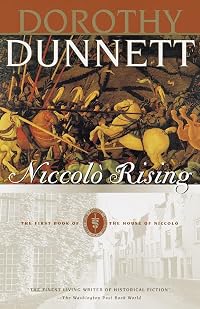
In this first book of The House of Niccolò series, the author of the Lymond Chronicles introduces a new hero, Nicholas vander Poele of Bruges, the good-natured dyer's apprentice who schemes and swashbuckles his way to the helm of a mercantile empire. With the bravura storytelling and pungent authenticity of detail she brought to her acclaimed Lymond Chronicles, Dorothy Dunnett, grande dame of the historical novel, presents The House of Niccolò series. The time is the fifteenth century, show more when intrepid merchants became the new knighthood of Europe. Among them, none is bolder or more cunning than Nicholas vander Poele of Bruges. Niccolò Rising, book one of the series, finds us in Bruges, 1460. Jousting is the genteel pastime, and successful merchants are, of necessity, polyglot. Street smart, brilliant at figures, adept at the subtleties of diplomacy and the well-timed untruth, Dunnett's hero rises from wastrel to prodigy in a breathless adventure that wins him the hand of the strongest woman in Bruges and the hatred of two powerful enemies. From a riotous and potentially murderous carnival in Flanders, to an avalanche in the Alps and a pitched battle on the outskirts of Naples, Niccolò Rising combines history, adventure, and high romance in the tradition stretching from Alexandre Dumas to Mary Renault. show lessTags
Recommendations

Member Reviews
Hello, a happy Dunnett reader here. I started this series with excitement and some trepidation. What was it going to be like? You know what to expect from Dunnett, and you never know what to expect from Dunnett.
So, we are in the 1460’s – here is Flanders, here is Burgundy, here is Brittany, here is Milan...
Intrigues; back-stabbing; clandestine meetings; assassination attempts; avalanches; swashbuckling; duels (fought with oars, of all things!); battles; crazy fun escapades; merchant house machinations. What a great mix of ingredients! I had no idea I could care so much about trade in Renaissance Europe. Dunnett made it fascinating, glorious, exciting. I had no idea I could care about alum! (I had to google it, too!)
The writing show more brought me joy.
”Bruges was the multiple voice of working water; and the quality of brick-thrown echoes, and the hiss of trees and the flap of drying cloths in the flat-country wind, and the grunting, like frogs in a marsh, of quires of crucified clothes, left to vibrate in the fields of the tenters. Bruges was the cawing scream of the gulls, and the bell-calls.”
Let’s talk about the characters. Claes/Nicholas: a dyer’s apprentice who is anything but by the end of the book. Dunnett tries to fool you, talking about an “oak tree with dimples”. Claes gets beaten uo a lot and makes people laugh. But ”Claes was always making toys, and other people broke them.”. Me: I think these people and the world had better watch out. Dunnett does a lot of showing and no telling at all. Most characters, and Claes especially, remain obscure. The showing that is going on is akin to a stage magician’s – look into my hat; no, there was no hat. You get glimpses. Claes/Nicholas is a genius, ”He had only his brain, which absorbed instruction and held it, for ever.” I found that I was always ageing him in my head by 10 years or so – there is no way he is eighteen. (Suspension of disbelief is a useful thing.) I do like that my idea of him is not complete yet. There are seven more books to go, after all. As for the others – Katelina (awesome!), Julius, Tobie, Gregorio, Marion – I am so curious about them all. I am curious about the villains, too. They are quite delicious, all wearing a sign “I am the villain of this book, am I being villainous enough for you?” It reminded me of the moment in The Three Musketeers, when d’Artagnan meets de Rochefort for the first time – only Dumas spells it out much more than Dunnett.
The plotting is impeccable, and Dunnett, as always, excels at emotionally exhausting scenes. There were narrative choices I did not quite like, but they did not lessen my enjoyment. Oh, and my heart broke again. The dramatic reveals towards the end are very satisfying to any reader who likes intricate and intelligent plots. The ending is excellent. I am looking forward to the next book so, so, so much!
P.S. The ostrich is great, I loved the ostrich! 😆😆😆 show less
So, we are in the 1460’s – here is Flanders, here is Burgundy, here is Brittany, here is Milan...
Intrigues; back-stabbing; clandestine meetings; assassination attempts; avalanches; swashbuckling; duels (fought with oars, of all things!); battles; crazy fun escapades; merchant house machinations. What a great mix of ingredients! I had no idea I could care so much about trade in Renaissance Europe. Dunnett made it fascinating, glorious, exciting. I had no idea I could care about alum! (I had to google it, too!)
The writing show more brought me joy.
”Bruges was the multiple voice of working water; and the quality of brick-thrown echoes, and the hiss of trees and the flap of drying cloths in the flat-country wind, and the grunting, like frogs in a marsh, of quires of crucified clothes, left to vibrate in the fields of the tenters. Bruges was the cawing scream of the gulls, and the bell-calls.”
Let’s talk about the characters. Claes/Nicholas: a dyer’s apprentice who is anything but by the end of the book. Dunnett tries to fool you, talking about an “oak tree with dimples”. Claes gets beaten uo a lot and makes people laugh. But ”Claes was always making toys, and other people broke them.”. Me: I think these people and the world had better watch out. Dunnett does a lot of showing and no telling at all. Most characters, and Claes especially, remain obscure. The showing that is going on is akin to a stage magician’s – look into my hat; no, there was no hat. You get glimpses. Claes/Nicholas is a genius, ”He had only his brain, which absorbed instruction and held it, for ever.” I found that I was always ageing him in my head by 10 years or so – there is no way he is eighteen. (Suspension of disbelief is a useful thing.) I do like that my idea of him is not complete yet. There are seven more books to go, after all. As for the others – Katelina (awesome!), Julius, Tobie, Gregorio, Marion – I am so curious about them all. I am curious about the villains, too. They are quite delicious, all wearing a sign “I am the villain of this book, am I being villainous enough for you?” It reminded me of the moment in The Three Musketeers, when d’Artagnan meets de Rochefort for the first time – only Dumas spells it out much more than Dunnett.
The plotting is impeccable, and Dunnett, as always, excels at emotionally exhausting scenes. There were narrative choices I did not quite like, but they did not lessen my enjoyment. Oh, and my heart broke again. The dramatic reveals towards the end are very satisfying to any reader who likes intricate and intelligent plots. The ending is excellent. I am looking forward to the next book so, so, so much!
P.S. The ostrich is great, I loved the ostrich! 😆😆😆 show less
Some chaotic incidents, beginning with an incident with a bath, a cannon and a canal, upset the good Burghers of Bruges. They also launch the career of a brilliant, dangerous man into the world of the Renaissance, where chivalry is on the wane and business is on the rise, and war is business. Despite his brilliance, he makes mistakes, or over-reaches, or simply sets in motion trains of events that have outcomes even he can't control or predict, for he is still young and inexperienced. If he survives his enemies, disasters, wars, tragedies and the machinations of Dukes and kings, he still has his family to worry about, because under all the plots and plans and clever designs there are deeper, ineradicable secrets. This is merely the show more edge, the launch and dive into the world of Niccolo. Questions you weren't aware were being posed in the first page will not be answered the end of seven whole epic novels, because though the writing can seem fine as filigree, it's also as sharp as razors and the plot is like a network of steel hawsers. Dive in, it's brilliant. show less
Oh Nicholas, the little schemer you are… I’m obsessed.
Set in the high middle ages on the cusp of the renaissance, Europe is filled with many factions and their representatives, all with their own agendas. (Both the factions and the people, and the people’s goals do not necessarily align with the faction they are part of to complicate things further.) Conflicts are fought in the background between the Ottoman empire and the Pope, between the French among themselves and the English also among themselves.
Among it all, Nicholas the foolish apprentice turns into a merchant who trades in letters, mercenaries, cloth and secrets.
The story was told through various third person perspectives, and this is both a strength and a weakness. This show more book is filled with names, titles and places, in various languages. It added an amazing scope to the story, but also distanced Nicholas.
No one knows what he is truly thinking or feeling. Maybe he loves the Charetty family. Maybe his personality all an act. Maybe it’s maybelline. Who knows?
Regardless, it was a grand adventure to follow him and I want to read what he does next.
D.A.2. 14 Jan 2025 show less
Set in the high middle ages on the cusp of the renaissance, Europe is filled with many factions and their representatives, all with their own agendas. (Both the factions and the people, and the people’s goals do not necessarily align with the faction they are part of to complicate things further.) Conflicts are fought in the background between the Ottoman empire and the Pope, between the French among themselves and the English also among themselves.
Among it all, Nicholas the foolish apprentice turns into a merchant who trades in letters, mercenaries, cloth and secrets.
The story was told through various third person perspectives, and this is both a strength and a weakness. This show more book is filled with names, titles and places, in various languages. It added an amazing scope to the story, but also distanced Nicholas.
No one knows what he is truly thinking or feeling. Maybe he loves the Charetty family. Maybe his personality all an act. Maybe it’s maybelline. Who knows?
Regardless, it was a grand adventure to follow him and I want to read what he does next.
D.A.2. 14 Jan 2025 show less
Three young men floating down a canal inside a bathtub being delivered to a Duke in Bruges. Action and hilarity ensue but this chapter is key--don't read it lightly. I read it twice in a row. The chapter has layers and kicks off the events not only in this book but in the entire series. This is my second time through this series--it was a delight the first time when I had the pleasure of reading it through with several co-workers--we had a lot of fun at lunchtime discussing the antics of Nicholas de Fleury and company. And it was a delight this time. Dorothy Dunnett is for people who love dense historical fiction (I know this because there is a Dorothy Dunnett society and a Wiki)--she mixes in real events with fictional characters in show more 15th century Europe and there is always a surprise waiting around the page for you the reader and the characters in her books.
Please, oh please, someone adapt this into a series for HBO, Showtime or Netflix. show less
Please, oh please, someone adapt this into a series for HBO, Showtime or Netflix. show less
I liked this very much. It's a real puzzle-box of a book, and wants close attention -- Dunnett makes you work hard for your swashbuckling. But it was so rewarding, and exactly what I want out of the genre. I'd read some really tepid historical fiction in my 20s and had pretty much decided it wasn't for me, but Wolf Hall knocked me out and I'd been hoping for something similarly complex, evocative, and seamless in regard to research/story. This was entertaining and invigorating, although it took me the first hundred pages or so to get into her narrative groove. But very much worth it, and dammit now there are seven more to the series and, I find out, two companion books so you can look up the historical references. I'm hoping they have show more costume pictures, because that's what I was most curious about, and Google only satisfies halfway show less
Dorothy Dunnett’s House of Niccolo series offers us an entry into the world of the late 15 century in all its richness and physicality, with the food, the pewter cups and candian wine, the sumptuous clothes, the woodsmoke-filled freezing halls, the pissstinking dye vats, the canals and bridges and gates of the towns, the armour, the pageants, jousts, feasts and plagues, the high politics, and low scheming of bankers, burghers, bishops and high born bastards, Dukes, Kings and Princes, the wars, wounds, living, loving and dying.
Here is a partial list of historical events covered by the series:
The fall of Trebizond, last outpost of the Byzantine empire
The rise of the Ottoman Empire in the black sea
The trade rivalry between Genoa and show more Venice
The end of the Lusignan dynasty on Cypress
The Wars of the Roses in England,
The marriage of James II of Scotland and Margaret of Denmark
The marriage of Zoe Paleologue and Ivan the Third Grand Duke of Musocvy
The disintegration of the empire of the Golden Horde
The sack of Timbuktu by the Songhai empire
The siege of Famagusta
The fall of the duchy of Burgundy
Through all these events the hero of the series, Nicholas van der Poele, steers his remarkable career, first as a Tyl Eulenspeigel-like apprentice in Bruges, then mercenary leader, merchant, banker, pirate adventurer, inventor, maths genius, lover, diviner, political and financial advisor to Dukes and Princes, father and enigmatic friend. He is accompanied on these adventures through early modern Europe and the Levant by his band of friends and colleagues, each of whom has a particular skill: a doctor, a priest, an apothecary, a gunner and metalsmith, a notary, a business manager, a ship master and so on. The running story line is the visceral feud between Niccolo and the St Pol family, and the commercial rivalry between Nicholas’s own company and the mysterious Vatachino firm.
Dunnet is an extraordinary phenomenon. Her novelistic method is to eschew internal psychological narration (of the kind that Eliot and Tolstoy employ), and to focus on the events and actions of the characters, the external view. This creates the incredible pace of the novels, and at the same time keeps the reader alert for what is really going on underneath the surface. Her understanding and presentation of history is thick with the details of ordinary life; she completely understands the complex relationships between politics, religion, economic forces and the inertia of everyday life and how in this period all is seared with trade. She is capable of intensely beautiful descriptive prose, a kind of maidenly raciness in the love scenes, swashbuckling set-pieces of violence, subtle and elusive descriptions of negotiations at high levels. She weaves together her fictional characters and the real personages of history so well that you cannot tell the difference. Her development of character (over 4,300 pages and eight novels) is astonishing in the way she commands the reader’s loyalty, respect and love for the ‘good’ characters, and hatred for the ‘bad’ characters, without sacrificing complexity and insight into how those characters have become what they are. She is also a witty commentator on the parameters and conventions of the genre without introducing the kind of jarring anachronisms that mar many writers of historical fiction. Her metaphors are all firmly entrenched in the worldview of the characters (which, according to that most didactic of critics James Wood, is the hallmark of great writing) and there are several very funny jokes. My favourite is the list of the (uncapitalised) names of the castles owned by Prince Sigismond of the Tyrol: sigmundhelm, sigmundhof, sigmundfried sigmundfreud…
Like the great Dumas, she is capable of invoking in a sophisticated (possibly jaded) adult reader the kind of feverish, intoxicated, under-the-bedclothes-with-a-torch kind of reading last experienced in childhood.
Read the full review on The Lectern:
http://thelectern.blogspot.com/2008/09/house-of-niccolo-dorothy-dunnett.html show less
Here is a partial list of historical events covered by the series:
The fall of Trebizond, last outpost of the Byzantine empire
The rise of the Ottoman Empire in the black sea
The trade rivalry between Genoa and show more Venice
The end of the Lusignan dynasty on Cypress
The Wars of the Roses in England,
The marriage of James II of Scotland and Margaret of Denmark
The marriage of Zoe Paleologue and Ivan the Third Grand Duke of Musocvy
The disintegration of the empire of the Golden Horde
The sack of Timbuktu by the Songhai empire
The siege of Famagusta
The fall of the duchy of Burgundy
Through all these events the hero of the series, Nicholas van der Poele, steers his remarkable career, first as a Tyl Eulenspeigel-like apprentice in Bruges, then mercenary leader, merchant, banker, pirate adventurer, inventor, maths genius, lover, diviner, political and financial advisor to Dukes and Princes, father and enigmatic friend. He is accompanied on these adventures through early modern Europe and the Levant by his band of friends and colleagues, each of whom has a particular skill: a doctor, a priest, an apothecary, a gunner and metalsmith, a notary, a business manager, a ship master and so on. The running story line is the visceral feud between Niccolo and the St Pol family, and the commercial rivalry between Nicholas’s own company and the mysterious Vatachino firm.
Dunnet is an extraordinary phenomenon. Her novelistic method is to eschew internal psychological narration (of the kind that Eliot and Tolstoy employ), and to focus on the events and actions of the characters, the external view. This creates the incredible pace of the novels, and at the same time keeps the reader alert for what is really going on underneath the surface. Her understanding and presentation of history is thick with the details of ordinary life; she completely understands the complex relationships between politics, religion, economic forces and the inertia of everyday life and how in this period all is seared with trade. She is capable of intensely beautiful descriptive prose, a kind of maidenly raciness in the love scenes, swashbuckling set-pieces of violence, subtle and elusive descriptions of negotiations at high levels. She weaves together her fictional characters and the real personages of history so well that you cannot tell the difference. Her development of character (over 4,300 pages and eight novels) is astonishing in the way she commands the reader’s loyalty, respect and love for the ‘good’ characters, and hatred for the ‘bad’ characters, without sacrificing complexity and insight into how those characters have become what they are. She is also a witty commentator on the parameters and conventions of the genre without introducing the kind of jarring anachronisms that mar many writers of historical fiction. Her metaphors are all firmly entrenched in the worldview of the characters (which, according to that most didactic of critics James Wood, is the hallmark of great writing) and there are several very funny jokes. My favourite is the list of the (uncapitalised) names of the castles owned by Prince Sigismond of the Tyrol: sigmundhelm, sigmundhof, sigmundfried sigmundfreud…
Like the great Dumas, she is capable of invoking in a sophisticated (possibly jaded) adult reader the kind of feverish, intoxicated, under-the-bedclothes-with-a-torch kind of reading last experienced in childhood.
Read the full review on The Lectern:
http://thelectern.blogspot.com/2008/09/house-of-niccolo-dorothy-dunnett.html show less
Historical fiction set largely in Flanders when Bruges was an economic power center. The main character is a young man from an unpromising background who works as an apprentice for a successful merchant. As the story progresses, we find the amiable Claes revealed as a polymath and clever tactician in politics and human affairs, which naturally means he has a knack for trade, networks, and business. As Claes evolves into Niccolo and gains status among the merchant class, it seems his story is about a talented, hard-working person overcoming his situation; by the end it seems Niccolo is perhaps something else entirely. The book ends a bit abruptly, clearly pointing the reader to pick up the next volume in an eight (!) volume series.
A show more small nit to pick, just because I think the details really matter in historical fiction: late in the book, there is a scene involving an ostrich chase. One of the characters grabs a horse from the stables that was wearing a 'harness' (probably meant bridle? because a harness is what's used to hitch a horse to a wagon or carriage) and hops on bareback. A few pages later, he's 'gripping the saddle'. Where was the part where he stopped mid-chase to borrow a saddle and saddle the horse? This continuity error irks when an author asks the reader to pay close attention to vast cast of characters, complicated timelines, and lots of changes in setting.
I decided to read this book during a trip in Belgium and it offered a few nuggets about the places I visited that I appreciated. Still, I didn't find the book compelling enough to read more of Niccolo's story. I would potentially recommend this for people who enjoy the historical fiction genre and/or lengthy fiction series. For me, there was not enough literary quality in the writing and far too many characters to keep track of. I had the sense that this book was just the trailer to get me to buy the ticket for a bunch more books. show less
A show more small nit to pick, just because I think the details really matter in historical fiction: late in the book, there is a scene involving an ostrich chase. One of the characters grabs a horse from the stables that was wearing a 'harness' (probably meant bridle? because a harness is what's used to hitch a horse to a wagon or carriage) and hops on bareback. A few pages later, he's 'gripping the saddle'. Where was the part where he stopped mid-chase to borrow a saddle and saddle the horse? This continuity error irks when an author asks the reader to pay close attention to vast cast of characters, complicated timelines, and lots of changes in setting.
I decided to read this book during a trip in Belgium and it offered a few nuggets about the places I visited that I appreciated. Still, I didn't find the book compelling enough to read more of Niccolo's story. I would potentially recommend this for people who enjoy the historical fiction genre and/or lengthy fiction series. For me, there was not enough literary quality in the writing and far too many characters to keep track of. I had the sense that this book was just the trailer to get me to buy the ticket for a bunch more books. show less
Members
- Recently Added By
Lists

Best Historical Fiction
620 works; 261 members

History novels (not too romancey)
37 works; 5 members

Books Read in 2017
4,249 works; 130 members
Author Information

35+ Works 18,085 Members
Dorothy Dunnett was born on August 25, 1923 in Dunfermline, Fife, Scotland. She attended Gillespie's High School for Girls. After graduation she attended Edinburgh College of Art, and transferred, upon her marriage, to Glasgow School of Art. From 1940-1955, she worked for the Civil Service as a press officer. Her first novel, The Game of Kings, show more was published in the United States in 1961 and in the United Kingdom the year after. During her lifetime, she wrote over 20 books including King Hereafter, the six-part Lymond Chronicles, and the eight-part House of Niccolo series. She was also a professional portrait painter and exhibited at the Royal Scottish Academy. In 1992 she was awarded the Office of the British Empire for services to literature. She died from cancer on November 9, 2001 at the age of 78. (Bowker Author Biography) show less
Some Editions
Awards and Honors
Notable Lists
Series

Belongs to Publisher Series
rororo (12060)
Work Relationships
Has as a reference guide/companion
Common Knowledge
- Canonical title
- Niccolò Rising
- Original title
- Niccolò Rising
- Original publication date
- 1986
- People/Characters
- Claes, or Nicholas Vander Poele; Felix de Charetty; Marian de Charetty; Katelina von Borselen; Simon Kilmirren; Jordan de Riberac
- Important places
- Bruges, West Flanders, Belgium
- First words
- From Venice to Cathay, from Seville to the Gold Coast of Africa, men anchored their ships and opened their ledgers and weighed one thing against another as if nothing would ever change.
- Last words
- (Click to show. Warning: May contain spoilers.)And then she walked forward and smiled; for she was a merchant.
Classifications
Statistics
- Members
- 1,462
- Popularity
- 15,981
- Reviews
- 39
- Rating
- (4.28)
- Languages
- 6 — Dutch, English, French, German, Italian, Russian
- Media
- Paper, Audiobook, Ebook
- ISBNs
- 34
- ASINs
- 15