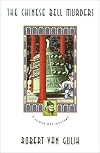
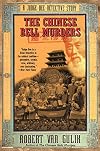
The Chinese Bell Murders
by Robert van Gulik
Judge Dee: Publication order (2), Judge Dee: Chronological order (5)
On This Page
Description
The great Chinese detective Judge Dee begins work on the most disquieting case of his career when he reviews a rape and murder on Half Moon Street, an investigation that brings him face to face with a clan of killer monks and a long-standing feud between two of the city's most important families.Tags
Recommendations



































Member Reviews
Admirers of Robert van Gulik's always delightful Judge Dee mysteries have another treat in store with The Chinese Bell Murders. In this novel, Judge Dee is newly arrived in the city of Poo-Yang, and he begins by re-investigating a case that his predecessor, Judge Feng, could not complete since Feng had had to leave when he was reassigned to a new posting. In that case, an impoverished literary candidate named Wang was on the verge of being executed for the rape and murder of a butcher's daughter; however, Judge Dee cleverly and immediately realizes that the real culprit was someone else!
As in all Judge Dee novels, there are two more mysteries for Judge Dee to solve before the reader happily comes to the end: the case of a decades-long show more feud between two families who hail from Canton and some nefarious goings-on at a Buddhist temple. At the Temple of Boundless Mercy, barren women who spend the night, as often as not, later conceive. While the temple's abbot, who goes by the name of Spiritual Virtue, gives credit to the goddess Kwan Yin, Judge Dee suspects otherwise. Although in most Judge Dee novels the three mysteries are intertwined, in The Chinese Bell Murders, the mysteries stand alone and are solved consecutively.
In solving all three crimes, Judge Dee is ably assisted by his loyal and enterprising staff: a longtime family servant turned sergeant, Hoong; two former highwaymen, Ma Joong and Chiao Tai (whom Judge Dee first met in The Chinese Gold Murders) and the former conman, Tao Gan (who joined Judge Dee in The Chinese Lake Murders). What a pleasure to meet up with Judge Dee and his lieutenants again! While The Chinese Bell Murders was the third book that van Gulik wrote, the novel ranks eighth chronologically. None of that matters, however, as -- unlike with some mystery series, which must be read in order so as to make sense -- readers will enjoy Judge Dee novels in whatever order they read them.
Unlike most Judge Dee mysteries, The Chinese Bell Murders begins with an odd supernatural set-up. Readers new to Judge Dee should not let that put them off. The mysteries aren't the least bit twee, and all of the novels provide an illuminating glimpse into the 7th century China.
Judge Dee is based on a real-life Chinese magistrate during the T'ang Dynasty named Ti Jen-chieh, a name van Gulik simplified to Judge Dee Jen-djieh. Van Gulik first introduced Judge Dee to the West in Celebrated Cases of Judge Dee, first published in 1949 (although not translated into English until 1976). As in the other novels, for the three cases in The Chinese Bell Murders, van Gulik took his inspiration from original ancient Chinese cases and 18th century Chinese detective stories, although van Gulik changes the case enough, removing much of the coincidence and supernatural elements so that he makes the stories his own. show less
As in all Judge Dee novels, there are two more mysteries for Judge Dee to solve before the reader happily comes to the end: the case of a decades-long show more feud between two families who hail from Canton and some nefarious goings-on at a Buddhist temple. At the Temple of Boundless Mercy, barren women who spend the night, as often as not, later conceive. While the temple's abbot, who goes by the name of Spiritual Virtue, gives credit to the goddess Kwan Yin, Judge Dee suspects otherwise. Although in most Judge Dee novels the three mysteries are intertwined, in The Chinese Bell Murders, the mysteries stand alone and are solved consecutively.
In solving all three crimes, Judge Dee is ably assisted by his loyal and enterprising staff: a longtime family servant turned sergeant, Hoong; two former highwaymen, Ma Joong and Chiao Tai (whom Judge Dee first met in The Chinese Gold Murders) and the former conman, Tao Gan (who joined Judge Dee in The Chinese Lake Murders). What a pleasure to meet up with Judge Dee and his lieutenants again! While The Chinese Bell Murders was the third book that van Gulik wrote, the novel ranks eighth chronologically. None of that matters, however, as -- unlike with some mystery series, which must be read in order so as to make sense -- readers will enjoy Judge Dee novels in whatever order they read them.
Unlike most Judge Dee mysteries, The Chinese Bell Murders begins with an odd supernatural set-up. Readers new to Judge Dee should not let that put them off. The mysteries aren't the least bit twee, and all of the novels provide an illuminating glimpse into the 7th century China.
Judge Dee is based on a real-life Chinese magistrate during the T'ang Dynasty named Ti Jen-chieh, a name van Gulik simplified to Judge Dee Jen-djieh. Van Gulik first introduced Judge Dee to the West in Celebrated Cases of Judge Dee, first published in 1949 (although not translated into English until 1976). As in the other novels, for the three cases in The Chinese Bell Murders, van Gulik took his inspiration from original ancient Chinese cases and 18th century Chinese detective stories, although van Gulik changes the case enough, removing much of the coincidence and supernatural elements so that he makes the stories his own. show less
The Chinese Bell Murders is structurally interesting and has some solid writing but ultimately feels more like a particularly good crime drama than a proper mystery.
Judge Di, rather than your typical detective, is a government magistrate responsible for the general governance of his domain and all the duties that entails. This places him in an interesting position compared to the rest of the genre as he balances between more matters than just finding the criminal and involves him in the sorts of crimes a typical detective wouldn’t be involved in. Over the course of the book Judge Di solves three noteworthy crimes with some strands of each tying them together into a greater whole. The structure is interesting and, if the book operated show more like a more traditional mystery with its use of hints and evidence it could have been great but it ultimately feels more like the reader’s job is to sit back and watch Di do all the solving rather than interrogate the book any further to figure things out for ourselves. There are a handful of hints but they’re quite sparse and deciphering the truth from them would be quite a stretch while the writing does more to emphasize Di’s planning and subterfuge more than pure reasoning.
I read van Gulik’s previous work, The Chinese Maze Murders, a short time ago and found myself pretty intrigued by its structural aspects as a different branch of the mystery genre outside the more typical Sherlock Holmes lineage. My issues with the Maze Murders are similar to my issues here, though in that case I could overlook them for the novelty of the structure but if the rest of van Gulik’s books are going to conform the same way then I’ll probably pass on reading any more.
It's still a good book and all, but it's just not what I’m looking for in a mystery. Depending on what you’re looking for in a book like this it could work much better, particularly if your interest is more in crime fiction than a mystery you’re intended to solve. Though if you were to try out one of van Gulik’s books then Maze Murders does seem like the better of the two to start with (though he has written plenty of others, some of which may be better start points than that one too). show less
Judge Di, rather than your typical detective, is a government magistrate responsible for the general governance of his domain and all the duties that entails. This places him in an interesting position compared to the rest of the genre as he balances between more matters than just finding the criminal and involves him in the sorts of crimes a typical detective wouldn’t be involved in. Over the course of the book Judge Di solves three noteworthy crimes with some strands of each tying them together into a greater whole. The structure is interesting and, if the book operated show more like a more traditional mystery with its use of hints and evidence it could have been great but it ultimately feels more like the reader’s job is to sit back and watch Di do all the solving rather than interrogate the book any further to figure things out for ourselves. There are a handful of hints but they’re quite sparse and deciphering the truth from them would be quite a stretch while the writing does more to emphasize Di’s planning and subterfuge more than pure reasoning.
I read van Gulik’s previous work, The Chinese Maze Murders, a short time ago and found myself pretty intrigued by its structural aspects as a different branch of the mystery genre outside the more typical Sherlock Holmes lineage. My issues with the Maze Murders are similar to my issues here, though in that case I could overlook them for the novelty of the structure but if the rest of van Gulik’s books are going to conform the same way then I’ll probably pass on reading any more.
It's still a good book and all, but it's just not what I’m looking for in a mystery. Depending on what you’re looking for in a book like this it could work much better, particularly if your interest is more in crime fiction than a mystery you’re intended to solve. Though if you were to try out one of van Gulik’s books then Maze Murders does seem like the better of the two to start with (though he has written plenty of others, some of which may be better start points than that one too). show less
Judge Dee in mid career as a magistrate, is posted to Poo-yang where everything seems to be pretty prosperous and the only crime is a rape murder with an obvious suspect. Then there are those Buddhist monks who are ever so prosperous and a crazy old woman who claims a merchant has ruined her family in Canton and killed her grandson here. More like an interesting tour through a novel judicial system and strange town than a modern mystery, still the characters are interesting and the puzzles, at least the first time through,intriguing. This may be my fourth time through, but at least it's been well over a decade.
Back in the 1980s, my mother read all Robert van Gulik's Judge Dee books and loved them. I knew that, sooner or later, I would have to read at least one of them myself. Much, much later, I have finally done so, and I can see why Mom enjoyed them so much.
Three of Judge Dee's cases are covered in The Chinese Bell Murders: "Rape Murder in Half Moon Street," "The Secret Door of the Buddhist Temple," and "The Case of the Skeleton Under the Bell."
Judge Dee is often called the Sherlock Holmes of ancient China, and it's easy to see why. These cases are all about their ingenious mysteries, all about solving the puzzles. Judge Dee thinks nothing of donning disguises to get at the truth, and he is scrupulous at upholding the law, although not all show more of his able assistants are. I also appreciated the glimpse into the life and culture of 7th-century China.
This is a series that I feel I can come back to once in a while when I'm in the mood for a "Just the facts, ma'am" mystery. Even though I am a bone-deep character-driven reader, there is something to be said for occasionally solving a concise puzzle or two. show less
Three of Judge Dee's cases are covered in The Chinese Bell Murders: "Rape Murder in Half Moon Street," "The Secret Door of the Buddhist Temple," and "The Case of the Skeleton Under the Bell."
Judge Dee is often called the Sherlock Holmes of ancient China, and it's easy to see why. These cases are all about their ingenious mysteries, all about solving the puzzles. Judge Dee thinks nothing of donning disguises to get at the truth, and he is scrupulous at upholding the law, although not all show more of his able assistants are. I also appreciated the glimpse into the life and culture of 7th-century China.
This is a series that I feel I can come back to once in a while when I'm in the mood for a "Just the facts, ma'am" mystery. Even though I am a bone-deep character-driven reader, there is something to be said for occasionally solving a concise puzzle or two. show less
It took a couple of chapters until I found myself enjoying the book. But once I did, it was a page turner. Besides the stories, the postscript was fascinating. Recommended.
I thought that this was a very good read. I have read some of the other Judge Dee, and I like the whole series. This book does include some torture, but so did the time, and it isn't written in a gruesome way. I really enjoyed this book.
One of the best in the series. Judge Dee and his four assistants, Sergeant Hoong, Chiao Tao, Ma Joong, and Tao Gan, investigate three cases: a 20-year-old feud between two Cantonese families, a suspiciously wealthy Buddhist temple, and the murder of a young girl. Science fiction writers could learn a thing or two from how van Gulik subtly conveys to the reader how the world of ancient China works.
Members
- Recently Added By
Lists

Best Fiction Set in China
43 works; 27 members

Anthony Boucher's Best Crime Fiction of the Year
115 works; 5 members

Books Read in 2017
4,249 works; 130 members
Author Information

112+ Works 10,339 Members
Robert H. Van Gulik was born in the Netherlands on August 9, 1910. He joined the Dutch Foreign Service in 1935. From 1942-1945, he was secretary for the Dutch mission to Chiang Kai-shek's Nationalist government in Chongqing, China. During this time, he translated a number of Chinese texts including Celebrated Cases of Judge Dee (Dee Goong An). He show more proceeded to write sixteen of his own Judge Dee novels. His scholarly works included Siddham: An Essay on the History of Sanskrit Studies in China and Japan, Hayagriva: Horse Cult in Asia, and Sexual Life in Ancient China. He died on September 24, 1967. (Bowker Author Biography) show less
Awards and Honors
Distinctions
Series


Belongs to Publisher Series
Work Relationships
Common Knowledge
- Canonical title
- The Chinese Bell Murders
- Original title
- The Chinese Bell Murders
- Alternate titles*
- Le squelette sous cloche - Les enquêtes du juge Ti
- Original publication date
- 1958 (English) (English)
- People/Characters
- Judge Dee; Tao Gan; Hoong Liang; Ma Joong; Chiao Tai; Han Yung-han
- Important places
- Poo-yang, China
- Important events
- Tang Dynasty (618 | 907)
- First words
- It is now six years since I withdrew from the prosperous tea firm inherited from my father, and settled down to peaceful retirement in our country villa outside the eastern city gate.
- Last words
- (Click to show. Warning: May contain spoilers.)High up above him the morning sun coming through the windows shone on four large guilded characters, written in the Emperor's faultless caligraphy: Justice outweighs human life.
- Original language
- English
*Some information comes from Common Knowledge in other languages. Click "Edit" for more information.
Classifications
Statistics
- Members
- 746
- Popularity
- 37,688
- Reviews
- 13
- Rating
- (3.91)
- Languages
- 14 — Czech, Danish, Dutch, English, Estonian, Finnish, French, German, Hungarian, Italian, Polish, Portuguese, Spanish, Swedish
- Media
- Paper, Ebook
- ISBNs
- 30
- ASINs
- 20