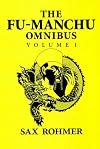
The Fu Manchu Omnibus: Volume 1
by Sax Rohmer
Fu Manchu Omnibus (1), Fu Manchu (Collections and Selections — Omnibus 1-3)
On This Page
Description
Since 1913, Sax Rohmer's tales of the sinister Dr. Fu-Manchu have delighted readers and moviegoers alike. For nearly a quarter of a century, they have been out of print, but Allison & Busby is reissuing them all in omnibus editions.Tags
Recommendations







































Member Recommendations

jseger9000 Both series deal with a Vitorian era master criminal and the intrepid adventurers who protect us from them. Dr. Nikola is seen as one of the inspirations for Fu Manchu.
20

Sumuru by Sax Rohmer
by Bookwomble
Member Reviews
The first book in the volume, The Mystery of Dr Fu Manchu, was, I think, the best of the three in this omnibus edition. Introducing the arch-rivals Fu Manchu and Dennis Nayland Smith, together with Smith's sidekick Dr Petrie, in exciting and mysterious fashion. Set in England, the locales are nonetheless exotic (of course, England might be exotic to you anyway, if you don't live here): London's Chinatown, full of dank opium dens next to a dirty River Thames, equally full with strangely mutilated corpses; town houses occupied by larger-than-life hunter/explorers and packed with plundered artefacts; country mansions where invisible death lurks in the shrubbery!
The second, The Devil Doctor, more obviously showed that these stories were show more first serialised in magazines. Enjoyable in an episodic manner, but the plot didn't hang together so well. I can't really remember much of the story already, but it was definitely good reading at the time!
The final book, The Si-Fan Mysteries, improves somewhat on the second. Already the incidents are starting to show a certain familiarity, but that's actually part of the charm - you know roughly what you're getting, so it's proper escapist, don't-have-to-think-too-much fun. Some nice atmospheric stuff in this one, and the mandarin Ki-Ming seems like he might actually be a match for the Devil Doctor!
I suppose something must be said about charges of racism - firstly, it's foolish to judge the mores of another time by our own. It's most unlikely the books would see print in their present form if first published now, and that's as it should be. At the time, however, the cultural stereotypes were mainstream and Rohmer shouldn't be overly criticised for not pre-empting the general change in outlook that would come many decades later. The stereotypes, when used, are really just a shorthand so that the action can keep going without excessive explanatory narrative. Rohmer's purpose is not a racist one and there are stereotypical stock characters, both good and bad, from east and west in the books. Crucially, the narrator, Dr Petrie, falls in love with and marries an eastern woman, not a likely plot device if racism and white supremacy was the sub-text.
Put these things in their historical context and then go with the flow. show less
The second, The Devil Doctor, more obviously showed that these stories were show more first serialised in magazines. Enjoyable in an episodic manner, but the plot didn't hang together so well. I can't really remember much of the story already, but it was definitely good reading at the time!
The final book, The Si-Fan Mysteries, improves somewhat on the second. Already the incidents are starting to show a certain familiarity, but that's actually part of the charm - you know roughly what you're getting, so it's proper escapist, don't-have-to-think-too-much fun. Some nice atmospheric stuff in this one, and the mandarin Ki-Ming seems like he might actually be a match for the Devil Doctor!
I suppose something must be said about charges of racism - firstly, it's foolish to judge the mores of another time by our own. It's most unlikely the books would see print in their present form if first published now, and that's as it should be. At the time, however, the cultural stereotypes were mainstream and Rohmer shouldn't be overly criticised for not pre-empting the general change in outlook that would come many decades later. The stereotypes, when used, are really just a shorthand so that the action can keep going without excessive explanatory narrative. Rohmer's purpose is not a racist one and there are stereotypical stock characters, both good and bad, from east and west in the books. Crucially, the narrator, Dr Petrie, falls in love with and marries an eastern woman, not a likely plot device if racism and white supremacy was the sub-text.
Put these things in their historical context and then go with the flow. show less
I love pulp's weird vulnerability. And this is really that.
This collection of the first three Fu Manchu books are certainly a product of their time and blatantly non-politically correct. However, they are still great fun and an entertaining read. All three of these books are available for free in the Kindle library, however the quality of those free editions are lacking in terms of what we have come to expect of Kindle. This omnibus was created especially for the Kindle and as such is a higher quality ebook. Sure, it costs a little money but for 99 cents I found the books to be a much easier read in this format.
Ratings
Members
- Recently Added By
Lists

Guilty Pleasures
223 works; 86 members
Author Information

189+ Works 6,135 Members
Sax Rohmer was born in Birmingham, Warwickshire. At the age of 18, he adopted the name Sarsfield, the name of a famous Irish general admired by Rohmer's mother. He married Rose Elizabeth Knox in 1909 and, at his wife's insistence, began using the name Sax Rohmer for his fiction, eventually employing the pseudonym as his actual name. Rohmer was show more basically a self-taught scholar. He started writing as a journalist; his beat was the Limehouse underworld in London. Rohmer had a difficult time breaking into the professional fiction markets, but once he did, he became a household name for exotic adventure both in England and in America. Although his writing brought Rohmer success and money, he was never much of a businessman, and most of his wealth was squandered because of his extravagance and through financial mismanagement. Rohmer eventually moved to New York City. One of Rohmer's great intellectual interests was the occult and supernatural, and these elements frequently appeared as motifs in his fiction. His most famous creation was the evil oriental mastermind, Dr. Fu Manchu, first presented in the novel The Mystery of Fu Manchu in 1913 (later retitled The Insidious Dr. Fu Manchu for its American publication, also in 1913). Most espionage or adventure fiction exploits the social paranoias of its time, and Rohmer himself effectively tapped the Westerner's fear of the stereotyped "yellow peril" threat---the negatively perceived belief that Orientals will conquer the world. The Fu Manchu adventures were patterned, in part, after Arthur Conan Doyle's Sherlock Holmes stories. Rohmer's protagonists in these adventures, Sir Denis Nayland Smith and his companion Dr. Petrie, look very much like Doyle's Holmes and Watson, but, whereas Doyle centered his narratives on the heroes and specifically on the elaborate process of detection, Rohmer focused his attention on the villain and on slam-bang action. Fu Manchu was a master of both Western science and Eastern mysticism, and his efforts at world domination caused no end of problems for Smith and Petrie. In Fu Manchu, Rohmer had created the most famous villain in popular fiction (although Rohmer maintained that Fu Manchu was based on an actual Limehouse criminal). Despite Rohmer's use of outrageous racial stereotyping, many of his novels hold up well today and provide superior examples of how to create narrative pacing and suspense. (Bowker Author Biography) show less
Series


Work Relationships
Common Knowledge
- Canonical title
- The Fu Manchu Omnibus: Volume 1
- People/Characters
- Fu Manchu; Sir Denis Nayland Smith; Dr. Petrie; Karamaneh; Fah Lo Suee
- Important places
- London, England, UK
- Important events
- Yellow Peril
- Original language
- English
- Canonical DDC/MDS
- 823.0872
Classifications
Statistics
- Members
- 107
- Popularity
- 303,230
- Reviews
- 3
- Rating
- (4.18)
- Languages
- English
- Media
- Paper, Ebook
- ISBNs
- 2
- ASINs
- 2