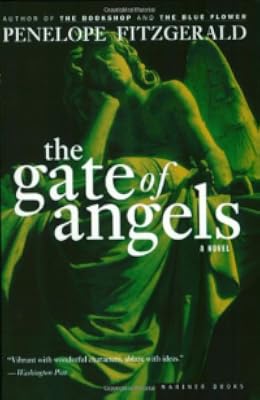
The Gate of Angels
by Penelope Fitzgerald
On This Page
Description
Shortlisted for the Booker Prize: A novel of two 'wonderful characters' who meet by accident in Edwardian England, and fall inconveniently in love (The Washington Post). In 1912, rational scientist Fred Fairly, one of Cambridge's best and brightest, crashes his bike and wakes up in bed with a stranger-fellow casualty Daisy Saunders, a charming, pretty, and almost pathologically generous working-class nurse. So begins a series of complications-not only of the heart but also of the head-as show more Fred and Daisy take up each other's education and turn each other's philosophies upside down. From the recipient of a National Book Critics Circle Award, among other honors, this is a story of an unlikely and possibly doomed romance. show lessTags
Recommendations



























Member Reviews
This could easily have turned into a fairly silly 'positivist-scientist comes to see that there's at least one thing that he can't explain positivistically, viz., love' kind of tale, which I'd be fine with under other circumstances, but I expect more from Fitzgerald. And she delivers more, much more--emotionally compelling, intellectually riveting, and told with her usual cold, charming narrator's voice. But most importantly she avoids the romantic-comedy category by making it very clear that Fred's love for Daisy is nowhere near as important as the many, many other things in life that aren't susceptible to a 'scientific' analysis, such as, say, morality, mystery, and history.
Going on what the blurb says, The gate of angels is an academic novel and a romance set in 1912 Cambridge. Also, it apparently features a character based on M. R. James, whose early 20thC horror stories I will always have a soft spot for. And an academic novel and a romance set in 1912 Cambridge is indeed a good way to describe this novel. The two main characters, Fred Fairly and Daisy Saunders meet by (literal) accident, and since the former is a Physics fellow at a tiny Cambridge College, and the latter is a working-class nurse-in-training, there is the expected attraction of opposites. Well, kind of. The book never specifies that that is what’s going on, but merely implies it.
In fact, Fitzgerald leaves lots unsaid in this book: show more she juxtaposes sections that may differ in tone, location, sometimes even genre, and leaves it up to the reader to connect them -- the well-read reader, who knows how romances and academic novels typically develop. Characterization is bare-bones, mainly done through dialogue and Omniscient-Narrator commentary, only hinting at a more coherent personality in the background -- all this is again to be assembled by the reader. I imagine that this may feel disjointed or even unfinished to some, but reading one section in the spirit of the others worked wonderfully for me (or perhaps I merely like the way my own imagination works). Carrying over the subtle silliness and absurdity from some of the sections and treating the novel as though that is the kind of heightened reality in which it is set makes the whole thing come together beautifully.
For silly and absurd is what this novel is -- quietly and occasionally at first, but the mainly straightforward romance plot, which runs so much on readers’ expectations of both romances and academic settings, acquires more and more sudden absurdities and tongue-in-cheek moments until it reaches a crescendo and turns into what I unrepentantly call “uproariously funny”. I giggle-laughed with delight repeatedly.
It turns out there is a character based on M. R. James in there -- a pipe-smoking mediaeval palaeographer who writes ghost stories in his spare time and is fond of reading them out loud to colleagues at various Colleges. Fitzgerald even includesher take on one of his ghost stories -- a case of sudden genre shift, at which point the novel finally comes into its own as an unapologetically funny book. Seriously, the crowning moment of awesome in this book is a reference to another writer’s style -- I love it when media can pull that off. (Does it work if you haven’t read M. R. James? Totally! The genre shift even comes with foreshadowing!) After that, the book coasts to an ending on a wave of good-will.
Penelope Fitzgerald has an exquisitely calibrated sense of humour, and she puts it to excellent use in The gate of Angels. I absolutely loved this book: it’s going to be hard to beat this one in terms of liveliness and shameless fun. show less
In fact, Fitzgerald leaves lots unsaid in this book: show more she juxtaposes sections that may differ in tone, location, sometimes even genre, and leaves it up to the reader to connect them -- the well-read reader, who knows how romances and academic novels typically develop. Characterization is bare-bones, mainly done through dialogue and Omniscient-Narrator commentary, only hinting at a more coherent personality in the background -- all this is again to be assembled by the reader. I imagine that this may feel disjointed or even unfinished to some, but reading one section in the spirit of the others worked wonderfully for me (or perhaps I merely like the way my own imagination works). Carrying over the subtle silliness and absurdity from some of the sections and treating the novel as though that is the kind of heightened reality in which it is set makes the whole thing come together beautifully.
It turns out there is a character based on M. R. James in there -- a pipe-smoking mediaeval palaeographer who writes ghost stories in his spare time and is fond of reading them out loud to colleagues at various Colleges. Fitzgerald even includes
Penelope Fitzgerald has an exquisitely calibrated sense of humour, and she puts it to excellent use in The gate of Angels. I absolutely loved this book: it’s going to be hard to beat this one in terms of liveliness and shameless fun. show less
Set in 1912, Fred Fairly an academic of the fictional St Angelicus College in Cambridge is a confirmed bachelor in accordance with college rules that permit no female to enter their doors. Then Daisy arrived in dramatic fashion when he crashed his bicycle into hers. They were both knocked unconscious and wakened up in the same bed, Daisy's wedding ring intended to fend off unwelcome men causing the misunderstanding. Without providing him even with her name the endearing Daisy returned to London going on to become a probationer nursing student. All this time Fred has been unable to forget her.
Fitzgerald's books are little jewels and this one is exactly that, however, she also introduces questions about the nature of belief and of issues show more facing women and their need for solidarity. While it is a charming love story it's also beautifully written with wit and intelligence. show less
Fitzgerald's books are little jewels and this one is exactly that, however, she also introduces questions about the nature of belief and of issues show more facing women and their need for solidarity. While it is a charming love story it's also beautifully written with wit and intelligence. show less
Is it possible that there was ever a more charming writer than Penelope Fitzgerald? Though not every one of her stories quite came off, the style was always there, the humanity, and the wit with its wisdom. That was much the case with 'Gate of Angels,' a fine human comedy with a touch of the ghost story at its heart. It also featured real-life scientists - or, I should say, characters of a scientific disposition who come across as being true to the science they love. No simple name-dropping here - Fitzgerald seems to have a fine grasp of her stuff, and it makes for some fantastic moments.
Time, Space, Love, Atomic Particles, Collide on a Dirt Road in Cambridge
Set in 1912 (dates are significant) around an obscure little male only college of Cambridge University. So male that celibacy is preferred for many of the staff, so small that there isn’t even a residence.
Scientific debates surface like faith in the senses that compels Fred to speak to his rector father that he has lost his faith. The atom is declared unreliable, but not because Einstein, but because one academic thinks it might fade.
This privileged world is punctured by Daisy, a girl from the south of London who runs into trouble with men and her values clash with her duties as a nurse when she tries to do good, though her working class poor background good is show more not the same as medical good. She ends up in Cambridge and an accident with a bicycle, a cart without lights and a runaway cyclist propels her into Fred’s love. Atoms still colliding randomly in space showing off their relevance.
Such eruptions seem trivial just before the war in two year’s time that will rupture all known ways of being. The foreboding is there – Rupert Brooke is playing Mephistopheles at the Marlowe Society theatre event. Young men taking their first year fail their first essays and wonder if their master is the right sort for them, little do they know how the social order will change them.
Though Rupert Brooke – who would be dead from septicaemia on his way to Gallipoli in 1915, buried on the Greek island of Skiros, performed in that play in 1907, not in 1912. What do we make of this cosmological anachronism? Is time variable or something. Perhaps to the old academics at Angelicus, the logic that an event can take place 5 years later may seem as logical as any spiritual mystical event – there’s a nice ghost story in there too – or attitudes as old as the 17thC candle holders that light the receptions rooms of the college.
Though, Fred and Daisy coming together reflects the broader transformation in the 20thC where such things are possible. The space time continuum is called into question. Fred is at the heart of change, his mother and sisters have turned the house into a busy hub of the suffragette battles. Daisy is a go-getter who may do very well in the world once the war is over.
This is a fun read, Fitzgerald has a lovely light touch whether in dialogue or the description of residency rooms. She brings people in and out of the story like a stage manager. She easily handles metaphysical questions alongside London street talk. I can imagine that the details she uses came across her desk when she worked in a bookshop. I can see her putting aside musty old books about colleges, physics, candelabra, British road law, suffragette memoirs rolling it all up into a gem of a story about the illogic of love.
**thanks to GR reader Fionnuala for her deep reading style introducing us to authors we wouldn't normally think of** show less
Set in 1912 (dates are significant) around an obscure little male only college of Cambridge University. So male that celibacy is preferred for many of the staff, so small that there isn’t even a residence.
Scientific debates surface like faith in the senses that compels Fred to speak to his rector father that he has lost his faith. The atom is declared unreliable, but not because Einstein, but because one academic thinks it might fade.
This privileged world is punctured by Daisy, a girl from the south of London who runs into trouble with men and her values clash with her duties as a nurse when she tries to do good, though her working class poor background good is show more not the same as medical good. She ends up in Cambridge and an accident with a bicycle, a cart without lights and a runaway cyclist propels her into Fred’s love. Atoms still colliding randomly in space showing off their relevance.
Such eruptions seem trivial just before the war in two year’s time that will rupture all known ways of being. The foreboding is there – Rupert Brooke is playing Mephistopheles at the Marlowe Society theatre event. Young men taking their first year fail their first essays and wonder if their master is the right sort for them, little do they know how the social order will change them.
Though Rupert Brooke – who would be dead from septicaemia on his way to Gallipoli in 1915, buried on the Greek island of Skiros, performed in that play in 1907, not in 1912. What do we make of this cosmological anachronism? Is time variable or something. Perhaps to the old academics at Angelicus, the logic that an event can take place 5 years later may seem as logical as any spiritual mystical event – there’s a nice ghost story in there too – or attitudes as old as the 17thC candle holders that light the receptions rooms of the college.
Though, Fred and Daisy coming together reflects the broader transformation in the 20thC where such things are possible. The space time continuum is called into question. Fred is at the heart of change, his mother and sisters have turned the house into a busy hub of the suffragette battles. Daisy is a go-getter who may do very well in the world once the war is over.
This is a fun read, Fitzgerald has a lovely light touch whether in dialogue or the description of residency rooms. She brings people in and out of the story like a stage manager. She easily handles metaphysical questions alongside London street talk. I can imagine that the details she uses came across her desk when she worked in a bookshop. I can see her putting aside musty old books about colleges, physics, candelabra, British road law, suffragette memoirs rolling it all up into a gem of a story about the illogic of love.
**thanks to GR reader Fionnuala for her deep reading style introducing us to authors we wouldn't normally think of** show less
A delicate little sketch of a young physicist in 1912 Cambridge whose rationalist convictions about the way the world should be are challenged on every side by the way it actually is: modern physics, the complexities of human emotions, feminism and the women's suffrage movement, M.R. James and his ghost stories, the European political situation, etc., etc. As you would expect from Fitzgerald, it's full of gloriously unexpected, subversive details and it's a delight to read, but perhaps she overdid her instinct for compression a bit: there are an awful lot of Big Ideas lurking around on the fringes of this book, but they rely very heavily on the reader to fill in the blanks.
As in The blue flower, we are expected to notice how the men show more keep themselves busy theorising and analysing whilst the women are solving real-world problems. St Angelicus College, which manages to function entirely without female assistance, is shown to be an absurdity that has never contributed anything useful to the world except as a model of bloody-minded reaction.
When she talks about external historical events, there is obviously a bit of simplification and time-compression going on (e.g. with Marsden and Geiger's visit to Cambridge in the last chapter: what they presented probably didn't come as such a surprise to Cambridge scientists as Fitzgerald implies, given that Rutherford had published his model of the atom a year earlier). It's not a super-realistic historical novel, and it's clearly not intended to be, but it gives a plausible feel to the pre-war Cambridge that it describes, without any intrusive anachronisms. show less
As in The blue flower, we are expected to notice how the men show more keep themselves busy theorising and analysing whilst the women are solving real-world problems. St Angelicus College, which manages to function entirely without female assistance, is shown to be an absurdity that has never contributed anything useful to the world except as a model of bloody-minded reaction.
When she talks about external historical events, there is obviously a bit of simplification and time-compression going on (e.g. with Marsden and Geiger's visit to Cambridge in the last chapter: what they presented probably didn't come as such a surprise to Cambridge scientists as Fitzgerald implies, given that Rutherford had published his model of the atom a year earlier). It's not a super-realistic historical novel, and it's clearly not intended to be, but it gives a plausible feel to the pre-war Cambridge that it describes, without any intrusive anachronisms. show less
Set in 1912, Fred Fairley is a junior fellow at the St Angelicus College at Cambridge. He is a student of physics who has veered away from his Christian upbringing. When he and Daisy Saunders collide on their bicycles, he falls in love and contemplates the irrational emotional realm, which seems almost opposite to his scientific perspective. He returns home to visit his family, and finds his mother and sisters are now supporting women’s suffrage.
It speaks to a society on the verge of massive change, and I am sure it is no accident that it is set just before the onset of World War I. Upcoming changes include the rise of scientific explanations of the world, women’s suffrage, and the decreasing separation in social classes. It show more contains a number of literary allusions, and even an embedded ghost story! Fitzgerald covers a lot of ground in a short novel. I particularly enjoyed the subtle humor. It will appeal to those who enjoy quiet novels with interesting characters and societal insights. show less
It speaks to a society on the verge of massive change, and I am sure it is no accident that it is set just before the onset of World War I. Upcoming changes include the rise of scientific explanations of the world, women’s suffrage, and the decreasing separation in social classes. It show more contains a number of literary allusions, and even an embedded ghost story! Fitzgerald covers a lot of ground in a short novel. I particularly enjoyed the subtle humor. It will appeal to those who enjoy quiet novels with interesting characters and societal insights. show less
Members
- Recently Added By
Lists

Booker Prize
491 works; 62 members
Booker Prize Shortlist: Titles Read
103 works; 10 members

Man Booker Prize Longlist 1990
6 works; 2 members

Books Read in 2016
4,666 works; 197 members

Books Read in 2018
4,360 works; 110 members

Michael Dirda's 100 Best Comic Novels
100 works; 1 member
Author Information

24+ Works 12,070 Members
In 1997 Penelope Fitzgerald's novel The Blue Flower was named one of the New York Times Book Review's eleven Best Books of the Year. Winner of the 1979 Booker Prize for Offshore, Fitzgerald was also short-listed for the Booker for The Bookshop. The Beginning of Spring, and The Gate of Angels. Penelope Fitzgerald lives in England. (Bowker Author show more Biography) Penelope Fitzgerald, one of England's most-celebrated contemporary writers, is the author of "The Blue Flower," which won the National Book Critics Circle Award. Winner of the 1979 Booker Prize for "Offshore," she was also shortlisted for the Booker for "The Bookshop," "The Beginning of Spring," & "The Gate of Angels." She lives in London. (Bowker Author Biography) Admired by many as one of the leading English novelists of her day, Penelope Fitzgerald (1916-2000) wrote some twelve books of fiction and nonfiction over the course of her writing career; which began at the age of sixty. She won the National Book Critics Circle Award for "The Blue Flower" and the Booker Prize for "Offshore". She died on April 28, 2000, at the age of eighty-three. (Bowker Author Biography) show less
Some Editions
Awards and Honors
Awards
Notable Lists
Series
Belongs to Publisher Series
insel taschenbuch (2247)
Work Relationships
Is contained in
Common Knowledge
- Canonical title
- The Gate of Angels
- Original title
- The Gate of Angels
- Original publication date
- 1990
- People/Characters
- Fred Fairly; Daisy Saunders
- Important places
- University of Cambridge, Cambridge, Cambridgeshire, England, UK; Cambridge, Cambridgeshire, England, UK
- First words
- How could the wind be so strong, so far inland, that cyclists coming into the town in the late afternoon looked more like sailors in peril?
- Quotations
- Fred took a few sheets of the college paper. He shook his fountain pen to see how much ink was left in it, and wrote: "Dear Miss Saunders".
- Last words
- (Click to show. Warning: May contain spoilers.)The slight delay, however, meant that she met Fred Fairly walking slowly back to St Angelicus.
Classifications
Statistics
- Members
- 956
- Popularity
- 27,595
- Reviews
- 40
- Rating
- (3.72)
- Languages
- 5 — Dutch, English, German, Italian, Spanish
- Media
- Paper, Audiobook, Ebook
- ISBNs
- 22
- UPCs
- 1
- ASINs
- 14