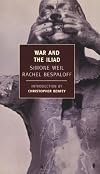
War and the Iliad
by Simone Weil, Rachel Bespaloff
On This Page
Description
"Simone Weil's "The Iliad, or the Poem of Force" is one of her most celebrated works - an analysis of Homer's epic that presents a nightmare vision of combat as a machine in which all humanity is lost. First published on the eve of war in 1939, the essay has often been read as a pacifist manifesto. Rachel Bespaloff was a French contemporary of Weil's whose work similarly explored the complex relations between literature, religion, and philosophy. She composed her own distinctive discussion show more of the Iliad in the midst of World War II. Bespaloff's account of the Iliad brings out Homer's novelistic approach to character and the existential drama of his characters' choices; it is marked, too, by a tragic awareness of how the Iliad speaks to times and places where there is no hope apart from war. This edition brings together these two influential essays for the first time."--BOOK JACKET. show lessTags
Recommendations


















Member Reviews
This soaring and glorious meditation on the Iliad made me feel I’d learned something that only Simone Weil could teach me. In a way though it made me sad to read this essay, because I realized once again how few women write like this, absolutely sure of their superior intellect and expertise, and with absolute authority, and without a hint of apology for taking command of their thesis and telling the reader what’s what. No throat clearing clauses like “I’m not sure but” or “It’s possible that…”. Just a rush of knowledge written without doubt or equivocation.
Susan Sontag wrote this way. So did Gertrude Stein. Camille Paglia writes this way. In her case I disagree with most of what she writes but I still love what I show more would call her …a word comes to mind…see, here is the problem, the word that comes to mind is “I love her ballsy-ness.” My language for the act of writing with unapologetic authority is corrupted by a learned cultural sense that to write this way is inherently male. That's bad. show less
Susan Sontag wrote this way. So did Gertrude Stein. Camille Paglia writes this way. In her case I disagree with most of what she writes but I still love what I show more would call her …a word comes to mind…see, here is the problem, the word that comes to mind is “I love her ballsy-ness.” My language for the act of writing with unapologetic authority is corrupted by a learned cultural sense that to write this way is inherently male. That's bad. show less
Ratings
Members
- Recently Added By
Lists

Books Read in College
80 works; 5 members

In Our Time books
4,934 works; 2 members
Author Information

220+ Works 7,476 Members
Born in Paris, Weil came from a highly intellectual family. After a brilliant academic career at school and university, she taught philosophy interspersed with periods of hard manual labor on farms and in factories. Throughout her life she combined sophisticated and scholarly interests with an extreme moral intensity and identification with the show more poor and oppressed. A twentieth-century Pascal (see Vol. 4), this ardently spiritual woman was a social thinker, sensitive to the crises of modern humanity. Jewish by birth, Christian by vocation, and Greek by aesthetic choice, Weil has influenced religious thinking profoundly in the years since her death. "Humility is the root of love," she said as she questioned traditional theologians and held that the apostles had badly interpreted Christ's teaching. Christianity was, she thought, to blame for the heresy of progress. During World War II, Weil starved herself to death, refusing to eat while victims of the war still suffered. (Bowker Author Biography) show less

9+ Works 527 Members
Some Editions
Series
Belongs to Publisher Series
Work Relationships
Common Knowledge
- Canonical title
- War and the Iliad
- Original title
- War and the Iliad
- People/Characters
- Homer
- Important events
- Bronze Age; Trojan War
- Original language
- French
- Disambiguation notice
- Originally published as two separate essays: L'Iliade ou le poème de la force/Simone Weill; De l'Iliade / Rachel Bespaloff. Now published together and translated into English.
Classifications
- Genres
- Literature Studies and Criticism, Nonfiction, Fiction and Literature
- DDC/MDS
- 883.01 — Literature & rhetoric Classical & modern Greek literatures Classical Greek epic poetry and fiction Pseudo-Callisthenes
- LCC
- PA4037 .W3513 — Language and Literature Greek language and literature. Latin language and literature Greek literature Individual authors Homer
- BISAC
Statistics
- Members
- 416
- Popularity
- 74,469
- Reviews
- 1
- Rating
- (3.96)
- Languages
- English, French, German
- Media
- Paper, Ebook
- ISBNs
- 3
- ASINs
- 1