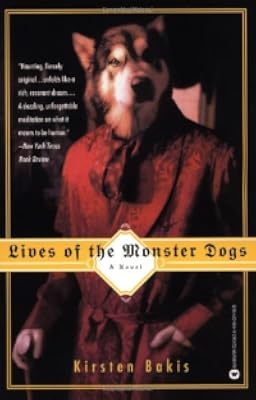
Lives of the Monster Dogs
by Kirsten Bakis
On This Page
Description
The twentieth anniversary of a postmodern classic, blending the gothic novel with bleeding-edge science fictionAfter a century of cruel experimentation, a haunted race of genetically and biomechanically uplifted canines are created by the followers of a mad nineteenth-century Prussian surgeon. Possessing human intelligence, speaking human language, fitted with prosthetic hands, and walking upright on their hind legs, the monster dogs are intended to be super soldiers. Rebelling against show more their masters, however, and plundering the isolated village where they were created, the now wealthy dogs make their way to New York, where they befriend the young NYU student Cleo Pira and—acting like Victorian aristocrats—become reluctant celebrities.
Unable to reproduce, doomed to watch their race become extinct, the highly cultured dogs want no more than to live in peace and be accepted by contemporary society. Little do they suspect, however, that the real tragedy of their brief existence is only now beginning.
Told through a variety of documents—diaries, newspaper clippings, articles for Vanity Fair, and even a portion of an opera libretto—Kirsten Bakis's Lives of the Monster Dogs uses its science-fictional premise to launch a surprisingly emotional exploration of the great themes: love, death, and the limits of compassion. A contemporary classic, this edition features a new introduction by Jeff VanderMeer.
. show less
Tags
Recommendations

















Member Recommendations
raizel It's been a long time since I read this, but I remember the same feeling of sadness about the whole sorry affair.
40
Member Reviews
I had to stop reading this book.
I was able to get 30% of the way through the book and it just became so over the top.
A group of dogs that are able to talk via voice box, and have prosthetic arms with working fingers, have tons of money, and insist on wearing Prussian style clothing from the 1800s arrive in 2009 Manhattan. The dogs had killed their masters, humans that were treating the dogs as slaves in some remote area in Canada. They collected all the money, jewels, gold, etc and ran to New York and announce their arrival by helicopter.
And … Manhattan seems okay with this? Like it’s not a big deal that these large furry dogs are walking around in very expensive frippery, buying up real estate, booking spots on news programs. show more Cleo Pira, one of the main characters, writes a news article saying “Some people are surprised they haven’t vanished yet: been debunked, proved to be a collective hallucination.” Id like to believe that this book I hold in my hands is a massive hallucination, but seeing evidence that so many have also read and reviewed this book would prove otherwise.
In one of the beginning chapters (because that’s all I really got through) the early life of Augustus Rank, the creator of these “Monster Dogs” is written out, part biography by one of the dogs and part memoir by Augustus himself. In these brief passages, we find that Augustus experimented on animals from a young age, first birds, where the author Kirsten Bakis gives an extremely detailed account of the feeling of a knife entering the birds body, then moved on to bats, mice, cats, and culminating with a grotesque surgery on a cow. And no one bats an eye other than at the financial cost young Augustus has caused.
What really sealed my ability to finish the book was a diary entry from Augustus where he describes murdering his half brother, and then 2 paragraphs later says that he has a woman in his head. But a note from the dog that is attempting to be a historian and write about Augustus says that this never comes up again?? So we’re just reading the thoughts of a deranged killer. Point blank. And this person is also supposed to be some great mind who is responsible for creating these “monster dogs” that may be dying or reverting back to dog form.
Also there appear to just be laser guns in this 2009 Manhattan that people just wear on their hips.
I don’t know what you’re looking for in a story, but I can promise you, this isn’t it. show less
I was able to get 30% of the way through the book and it just became so over the top.
A group of dogs that are able to talk via voice box, and have prosthetic arms with working fingers, have tons of money, and insist on wearing Prussian style clothing from the 1800s arrive in 2009 Manhattan. The dogs had killed their masters, humans that were treating the dogs as slaves in some remote area in Canada. They collected all the money, jewels, gold, etc and ran to New York and announce their arrival by helicopter.
And … Manhattan seems okay with this? Like it’s not a big deal that these large furry dogs are walking around in very expensive frippery, buying up real estate, booking spots on news programs. show more Cleo Pira, one of the main characters, writes a news article saying “Some people are surprised they haven’t vanished yet: been debunked, proved to be a collective hallucination.” Id like to believe that this book I hold in my hands is a massive hallucination, but seeing evidence that so many have also read and reviewed this book would prove otherwise.
In one of the beginning chapters (because that’s all I really got through) the early life of Augustus Rank, the creator of these “Monster Dogs” is written out, part biography by one of the dogs and part memoir by Augustus himself. In these brief passages, we find that Augustus experimented on animals from a young age, first birds, where the author Kirsten Bakis gives an extremely detailed account of the feeling of a knife entering the birds body, then moved on to bats, mice, cats, and culminating with a grotesque surgery on a cow. And no one bats an eye other than at the financial cost young Augustus has caused.
What really sealed my ability to finish the book was a diary entry from Augustus where he describes murdering his half brother, and then 2 paragraphs later says that he has a woman in his head. But a note from the dog that is attempting to be a historian and write about Augustus says that this never comes up again?? So we’re just reading the thoughts of a deranged killer. Point blank. And this person is also supposed to be some great mind who is responsible for creating these “monster dogs” that may be dying or reverting back to dog form.
Also there appear to just be laser guns in this 2009 Manhattan that people just wear on their hips.
I don’t know what you’re looking for in a story, but I can promise you, this isn’t it. show less
This book had been on my wish list for so long that it's probably a bigger disappointment to me than it would have been if I'd just picked it up without knowing anything about it other than its intriguing title.
The plot, a synopsis of which was what interested me originally in this book, involves a group of artificially enhanced, intelligent dogs of mysterious origins who have moved to the New York City of the near future. A graduate student, Cleo, is one of the few humans admitted into their social circle. There are so many interesting ideas that are raised and could have been explored, but instead we are told way too much about Cleo's none-too-interesting personal angst and are ultimately treated to metaphysical babble that sheds no show more light on—in fact, seems to have nothing to do with—the very interesting moral, philosophical, and even medical issues that these monstrous dogs (and they are monstrous in some ways) would have, or with the enigma of their grisly creator, Augustus Rank. The story of the dogs' origin is presented early on, and its titillatingly gruesome details are rather a red herring, since the dogs' own feelings about their creator is never really revealed.
Rarely has such a good premise, full of so many ideas ripe for exploration, been utilized so poorly. Even Cleo, the dogs' human spokesperson, is underdrawn. We learn far more about her taste in clothes than about the reason for her fascination with the dogs. Ultimately, while this book isn't monstrous, it is a dog. I wonder why it was short-listed for the Orange Prize. show less
The plot, a synopsis of which was what interested me originally in this book, involves a group of artificially enhanced, intelligent dogs of mysterious origins who have moved to the New York City of the near future. A graduate student, Cleo, is one of the few humans admitted into their social circle. There are so many interesting ideas that are raised and could have been explored, but instead we are told way too much about Cleo's none-too-interesting personal angst and are ultimately treated to metaphysical babble that sheds no show more light on—in fact, seems to have nothing to do with—the very interesting moral, philosophical, and even medical issues that these monstrous dogs (and they are monstrous in some ways) would have, or with the enigma of their grisly creator, Augustus Rank. The story of the dogs' origin is presented early on, and its titillatingly gruesome details are rather a red herring, since the dogs' own feelings about their creator is never really revealed.
Rarely has such a good premise, full of so many ideas ripe for exploration, been utilized so poorly. Even Cleo, the dogs' human spokesperson, is underdrawn. We learn far more about her taste in clothes than about the reason for her fascination with the dogs. Ultimately, while this book isn't monstrous, it is a dog. I wonder why it was short-listed for the Orange Prize. show less
I first read this book when I was in that gray, everlastingly numb area after a breakup. The main character, Cleo Pira, was in the same place at the beginning of this novel, and Bakis's prose captured that lost feeling incredibly well.
I soon forgot about my own feelings as I was engrossed in the melancholy lives of the monster dogs, their magnificent and horrible creation and escape to modern-day (2008) New York City, and their attempt to make a life as creatures destined to be outsiders.
There is so much feeling in this book, much of it sad, but also accepting. There are twinges of sci-fi and medical horror - the descriptions of the creator of the monster dogs, Augustus Rank, his childhood and brilliantly single-minded and psychopathic show more devotion to his work, were perfectly chilling. I love stories about mad scientists and what comes of their mad work, and Bakis's novel fits in easily with Shelley's Frankenstein and Wells's Island of Doctor Moreau. show less
I soon forgot about my own feelings as I was engrossed in the melancholy lives of the monster dogs, their magnificent and horrible creation and escape to modern-day (2008) New York City, and their attempt to make a life as creatures destined to be outsiders.
There is so much feeling in this book, much of it sad, but also accepting. There are twinges of sci-fi and medical horror - the descriptions of the creator of the monster dogs, Augustus Rank, his childhood and brilliantly single-minded and psychopathic show more devotion to his work, were perfectly chilling. I love stories about mad scientists and what comes of their mad work, and Bakis's novel fits in easily with Shelley's Frankenstein and Wells's Island of Doctor Moreau. show less
A 19th-century Prussian mad scientist dreams of creating a conquering army of intelligent dogs with prosthetic hands. He and his cult of followers relocate to a small and hidden town in Canada, where eventually one of his successors does in fact manage to create these dogs, who the humans in the town then keep as slaves, until eventually they rise up and massacre them all. They then live in the Canadian wilderness somewhere for eight years, before finally coming to New York City, where they live rich and famous lives. One of them -- a scholar attempting to write a history of the dogs and the man who envisioned their creation -- latches onto a college student, apparently because he thinks she looks like the mad scientist's mother, and show more she becomes the one tasked with bringing their story to the world.
It's a very odd book, and not just due to its strange science-fictional premise. Early on, I found myself thinking, OK, I don't know what to make of this, but I'm interested to see where it goes. Having finished it, I still don't know what to make of it, nor am I entirely certain where it went. The concept, for all its weirdness, is certainly interesting. There are some nicely well-written passages, and perhaps a slightly poignant moment or two. But it never felt especially compelling to me, and it just never felt like any of it really added up to much of anything. Also, it features a bizarre kind of mysticism that never particularly worked for me. show less
It's a very odd book, and not just due to its strange science-fictional premise. Early on, I found myself thinking, OK, I don't know what to make of this, but I'm interested to see where it goes. Having finished it, I still don't know what to make of it, nor am I entirely certain where it went. The concept, for all its weirdness, is certainly interesting. There are some nicely well-written passages, and perhaps a slightly poignant moment or two. But it never felt especially compelling to me, and it just never felt like any of it really added up to much of anything. Also, it features a bizarre kind of mysticism that never particularly worked for me. show less
An elegant and beautiful novel, a dream-like memoir of the (future) time when the Monster Dogs lived in New York, told by an intimate human friend.
The narrator Cleo's relationship with the genetically altered, intelligent, speaking dogs explores what we mean by friendship, by love, by identification with the Other, by sanity itself. How far can we change who we are and still be who we are? Can we ever change enough to leave who we are behind?
The narrator Cleo's relationship with the genetically altered, intelligent, speaking dogs explores what we mean by friendship, by love, by identification with the Other, by sanity itself. How far can we change who we are and still be who we are? Can we ever change enough to leave who we are behind?
On November 7th 2008 a phone call is made to various journalists announcing that an ‘incredible monster’ would be arriving at the V.I.P. heliport in Manhattan the following day. On November 8th the helicopter lands and stepping from the helicopter dressed in a dark coloured uniform style jacket, wearing spectacles and holding a cane is a six foot tall Malamute dog standing on its hind legs. It’s reported that instead of front paws the dog has hands and that it talks. After this arrival 150 more ‘monster dogs’ appear in New York after having left a secret location in Canada some years earlier.
The novel moves between the Cleo Pira’s reminiscences of her time as the monster dog’s official biographer and the diary and papers show more of Ludwig von Sacher, the monster dog’s historian. It is through Ludwig that we learn the story of Augustus Rank, the man who created the monster dogs. As a child the brilliant Augustus Rank would surgically operate on small animals trying to create, ‘Frankenstein’ like, a hybrid of birds and mice; more specifically, attempting to transplant the wings of birds onto mice. At the age of thirteen he successfully removes the forelegs of a cow and reattachments them on opposite sides. This activity brings him to the attention of a Dr. Buxtorf a professor of surgery at the University of Basle. Sometime after that Rank, under the patronage of Wilhelm II, begins to work on creating an army of monster dogs.
Kirsten Bakis’s novel can be read as an allegory, a fable or a satire. And with all due credit to the author it works on all levels. The novel is a superb, strange, fascinating tale that can be amusing, heartbreaking and thought provoking. The novel examines the polar opposites of love and hate, fear and bravery, life and death, abandonment and cherishing and how we as animals attempt to face them all.
In less capable hands this bizarre debut novel could so easily have become a pretentious, dishonest congealed mess of a book but Kirsrten Bakis has successfully tiptoed through that particular minefield that is deeply littered with the dead, forgotten bodies of many a novel.
Honesty is what separates this book from the chaff. The character development and dialogue felt true and straight and unlike so many novels written in the past twenty years it didn’t feel like the novelist was writing the story with one eye on it being a Hollywood screenplay.
The novel moves smoothly between the gothic horror of Ludwig’s biographical telling of Augustus Rank’s tale of losing his loving mother, being abandoned by his father and his pathological surgical experiments and the modern day experiences of Cleo Pira’s encounters with the monster dogs. The author balances the two stories like a veteran funambulist, both storylines as interesting and compelling as the other.
This electrifying novel will remain wrapped in the synapses of your brain for a long time after you have read the last page. Those synaptic signals will cause you to never look at dogs in the same way again.
Originally published at http://womensprizeforfictionbookreview.wordpress.com/ show less
The novel moves between the Cleo Pira’s reminiscences of her time as the monster dog’s official biographer and the diary and papers show more of Ludwig von Sacher, the monster dog’s historian. It is through Ludwig that we learn the story of Augustus Rank, the man who created the monster dogs. As a child the brilliant Augustus Rank would surgically operate on small animals trying to create, ‘Frankenstein’ like, a hybrid of birds and mice; more specifically, attempting to transplant the wings of birds onto mice. At the age of thirteen he successfully removes the forelegs of a cow and reattachments them on opposite sides. This activity brings him to the attention of a Dr. Buxtorf a professor of surgery at the University of Basle. Sometime after that Rank, under the patronage of Wilhelm II, begins to work on creating an army of monster dogs.
Kirsten Bakis’s novel can be read as an allegory, a fable or a satire. And with all due credit to the author it works on all levels. The novel is a superb, strange, fascinating tale that can be amusing, heartbreaking and thought provoking. The novel examines the polar opposites of love and hate, fear and bravery, life and death, abandonment and cherishing and how we as animals attempt to face them all.
In less capable hands this bizarre debut novel could so easily have become a pretentious, dishonest congealed mess of a book but Kirsrten Bakis has successfully tiptoed through that particular minefield that is deeply littered with the dead, forgotten bodies of many a novel.
Honesty is what separates this book from the chaff. The character development and dialogue felt true and straight and unlike so many novels written in the past twenty years it didn’t feel like the novelist was writing the story with one eye on it being a Hollywood screenplay.
The novel moves smoothly between the gothic horror of Ludwig’s biographical telling of Augustus Rank’s tale of losing his loving mother, being abandoned by his father and his pathological surgical experiments and the modern day experiences of Cleo Pira’s encounters with the monster dogs. The author balances the two stories like a veteran funambulist, both storylines as interesting and compelling as the other.
This electrifying novel will remain wrapped in the synapses of your brain for a long time after you have read the last page. Those synaptic signals will cause you to never look at dogs in the same way again.
Originally published at http://womensprizeforfictionbookreview.wordpress.com/ show less
A few months ago I read Carmen Dog by Carol Emshwiller, and obviously I was reminded of this -- since both are New York novels featuring intelligent talking canines -- when I picked up Bakis's book. In reality, the two are quite different creations: Emshwiller's is a feminist surrealist satire while Bakis, a significantly more disciplined writer, has produced a very moving book that, while not without its own satirical and surrealist moments, approaches its subject matter almost reverentially.
Back at the end of the 19th century and first part of the 20th, mitteleuropean sociopath Augustus Rank had a dream of creating, by use of prosthetics, dogs that could walk and talk. Fleeing eventually to Canada where he founded a remote show more settlement to further his project, he was still never to see the success he craved. Those who survived him, however, did manage to bring into being the monster dogs of the book's title -- dogs who, in our present (the book's near future), massacre their human creators and come to New York in hope of finding their place in human society . . . and also of rediscovering their own past. By happenstance, a young woman called Cleo becomes their chronicler. You might expect that those chronicles of hers would comprise the novel's text, but no: here we have Cleo's own informal reminiscences of her encounters and interactions with some of the canine leaders and intellectuals, plus various documents -- even including an opera libretto! -- depicting the dogs' past. Far too soon, though, the dogs realize they can have no future -- that their construction includes irreparable flaws -- and they prepare the way for their species to have a dignified exit.
To say this book is odd would be trite -- and also misleading, because one of the wonderful things about it is that it's almost not odd: before very long I found myself accepting its narrative, which avoids all temptations to lurch into Dr Moreau territory, as something quite naturalistic, as if there were nothing outrageous at all about a community of talking dogs having implausible adventures in NYC. This is a haunting, marginally disquieting book that I suspect I'll be remembering for a very long time to come. show less
Members
- Recently Added By
Lists

Favourite Women's Prize for Fiction, Orange & Bailey's Prize contenders
132 works; 52 members

Books With Interesting Titles
173 works; 14 members

BingoDOG - Animals in Adult Fiction
78 works; 20 members

BingoDOG - Genre Benders
74 works; 14 members

Bram Stoker Award
238 works; 5 members

Reading Glasses Podcast
410 works; 3 members

Stephen King's 'On Writing' reading list
95 works; 4 members

Biggest Disappointments
606 works; 163 members
Author Information

2 Works 1,308 Members
Some Editions
Awards and Honors
Awards
Common Knowledge
- Original title
- Lives of the Monster Dogs
- Original publication date
- 1998
- Epigraph
- In length and breadth how doth my poodle grow!
—Goethe, Faust - First words
- In the years since the monster dogs were here with us, in New York, I've often been asked to write something about the time I spent with them. [from Preface]
- Last words
- (Click to show. Warning: May contain spoilers.)Sometimes I pray to dream about Ludwig. I pray that when I sleep the channels will open up and I'll get word of whether he is still alive and where he is. Even if I couldn't know that, I'd like to have a dream about him, just to see him again. But I never do. I miss him.
Classifications
- Genres
- Fiction and Literature, General Fiction, Science Fiction, Fantasy, Horror
- DDC/MDS
- 813.54 — Literature & rhetoric American literature in English American fiction in English 1900-1999 1945-1999
- LCC
- PS3552 .A436 .L58 — Language and Literature American literature American literature Individual authors 1961-
- BISAC
Statistics
- Members
- 1,189
- Popularity
- 21,125
- Reviews
- 40
- Rating
- (3.51)
- Languages
- 6 — Dutch, English, Estonian, Finnish, French, German
- Media
- Paper, Audiobook, Ebook
- ISBNs
- 16
- ASINs
- 5