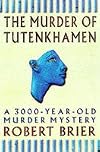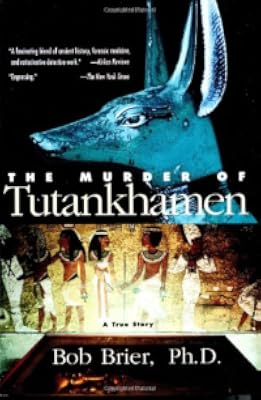
The Murder of Tutankhamen
by Bob Brier
On This Page
Description
Examines artifacts, documents, tombs, and x-rays of ancient mummies to support the author's claim that young Egyptian pharaoh Tutankhamen was murdered.Tags
Recommendations

















Member Reviews
Eminently readable conjecture on the life and death of Egypt's "Boy King", whose funerary treasures have become synonymous with the glories of a vanished kingdom.
Brier's specialty, paleopathology, made him uniquely qualified to examine the early records of the young pharaoh's body, and to look at the evidence with the equipment and techniques developed since it was first unearthed a century ago. He combines that interest with a sprightly writing style that makes the long and complex history of ancient Egypt accessible to the modern reader, and comes up with a theory that seems plausible for Tutankhamen's untimely death.
Brier's specialty, paleopathology, made him uniquely qualified to examine the early records of the young pharaoh's body, and to look at the evidence with the equipment and techniques developed since it was first unearthed a century ago. He combines that interest with a sprightly writing style that makes the long and complex history of ancient Egypt accessible to the modern reader, and comes up with a theory that seems plausible for Tutankhamen's untimely death.
The Gist: (Note: There isn't really a blurb on the back of the book so I have cobbled one together.) King Tutankhamen of the Eighteenth Dynasty became pharaoh of Upper and Lower Egypt at the age of ten and died at the age of 18 or 19. Many scholars of ancient Egypt question why Tutankhamen died at such a young age. While examining his remains, scientists discovered (through x-rays) that Tutankhamen suffered a blow to the head right where the skull meets the neck. This injury and other evidence causes Bob Brier, Ph.D author of The Murder Of Tutankhamen, to find the murder theory of the young king plausible. In this book, Brier examines not only the physical evidence that remains today, but also the motives of those who would be show more king.
Readers do not have to be experts in ancient Egyptian history to enjoy Bob Brier's book The Murder Of Tutankhamen. Brier provides the reader with a "crash course" on the history of ancient Egypt: how it became a great power, the creation of its social structure, its political structure and so on. If you are already familiar with ancient Egyptian history, this portion of the book provides a good "refresher course." I learned many new facts about ancient Egypt--including how often the embalmers screwed up when preparing a body for burial. I find it intriguing yet highly disturbing that the embalmers often misplaced body parts or reassembled the body incorrectly. For example, placing the arms where the legs belong or losing some one's head.
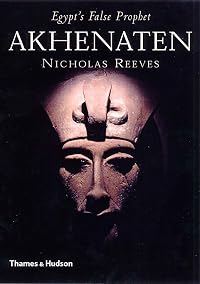
Brier spends several pages discussing Akhenaten, Tutankhamen's father. I agree with Brier that to understand Tutankhamen's reign, his death/murder, and its aftermath an understanding about Akhenaten's reign is important. However, while Brier does a good job bringing this ancient king to life, I found that at times he loses his objectivity as a scientist/historian. When I read the sections in which Brier lauds Akhenaten for being a visionary and for bringing monotheism to ancient Egypt, I began to vehemently disagree with Brier about how "terrific" Akhenaten was as a visionary leader. I find Akhenaten's neglect of his pharaonic duties appalling.
Brier tends to generalize a lot about religion and other aspects of ancient Egyptian history. I suspect the reason for these generalizations is that Brier wants to give readers an overview of ancient Egyptian life. Any greatly detailed history would lead away from the point of the book: Did someone murder Tutankhamen and if so, who orchestrated and carried out the act? If you read this book, I recommend performing a little research on your own just to have another historian's point of view about ancient Egypt.
Brier intrigued me with his discussion about the power vacuum created after Tutankhamen's death. I wish he had spent more time discussing the political intrigue that took place in a pharaoh's court. For example, we know a lot about the backstabbing politics of England's Tudor court. Was the pharaoh's court similar?
Brier excels at bringing Tutankhamen and his wife Ankhesenamen to life. They become three dimensional people with wishes and dreams. Through Brier's discussion about artifacts depicting the royal couple, readers learn that Tutankhamen and Ankhesenamen truly loved each other and enjoyed each other's company. According to Brier, the artists who created the paintings and carvings of the couple always show them holding hands or in some way showing affection for each other. For Tutankhamen, Ankhesenamen was the only wife and queen for him. He did not have any other wives.
So for me, their story is tragic. Tutankhamen and Ankhesenamen died at unusually young ages. And both of them died under mysterious circumstances. From what little historians know about them, they seemed to enjoy life as well as each other's company. To me, their story is worse than Romeo and Juliet because Tutankhamen and Ankhesenamen's story is true. show less
Readers do not have to be experts in ancient Egyptian history to enjoy Bob Brier's book The Murder Of Tutankhamen. Brier provides the reader with a "crash course" on the history of ancient Egypt: how it became a great power, the creation of its social structure, its political structure and so on. If you are already familiar with ancient Egyptian history, this portion of the book provides a good "refresher course." I learned many new facts about ancient Egypt--including how often the embalmers screwed up when preparing a body for burial. I find it intriguing yet highly disturbing that the embalmers often misplaced body parts or reassembled the body incorrectly. For example, placing the arms where the legs belong or losing some one's head.
Brier spends several pages discussing Akhenaten, Tutankhamen's father. I agree with Brier that to understand Tutankhamen's reign, his death/murder, and its aftermath an understanding about Akhenaten's reign is important. However, while Brier does a good job bringing this ancient king to life, I found that at times he loses his objectivity as a scientist/historian. When I read the sections in which Brier lauds Akhenaten for being a visionary and for bringing monotheism to ancient Egypt, I began to vehemently disagree with Brier about how "terrific" Akhenaten was as a visionary leader. I find Akhenaten's neglect of his pharaonic duties appalling.
Brier tends to generalize a lot about religion and other aspects of ancient Egyptian history. I suspect the reason for these generalizations is that Brier wants to give readers an overview of ancient Egyptian life. Any greatly detailed history would lead away from the point of the book: Did someone murder Tutankhamen and if so, who orchestrated and carried out the act? If you read this book, I recommend performing a little research on your own just to have another historian's point of view about ancient Egypt.
Brier intrigued me with his discussion about the power vacuum created after Tutankhamen's death. I wish he had spent more time discussing the political intrigue that took place in a pharaoh's court. For example, we know a lot about the backstabbing politics of England's Tudor court. Was the pharaoh's court similar?
Brier excels at bringing Tutankhamen and his wife Ankhesenamen to life. They become three dimensional people with wishes and dreams. Through Brier's discussion about artifacts depicting the royal couple, readers learn that Tutankhamen and Ankhesenamen truly loved each other and enjoyed each other's company. According to Brier, the artists who created the paintings and carvings of the couple always show them holding hands or in some way showing affection for each other. For Tutankhamen, Ankhesenamen was the only wife and queen for him. He did not have any other wives.
So for me, their story is tragic. Tutankhamen and Ankhesenamen died at unusually young ages. And both of them died under mysterious circumstances. From what little historians know about them, they seemed to enjoy life as well as each other's company. To me, their story is worse than Romeo and Juliet because Tutankhamen and Ankhesenamen's story is true. show less
This is the translation of The Murder of Tutankhamon. It is a very curious mixture of ancient egyptian history, detective story, and popular science enquiry. The author, an egyptologist and paleopathologist at the University of Long Island, suspects that Tutankhamon was murdered. The possible supporting evidence was obtained from analysis to the x-ray images of the king's mummy. Half of the book is taken by a description of Egypt, particularly during the 18th Dinasty, close to the end of which Tutankhamon reigned. Also included are good short descriptions of the expeditions that led to the discovery of the tomb, and also of some important archeological discoveries with connection with the author's argument, such as the el-Amarna ruins, show more and the progressive discovery of the existence and importance of Akhenaton, the father of Tutankhamon. The book is well translated and it seems that the plot to murder Tutankhamon could indeed have taken place (although I was not convinced neither way...), but I am not going to reveal here who's the most likely culprit! An enjoyable book. show less
Forensics and ancient documents lead the author to believe that King Tut was murdered. (Duh, you could tell that from the title.)
The book gives a brief history of the Eighteenth Dynasty of Egypt and details the contemporaneous goings-on in the years surrounding Tutankhamen's reign. The author lays out his evidence for his belief, including his prime suspects for the actual deed.
An entertaining read, regardless if one agrees with his conclusions.
The book gives a brief history of the Eighteenth Dynasty of Egypt and details the contemporaneous goings-on in the years surrounding Tutankhamen's reign. The author lays out his evidence for his belief, including his prime suspects for the actual deed.
An entertaining read, regardless if one agrees with his conclusions.
Bob Brier knows as much about ancient Egypt as anyone but no-one knows very much. This book is of the conspiracy theory school with a little scholarship sprinkled on top.
Ratings
Members
- Recently Added By
Author Information

36+ Works 1,840 Members
Bob Brier is Senior Research Fellow at Long Island University, USA, and is a world-famous Egyptologist. He is the author of The Murder of Tutankhamen, Ancient Egyptian Magic, Egyptian Mummies, and Secret of the Great Pyramid. He was host to TLC's documentary series The Great Egyptians, The World of Pyramids, and Mummy Detective.
Some Editions
Common Knowledge
- Original title
- The murder of Tutankhamen
- Original publication date
- 1998
- People/Characters
- Ankhesenamun; Ay; Horemheb; Tutankhamun
- Important places
- Africa; Egypt (Ancient)
- Important events
- New Kingdom of Egypt; Eighteenth Dynasty of Egypt; Amarna Period
Classifications
- Genres
- History, Nonfiction, General Nonfiction, Anthropology, Biography & Memoir
- DDC/MDS
- 932.014 — History & geography History of ancient world (to ca. 499) Egypt to 640 Early history to 332 BC Pharaohs -- Biography and History
- LCC
- DT87.5 .B667 — History of Europe, Asia, Africa and Oceania Africa History of Africa Egypt History
- BISAC
Statistics
- Members
- 486
- Popularity
- 62,120
- Reviews
- 5
- Rating
- (3.51)
- Languages
- 9 — Dutch, English, French, German, Italian, Polish, Portuguese, Slovenian, Spanish
- Media
- Paper, Ebook
- ISBNs
- 21
- UPCs
- 1
- ASINs
- 4