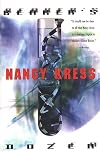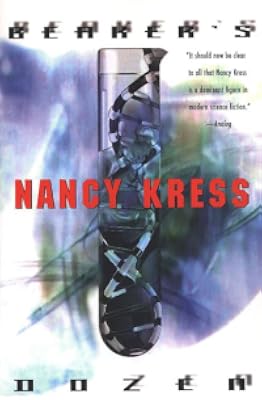
Beaker's Dozen
by Nancy Kress
On This Page
Description
"The twenty-first century, it's often remarked, will transform our knowledge of biology, in the same way that the twentieth century transformed physics. With knowledge of course, comes application. And with the application of all we are learning about genetic engineering come social and ethical questions, some of them knotty. This is where science fiction enters, stage left. Scientific laboratories are where the new technologies are rehearsed. Science fiction rehearses the implications of show more those technologies. What might we eventually do with out new-found power? Should we do it? Who should do it? Who will be affected? How? Is that a good thing or not? For whom? Of the thirteen stories in this book, eight of them are concerned with what might come out of the beakers and test tubes and gene sequencers of microbiology. Not everything in these stories will come to pass. Possibly nothing in them will; fiction is not prediction. But I hope the stories at least raise questions about the world rushing in onus at the speed--not of light--but of thought." -- Nancy Kress from her introduction show lessTags
Recommendations


















Member Recommendations
Member Reviews
As in all collections of shorter fiction, the offerings varied. I enjoyed the first and last pieces the most. Others I felt were too restricted by the form and had potential for expansion, while others I just didn't get at all (though she does admit in the intros for some that most readers didn't so perhaps that's on her).
Science fiction writers often write short fiction and Nancy Kress is one of the best at it. This collection of 13 short stories was published in 1998 and all of the stories were written in the last decade of the twentieth century. So some of these stories are more than 20 years old but they are not dated.
In her introduction Kress acknowledges the fact that it is significant that these stories were written in the 1990s. She says"...strange and wondrous things are happening in science labs around the world." She mentions cloning and pharming and genetic engineering. Eight of the stories are "concerned with what might come out of the beakers and test tubes and gene sequencers of microbiology." She also says "The twenty-first century...will show more transform our knowledge of biology in the same way that the twentieth century transformed physics." I would say she was remarkably prescient; genetics has almost become mainstream and there are still over 80 years to go in this century.
I don't know that I have a favourite story in this collection because they are all good but the last story "Dancing on Air" will probably be the one that stays with me longest. It deals with how genetic engineering could transform ballet dancers; but then is it still an art form if performance is dependent upon who has the best doctors?
I love the way Kress writes. Note to self: read more of her work. show less
In her introduction Kress acknowledges the fact that it is significant that these stories were written in the 1990s. She says"...strange and wondrous things are happening in science labs around the world." She mentions cloning and pharming and genetic engineering. Eight of the stories are "concerned with what might come out of the beakers and test tubes and gene sequencers of microbiology." She also says "The twenty-first century...will show more transform our knowledge of biology in the same way that the twentieth century transformed physics." I would say she was remarkably prescient; genetics has almost become mainstream and there are still over 80 years to go in this century.
I don't know that I have a favourite story in this collection because they are all good but the last story "Dancing on Air" will probably be the one that stays with me longest. It deals with how genetic engineering could transform ballet dancers; but then is it still an art form if performance is dependent upon who has the best doctors?
I love the way Kress writes. Note to self: read more of her work. show less
This collection did get me to think about issues around bioengineering. But overall, I was disappointed. The plotting and characters veered from trite to inplausible in a way that felt like something straight out of "Days of Our Lives" or "Guiding Light" (American television soap operas, for those of you that might not be familiar with this genre).
Which is not to deny that there are several decent stories here, including the memorably strange "Feigenbaum Number," the only story in the collection that wasn't new to me. Overall, my favorite was "Unto the Daughters," a feminist take on the Garden of Eden story. The biggest disappointments were "Ars Longa," in which teacher dearest robs the world of the genius of Walt Disney, and "Dancing show more on Air," a story about genetically enhanced dogs and ballerinas. show less
Which is not to deny that there are several decent stories here, including the memorably strange "Feigenbaum Number," the only story in the collection that wasn't new to me. Overall, my favorite was "Unto the Daughters," a feminist take on the Garden of Eden story. The biggest disappointments were "Ars Longa," in which teacher dearest robs the world of the genius of Walt Disney, and "Dancing show more on Air," a story about genetically enhanced dogs and ballerinas. show less
A collection of short stories, novelettes and novellas previously published in science fiction magazines and anthologies. Some of my favorite Kress stories are here including the novella of Beggars in Spain which came before the novel. I also highly recommend Flowers of Aulit Prison, a stunning LeGuinesque story about a political prisoner. Dancing on Air is a fine story about the risks, benefits and temptations of genetic engineering -- and about ballet as well.
Introduction
Beggars in Spain
Feigenbaum Number
Margin of Error
Fault Lines
Unto the Daughters
Evolution
Ars Longa
Sex Education
Grant Us This Day
Flowers of Aulit Prison
Summer Wind
Always True to Thee, In My Fashion
Dancing on Air
Beggars in Spain
Feigenbaum Number
Margin of Error
Fault Lines
Unto the Daughters
Evolution
Ars Longa
Sex Education
Grant Us This Day
Flowers of Aulit Prison
Summer Wind
Always True to Thee, In My Fashion
Dancing on Air
Ratings
Members
- Recently Added By
Lists

Favorite Science Fiction by Women Authors
737 works; 202 members

Science Fiction Short Story Collections
9 works; 2 members
Author Information

188+ Works 12,961 Members
Nancy Kress is an author who won Best Novella at the Nebula Awards 2014 for her title Yesterday's Kin. (Bowker Author Biography)
Some Editions
Work Relationships
Contains
Common Knowledge
- Original publication date
- 1998 (collection) (collection); 1997 (Always True to Thee, In My Fashion) (Always True to Thee, In My Fashion); 1994 (Ars Longa) (Ars Longa); 1991 (Beggars in Spain) (Beggars in Spain); 1993 (Dancing on Air) (Dancing on Air); 1995 (Evolution) (Evolution) (show all 14); 1995(Fault Lines) (Fault Lines); 1995 (Feigenbaum Number) (Feigenbaum Number); 1996 (Flowers of Aulit Prison) (Flowers of Aulit Prison); 1993 (Grant Us This Day) (Grant Us This Day); 1994 (Margin of Error) (Margin of Error); 1996 (Sex Education) (Sex Education); 1995 (Summer Wind) (Summer Wind); 1995 (Unto the Daughters) (Unto the Daughters)
Classifications
Statistics
- Members
- 169
- Popularity
- 193,971
- Reviews
- 5
- Rating
- (3.59)
- Languages
- English
- Media
- Paper, Ebook
- ISBNs
- 3
- ASINs
- 1