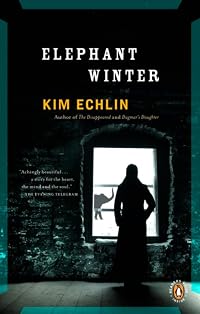
Elephant Winter
by Kim Echlin
On This Page
Description
Sophie Walker has come home to nurse her dying mother. Her mother's farm borders on "Safari", a tacky tourist spot, and from the kitchen window Sophie sees a group of immense Asian elephants playing in the snow. When the elephant keeper beckons for her to join them, Sophie goes to them. And so begins her Elephant Winter.Tags
Recommendations























Member Reviews
This is not a real review, perhaps, but my way to try and distil the amalgam of thoughts that assailed me after reading this novel, ... twenty years ago. I've never forgotten the feeling nor the image of that little elephant on the savannah.
I was moved by the beauty and simplicity of the prose: there is an elegance here that is larger than life, a great rumbling resonance echoes in the mind, much as elephants displace one's sense of reality by their very size. Everything is connected in such an elemental way: the mother dying of cancer; the captivity of this "all too solid flesh" which inhibits the freedom of spirit in both human and elephant; the death and birth cycle(s) of both human and elephant; the transmigration of thoughts show more between human and elephant.
But ... the resonance that so engaged me was as elusive as it was palpable: a paradox; a delightful tangential disturbance of the soul. We are connected in ways which are beyond all power of description. It is for this very reason, I suspect, that Echlin gives the elephants themselves a voice. In great detail, she reproduces their language, their rhythms; records both sound and meaning on the printed page, of the echoes she has heard ... elephant infra-sound she terms it.
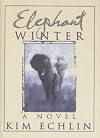
There is also ironic pleasure in holding Echlin's book in one's hands: the book is half-size, a tiny gift in the hand. The dust jacket is subtle: on a khaki background (a wonderful connection to the savannahs in which elephants roam) a picture of an elephant is super-imposed. The elephant is moving toward the reader in a misty haze of blues and greys: is the elephant charging? ... or merely walking toward the reader? Is this a confrontation, or an offering?
From the first words, Batter My Heart, the title of the first chapter, one encounters the meaning of the novel. It will be both a confrontation and an offering. Echlin intends to open your heart. She weaves elusive magic intricately, subtly. There isn't even a hint of seduction, until, to take a breath, the reader looks up and realizes that 200 pages have drifted through one's consciousness; that one has been communing silently, all the hours of a long, sunny afternoon. One closes the book and re-enters a void, which for a few short hours, had been filled, wholly, completely with a sense of being connected to all things. Wordsworth comes to mind, in a flash of sunlight:
... And I have felt
A presence that disturbs me with the joy
Of elevated thoughts; a sense sublime
Of something far more deeply interfused
Whose dwelling is the light of setting suns,
And the round ocean, and the living air,
And the blue sky, and in the mind of man.
A motion and a spirit that impels
All thinking things, all objects of all thought
And rolls through all things ...
(Tintern Abbey, 1798)
Two hundred years later, Echlin picks up Wordsworth's song and refreshes our memory about the inter-connected beauty of all things. (As the noises have gotten louder in the intervening two centuries, we have drowned out the wisdom of our elemental selves.) I hope I never forget how I feel in this moment, and at the same time, hope that the ache in my heart will stop soon.
From the novel:
When I was in Africa, I went out with a ranger in a Land-Rover to look at the bones of an elephant killed by poachers two days earlier. Lions and vultures had already stripped the skeleton clean and as we approached we saw a small group of elephants scatter them, then spread dust over them with their trunks. After several hours, the group moved off leaving a small elephant about four or five years old, behind. The driver, no longer afraid, reached to his keys to turn on his engine, but I begged him to stay a little longer. And so we sat and watched. The small elephant mimicked her elders, smelling the bones, pushing them, trying to spread dust over them. The driver said softly, "Go back little one, there are lions."
It is eerie to see a small animal alone in the open in Africa. There are so many threats. I kept checking the bushes and the trees for hyenas and lions. I asked the ranger why the usually protective herd would let the little one stay alone, and he said, "They have to eat and drink. They don't have any choice."
"Why?"
"That little one won't go. She did this yesterday too. They came back for her at night. Perhaps tonight she'll give it up."
"But why does she keep staying?"
"The bones are her mother's."
"I wonder if I'll want to stay with my mother's bones when she's dead," I said.
"The ranger, a young man who had spent his life in the bush silently watching, answered drily, "I wonder, would you risk your life to do it." show less
I was moved by the beauty and simplicity of the prose: there is an elegance here that is larger than life, a great rumbling resonance echoes in the mind, much as elephants displace one's sense of reality by their very size. Everything is connected in such an elemental way: the mother dying of cancer; the captivity of this "all too solid flesh" which inhibits the freedom of spirit in both human and elephant; the death and birth cycle(s) of both human and elephant; the transmigration of thoughts show more between human and elephant.
But ... the resonance that so engaged me was as elusive as it was palpable: a paradox; a delightful tangential disturbance of the soul. We are connected in ways which are beyond all power of description. It is for this very reason, I suspect, that Echlin gives the elephants themselves a voice. In great detail, she reproduces their language, their rhythms; records both sound and meaning on the printed page, of the echoes she has heard ... elephant infra-sound she terms it.
There is also ironic pleasure in holding Echlin's book in one's hands: the book is half-size, a tiny gift in the hand. The dust jacket is subtle: on a khaki background (a wonderful connection to the savannahs in which elephants roam) a picture of an elephant is super-imposed. The elephant is moving toward the reader in a misty haze of blues and greys: is the elephant charging? ... or merely walking toward the reader? Is this a confrontation, or an offering?
From the first words, Batter My Heart, the title of the first chapter, one encounters the meaning of the novel. It will be both a confrontation and an offering. Echlin intends to open your heart. She weaves elusive magic intricately, subtly. There isn't even a hint of seduction, until, to take a breath, the reader looks up and realizes that 200 pages have drifted through one's consciousness; that one has been communing silently, all the hours of a long, sunny afternoon. One closes the book and re-enters a void, which for a few short hours, had been filled, wholly, completely with a sense of being connected to all things. Wordsworth comes to mind, in a flash of sunlight:
... And I have felt
A presence that disturbs me with the joy
Of elevated thoughts; a sense sublime
Of something far more deeply interfused
Whose dwelling is the light of setting suns,
And the round ocean, and the living air,
And the blue sky, and in the mind of man.
A motion and a spirit that impels
All thinking things, all objects of all thought
And rolls through all things ...
(Tintern Abbey, 1798)
Two hundred years later, Echlin picks up Wordsworth's song and refreshes our memory about the inter-connected beauty of all things. (As the noises have gotten louder in the intervening two centuries, we have drowned out the wisdom of our elemental selves.) I hope I never forget how I feel in this moment, and at the same time, hope that the ache in my heart will stop soon.
From the novel:
When I was in Africa, I went out with a ranger in a Land-Rover to look at the bones of an elephant killed by poachers two days earlier. Lions and vultures had already stripped the skeleton clean and as we approached we saw a small group of elephants scatter them, then spread dust over them with their trunks. After several hours, the group moved off leaving a small elephant about four or five years old, behind. The driver, no longer afraid, reached to his keys to turn on his engine, but I begged him to stay a little longer. And so we sat and watched. The small elephant mimicked her elders, smelling the bones, pushing them, trying to spread dust over them. The driver said softly, "Go back little one, there are lions."
It is eerie to see a small animal alone in the open in Africa. There are so many threats. I kept checking the bushes and the trees for hyenas and lions. I asked the ranger why the usually protective herd would let the little one stay alone, and he said, "They have to eat and drink. They don't have any choice."
"Why?"
"That little one won't go. She did this yesterday too. They came back for her at night. Perhaps tonight she'll give it up."
"But why does she keep staying?"
"The bones are her mother's."
"I wonder if I'll want to stay with my mother's bones when she's dead," I said.
"The ranger, a young man who had spent his life in the bush silently watching, answered drily, "I wonder, would you risk your life to do it." show less
When she learns that her mother is dying, Sophie Walker must give up her nomadic lifestyle and leave Zimbabwe to return to the family farm in southern Ontario. As she contemplates her life, she looks out her mother’s kitchen window, at the snowy winter landscape … and a herd of Asian elephants. The adjacent property is not a farm, but a small safari park. Sophie interprets a gesture from the elephants’ trainer, Jo Mann, as an invitation, and ventures onto the park grounds. Thus, begins her “elephant winter.”
This is really a character-based story, though there are some significant events, including a couple of violent altercations. Mostly, however, Echlin treats the reader to Sophie’s thoughts as she considers her mother’s show more condition, her role as daughter, lover, friend, her past and future. And she has conversations with her mother, a wildlife painter, on the importance of work, of finding your passion, of following your dream, of being a mother.
I really liked Echlin’s writing style. There was something so quiet and comforting about it. And still her imagery is very vivid. Some examples:
The light over those snowy Ontario fields was short and grey and bleak. We were just past winter solstice and though I’d been home some weeks, I still found it odd to look through the kitchen window and see the curious face of a giraffe above the snowy maple trees.
I listened to the creaking of the barnboard, to the breath of the elephants, to the cracking to frozen branches outside. I could feel the elephants rumbling … For as long as I could I lay listening to all the sounds of the barn and beyond.
I heard her loneliness rattling around like a pea in a dried-up pod.
Winter came twice that year. The earth had been wet and fragrant and then there was a spring snowstorm. Chickadees tucked themselves against frozen tree trunks and curled their heads under plumped-up wings.
The thin dawn taped itself like a piece of old and yellowing cellophane to the horizon and the cold adhered to my skin.
Echlin intersperses chapters from Sophie’s work on Elephant language throughout the book. There are studies on elephants and their communication methods, but this is, of course, total fiction; still, I found it just fascinating.
Note There are scenes where animals are injured or die. Readers who are sensitive to such scenes are forewarned. show less
This is really a character-based story, though there are some significant events, including a couple of violent altercations. Mostly, however, Echlin treats the reader to Sophie’s thoughts as she considers her mother’s show more condition, her role as daughter, lover, friend, her past and future. And she has conversations with her mother, a wildlife painter, on the importance of work, of finding your passion, of following your dream, of being a mother.
I really liked Echlin’s writing style. There was something so quiet and comforting about it. And still her imagery is very vivid. Some examples:
The light over those snowy Ontario fields was short and grey and bleak. We were just past winter solstice and though I’d been home some weeks, I still found it odd to look through the kitchen window and see the curious face of a giraffe above the snowy maple trees.
I listened to the creaking of the barnboard, to the breath of the elephants, to the cracking to frozen branches outside. I could feel the elephants rumbling … For as long as I could I lay listening to all the sounds of the barn and beyond.
I heard her loneliness rattling around like a pea in a dried-up pod.
Winter came twice that year. The earth had been wet and fragrant and then there was a spring snowstorm. Chickadees tucked themselves against frozen tree trunks and curled their heads under plumped-up wings.
The thin dawn taped itself like a piece of old and yellowing cellophane to the horizon and the cold adhered to my skin.
Echlin intersperses chapters from Sophie’s work on Elephant language throughout the book. There are studies on elephants and their communication methods, but this is, of course, total fiction; still, I found it just fascinating.
Note There are scenes where animals are injured or die. Readers who are sensitive to such scenes are forewarned. show less
First lines:
~I am called the Elephant-Keeper, which suits me. My name is Sophie Walker. When I am not at the elephant barns, I live in a crowded house near a tacky commercial tourist farm in southern Ontario. I have a daughter and I take care of the elephants~
I was looking for a book to meet the February RandomCat Challenge out of the 2013 Category Challenge Group (Read a book with a title, author, or character that brings to mind some of the weather events we typically experience during the month of February) and I found this. The bonus is that it also fit my personal challenge to read books by Canadian authors.
I loved this short book. It is about a young woman who moves back home to care for her mother who is dying from cancer. Their show more home backs onto a Safari Park and she begins a deeply intimate relationship with the elephants and their keeper. Kim Echlin is from Ontario and I have been to the African Lion Safari Park that she bases this tale on.
The book is about community and communication and love and loss and death and life and is so beautifully written.
My own mother died on Feb 9th, 2007 and reading this book, at this time of year, was especially poignant as I was reminded of the many, many moments that made the time around her dying a sacred and meaningful experience. I became closer to her than ever before in those final weeks. I loved Echlin’s description of the many, many moments that made Sophie and her mother's experience of dying sacred and meaningful, and, yet, at the same time, she does not shy away from depicting the difficulties such experience brings.
And, I loved the depiction of the community and culture of the Asian elephants that teach Sophie so much about life and living.
I was touched and uplifted. I was not aware of Kim Echlin before this and am looking forward to reading more of her work. show less
~I am called the Elephant-Keeper, which suits me. My name is Sophie Walker. When I am not at the elephant barns, I live in a crowded house near a tacky commercial tourist farm in southern Ontario. I have a daughter and I take care of the elephants~
I was looking for a book to meet the February RandomCat Challenge out of the 2013 Category Challenge Group (Read a book with a title, author, or character that brings to mind some of the weather events we typically experience during the month of February) and I found this. The bonus is that it also fit my personal challenge to read books by Canadian authors.
I loved this short book. It is about a young woman who moves back home to care for her mother who is dying from cancer. Their show more home backs onto a Safari Park and she begins a deeply intimate relationship with the elephants and their keeper. Kim Echlin is from Ontario and I have been to the African Lion Safari Park that she bases this tale on.
The book is about community and communication and love and loss and death and life and is so beautifully written.
My own mother died on Feb 9th, 2007 and reading this book, at this time of year, was especially poignant as I was reminded of the many, many moments that made the time around her dying a sacred and meaningful experience. I became closer to her than ever before in those final weeks. I loved Echlin’s description of the many, many moments that made Sophie and her mother's experience of dying sacred and meaningful, and, yet, at the same time, she does not shy away from depicting the difficulties such experience brings.
And, I loved the depiction of the community and culture of the Asian elephants that teach Sophie so much about life and living.
I was touched and uplifted. I was not aware of Kim Echlin before this and am looking forward to reading more of her work. show less
I enjoyed the mood of this book ,and the cold winter feel to it. Sophie is a very real character who I liked very much and I liked learning about elephant behavior with her. Her relationship with her dying mother, who she comes home to be with, was very touching and real as they both deal with the pain of terminal cancer and relive the past together. The main focus in the novel is the elephants and how closely their lives mirror Sophie"s . A interesting book.
A good story set in the Africa Lion Safari Park, near where I live in Ontario.
Elephants figure prominently but there is love, loss, illness (human and animal) etc.
And people for those of you who need them in your stories too. I loved it.
Elephants figure prominently but there is love, loss, illness (human and animal) etc.
And people for those of you who need them in your stories too. I loved it.
Ratings
Members
- Recently Added By
Author Information

10 Works 841 Members
Some Editions
Awards and Honors
Awards
Common Knowledge
- Canonical title*
- L' inverno degli elefanti
- Original title
- Elephant Winter
*Some information comes from Common Knowledge in other languages. Click "Edit" for more information.
Classifications
Statistics
- Members
- 140
- Popularity
- 235,028
- Reviews
- 5
- Rating
- (3.79)
- Languages
- English, Italian
- Media
- Paper, Ebook
- ISBNs
- 4
- ASINs
- 1