On This Page
Description
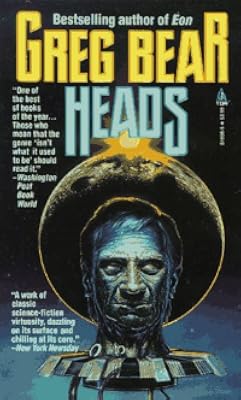
Two hundred years in the future, the Moon is emerging from an age of innocence. Once pioneers, the easiest motto for these Lunar families is 'Cut the Politics'. They think they are safe from the sophistication and corruption of political intrigue. William Pierce is searching for absolute zero. No scientist has succeeded yet, and William is almost there...His wife Rho has bought 410 heads, cryogenically frozen centuries before in the hope of resurrection. She thinks she can read them for show more information. But there are dangers. William doesn't quite understand that his experiments could distort space and time. Rho doesn't realise that her heads will bring interference from a new and deadly faction, the devotedly religious Logologists. 'Cut the Politics'. But they can't. And the politics of this society could destroy much, much more than Rho and William's work... show lessTags
Recommendations












Member Reviews
A guy is trying to lower the temperature of matter to absolute zero in a controlled environment, his wife decides to use some of the decidedly cold space in his lab to store a few hundred heads from the bankruptcy sale of one of those companies Timothy Leary ended up in, and people freak out.
There's not a whole lot to say about this one - the Big Reveal is so obvious that I had been anticipating it ever since conflict started, and the events at the end were of the "well duh, what did you *think* would happen" variety. Which is not really a flaw in the novel, as it means the author realistically depicted how these events would play out and it is only the characters who are clueless, but it is not that entertaining either.
The big surprise show more with this novel is the evisceration of, shall we saw, Elron Hoover's First Church of Appliantology:
This is particularly interesting because, while the "church" harrassment of critics was in full swing when this novel was written, it was only in 1993 (a full year later) that Steven Fishman released documents in court that publicly revealed just how ludicrous the purported religious doctrine actually was. South Park famously skewered these beliefs some ten years later, but Greg Bear seems to have been ahead of the curve here. As usual. show less
There's not a whole lot to say about this one - the Big Reveal is so obvious that I had been anticipating it ever since conflict started, and the events at the end were of the "well duh, what did you *think* would happen" variety. Which is not really a flaw in the novel, as it means the author realistically depicted how these events would play out and it is only the characters who are clueless, but it is not that entertaining either.
The big surprise show more with this novel is the evisceration of, shall we saw, Elron Hoover's First Church of Appliantology:
Here was a creed without a coherent philosophy - a system without a sensible metaphysics. Here was puerile hypothesis and even outright fantasy masquerading as revealed truth.
This is particularly interesting because, while the "church" harrassment of critics was in full swing when this novel was written, it was only in 1993 (a full year later) that Steven Fishman released documents in court that publicly revealed just how ludicrous the purported religious doctrine actually was. South Park famously skewered these beliefs some ten years later, but Greg Bear seems to have been ahead of the curve here. As usual. show less
My reaction to reading this book in 1992. Spoilers follow.
A tale of Bear’s that mixes religion and politics to good effect.
I liked the central point that even libertarian minded scientists, businessmen, and technicians who despise administrators and politicos have to pay attention to politics – not only the external threat of foreign governments but the ability of a government to hold a community together, to help it resolve disputes between citizens. The lunar syndicates learn that politics “is the art of avoiding disasters, of managing difficult situations for the benefit of all” in their political fight against a domineering Earth and the Church of Logology.
The Church is quite obviously based on L. Ron Hubbard’s movements show more and Mormonism, a satire against both. The Mormon parallel is founder K. D. Thierry being handed a crystal rock by a huge female figure (the “last of the True Human”). The rock is supposedly encoded with the secrets to free the mind and body from its shackles (like Dianetics). Like Hubbard, Thierry expounds his doctrines with many books while wondering about the world and eventually retreats into seclusion. Like Hubbard, Thierry sponsers a contest for budding Lit Vid stories. Linking these two is an eerie program by one of the moon syndicates to interrogate some severed heads for archaeological knowledge. (Cryonics was popular in the early twenty-first, but no one figured out how to thaw them out, so – and I liked this feature – keeping the frozen corpsicles around became a real nuisance. They’re frequently sold.) Specifically, the head of one Thierry. The Church of Logolists objects strongly, eventually turning to violence to stop the program. The project is partially run by the strange artificial intelligence QL (for quantam) – built by a singular Chinese genius. The QL works beyond regular logic and in the post Boolean realm, completely in tune with the “Planck-Wheeler” continum. (Bear is a master of creating plausible sounding history, science, and technologies with just a few words.).
The ending was weakened a bit by the almost mystical violation of time and space, the creepy speaking of the dead frozen heads to our narrator. Still, Bear does a nice job melding science, religion, and politics. show less
A tale of Bear’s that mixes religion and politics to good effect.
I liked the central point that even libertarian minded scientists, businessmen, and technicians who despise administrators and politicos have to pay attention to politics – not only the external threat of foreign governments but the ability of a government to hold a community together, to help it resolve disputes between citizens. The lunar syndicates learn that politics “is the art of avoiding disasters, of managing difficult situations for the benefit of all” in their political fight against a domineering Earth and the Church of Logology.
The Church is quite obviously based on L. Ron Hubbard’s movements show more and Mormonism, a satire against both. The Mormon parallel is founder K. D. Thierry being handed a crystal rock by a huge female figure (the “last of the True Human”). The rock is supposedly encoded with the secrets to free the mind and body from its shackles (like Dianetics). Like Hubbard, Thierry expounds his doctrines with many books while wondering about the world and eventually retreats into seclusion. Like Hubbard, Thierry sponsers a contest for budding Lit Vid stories. Linking these two is an eerie program by one of the moon syndicates to interrogate some severed heads for archaeological knowledge. (Cryonics was popular in the early twenty-first, but no one figured out how to thaw them out, so – and I liked this feature – keeping the frozen corpsicles around became a real nuisance. They’re frequently sold.) Specifically, the head of one Thierry. The Church of Logolists objects strongly, eventually turning to violence to stop the program. The project is partially run by the strange artificial intelligence QL (for quantam) – built by a singular Chinese genius. The QL works beyond regular logic and in the post Boolean realm, completely in tune with the “Planck-Wheeler” continum. (Bear is a master of creating plausible sounding history, science, and technologies with just a few words.).
The ending was weakened a bit by the almost mystical violation of time and space, the creepy speaking of the dead frozen heads to our narrator. Still, Bear does a nice job melding science, religion, and politics. show less
I read this novella because of the premise: some lunar colonists come into possession of a bunch of cryogenically-preserved heads, from an Alcor-like foundation. Can they figure out a way to read the memories of those colonists? I've been reading sf stories about life extension technologies for a class I'm guying to teach. Well, this book has very little to say about its actual premise, as it mostly focuses on largely uninteresting and seemingly over-simplistic politics on the Moon. There's also some Scientology satire; maybe this would have felt fresher in 1991, but thirty years on it's pretty dull stuff. The revelation about why the Scientologists don't want the heads revived is blindingly obvious, but takes the protagonists a hundred show more pages to catch up to the reader on. I guess this is set in the same milieu as Bear's Moving Mars, but that was a much better book. show less
A short book by Bear - more of a novella, really. The moon has been colonized, and society has developed into a clanlike structure of family/companies. On one of these, a man is working on scientific experiments to try to achieve absolute zero, which he believes would result in phenomena interesting to physics. His sister comes across an opportunity to acquire a batch of frozen heads, cryonically preserved in centuries past by those hoping for future resurrection. This seems unlikely, but she hopes to be able to use new techniques to reads some of these heads' preserved memories, to study anthropologially. Clinching the deal is that two of the individuals wetre the founders of their clan.
Unfortunately, unbeknownst to them, another of show more the heads is that of the founder of a powerful religious group (bearing more than a passing resemblance to Scientology), and that group will do anything to stop the transfer of heads from happening...
Pretty good sci-fi, the ending is a bit overblown, however. show less
Unfortunately, unbeknownst to them, another of show more the heads is that of the founder of a powerful religious group (bearing more than a passing resemblance to Scientology), and that group will do anything to stop the transfer of heads from happening...
Pretty good sci-fi, the ending is a bit overblown, however. show less
A short novel, with much less complexity than #1--William is trying to produce absolute-zero, his wife, Rho, has purchased 400+ corpsicles (who will never be resuscitated) and Micky is trying to coerce enough money to support both their efforts. The plot revolves around a) what will happen when/if they produce 0-degrees; b) can they read the minds of the frozen heads; c) how can they survive the attempts of a politically powerful religious cult that is intent on destroying the entire family.
what was the point this book is trying to make? I cannot say.
Ratings
Members
- Recently Added By
Author Information

Greg Bear was born in San Diego, California, on August 20, 1951. He received a Bachelor of Arts degree from San Diego State University in 1973. At age 14, he began submitting pieces to magazines and at 15 he sold his first story to Robert Lowndes' Famous Science Fiction. It would be five years before he sold another piece, but by 23 he was selling show more stories regularly. He has written more than 30 science fiction and fantasy books and has won numerous awards for his work. In 1984, Hardfought and Blood Music won the Nebula Awards for best novella and novelette; Blood Music went on to win the Hugo Award. The novel version of that story, also called Blood Music, won the Prix Apollo in France. In 1987, Tangents won the Hugo and Nebula awards for best short story. He also won a Nebula in 1994 for Moving Mars and in 2001 for Darwin's Radio. Both Dinosaur Summer and Darwin's Radio have been awarded the Endeavour for best novel published by a Northwest science fiction author. He is also an illustrator and his work has appeared in Galaxy, Fantasy and Science Fiction, and Vertex, and in both hardcover and paperback books. He was a founding member of ASFA, the Association of Science Fiction Artists. His works include City at the End of Time, Hull Zero Three, The Mongoliad, Mariposa, Halo: Cryptum, Halo: Primordium and Halo: Silentium. (Bowker Author Biography) show less
Some Editions
Awards and Honors
Awards
Series

Belongs to Publisher Series
Work Relationships
Is contained in
Common Knowledge
- Canonical title
- Heads
- Original publication date
- 1990
- Dedication
- For Phil Tippett
- First words
- Order and cold, heat and politics.
- Last words
- (Click to show. Warning: May contain spoilers.)In the quiet.
- Original language
- English
Classifications
Statistics
- Members
- 611
- Popularity
- 48,057
- Reviews
- 6
- Rating
- (3.27)
- Languages
- 5 — Dutch, English, Finnish, German, Italian
- Media
- Paper, Ebook
- ISBNs
- 12
- ASINs
- 4