On This Page
Description
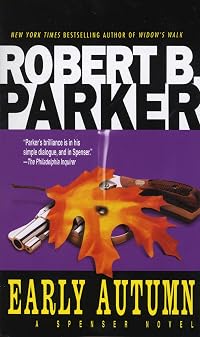
A bitter divorce is only the beginning. First the father hires thugs to kidnap his son. Then the mother hires Spenser to get the boy back. But as soon as Spenser senses the lay of the land, he decides to do some kidnapping of his own. With a contract out on his life, he heads for the Maine woods, determined to give a puny 15 year old a crash course in survival and to beat his dangerous opponents at their own brutal game.Tags
Recommendations








Member Reviews
Among Parker's "Spenser" novels, Early Autumn is an unexpected treat. This is not a book about crime detection, but rather Spenser’s rescue of a boy who is ill- treated by his wealthy parents. Socialite Patty Giacomin hires Spenser to protect her son Paul from being kidnapped by her estranged husband. Paul not only is unwanted by both parents (who are using him as a pawn in their quarrel), but is entirely lacking on social skills, ambition, and interests. Spenser takes him in, teaches him to exercise, to lift weights, and how to box, and ultimately, works with him to build a house. Spenser is tough but treats him with respect and dignity. Paul gains confidence and self-respect and is ready to live on his own by the book’s end.
I show more found the story touching, with real sensitivity. It showed a side of Spenser we didn’t know existed. Spenser’s lady friend Susan Silverman also shows a new side, though not a pleasant one – she turns out to be selfish and lacking in understanding. While this is an unusual sort of Spenser novel, I liked it and can see why many Amazon readers rate it very highly. show less
I show more found the story touching, with real sensitivity. It showed a side of Spenser we didn’t know existed. Spenser’s lady friend Susan Silverman also shows a new side, though not a pleasant one
This originally appeared at The Irresponsible Reader.
---
This is the least "Spenser"-ish of the Spenser novels, and it's the most quintessentially "Spenser"-sh. If that's possible. I've probably read it more than any other in the series and probably could've written 75% of what I'm going to end up saying here without cracking it open. But why deny myself?
I'm going to try to keep this from getting out of control, but no promises.
Please. I have no one else. Please."
"There's a qustion whether you need anyone else," I said, "but I'll take a whack at it on one condition."
"What?"
"You tell me your name so I'll know where the bill gets sent."
She smiled. "Giacomin," she said, "Patty Giacomin."
"Like the old Ranger's goalie," I said.
"I'm show more sorry?"
"Gentleman of the same name used to be a hockey player."
"Oh. I"m afraid I don't follow sports much."
"No shame to it," I said. "Matter of not being raised properly. Not your fault at all."
She smiled again, although this time it was a little unsure, as if now that she had me she wasn't certain she wanted me. It's a look I've seen a lot.
WHAT'S EARLY AUTUMN ABOUT?
Patty Giacomin comes to Spenser (in a newly relocated office, this will be important a few books from now) for help, her ex-husband has taken their teenaged son in some sort of revenge move. She wants Spenser to get him back. He does so, in possibly the dullest scene in the series (only because it was so easy). This is not the kind of stuff we read P.I. novels for—Paul's back home by page 30.
Three months later, a stranger attempts to kidnap Paul, but he escapes. Patty hires Spenser to stay with them and protect Paul—and her, after the would-be kidnapper and an accomplice try to break in and take Paul. Spenser interferes with that plan, but Paul's safe, Patty's eventually kidnapped by these men, and the exchange is set up, son for mom.
Spenser and Hawk interfere with that plan, and this time it gets a bit more violent. Clearly things are going to keep escalating, so they need another tack. It's decided that Patty will lie low with a friend for a while, and Spenser and Paul will go out of town until the heat dies down. Spenser had promised to build a cabin for Susan on some property in Maine, so he and the boy head off to do that.
At this point, it's not just about keeping Paul safe for Spenser. He's trying to help the kid—trying to push him into being an autonomous person with skills and interests. Angela Duckworth would say that Spenser's trying to foster grit in Paul, who certainly needs something.
Clearly, Mel Giacomin has some less-than-savory friends/business associates if he can get this kind of help. Spenser moves the bodyguarding to the side and beings investigating—why would Mel be able to find this kind of help? Would knowing this give Spenser the leverage to get Mel out of Paul's life?
PAUL
When we first meet Paul, he's a sullen, almost affect-less fifteen year-old whose major form of communication is a shrug. He has no interests, few friends, really doesn't seem to care which parent he's with, and would rather just sit around watching syndicated reruns all day than worry about any of this. (one can only imagine how a Paul would be written today with hundreds of cable channels, Netflix (and the rest)—not to mention the Internet—rather than the few choices that 1981 TV provides.
When Spenser starts to teach him to exercise, to box, and to swing a hammer, Paul couldn't care less about any of it. He goes along because he has nothing better to do (there's no TV at the cabin) and because Spenser's not really taking no for an answer. Soon Paul goes along with it because he's seeing and feeling the results of an active lifestyle.
When Spenser gets ready to investigate his parents, Paul's more than willing to tag along and help. He's not a budding P.I., this isn't Spenser adding a Robin to his Batman. It's Paul exercising some self-determination. By the end of the novel, he knows who his parents are. He understands their motivations and what they're like when they're not being some of the lousiest parents you'll encounter in print. More than that, he'll know the kind of man he wants to be and he'll know how he wants to become that kind of man.
SUSAN
Previously to now, we've seen Susan understand and support Spenser's work. She may not enjoy it or agree with his methods, but she understands and supports him—even assists him as best as she can (when feasible). But that's not the case in Early Autumn, she discourages Spenser from following his plan. She's outright critical about parts of it, and spends most of the novel in one "funk" (Spenser's word) or another. This case, and Spenser's approach to it, puts a strain on their relationship, and it's easy to understand why that is from her perspective (his, too, neither are wrong).
While Susan doesn't seem to come across all that well for much of the book, she does come across as human. She's not perfect, she's a little jealous, she's put out that Spenser will just drop strangers on her front door with no warning claiming to be in danger. But when the chips are down, she pitches in, and eventually embraces Spenser's mission regarding Paul. In a few years, we won't see that complex of a reaction from Susan. The character (and the series) will be less for that, so when possible, I've got to enjoy it.
HAWK
We get a scene in this book that in my mind we get a lot more than Parker actually wrote (although it does show up in Spener: For Hire a few times), someone has contacted Hawk about a hit on Spenser. Something Hawk would never do, but not too many people know that. It's a great scene, and Hawk seems to enjoy it more than even I do.
He's not around for much of this book, but when he is, it matters. I don't think Hawk's appearances before now have qualified, but I'd say he steals almost every scene he's in. It's one of those cases where a supporting character becomes as, if not more, beloved than the series protagonist/central character.
He's ruthless, he's dependable, and he does what he thinks is necessary—even when it conflicts with Spenser's wishes—because he thinks Spener's soft. Frequently, he lets Spenser's "rules" get in the way of what he wants to do. But this time, he won't--because he's convinced it'll get Spenser killed, and then Hawk would have to come along and get revenge later. He'd rather cut out the middle stuff and take care of it now. No matter what Hawk, Spenser, and others may say about the two of them being the same. They're not. And it's because of things like this.
THE CRIMINAL INVESTIGATION
As I said before, it's obvious that Mel Giacomin is up to something. Upstanding citizens don't enlist criminal help in a custody case (they wouldn't know how). Spenser and Paul take very little time or effort (although there is some, helping Paul increase his grit) to uncover enough to send his father to jail—or to blackmail him into supporting Paul's education while keeping him safe from further abductions.
It's a step or two above perfunctory, and it really doesn't matter. The core of this book is Paul. Paul and his relationship to his parents. Paul and Spenser. Paul starting to think and act on his own behalf, making choices, and being autonomous to whatever degree he can. Parker has to throw in the criminal activity because Spenser's not Spenser without a villain to thwart. Also, how else would it stay in the genre?
SO, WHAT DID I THINK ABOUT EARLY AUTUMN?
You've gotten yourself in a lot of trouble over this, Jack, and don't you forget it," he said.
I said, "Name's Spenser with an S, like the poet. I'm in the Boston book." I stepped through the door and closed it. Then I opened it again and stuck my head back into the hall. "Under Tough," I said. And closed the door, and walked out.
I love it. We get the clearest, and most unabashed description of Spenser's code of honor, code of life, and way of approaching things that we'll ever get. He's embarrassed to talk about it to Rachel Wallace, he'll joke around the truth with others, and he and Susan will cover the same ground ad nauseam. But here he's trying to pass it on to Paul, even if Paul doesn't embrace it wholeheartedly, Spenser wants to inspire Paul to come up with his own code, his own guiding principles and the best way to do that is by being open an honest.
We learn so much about Spenser here that it's essential reading for anyone wanting to understand the character.
I was younger than Paul the first few times I read this book, and I won't say that it inspired me the same way it does Paul. I can't say I developed the need for, or interest, in being an autonomous person, or in defining my own moral code. But the novel did inspire me, it made me think about life in a way that most people my age didn't do (probably still don't).
The dialogue was snappy, I learned early on that it a shrug shouldn't be used as an all-purpose method of communication, the action was good (if almost an afterthought), and anything that contains a couple of strong Hawk scenes is worth the read.
This isn't Spenser at his smartest, his toughest, or even his funniest. But it's Spenser in the raw, the Platonic ideal of Spenser on display for readers and characters alike.
It's a great read. show less
---
This is the least "Spenser"-ish of the Spenser novels, and it's the most quintessentially "Spenser"-sh. If that's possible. I've probably read it more than any other in the series and probably could've written 75% of what I'm going to end up saying here without cracking it open. But why deny myself?
I'm going to try to keep this from getting out of control, but no promises.
Please. I have no one else. Please."
"There's a qustion whether you need anyone else," I said, "but I'll take a whack at it on one condition."
"What?"
"You tell me your name so I'll know where the bill gets sent."
She smiled. "Giacomin," she said, "Patty Giacomin."
"Like the old Ranger's goalie," I said.
"I'm show more sorry?"
"Gentleman of the same name used to be a hockey player."
"Oh. I"m afraid I don't follow sports much."
"No shame to it," I said. "Matter of not being raised properly. Not your fault at all."
She smiled again, although this time it was a little unsure, as if now that she had me she wasn't certain she wanted me. It's a look I've seen a lot.
WHAT'S EARLY AUTUMN ABOUT?
Patty Giacomin comes to Spenser (in a newly relocated office, this will be important a few books from now) for help, her ex-husband has taken their teenaged son in some sort of revenge move. She wants Spenser to get him back. He does so, in possibly the dullest scene in the series (only because it was so easy). This is not the kind of stuff we read P.I. novels for—Paul's back home by page 30.
Three months later, a stranger attempts to kidnap Paul, but he escapes. Patty hires Spenser to stay with them and protect Paul—and her, after the would-be kidnapper and an accomplice try to break in and take Paul. Spenser interferes with that plan, but Paul's safe, Patty's eventually kidnapped by these men, and the exchange is set up, son for mom.
Spenser and Hawk interfere with that plan, and this time it gets a bit more violent. Clearly things are going to keep escalating, so they need another tack. It's decided that Patty will lie low with a friend for a while, and Spenser and Paul will go out of town until the heat dies down. Spenser had promised to build a cabin for Susan on some property in Maine, so he and the boy head off to do that.
At this point, it's not just about keeping Paul safe for Spenser. He's trying to help the kid—trying to push him into being an autonomous person with skills and interests. Angela Duckworth would say that Spenser's trying to foster grit in Paul, who certainly needs something.
Clearly, Mel Giacomin has some less-than-savory friends/business associates if he can get this kind of help. Spenser moves the bodyguarding to the side and beings investigating—why would Mel be able to find this kind of help? Would knowing this give Spenser the leverage to get Mel out of Paul's life?
PAUL
When we first meet Paul, he's a sullen, almost affect-less fifteen year-old whose major form of communication is a shrug. He has no interests, few friends, really doesn't seem to care which parent he's with, and would rather just sit around watching syndicated reruns all day than worry about any of this. (one can only imagine how a Paul would be written today with hundreds of cable channels, Netflix (and the rest)—not to mention the Internet—rather than the few choices that 1981 TV provides.
When Spenser starts to teach him to exercise, to box, and to swing a hammer, Paul couldn't care less about any of it. He goes along because he has nothing better to do (there's no TV at the cabin) and because Spenser's not really taking no for an answer. Soon Paul goes along with it because he's seeing and feeling the results of an active lifestyle.
When Spenser gets ready to investigate his parents, Paul's more than willing to tag along and help. He's not a budding P.I., this isn't Spenser adding a Robin to his Batman. It's Paul exercising some self-determination. By the end of the novel, he knows who his parents are. He understands their motivations and what they're like when they're not being some of the lousiest parents you'll encounter in print. More than that, he'll know the kind of man he wants to be and he'll know how he wants to become that kind of man.
SUSAN
Previously to now, we've seen Susan understand and support Spenser's work. She may not enjoy it or agree with his methods, but she understands and supports him—even assists him as best as she can (when feasible). But that's not the case in Early Autumn, she discourages Spenser from following his plan. She's outright critical about parts of it, and spends most of the novel in one "funk" (Spenser's word) or another. This case, and Spenser's approach to it, puts a strain on their relationship, and it's easy to understand why that is from her perspective (his, too, neither are wrong).
While Susan doesn't seem to come across all that well for much of the book, she does come across as human. She's not perfect, she's a little jealous, she's put out that Spenser will just drop strangers on her front door with no warning claiming to be in danger. But when the chips are down, she pitches in, and eventually embraces Spenser's mission regarding Paul. In a few years, we won't see that complex of a reaction from Susan. The character (and the series) will be less for that, so when possible, I've got to enjoy it.
HAWK
We get a scene in this book that in my mind we get a lot more than Parker actually wrote (although it does show up in Spener: For Hire a few times), someone has contacted Hawk about a hit on Spenser. Something Hawk would never do, but not too many people know that. It's a great scene, and Hawk seems to enjoy it more than even I do.
He's not around for much of this book, but when he is, it matters. I don't think Hawk's appearances before now have qualified, but I'd say he steals almost every scene he's in. It's one of those cases where a supporting character becomes as, if not more, beloved than the series protagonist/central character.
He's ruthless, he's dependable, and he does what he thinks is necessary—even when it conflicts with Spenser's wishes—because he thinks Spener's soft. Frequently, he lets Spenser's "rules" get in the way of what he wants to do. But this time, he won't--because he's convinced it'll get Spenser killed, and then Hawk would have to come along and get revenge later. He'd rather cut out the middle stuff and take care of it now. No matter what Hawk, Spenser, and others may say about the two of them being the same. They're not. And it's because of things like this.
THE CRIMINAL INVESTIGATION
As I said before, it's obvious that Mel Giacomin is up to something. Upstanding citizens don't enlist criminal help in a custody case (they wouldn't know how). Spenser and Paul take very little time or effort (although there is some, helping Paul increase his grit) to uncover enough to send his father to jail—or to blackmail him into supporting Paul's education while keeping him safe from further abductions.
It's a step or two above perfunctory, and it really doesn't matter. The core of this book is Paul. Paul and his relationship to his parents. Paul and Spenser. Paul starting to think and act on his own behalf, making choices, and being autonomous to whatever degree he can. Parker has to throw in the criminal activity because Spenser's not Spenser without a villain to thwart. Also, how else would it stay in the genre?
SO, WHAT DID I THINK ABOUT EARLY AUTUMN?
You've gotten yourself in a lot of trouble over this, Jack, and don't you forget it," he said.
I said, "Name's Spenser with an S, like the poet. I'm in the Boston book." I stepped through the door and closed it. Then I opened it again and stuck my head back into the hall. "Under Tough," I said. And closed the door, and walked out.
I love it. We get the clearest, and most unabashed description of Spenser's code of honor, code of life, and way of approaching things that we'll ever get. He's embarrassed to talk about it to Rachel Wallace, he'll joke around the truth with others, and he and Susan will cover the same ground ad nauseam. But here he's trying to pass it on to Paul, even if Paul doesn't embrace it wholeheartedly, Spenser wants to inspire Paul to come up with his own code, his own guiding principles and the best way to do that is by being open an honest.
We learn so much about Spenser here that it's essential reading for anyone wanting to understand the character.
I was younger than Paul the first few times I read this book, and I won't say that it inspired me the same way it does Paul. I can't say I developed the need for, or interest, in being an autonomous person, or in defining my own moral code. But the novel did inspire me, it made me think about life in a way that most people my age didn't do (probably still don't).
The dialogue was snappy, I learned early on that it a shrug shouldn't be used as an all-purpose method of communication, the action was good (if almost an afterthought), and anything that contains a couple of strong Hawk scenes is worth the read.
This isn't Spenser at his smartest, his toughest, or even his funniest. But it's Spenser in the raw, the Platonic ideal of Spenser on display for readers and characters alike.
It's a great read. show less
I've loved this Spenser outing since I was a teenaged sprout. When Spenser takes an interest in a fifteen year-old kid who's about to "go down the tubes" (as Spenser puts it) because his parents have no interest in him, we get a story that is part typical Spenser PI fare, part coming-of-age story, and part character study. And it's brilliant. If I ever had a troubled son, I'd send him off with Spenser to "grow up fast" in a heart-beat. Love Hawk here, too. One of the very best Spensers, this.
My favorite Spenser, and the first one I read. It simply obliterated my expectations, established an unforgettable character in a way that had nothing to do with the detective genre, and got me to care about a character I didn't even like at first meeting. I spent the next two years tracking down every last book in the series.
Robert B. Parker's books are comfy. They are light---especially in paperback, so easy to hold lying down. Spenser's style of talking is simple and often funny. The scenes around Boston and Cambridge are nostalgic. And he usually surprises you with something wise. (see the quotes). An important book in the series, since the teenage boy that Parker mentors, Paul Giacomin, appears in later stories.
This is the second Spenser novel I've read, I liked it much more than the first, but I think that's because I've settled and become comfortable with the character; it's not because of the great writing. Reading Parker is like wearing a dirty pair of pants. Easier than pressing a new pair when they're right there...
Having read all the Spenser novels at least once, they all blur together...except for this one. Spenser's attempt to reclaim the heart and soul of an almost lost boy is completely memorable. The book reads quickly, although in this early novel, Parker hasn't pared his style down to 2-page chapters that consist of nothing but dialogue--screenplays without camera directions. Eventually he became almost a caricature of himself. But he's one of the best, and this is one of his finest.
Members
- Recently Added By
Lists

Tozai Mystery Best 100 | The Top 100 Mystery Novels
111 works; 3 members
Author Information

126+ Works 72,849 Members
Robert Brown Parker is an American fiction writer of mysteries. He was born in Springfield, Massachusetts and earned his BA degree from Colby College in Waterville, Maine. He went on to earn his master's degree in English literature from Boston University. He started his career working in advertising. After some years, he went back to school to show more earn his PhD in English from Boston University in 1971. He then began his writng career while teaching at Northeastern University. He decided to become a full-time writer in 1979. His most popular works were the 40 novels written about the private detective Spenser. The ABC Television Network developed the television series "Spenser: For Hire", based on the character in the mid-1980s. Parker also wrote nine novels based on the character Jesse Stone and six novels based on the character Sunny Randall. On January 18, 2010, Robert Parker died suddenly of a heart attack at his home in Cambridge Massachusetts. (Bowker Author Biography) show less
Some Editions
Awards and Honors
Series

Work Relationships
Is contained in
Has as a student's study guide
Common Knowledge
- Canonical title*
- Otoño temprano
- Original title
- Early Autumn
- Original publication date
- 1981
- People/Characters
- Mel Giacomin; Patty Giacomin; Paul Giacomin; Hawk; Spenser; Susan Silverman
- Important places
- Boston, Massachusetts, USA; Massachusetts, USA; New York, USA; New York, New York, USA
- Dedication
- For David Parker and Daniel Parker, with the respect and admiration of their father, who grew up with them.
- First words
- The urban renewers had struck again.
- Quotations
- "When all your options are lousy," I said, "you try to choose the least lousy." [p. 28]
"... Too much positive is either scared or stupid or both. Reality is uncertain. Lot of people need certainty. ... They spend their lives trying to be what they're supposed to be and being scared they aren't. Quiet desperatio... (show all)n." [pp. 139-140] - Last words
- (Click to show. Warning: May contain spoilers.)"Winter's coming," I said.
*Some information comes from Common Knowledge in other languages. Click "Edit" for more information.
Classifications
Statistics
- Members
- 1,333
- Popularity
- 18,043
- Reviews
- 34
- Rating
- (3.97)
- Languages
- 5 — Dutch, English, French, German, Spanish
- Media
- Paper, Audiobook, Ebook
- ISBNs
- 21
- ASINs
- 9