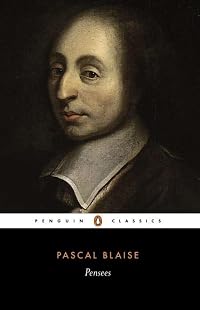
Pensées
by Blaise Pascal
On This Page
Description
Pascal's Pensées is a masterpiece, and a landmark in French literature. This is Pascal's most influential theological work-in it he surveys several philosophical paradoxes: infinity and nothing; faith and reason; soul and matter; death and life; meaning and vanity-seemingly arriving at no definitive conclusions besides humility, ignorance, and grace.Tags
Recommendations











Member Reviews
"It is a bad sign when, on seeing a person, you remember his book" — Pascal Pensées
On Contradiction
The prelapsarian urgency with which the (first part of) Pensées is written suggests the intensity of someone trying to land the first blow on the corpus of an enemy — rather than, for instance, the blank fervor of faith. (I am taking this interpretation from a direct reading of a certain text, though I have forgotten the original . . . perhaps it was Spivak or Sloterdijk.) My personal notes from a time of intensity are written the same way, and certainly with my own enemy in (the back of my) mind. Here, Pascal decries, "A maker of witticisms, a bad character" (46), which is another way of saying "the poet." (One wonders at the show more (intentional?) irony in this phrase, itself a witticism, especially given that Pascal is currently supplying at least three witty epigraphs in Sloterdijk's Critique of Cynical Reason.) Someone ought to introduce Pascal, with his attendant metrophobia (fear of poetry) to our (modern?) Pascal: i.e. William Blake, whose Proverbs of Hell is a collection of witticisms to rival the Pensées/.
Shouts and Murmurs: Conversation Overhead between Pascal and Blake
ON LUST
Full of lust; therefore we are full of evil; we ought to hate ourselves — Pascal (479)
The head Sublime, the heart Pathos, the genitals Beauty, the hands & feet Proportion. — Blake
You are only a king of lust — Pascal (314)
The lust of the goat is the bounty of God — Blake
Enough is as good as a feast— Pascal
You never know what is enough unless you know what is more than enough. — Blake
ON DIVERSION
Now, to remind ourselves of our duty, we must set ourselves a task we dislike — Pascal (104)
The busy bee has no time for sorrow — Blake
Reasons why we like the chase better than the quarry. — Pascal (139)
The fox condemns the trap, not himself — Blake
[I have no friends] to your advantage — Pascal (154)
If others had not been foolish, we should be so. — Blake
ON DEATH
All good maxims are in the world. We only need to apply them — Pascal (380)
Drive your cart and your plow over the bones of the dead. — Blake
There are no limits in things. (Laws would put them there, and the mind cannot suffer it) — Pascal (380)
No bird soars too high, if he soars with his own wings. — Blake
These reasons were only found [afterward] because it shocks him. — Pascal (276)
One thought, fills immensity. — Blake
God humiliated; by His grace, I await death in peace — Pascal (736)
The chief characters in Thomas Bernhard novels are always carrying around a copy of the Pensées; perhaps those monologuing obsessives, for whom nobody else really exists, are feeling an elective affinity for such work. Aside, I am recalling that humorous episode in Gargoyles in which the prince has gathered everyone around for a reading of the Elective Affinities and instead decides to read an article from an old newspaper about how potatoes are stored for the winter in England. Sometimes we think we're reading the Pensées whereas we're actually reading an article from an old newspaper. I want to say many things at once about the dialogic first part of Pensées, which is producing its hermetic eccentricity, and about the hermetic second part of Pensées, which is producing a stale orthodoxy on Christian dogma not new to anyone. (Thoughts both in praise of and against dialogue with another: Walter Benjamin stating that, in addition to intelligence, one needs an equal part of stupidity for any great work. Quayle on the dialogic process: "People who are really very [hermetic] can get into sensitive situations and have a tremendous impact on [the text]." Pascal on the Other: "We never love a person but only qualities.") In either case, there is evidently a contradiction between the early Pascal, whose short phrases read like hard-fought victories in an essai against Montaigne, and the late Pascal, who's quoting facile scripture at length.
Pascal assists us in this investigation of contradiction with an approach we might not have expected: "Contradiction is a bad sign of truth; several things which are certain are contradicted; several things which are false pass without contradiction. Contradiction is not a sign of falsity, nor the want of contradiction a sign of truth" (384). This is a curious phrase, which suggests, at its extreme, an incompatibility between tertium non datur and the Holy Trinity. An insistence with letting contradictions lie — this is one aspect of what Edward Said calls "Late Style," and which, precociously, appears rather early in the text. Yet this perspective is later contradicted by Pascal himself: "Thus, we must have a meaning in which all the contrary passages [in scripture] are reconciled. It is not enough to have one which suits many concurring passages; but it is necessary to have one which reconciles even contradictory passages. Every author has a meaning in which all the contradictory passages agree, or he has no meaning at all"(683). We are contrasting this with Pascal's earlier statement that truths may just as well contain contradictions. (We also recall Pascal's perspective on the immanent contradictions of what he perceives to be true in mind-body Dualism, in the corporeal presence of both Lusts and the higher affinities, and in the divine contradiction between the Temporal and the Eternal.) So, catching Pascal in a contradiction, one wonders whether this is the kind of contradiction which suggests truth or one which "has no meaning at all." The better reading would be to let it lie, but we are tempted to resolve it the same way Pascal does: abstracting one step further back and constructing a meaning which reconciles everything. This is a way to make everything go smoothly, but also recalls Susan Sontag's paraphrase of Sartre: "Evil is the systematic substitution of the general for the particular." Bad writing is, if anything, evil, and this process perhaps explains why the latter orthodox sections of the Pensées smell a touch like hellfire. Pascal, who has at some point lost his interlocutor, may have wondered why those last sections caused no trouble. Yet, even in those dry parts, we are heartened by Pascal's incidental notions of Catholic guilt, which we might benefit from yet. Pascal being just like us in his perseveration on the guilty condition (in his case, due awareness of Lust) — the only difference being that the present-day equivalent to seventeenth-century Catholic self-hatred is hating oneself due to the knowledge that one will never write oneself out from under Susan Sontag. show less
As far as I'm concerned, Pascal's "shorts" are far more clever, succinct, surprising, and woven together than those of Rouchefoucauld and others. There are many threaded thoughts woven amongst more than 900 maxims and mini-essays each of which stand on their own. The profundity and diversity of topics makes the Pensees something to read slowly and ponder -- it takes much more time than reading the same amount of text in typical prose. Here Pascal masterfully forces us to contemplate just about every philosophical aspect of nature, religion, culture, and government, and the human condition in general. Starting with a discussion of the mathematical versus the intuitive mind (there are advantages in both but true genius lies in the show more mathematically trained also being able to see the big picture and beyond the concrete), he then portrays theology in nature, argues against atheism, supports Catholic doctrine, and finds the source of all unhappiness. show less
2
Os pensamentos do senhor Pascal começam bem, como uma coleção de aforismos pré-Nietzscheanos e com observações interessantes e de boa pena, mas descambam rumo ao seu objetivo, aparentemente principal, e de modo insuportável ao final - a defesa apologética do cristianismo. Não que não se possa defender em argumentos o cristianismo, mas aqui há uma enorme quantidade de petições de princípio e acenos para aqueles que já estão convencidos da importância dessa religião, muito mais que qualquer outra coisa. As certezas que a aceitação acrítica da fé trazem, acabam então engolindo as observações sobre a importância do hábito e dos costumes na formação da cultura, e há ainda a decepção do episódio da "aposta de show more Pascal" ser assim, no original, tão simplório. show less
I tried to read Pensees circa 2018, and never finished. I lacked the patience. My notes suggest that I got at least as far as pensee #100. I should consider trying again at some point, because it wasn't a waste of time--not exactly. Especially if the journal was good enough to impress T.S. Eliot. But if nothing else, I learned (to my amusement) enough about how Blaise Pascal's mind apparently worked. I used to be into the Rationalists, early in my college career. I wouldn't recommend them now.
If I recall from reading about Pensees, these thoughts (pensees) were personal journal musings; and I have the impression that they might be "wastebasket stuff" that Pascal never intended to keep, much less publish. That would make sense, because show more this journal (as far as i progressed in it) is unfocused, scattershot. A small few honestly did strike me as a waste of time: I took some notes, writing at least brief comments on many pensees; and there were more than one for which I wondered whether they were babbling, and one for which I wrote "irrelevant and nearly incomprehensible."
The other thing one can remark on is how naive some of them are, how lacking in awareness of what society over time had already figured out. In other words, Pascal seems to assume by default that whatever he noticed is a unique discovery that the wisdom of the ages knows nothing of. There is at least one pensee about which I wrote "interesting but obvious," and another where I reacted more crudely: "Duh." Why? Because according to my notes, that particular pensee actually bothered to remark on how rearranging words creates different meaning. Pascal appears to have been an archetype of the prodigy who is too self-absorbed to know or care what other people think, and consequently doesn't know that some of his "revelations" aren't revelatory to anyone else. (That's probably why I said Pascal's pensees amuse me. A deep thinker who doesn't suppose that his deep thoughts have occurred to someone before.)
Also, the Pensees seem as good an example as any Rationalist work of what I called "vulgar [common, not dirty] rationalism." I did not bother to write down the text that struck me as such, but my notes say it was pensee 56.
If the famous Pascal's Wager is even in this book (I generally supposed so), I don't think I got that far. Or, if it was earlier than pensee 100, I didn't notice it.
Finally, you don't need to buy a copy or even go to the library to read this. Like many public-domain works, it's available on Project Gutenberg. show less
If I recall from reading about Pensees, these thoughts (pensees) were personal journal musings; and I have the impression that they might be "wastebasket stuff" that Pascal never intended to keep, much less publish. That would make sense, because show more this journal (as far as i progressed in it) is unfocused, scattershot. A small few honestly did strike me as a waste of time: I took some notes, writing at least brief comments on many pensees; and there were more than one for which I wondered whether they were babbling, and one for which I wrote "irrelevant and nearly incomprehensible."
The other thing one can remark on is how naive some of them are, how lacking in awareness of what society over time had already figured out. In other words, Pascal seems to assume by default that whatever he noticed is a unique discovery that the wisdom of the ages knows nothing of. There is at least one pensee about which I wrote "interesting but obvious," and another where I reacted more crudely: "Duh." Why? Because according to my notes, that particular pensee actually bothered to remark on how rearranging words creates different meaning. Pascal appears to have been an archetype of the prodigy who is too self-absorbed to know or care what other people think, and consequently doesn't know that some of his "revelations" aren't revelatory to anyone else. (That's probably why I said Pascal's pensees amuse me. A deep thinker who doesn't suppose that his deep thoughts have occurred to someone before.)
Also, the Pensees seem as good an example as any Rationalist work of what I called "vulgar [common, not dirty] rationalism." I did not bother to write down the text that struck me as such, but my notes say it was pensee 56.
If the famous Pascal's Wager is even in this book (I generally supposed so), I don't think I got that far. Or, if it was earlier than pensee 100, I didn't notice it.
Finally, you don't need to buy a copy or even go to the library to read this. Like many public-domain works, it's available on Project Gutenberg. show less
This is one of 14 books I have left on my Invitation to the Classics Book List, and I started it wondering what I had gotten myself into! It seemed too difficult to understand, but once I got into the rhythm of Pascal's numbered thoughts and reflections, I was hooked. He was a very Godly man who had some things to say about the condition of man and God's remedy for it! He reacts to Montaigne and Descartes and quotes Augustine. These are all writers I have read. So that was fun to read Pascal's reaction to their writings.
I listened to the LibriVox recording of this book and followed along with my free Kindle edition. There are many advantages to listening to this rendition of the book.
The narrator is excellent (Shout out to Dexter from show more Canada),
The Latin is read by Leni in Rio de Janeiro and translated into English by Dexter. You would lose quite a bit not knowing what the Latin meant.
Dexter reads all the footnotes which aren't hyperlinked on the Kindle edition (because it was free :)). He reads the Scripture in the footnotes too.
I walked along and listened to this book and felt it was part of my time with God! Pascal went through the whole Bible. I loved having the narrator read Scripture after Scripture that points to Christ! Awesome and intelligent devotional book.
Here is a summary of what the Pensées are all about:
Pascal’s Pensées is widely considered to be a masterpiece, and a landmark in French prose. When commenting on one particular section (Thought #72), Sainte-Beuve praised it as the finest pages in the French language. Will Durant, in his 11-volume, comprehensive The Story of Civilization series, hailed it as “the most eloquent book in French prose.” In Pensées, Pascal surveys several philosophical paradoxes: infinity and nothing, faith and reason, soul and matter, death and life, meaning and vanity—seemingly arriving at no definitive conclusions besides humility, ignorance, and grace. Rolling these into one he develops Pascal’s Wager. (Summary from Wikipedia)
It really is a masterpiece, and if you read nothing else, read the "Pascal's Wager" portion. It is brilliant. In 2008, I talked about the "wager" portion as I sat with my college friend, Bruce, who was waiting to be admitted to the hospital. How poignant to discuss Pensées with a dying man. That was his last admission to the hospital. Bruce wagered on the "God is" side of the coin, and I am sure he is in heaven with the angels as I type this.
My husband is a mathematician, and I was just extolling to him the virtues of reading Pensées, and he said, "Oh, I read it during one of my days of prayer last year."
Did I marry the right man or what?
Link to LibriVox recording: http://librivox.org/pensees_by_blaise_pascal/ show less
I listened to the LibriVox recording of this book and followed along with my free Kindle edition. There are many advantages to listening to this rendition of the book.
The narrator is excellent (Shout out to Dexter from show more Canada),
The Latin is read by Leni in Rio de Janeiro and translated into English by Dexter. You would lose quite a bit not knowing what the Latin meant.
Dexter reads all the footnotes which aren't hyperlinked on the Kindle edition (because it was free :)). He reads the Scripture in the footnotes too.
I walked along and listened to this book and felt it was part of my time with God! Pascal went through the whole Bible. I loved having the narrator read Scripture after Scripture that points to Christ! Awesome and intelligent devotional book.
Here is a summary of what the Pensées are all about:
Pascal’s Pensées is widely considered to be a masterpiece, and a landmark in French prose. When commenting on one particular section (Thought #72), Sainte-Beuve praised it as the finest pages in the French language. Will Durant, in his 11-volume, comprehensive The Story of Civilization series, hailed it as “the most eloquent book in French prose.” In Pensées, Pascal surveys several philosophical paradoxes: infinity and nothing, faith and reason, soul and matter, death and life, meaning and vanity—seemingly arriving at no definitive conclusions besides humility, ignorance, and grace. Rolling these into one he develops Pascal’s Wager. (Summary from Wikipedia)
It really is a masterpiece, and if you read nothing else, read the "Pascal's Wager" portion. It is brilliant. In 2008, I talked about the "wager" portion as I sat with my college friend, Bruce, who was waiting to be admitted to the hospital. How poignant to discuss Pensées with a dying man. That was his last admission to the hospital. Bruce wagered on the "God is" side of the coin, and I am sure he is in heaven with the angels as I type this.
My husband is a mathematician, and I was just extolling to him the virtues of reading Pensées, and he said, "Oh, I read it during one of my days of prayer last year."
Did I marry the right man or what?
Link to LibriVox recording: http://librivox.org/pensees_by_blaise_pascal/ show less
*Finally* finished this over the course of two lengthy plane rides. Had I somehow read Pascal's thoughts as a contemporary, I suppose I would've been much more engaged-- but having taken it on as a duty, after having heard so many others expound upon it, the magic was gone before I even got started. I really enjoyed the more "secular" witticisms at the beginning of the book, but finally had to resort more or less to skimming whole chunks in order to get through it all. I realize the 2.5-star rating is highly unfair-- but in this case, I just allowed the interest factor, pure and simple, to shove other considerations (such as philosophical and theological de/merits) out of the way.
Pascal's Thoughts on Philosophy and Religion (often just referred to as his Pensées ) consists of the fragments of an unfinished work which was to be a justification of the Christian religion.
This particular volume opens with a biography and essay on Pascal, written by Isaac Taylor, which together come to around 100 pages. This explains to the reader how Pascal was one of the most eminent mathematicians, scientists, and writers of his age, in addition to being a profound philosophical thinker.
One of the bits of the Pensées I enjoyed most was near the beginning, where the place of man in the universe is described, and the human condition. Some of the emphasis of this reminded me of the Meditations by Marcus Aurelius, such as our very show more smallness among the infinities of time and space, but our significance despite this due to our ability to think and appreciate our condition. Pascal's other insights into the human condition seem relevant and thought provoking still now, and demonstrate his clarity of thinking, and will probably be of more interest to the general reader than some of the more theological chapters later on in the work.
French philosophers had already a reputation as religious thinkers prior to Pascal, with Descartes being a notable member of these and also an associate of Pascal's father. Pascal differs greatly in his handling of religious matters from Descartes though, despite them both being geometers, logicians, and Christians. While Descartes took a more Deistic approach to the question of God, Pascal favours a Theistic viewpoint, with much more of a reliance on scripture than logic. This might be surprising to those who know of this work through “Pascal's Wager”, which shows a belief in God to be rational through an assessment of odds: If we deny the Christian God, and God exists, we face eternal hell, if he doesn't exist, then we lose nothing; If we believe in God and he does exist, we gain eternal life, if he doesn't exist we lose nothing. The odds of this assessment favour the belief in God. What, of course, this fails to do, is to create the belief in God in the individual, and merely shows that it is rational to believe. Pascal then goes on to say that God can only be known through Christ, and through the heart, and that God cannot be found through philosophy and logic alone, which contrasts to the deism of philosophers such as Spinoza, but appears again later in the religous philosophy of Kierkegaard.
This work is of very much more than purely religious interest, with one of the most interesting chapters being a collection of miscellaneous thoughts.
The chapters vary quite widely in the ease and enjoyment with which they can be read, but this is understandable given that the work was not finished. Despite this, it remains a largely accessible book, and worth making the effort to complete if the reader is interested in the major questions of Philosophy. show less
This particular volume opens with a biography and essay on Pascal, written by Isaac Taylor, which together come to around 100 pages. This explains to the reader how Pascal was one of the most eminent mathematicians, scientists, and writers of his age, in addition to being a profound philosophical thinker.
One of the bits of the Pensées I enjoyed most was near the beginning, where the place of man in the universe is described, and the human condition. Some of the emphasis of this reminded me of the Meditations by Marcus Aurelius, such as our very show more smallness among the infinities of time and space, but our significance despite this due to our ability to think and appreciate our condition. Pascal's other insights into the human condition seem relevant and thought provoking still now, and demonstrate his clarity of thinking, and will probably be of more interest to the general reader than some of the more theological chapters later on in the work.
French philosophers had already a reputation as religious thinkers prior to Pascal, with Descartes being a notable member of these and also an associate of Pascal's father. Pascal differs greatly in his handling of religious matters from Descartes though, despite them both being geometers, logicians, and Christians. While Descartes took a more Deistic approach to the question of God, Pascal favours a Theistic viewpoint, with much more of a reliance on scripture than logic. This might be surprising to those who know of this work through “Pascal's Wager”, which shows a belief in God to be rational through an assessment of odds: If we deny the Christian God, and God exists, we face eternal hell, if he doesn't exist, then we lose nothing; If we believe in God and he does exist, we gain eternal life, if he doesn't exist we lose nothing. The odds of this assessment favour the belief in God. What, of course, this fails to do, is to create the belief in God in the individual, and merely shows that it is rational to believe. Pascal then goes on to say that God can only be known through Christ, and through the heart, and that God cannot be found through philosophy and logic alone, which contrasts to the deism of philosophers such as Spinoza, but appears again later in the religous philosophy of Kierkegaard.
This work is of very much more than purely religious interest, with one of the most interesting chapters being a collection of miscellaneous thoughts.
The chapters vary quite widely in the ease and enjoyment with which they can be read, but this is understandable given that the work was not finished. Despite this, it remains a largely accessible book, and worth making the effort to complete if the reader is interested in the major questions of Philosophy. show less
Members
- Recently Added By
Lists

Church Times 100 Best Christian Books
106 works; 26 members

Philip Ward's Lifetime Reading Plan
592 works; 22 members
25 Books Every Christian Should Read
27 works; 4 members

Filosofía - Clásicos
217 works; 1 member

Harold Bloom - The Western Canon: B. The Aristocratic Age
231 works; 13 members

Mustich's 1000 Books to Read Before You Die: A Life Changing List
1,001 works; 19 members

.
396 works; 1 member

el
1,139 works; 1 member

Recommendations by Peter Kreeft
45 works; 4 members

Recommended Reading : 600 Classics Reviewed, Editors of Salem Press, 2015
634 works; 6 members

New Lifetime Reading Plan by Fadiman and Major
225 works; 5 members

My List
302 works; 1 member

Philosophy, Politics and Economics
61 works; 1 member

Trinity College Booklist (1951): Class Three, Philosophy and Religion
80 works; 3 members
How to Read a Book's Recommended Reading List
309 works; 10 members

Art of Reading
188 works; 5 members

Western World's Greatest Books - Project Gutenberg
295 works; 15 members

Best of French Literature
138 works; 27 members

CCE 100 Great Books List
145 works; 8 members

Generation Joshua
115 works; 3 members
GreatBooks Worldview Academy Lists
133 works; 4 members
Trinity Norman Recommended Christian Readings
170 works; 5 members

In Our Time books
4,934 works; 2 members
Talk Discussions
Past Discussions
Any thoughts on Pensees from Folio? in Folio Society Devotees (September 2024)
Author Information

418+ Works 10,489 Members
French Mathematician Blaise Pascal did much to set in motion what is known today as modern mathematics. An unusually creative mathematician, he developed a number of theorems and mathematical structures, including the beginnings of probability theory and a more sophisticated understanding of the geometry of conic structures. At the age of 16, show more Pascal wrote a brilliant paper on conics; the paper consisted of one single printed page on which he states his major theorem - the opposite sides of any hexagon inscribed in a cone intersect in a straight line. This theorem led Pascal to develop several hundred related theorems in geometry. Pascal's activities, however, were not confined to pure mathematics. When he was about 19 years old, he built a calculating machine that he demonstrated to the king of France. It worked well enough to allow him to build and sell about 50 of them over a few years' time. His work on problems in atmospheric pressure eventually resulted in an early version of the gas law. At the age of 25, Pascal entered a Jansenist monastery to begin an ascetic life of study and argument. However, he continued his mathematical work. With Pierre de Fermat, Pascal laid the foundation for the theory of probability. In 1654, Pascal's friend, the Chevelier de Mere, had asked him to analyze a problem arising from a game of chance. Pascal in turn exchanged a number of letters with Fermat about the problem. This correspondence became the starting point for a theory of probability. However, neither published the ideas developed in the correspondence. The letters did inspire one of Pascal's contemporaries, Christian Huygens of Holland, to publish in 1657 a short tract on the mathematics of games involving dice. Pascal's name is now attached to "Pascals' Triangle" of binomial coefficients which plays and important role in the study combinations and probability. The triangle was known at least 600 years before Pascal became interested in it, but because of his contributions to its study, the triangle eventually became associated with his name. A sensitive and temperamental man, Pascal was obsessed with religious philosophy, a subject on which he wrote extensively. In his general philosophy he was very much taken with the concept of the infinite, which unsettled him and inspired in him a sense of awe. Over a period of years, he wrote on many religious, philosophical, and mathematical subjects. His notes and letters were edited and published posthumously as his Pensees. (Bowker Author Biography) show less
Some Editions
Awards and Honors
Notable Lists
Series
Belongs to Publisher Series
Work Relationships
Is contained in
Contains
Is abridged in
Has as a study
Has as a student's study guide
Common Knowledge
- Canonical title
- Pensées
- Original title
- Pensées
- Original publication date
- 1669; before 1660, 1670
- First words
- The difference between the mathematical and the intuitive mind.
- Original language
- French
- Disambiguation notice
- Careful in combining Pensees, because there can be great variation in content due to the order that Pascal's thoughts are presented.
Classifications
Statistics
- Members
- 5,822
- Popularity
- 2,240
- Reviews
- 48
- Rating
- (3.86)
- Languages
- 25 — Catalan, Chinese, Danish, Dutch, English, Estonian, Finnish, French, German, Greek, Hungarian, Italian, Korean, Norwegian (Bokmål), Norwegian, Polish, Romanian, Russian, Serbian, Slovenian, Spanish, Swedish, Turkish, Portuguese (Portugal), Portuguese (Brazil)
- Media
- Paper, Audiobook, Ebook
- ISBNs
- 313
- UPCs
- 4
- ASINs
- 148