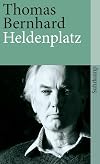
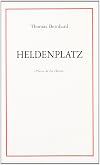
Heldenplatz
by Thomas Bernhard
On This Page
Description
Highly controversial in Austria, this play concerns a Jewish professor who returns to Vienna after the Second World War and discovers that his fellow Austrians are as anti-semitic as ever. Heldenplatz is the square in Vienna where the Austrian-born Hitler made his first speech after the Anschluss.Tags
Recommendations






















Member Recommendations
Member Reviews
Vienna's Heldenplatz, apart from being an important large open space next to a lot of important government buildings, still used for parades and similar public demonstrations of power, is known to most of us because of Hitler's speech there on the 15th of March 1938, when he welcomed the jubilant Austrian crowds home into the German Reich.
When Claus Peymann, director of the Burgtheater, commissioned Bernhard to write a piece for the 1988 "year of reflection" on the 50th anniversary of the Anschluss, he presumably expected to get something controversial, but in the event both Bernhard's piece and the reactions it let loose must have exceeded his wildest dreams. In the run-up to the première on 4 November 1988, various journalists got show more hold of sensational excerpts from the text and held them under the noses of political leaders, who almost without exception reacted in precisely the way intended, calling for censorship, deportation, withdrawal of subsidies, etc., and generally giving the rest of the world the impression that Austria was precisely the philistine nest of intolerant old Nazis that the Kurt Waldheim scandal had made everyone suspect it was already.
The right-wing press gleefully fanned the flames, and the whole thing turned into a major scandal, with the Burgtheater under police protection and all sorts of outrages threatened. As the Austrian critic Sigrid Löffler pointed out in the Spiegel, it can't have made the attackers any more comfortable with themselves when they actually saw the play and understood the context of the leaked lines - they are spoken by the members of a family of returned Jewish exiles driven to desperation (and in the case of the absent central character of the play, Professor Josef Schuster, suicide) by the continuing and unrepentant antisemitism and hatred they find in modern Austria: the play ends with the louder and louder roaring of Hitler's Heldenplatz audience in the background.
In the event, the first performance was a triumph, despite the hecklers and wavers of Austrian flags, and the news footage shows a jubilant Bernhard (who was already very frail and died a few months later) taking curtain calls with the cast.
As always, the energy and conviction of Bernhard's language is magnificent and overwhelming. This is a play you could quite easily read for the sheer pleasure of the text, whether or not you care about Austrian politics or agree with the attitudes expressed by the characters. Moreover, it's not really a play about actual politics, but rather about the way our perception of the social and political reality around us can have extreme effects on our moral and emotional state. And I think that's what makes it more than a bit of obsolete Waldheim-bashing.
Reading it now, 28 years later, you can only reflect on how we can see the kind of political and popular Stumpfsinnigkeit Bernhard talks about gaining more and more ground every day. Without, so far, the imminent global catastrophe Bernhard's characters expected, although perhaps we've lost a lot more on the way than we're aware of.
I was struck by the way Bernhard also makes it clear - in what he probably knew was his final message to the public - that literature is not actually capable of expressing the real awfulness of reality:
When Claus Peymann, director of the Burgtheater, commissioned Bernhard to write a piece for the 1988 "year of reflection" on the 50th anniversary of the Anschluss, he presumably expected to get something controversial, but in the event both Bernhard's piece and the reactions it let loose must have exceeded his wildest dreams. In the run-up to the première on 4 November 1988, various journalists got show more hold of sensational excerpts from the text and held them under the noses of political leaders, who almost without exception reacted in precisely the way intended, calling for censorship, deportation, withdrawal of subsidies, etc., and generally giving the rest of the world the impression that Austria was precisely the philistine nest of intolerant old Nazis that the Kurt Waldheim scandal had made everyone suspect it was already.
The right-wing press gleefully fanned the flames, and the whole thing turned into a major scandal, with the Burgtheater under police protection and all sorts of outrages threatened. As the Austrian critic Sigrid Löffler pointed out in the Spiegel, it can't have made the attackers any more comfortable with themselves when they actually saw the play and understood the context of the leaked lines - they are spoken by the members of a family of returned Jewish exiles driven to desperation (and in the case of the absent central character of the play, Professor Josef Schuster, suicide) by the continuing and unrepentant antisemitism and hatred they find in modern Austria: the play ends with the louder and louder roaring of Hitler's Heldenplatz audience in the background.
In the event, the first performance was a triumph, despite the hecklers and wavers of Austrian flags, and the news footage shows a jubilant Bernhard (who was already very frail and died a few months later) taking curtain calls with the cast.
As always, the energy and conviction of Bernhard's language is magnificent and overwhelming. This is a play you could quite easily read for the sheer pleasure of the text, whether or not you care about Austrian politics or agree with the attitudes expressed by the characters. Moreover, it's not really a play about actual politics, but rather about the way our perception of the social and political reality around us can have extreme effects on our moral and emotional state. And I think that's what makes it more than a bit of obsolete Waldheim-bashing.
Reading it now, 28 years later, you can only reflect on how we can see the kind of political and popular Stumpfsinnigkeit Bernhard talks about gaining more and more ground every day. Without, so far, the imminent global catastrophe Bernhard's characters expected, although perhaps we've lost a lot more on the way than we're aware of.
I was struck by the way Bernhard also makes it clear - in what he probably knew was his final message to the public - that literature is not actually capable of expressing the real awfulness of reality:
Was die Schriftsteller schreibenshow less
ist ja nichts gegen die Wirklichkeit
jaja sie schreiben ja daß alles fürchterlich ist
daß alles verdorben und verkommen ist
daß alles katastrophal ist
und daß alles ausweglos ist
aber alles das sie schreiben
ist nichts gegen die Wirklichkeit
die Wirklichkeit ist so schlimm
daß sie nicht beschrieben werden kann
noch kein Schriftsteller hat die Wirklichkeit so beschrieben
wie sie wirklich ist
das ist das Fürchterliche
(Professor Robert at the end of Scene 2)
Three stars compared to his best work, e.g. Extinction, because this single-minded and short work allows less room for the full play of his creative energy.
A very good play, published in 1988, in which modern Austria confronts a chapter Austria's history that I rather strongly suspect most Austrians would rather not hear about at all.
Jul 25, 2025 (Edited)English (UK)
Ratings
Members
- Recently Added By
Lists

German Literature
518 works; 55 members
Author Information

281+ Works 16,431 Members
Thomas Bernhard was born to Austrian parents in Holland and reared by his mother in the vicinity of Salzburg. His temperament and erratic health created difficulties for him as he grew up in a society governed by National Socialists. Bernhard found the alpine landscapes of his native Austria far more harsh than lyrical. The isolation of the show more characters in his novels is only slightly mitigated by friendship, generally only between men, and never by love. Yet many readers feel this lack of sentimentality gives Bernhard's work an epic power. (Bowker Author Biography) show less
Some Editions
Awards and Honors
Notable Lists
Series
Belongs to Publisher Series
Bibliothek Suhrkamp (997)
suhrkamp taschenbuch (2474)
Work Relationships
Is contained in
Has as a commentary on the text
Has as a student's study guide
Common Knowledge
- Canonical title*
- Heldenplatz
- Original publication date
- 1988
- People/Characters
- Robert Schuster
- Important places
- Heldenplatz, Vienna, Austria
- Original language
- German
- Disambiguation notice
- 3518389742 1995 softcover German suhrkamp taschenbuch 2474
3518784803 2012 eBook German suhrkamp taschenbuch 2474
*Some information comes from Common Knowledge in other languages. Click "Edit" for more information.
Classifications
Statistics
- Members
- 250
- Popularity
- 129,725
- Reviews
- 3
- Rating
- (3.78)
- Languages
- 8 — Dutch, English, Finnish, French, German, Italian, Spanish, Swedish
- Media
- Paper, Ebook
- ISBNs
- 13
- ASINs
- 3