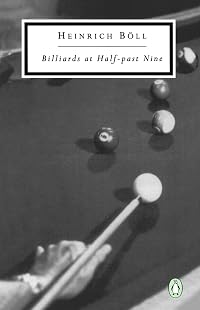
Billiards at half-past nine
by Heinrich Böll
On This Page
Description
After being drawn into the Second World War to command retreating German forces despite his anti-Nazi feelings, Faehmel struggles to re-establish a normal life at war's end by creating a rigorous routine for himself, which includes a daily game of billiards.Tags
Recommendations
















Member Recommendations
CGlanovsky Story from multiple perspectives told out of chronological sequence and partially from the point of view of someone mentally deficient
40

Member Reviews
In the passage of a single day and the interactions of three generations, Böll gathers the themes of postwar Germany.
Böll says so much in so little plot. It is a novel of characters and significance, not of events or revelation: what at first seems a secret, parceled out carefully across thirteen chapters-- the design & later destruction of St Anthony's Cathedral -- is revealed to have been known to everyone, even if only shortly before the story opens. But: not everyone was aware of what the others knew, and it would seem that remains the case when the story ends.
Böll never names the National Socialists, and though the Holocaust looms large it is never mentioned outright: the nearest he comes is in flatly observing a character in show more question is not, in fact, Jewish. [41, 269] Böll looks instead inward and outward, outward at German culture broadly, inward to the lives of one German family. The cultural refrain is Hindenberg and Bismarck, Uhlan and Junker before the war; the Host of the Beast, the Host of the Lamb during the war. Characters are all Germans interacting with other Germans. Böll addresses the German Question in miniature, and so his lens dilates to encompass everyone. Fähmel and Nettlinger are remarkably similar in their Democratic principles and passionless approach to modern ideals: such a slender thread divides their thoughts, and so we are left to ponder their actions.
Böll's focus on family suggests he is pointing to a certain way of looking at the legacy of the war, a way which is valid no matter the part one took in it. That in 1958 such an approach is vital to finding a healthy way to deal with the present and the past, and remain a family. But it's not immediately clear to me precisely what it is, at which he points. Perhaps it is that road taken in South Africa after Apartheid, and which the US has yet to take regarding its legacy of racial hate: an honest look at ourselves and one another, a national reckoning. Though "Truth Commission" would seem to doom any such effort to stillbirth.
//
Böll's choice of words is usually simple, but masterfully fitted together. Not merely in the careful plotting, glimpses of a single day's events from a rotating vantage, first through one character, then another, and perhaps a brief meeting of the two a few hours later; but also in the threads that stitch them together, key words (colours, catchphrases, lines of poetry) appearing and disappearing, symbols woven in but never overbearing. Billiards, architecture, the inner workings of hotel and restaurant. So much more compelling than Tonio Kröger's juxtaposition of artist and pragmatist, and with a more arresting focus. Böll doesn't argue for striking a balance, as I read Mann's verdict to have been, rather he insists irony is never enough. Perhaps the root crime he identifies is unforgivable detachment on the part of his characters, unforgivable no matter the intent behind it. show less
Böll says so much in so little plot. It is a novel of characters and significance, not of events or revelation: what at first seems a secret, parceled out carefully across thirteen chapters
Böll never names the National Socialists, and though the Holocaust looms large it is never mentioned outright: the nearest he comes is in flatly observing a character in show more question is not, in fact, Jewish. [41, 269] Böll looks instead inward and outward, outward at German culture broadly, inward to the lives of one German family. The cultural refrain is Hindenberg and Bismarck, Uhlan and Junker before the war; the Host of the Beast, the Host of the Lamb during the war. Characters are all Germans interacting with other Germans. Böll addresses the German Question in miniature, and so his lens dilates to encompass everyone. Fähmel and Nettlinger are remarkably similar in their Democratic principles and passionless approach to modern ideals: such a slender thread divides their thoughts, and so we are left to ponder their actions.
Böll's focus on family suggests he is pointing to a certain way of looking at the legacy of the war, a way which is valid no matter the part one took in it. That in 1958 such an approach is vital to finding a healthy way to deal with the present and the past, and remain a family. But it's not immediately clear to me precisely what it is, at which he points. Perhaps it is that road taken in South Africa after Apartheid, and which the US has yet to take regarding its legacy of racial hate: an honest look at ourselves and one another, a national reckoning. Though "Truth Commission" would seem to doom any such effort to stillbirth.
//
Böll's choice of words is usually simple, but masterfully fitted together. Not merely in the careful plotting, glimpses of a single day's events from a rotating vantage, first through one character, then another, and perhaps a brief meeting of the two a few hours later; but also in the threads that stitch them together, key words (colours, catchphrases, lines of poetry) appearing and disappearing, symbols woven in but never overbearing. Billiards, architecture, the inner workings of hotel and restaurant. So much more compelling than Tonio Kröger's juxtaposition of artist and pragmatist, and with a more arresting focus. Böll doesn't argue for striking a balance, as I read Mann's verdict to have been, rather he insists irony is never enough. Perhaps the root crime he identifies is unforgivable detachment on the part of his characters, unforgivable no matter the intent behind it. show less
A gentle, sad-yet-hopeful, and ever-so-principled tale of family tragedy not "against the backdrop of," as they say, but shattered by the heel of historical horror. Heinrich Fähmel is an architect who wanted to design and build himself a life, a wife, and seven times seven grandkids; he is a genius of living, the kindest and bravest high modern paterfamilias one could hope for. But it is all as nothing in the face of the whirlwind, and as this novel told in a series of meetings and reminiscences fills us in on "the things that happened" from the perspectives of all the surviving family members, all to some degree fractured but whole, we lose our hearts to them bit by bit seeing what each of them did to--not "endure the unendurable," show more that still-fascist phrase of Hirohito's that I'll borrow from the Pacific War, but cope with the uncopeable. The father's life work is destroyed by the son (by the sons--one dark changeling who sets the rot in motion and one tortured antihero who has to decide what to do about it under conditions that make every choice meaningless and absurd) and then the grandson has to decide what to do about it. That's a mighty arc worthy of a Dreiser or a Dos Passos on its own, but this is Old Europe and so it also takes place from under and within the horror, suffused with its essence.
This book makes a lot of "the Host of the Beast" and the "lambs" that refuse to take it--not Nazis and pacifists, per se, not the kind and good versus the indifferent and banal/evil, but simply those who refuse to intentionally damage another human life versus those who--under the same pressures--acquiesce (naturally, in some cases, seize it gladly). And it really speaks to the sensitivity of Böll's touch as bookwright that by the end he's placed an artful crack in Heinrich Fähmel, in Robert Fähmel, in Joseph, in Johanna, in Schrella (wabi-sabi, to go Japanese again), but left each of them more or less whole, dancing through the madness, touched by its livid tentacles but not drawn into its maw. At the end they laugh and cut into a cake shaped like the destroyed Abbey referenced above and it's, again, absurd--"who wants dessert?" and roll the credits. But this is absolutely sober realism: there is a crack in everything, that's how the light gets in, says the bard, and that metaphor is no desperate fancy, no regulating mantra like "billiards at half ten" to keep the psyche bound tight, but a profound human truth. show less
This book makes a lot of "the Host of the Beast" and the "lambs" that refuse to take it--not Nazis and pacifists, per se, not the kind and good versus the indifferent and banal/evil, but simply those who refuse to intentionally damage another human life versus those who--under the same pressures--acquiesce (naturally, in some cases, seize it gladly). And it really speaks to the sensitivity of Böll's touch as bookwright that by the end he's placed an artful crack in Heinrich Fähmel, in Robert Fähmel, in Joseph, in Johanna, in Schrella (wabi-sabi, to go Japanese again), but left each of them more or less whole, dancing through the madness, touched by its livid tentacles but not drawn into its maw. At the end they laugh and cut into a cake shaped like the destroyed Abbey referenced above and it's, again, absurd--"who wants dessert?" and roll the credits. But this is absolutely sober realism: there is a crack in everything, that's how the light gets in, says the bard, and that metaphor is no desperate fancy, no regulating mantra like "billiards at half ten" to keep the psyche bound tight, but a profound human truth. show less
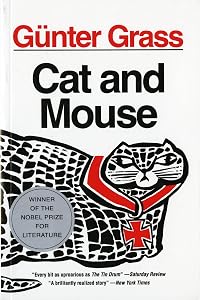
This was an interesting novel to pick up a few days after finishing Cat and Mouse by Günter Grass. There are a lot of parallels in the prose of Grass and Böll. Both feature narrators who are less than reliable, there is a complex chronology in both, and both cover the period of WW2 and/or its aftermath from a Germanic perspective.
But Böll’s work is definitely the more complex in terms of its storytelling if not its imagery. Set over three generations of architects and told from the perspective of over 10 narrators, it’s the kind of novel that you have to just relax into and go with the ebb and flow backwards and forwards between the First World War and 1958.
It wasn’t the kind of book that you come away with having learned show more something desperately new. I found it quite complex, and, like Cat and Mouse, I wasn’t entirely sure I’d got the point of what Böll was trying to say. There are some obvious bits about regret and skeletons in the family closet, but those are pretty obviously going to be part of any German novel that looks at the world wars it began.
There are characters who I’d like to have seen fleshed out even more and their interaction made more of: Nettlinger, who attempts to confront Faehmel early on in the book, for example. And I wonder if it’s a sign of the times that it was written in, when the scars of war were still suppurating in the German psyche, that the rise of Nazism and its adherents is not stated except in metaphorical terms.
Instead, we’re told of those who have “tasted of the Buffalo Sacrament” and those “of the lamb.” This duality sets the majority, the power holders and the oppressors against those who become their victims. While it’s obvious that the former stand for the Nazis, by not stating this explicitly, Böll is able to construct a novel whose characters could be any society in any era of history. In doing so, I think he is making a statement about how human society works, rather than just saying that the problems that gave rise to the Nazis were confined to one period in history. I think this is very wise.
The novel is therefore important, both as a product of its time but also, more significantly, because Böll is able to transcend this and write something that humanity should hear for centuries to come. show less
But Böll’s work is definitely the more complex in terms of its storytelling if not its imagery. Set over three generations of architects and told from the perspective of over 10 narrators, it’s the kind of novel that you have to just relax into and go with the ebb and flow backwards and forwards between the First World War and 1958.
It wasn’t the kind of book that you come away with having learned show more something desperately new. I found it quite complex, and, like Cat and Mouse, I wasn’t entirely sure I’d got the point of what Böll was trying to say. There are some obvious bits about regret and skeletons in the family closet, but those are pretty obviously going to be part of any German novel that looks at the world wars it began.
There are characters who I’d like to have seen fleshed out even more and their interaction made more of: Nettlinger, who attempts to confront Faehmel early on in the book, for example. And I wonder if it’s a sign of the times that it was written in, when the scars of war were still suppurating in the German psyche, that the rise of Nazism and its adherents is not stated except in metaphorical terms.
Instead, we’re told of those who have “tasted of the Buffalo Sacrament” and those “of the lamb.” This duality sets the majority, the power holders and the oppressors against those who become their victims. While it’s obvious that the former stand for the Nazis, by not stating this explicitly, Böll is able to construct a novel whose characters could be any society in any era of history. In doing so, I think he is making a statement about how human society works, rather than just saying that the problems that gave rise to the Nazis were confined to one period in history. I think this is very wise.
The novel is therefore important, both as a product of its time but also, more significantly, because Böll is able to transcend this and write something that humanity should hear for centuries to come. show less
I was keen to read this having studied another of Boell's books at school.
Robert Faehmel has a very clear instruction for his secretary, no one is to disturb him between half nine and 11 in the morning, unless their name is on the card. This is the time he spends playing billiards, telling his story to Hugo, a young man who works for the hotel. On this particular day, an old acquaintance is trying to get in touch with Faehmel, but the loyal staff won't let him in.
We learn of Faehmel's past, of his work in the war, ironically for an architect, his job was to blow up buildings. Boell goes back to tell us about Faehmel's father's life and also of an incident which almost pulled his family apart.
There are two types of people, those who show more take the Host of the Lamb and those who take the Host of the Beast, or in other words, those who are for peace and those who are for war. Billiards at Half-past Nine shares this anti-war, anti-establishment theme with Katharina Blum, but this time there isn't one main character, rather we see how different generations of family have been tainted by war.
I enjoyed reading my second Boell, and the style of the book, in which the narrative jumped from person to person. show less
Robert Faehmel has a very clear instruction for his secretary, no one is to disturb him between half nine and 11 in the morning, unless their name is on the card. This is the time he spends playing billiards, telling his story to Hugo, a young man who works for the hotel. On this particular day, an old acquaintance is trying to get in touch with Faehmel, but the loyal staff won't let him in.
We learn of Faehmel's past, of his work in the war, ironically for an architect, his job was to blow up buildings. Boell goes back to tell us about Faehmel's father's life and also of an incident which almost pulled his family apart.
There are two types of people, those who show more take the Host of the Lamb and those who take the Host of the Beast, or in other words, those who are for peace and those who are for war. Billiards at Half-past Nine shares this anti-war, anti-establishment theme with Katharina Blum, but this time there isn't one main character, rather we see how different generations of family have been tainted by war.
I enjoyed reading my second Boell, and the style of the book, in which the narrative jumped from person to person. show less
I was pleasantly surprised by this novel, although it took a while to get used to the style and narrative. I'm not sure if it was because German is such a good language for inventing new words by cobbling bits together that don't translate well or whether Boll intended to use very long sentences, but to start with I found I lost the ideas of sentences because they rambled too much. But once I got used to it, I enjoyed it.
Essentially this novel is about one day in 1958. The Faehmel family are coming together to celebrate Heinrich Faehmel's 80th birthday. However it is more a novel of the past, predominantly dealing with the First and Second World Wars. The recurring image that comes up is the 'Buffalo Sacrament' and the 'Lambs' - which show more eventually I realised was to do with those in power and those resisting. Those who had partaken of the Buffalo Sacrament were essentially those who had swallowed propaganda and believed in German dominance, and proved their beliefs by taking it out on the 'Lambs'. It wasn't clear whether the lambs were pacifists or communists - there were different motives behind different characters.
The novel is written from a number of different viewpoints, sometimes changing narrator from paragraph to paragraph within a chapter but ensuring that overall the reader gets a sense of regret, love, pity, sadness, guilt and a whole spectrum of feelings from the different characters as they examine their past actions and thoughts. I'm not generally a huge fan of German literature (and I studied German at uni so I'm not just making a sweeping statement), but I did get quite into this by the end and found myself far more involved with the family than I thought I would be. show less
Essentially this novel is about one day in 1958. The Faehmel family are coming together to celebrate Heinrich Faehmel's 80th birthday. However it is more a novel of the past, predominantly dealing with the First and Second World Wars. The recurring image that comes up is the 'Buffalo Sacrament' and the 'Lambs' - which show more eventually I realised was to do with those in power and those resisting. Those who had partaken of the Buffalo Sacrament were essentially those who had swallowed propaganda and believed in German dominance, and proved their beliefs by taking it out on the 'Lambs'. It wasn't clear whether the lambs were pacifists or communists - there were different motives behind different characters.
The novel is written from a number of different viewpoints, sometimes changing narrator from paragraph to paragraph within a chapter but ensuring that overall the reader gets a sense of regret, love, pity, sadness, guilt and a whole spectrum of feelings from the different characters as they examine their past actions and thoughts. I'm not generally a huge fan of German literature (and I studied German at uni so I'm not just making a sweeping statement), but I did get quite into this by the end and found myself far more involved with the family than I thought I would be. show less
I had to use Wikipedia to figure out the point of view for each chapter but once I did that, everything was clear. It's a look at the effect of Germany's history upon a family; how the violence and hate leaves them without any bearings. Each member finds his own way to cope. It actually only becomes effective after this troubled pacifist family begins to reveal their secrets and share the reasons for their actions. I found it interesting and worthwhile.
Reviewed May 2006
Wonderful book once you understand Boll’s style and chart who is who, the author really draws you into the story. You learn about these people’s very confused and stressful lives. The story focuses n the Faehmel family living in Cologne Germany and the effects of WWII on them. Amazing history told very confusingly, Boll does not tell you who is “speaking” most of the time. Also he bolts into the past without any pretext. You have to be very careful, many time you backtrack to keep following the story line. The author we learned in class really reflects the history of the Faehmels. Raised in a Catholic pacifist family in Cologne, Boll was forced into the army as well. The main characters are all architects show more whereas the author is a writer. One woman in our class mentioned that Boll writes in this narrative style to show that the family is inked, all events affect each other. Another woman pointed out that all events in this almost 300 page book take place in about 12 hours of this families life. Very interesting style and story
6-2006 show less
Wonderful book once you understand Boll’s style and chart who is who, the author really draws you into the story. You learn about these people’s very confused and stressful lives. The story focuses n the Faehmel family living in Cologne Germany and the effects of WWII on them. Amazing history told very confusingly, Boll does not tell you who is “speaking” most of the time. Also he bolts into the past without any pretext. You have to be very careful, many time you backtrack to keep following the story line. The author we learned in class really reflects the history of the Faehmels. Raised in a Catholic pacifist family in Cologne, Boll was forced into the army as well. The main characters are all architects show more whereas the author is a writer. One woman in our class mentioned that Boll writes in this narrative style to show that the family is inked, all events affect each other. Another woman pointed out that all events in this almost 300 page book take place in about 12 hours of this families life. Very interesting style and story
6-2006 show less
Members
- Recently Added By
Lists

1001 Books You Must Read Before You Die
1,448 works; 1,134 members

German Literature
518 works; 49 members

EU Fiction: 1950-2022
223 works; 68 members

Books Set in Germany
74 works; 12 members

1950s
340 works; 22 members

Harold Bloom - The Western Canon: D. The Chaotic Age
833 works; 24 members

Novels set over the course of a single day (or less)
72 works; 8 members

War Literature
101 works; 19 members
1,001 BYMRBYD Concensus
723 works; 27 members

E's Reader
30 works; 1 member

Nifty Fifties
129 works; 14 members

Read
293 works; 4 members

My TBR
371 works; 3 members

Books Read in 2024
4,623 works; 126 members
Author Information

Heinrich Böll was born in Cologne, Germany on December 21, 1917. He studied German at the University of Cologne. He was drafted into military service in 1938 shortly after he finished his schooling and served several years in the infantry before his demobilization in 1945. His first novel, Der Zug war pünktlich (The Train Was on Time), was show more published in 1949. His other works include Billiards at Half-Past Nine, The Clown, Absent without Leave, Enter and Exit, and The Lost Honor of Katharina Blum. He received numerous awards including the Georg Büchner Prize in 1967 and the Nobel Prize for Literature in 1972. He died on July 16, 1985 at the age of 67. (Bowker Author Biography) show less
Some Editions
Awards and Honors
Series
Belongs to Publisher Series
Work Relationships
Common Knowledge
- Canonical title
- Billiards at Half-Past Nine; Billiards at half-past nine
- Original title
- Billard um halb zehn
- Alternate titles*
- Billard um halbzehn
- Original publication date
- 1959; 1961 (English translation) (English translation)
- People/Characters
- Robert Faehmel
- Important places
- Cologne, North Rhine-Westphalia, Germany
- Important events
- World War II (1939 | 1945)
- First words
- This morning, for the first time ever, Faehmel was curt with her, almost rude.
- Quotations*
- Lehrjungen, Lastwagen, Nonnen: Leben auf der Straße.
- Last words
- (Click to show. Warning: May contain spoilers.)He cut off the spire of the Abbey first, and passed the plate to Robert.
- Original language
- German
*Some information comes from Common Knowledge in other languages. Click "Edit" for more information.
Classifications
- Genres
- General Fiction, Fiction and Literature
- DDC/MDS
- 833.914 — Literature & rhetoric German & related literatures German fiction 1900- 1900-1990 1945-1990
- LCC
- PT2603 .O394 — Language and Literature German, Dutch and Scandinavian literatures German literature Individual authors or works 1860/70-1960
- BISAC
Statistics
- Members
- 1,493
- Popularity
- 15,534
- Reviews
- 24
- Rating
- (3.79)
- Languages
- 20 — Catalan, Czech, Danish, Dutch, English, Estonian, Finnish, French, German, Greek, Hungarian, Italian, Norwegian (Bokmål), Polish, Russian, Slovenian, Spanish, Swedish, Turkish, Portuguese (Portugal)
- Media
- Paper, Audiobook, Ebook
- ISBNs
- 63
- ASINs
- 44