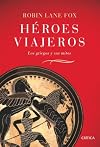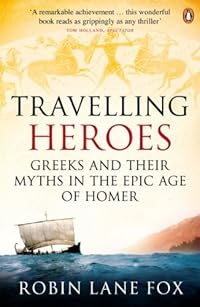
Travelling Heroes: In the Epic Age of Homer
by Robin Lane Fox
On This Page
Description
"Presented as a kind of historical detective story, Travelling heroes draws upon archaeology, ancient texts, and new discoveries to develop a fresh and provocative thesis: that migrants from the Greek island of Euboea settled in specific places both in the Near East and in Italy and that what they found there helped shape their most distinctive myths"--Jacket flap.Tags
Recommendations









Member Recommendations

Member Reviews
66. Travelling Heroes : In the Epic Age of Homer by Robin Lane Fox
published: 2008
format: 419 page paperback (plus 80 page bibliography/index)
acquired: July from Half Price Books
read: Oct 20 - Nov 5
rating: 2½
The cover blurb says, "Multilayered and beautifully written..." Don't be fooled by that nonsense, Fox's text is so dense that it's barely readable. As he sees it, he's really trying to do something new and dynamic with this book, combining as much archeological evidence as he can find and with all the obscure Greek mythologies and their variations and influences and histories, and constructing a history and timing of Greek storytelling itself. The book is the building of the argument he constructs, starting with raw archeological show more evidence. It presents a huge amount of information and in sometimes exhausting detail, mixed with various iffy but interesting inferences. A kind of survey of the archeological and mythological record comes out of this. The bibliography is enormous and there is a lot good stuff collected within - although keep in mind most of the information is not original. Also, and unfortunately, in my opinion the argument he makes is nothing more than interesting but imaginative hand waving.
The odd aspect of the archeological record is that Greeks enter the larger Mediterranean world through the island of Euboea. In the 700's bce, when Homer and Hesiod were supposed writing, Euboeans were sailing from the Levant to Spain and leaving their pottery everywhere - along with their graves and many other bits and pieces. They were clearly deeply involved in the trade runs, filling in gaps in the Phoenician routes, or competing with them, creating their own colonies in many different places, some long lasting and influential. In places they were competing among themselves. This appears to be a dominant source of Greek wealth for a long period time in a fruitful creative period - when east was influencing west and vice versa. And yet, there isn't a lot of Euboea in the Greek mythologies. Hesiod, interestingly enough, claims to have won an award on Euboea, presenting his Theogony in Chalcis. But he doesn't mention any special connection of the gods with Euboea. Homer mentions three locations in this catalogue of ships, and that's it. So, where does this leave us and Fox - apparently with a curious mystery of missing Euboeans.
Fox's story is essentially that the Euboea is in Hesiod. For example he claims that Hesiod pulled mythologies that he learned specifically in Euboea and added them to his story in a decipherable way. But to get to that somewhat anticlimactic contribution he must create a history of mythologies. So, he culls the record (readily available in many surveys, I might add) pulling stories and locating them with landscapes and geology and trade routes. Typhon and the Giants become a big deal, as do Aphrodite and Adonis, who tie in so well with Astart/Ishtar/Inanna and Dumuzi/Tummuz (a well known but really cool tie-in that also has nice links to Hittite mythologies ). He's really proud of what he creates. I'm more skeptical.
Early on I made a note to myself that when Fox says "no doubt", or "surely" it really means "it's possible". He presents what tend to be good ideas, but they don't exactly follow from the data. Often they are really unlikely and no better than numerous other possibilities. He also has an odd characteristic of stating his belief in the sources he cites - stating "I don't believe" or "I think" or "I doubt" or whatnot. I find that all very odd phrasing for a supposedly empirical approach. I'm not an archeologist, but it seems to me he could be cherry picking the evidence that fits his story, and it certainly feels like he's constantly hand waving, and then presenting this as a conclusion(!). All this stuff is possible, but the accumulation of unlikely idea on top of unlikely idea, mixed in with some solid facts, all presented together as a coherent story... I mean maybe there is some truth to this. But the world is a complicated place and the Mediterranean was crazy complex in this era. There are no clean stories and histories, it's all a mixed bag. That's really what the mythology tells us, and what the archeology confirms.
In sum, Fox has a lot of good info, but this is difficult and unpleasant to read and constructs a terribly weak argument - hence a mildly annoyed 2.5 stars.
2016
https://www.librarything.com/topic/226898#5790353 show less
published: 2008
format: 419 page paperback (plus 80 page bibliography/index)
acquired: July from Half Price Books
read: Oct 20 - Nov 5
rating: 2½
The cover blurb says, "Multilayered and beautifully written..." Don't be fooled by that nonsense, Fox's text is so dense that it's barely readable. As he sees it, he's really trying to do something new and dynamic with this book, combining as much archeological evidence as he can find and with all the obscure Greek mythologies and their variations and influences and histories, and constructing a history and timing of Greek storytelling itself. The book is the building of the argument he constructs, starting with raw archeological show more evidence. It presents a huge amount of information and in sometimes exhausting detail, mixed with various iffy but interesting inferences. A kind of survey of the archeological and mythological record comes out of this. The bibliography is enormous and there is a lot good stuff collected within - although keep in mind most of the information is not original. Also, and unfortunately, in my opinion the argument he makes is nothing more than interesting but imaginative hand waving.
The odd aspect of the archeological record is that Greeks enter the larger Mediterranean world through the island of Euboea. In the 700's bce, when Homer and Hesiod were supposed writing, Euboeans were sailing from the Levant to Spain and leaving their pottery everywhere - along with their graves and many other bits and pieces. They were clearly deeply involved in the trade runs, filling in gaps in the Phoenician routes, or competing with them, creating their own colonies in many different places, some long lasting and influential. In places they were competing among themselves. This appears to be a dominant source of Greek wealth for a long period time in a fruitful creative period - when east was influencing west and vice versa. And yet, there isn't a lot of Euboea in the Greek mythologies. Hesiod, interestingly enough, claims to have won an award on Euboea, presenting his Theogony in Chalcis. But he doesn't mention any special connection of the gods with Euboea. Homer mentions three locations in this catalogue of ships, and that's it. So, where does this leave us and Fox - apparently with a curious mystery of missing Euboeans.
Fox's story is essentially that the Euboea is in Hesiod. For example he claims that Hesiod pulled mythologies that he learned specifically in Euboea and added them to his story in a decipherable way. But to get to that somewhat anticlimactic contribution he must create a history of mythologies. So, he culls the record (readily available in many surveys, I might add) pulling stories and locating them with landscapes and geology and trade routes. Typhon and the Giants become a big deal, as do Aphrodite and Adonis, who tie in so well with Astart/Ishtar/Inanna and Dumuzi/Tummuz (a well known but really cool tie-in that also has nice links to Hittite mythologies ). He's really proud of what he creates. I'm more skeptical.
Early on I made a note to myself that when Fox says "no doubt", or "surely" it really means "it's possible". He presents what tend to be good ideas, but they don't exactly follow from the data. Often they are really unlikely and no better than numerous other possibilities. He also has an odd characteristic of stating his belief in the sources he cites - stating "I don't believe" or "I think" or "I doubt" or whatnot. I find that all very odd phrasing for a supposedly empirical approach. I'm not an archeologist, but it seems to me he could be cherry picking the evidence that fits his story, and it certainly feels like he's constantly hand waving, and then presenting this as a conclusion(!). All this stuff is possible, but the accumulation of unlikely idea on top of unlikely idea, mixed in with some solid facts, all presented together as a coherent story... I mean maybe there is some truth to this. But the world is a complicated place and the Mediterranean was crazy complex in this era. There are no clean stories and histories, it's all a mixed bag. That's really what the mythology tells us, and what the archeology confirms.
In sum, Fox has a lot of good info, but this is difficult and unpleasant to read and constructs a terribly weak argument - hence a mildly annoyed 2.5 stars.
2016
https://www.librarything.com/topic/226898#5790353 show less
The basis for a recent TV prog., the book's much better than the televised version (IMHO). RLF's theory is the Euboeans took Greek myths to the wider Med., ~ & argues his case very well - much better than could be compressed into the limited time of a TV rendition.
Travelling Heroes is an excellent book. Insightful, very detailed, brilliantly-investigated, and yet readily accessible to any reader. A fascinating study of the ancient Mediterranean world. I would recommend this to anyone interested in Greek history and literature.
A study of the relationship between Hesiod and Homer, dating Hesiod as a bit earlier and Homer as 780 BCE. This sort of thing sometimes allows me to deepen my thoughts about the origins of Greek literature and the interrelations of the ancient world. Readable
As I wrote in my review, this is a bad book, plain and simple, and should not have been published in its present form.
https://languagehat.com/travelling-heroes/
https://languagehat.com/travelling-heroes/
Ratings
Members
- Recently Added By
Lists

Books Read in 2023
5,547 works; 145 members
Author Information

29+ Works 7,323 Members
Robin Lane Fox is a university reader in ancient history and an emeritus fellow of New College, Oxford. The author of The Classical World and Alexander the Great, Fox lives in Oxford, England.
Common Knowledge
- Original title
- Travelling Heroes: Greeks and Their Myths in the Epic Age of Homer
- Alternate titles
- Travelling Heroes: In the Epic Age of Homer
- Original publication date
- 2008
- People/Characters
- Homer
- Important places
- Ancient Greece
- Epigraph
- Facts become art though love, which unifies them and lifts them to a higher plan of reality.
Kenneth Clark, Landscape into Art (1949)
I like it when somebody gets excited about something. It's nice. You just didn't know this teacher, Mr. Vinson. He could drive you crazy sometimes, him and the goddam class. I mean he'd keep telling you to unify and simpli... (show all)fy all the time. Some things you just can't do that to. I mean you can't hardly ever simplify and unify something just because somebody wants you to. You just didn't know this guy, Mr. Vinson. I mean he was very intelligent and all, but you could tell he didn't have too much brains.
J. D. Salinger, The Catcher in the Rye (1951) - Dedication
- For : H.J.L.F.
T.L.F.
M.J.L.F.
C.M.J.G.B.
M.L.F.
ηρωσγν οδηγουσι - First words
- The travelling heroes of this book are particular Greeks at a particular phase in the ancient world who travelled with mythical stories of gods and heroes in their minds
- Blurbers
- Beard, Mary; Miles, Richard; Cartledge, Paul; Speller, Elizabeth; Smith, Rowland
- Original language
- English
Classifications
- Genres
- History, Nonfiction, General Nonfiction
- DDC/MDS
- 938.01 — History & geography History of ancient world (to ca. 499) Greece to 323 Greece to 323 Mythical Age (-776 BC)
- LCC
- PA4037 .L328 — Language and Literature Greek language and literature. Latin language and literature Greek literature Individual authors Homer
- BISAC
Statistics
- Members
- 403
- Popularity
- 76,838
- Reviews
- 5
- Rating
- (3.32)
- Languages
- English, German, Italian, Spanish
- Media
- Paper, Ebook
- ISBNs
- 13
- ASINs
- 6