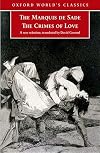
The Crimes of Love
by Marquis de Sade 
On This Page
Description
"Murder, seduction, and incest are among the cruel rewards for selfless love in Sade's stories; tragedy, despair, and death the inevitable outcome. In this text Sade asks questions about society, about ourselves, and about life, for which we have yet to find the answers"--Provided by publisher.Tags
Recommendations
































Member Reviews
Crimes of Love, a collection of short stories, was first published in 1800. Now five of these weird and wonderful tales are available to modern readers. This book is tame compared to the author’s other writings. This should be expected; after all it is from him that the term “Sadism” is derived.
The stories themselves are witty, moral, extremely tragic and bizarre, all at the same time. They contain murder, incest and intrigue. One involves a journey by Rodrigo, the King of Spain, to hell and back for money. The young girls he has murdered and raped haunt him throughout his journey. As well as that, he soars through the solar system on an eagle who gives him advice and words of wisdom. Sade’s villains stop at nothing to fulfil show more their evil plans, and have no motivation other than to cause suffering. The contrast between the villainous and virtuous characters is fascinating. The endings of these stories are moral, but not moral enough, as the damage caused is irreparable and the antagonists merely repent. They rarely receive their just desserts.
Also, reading the author’s footnotes is intriguing, as Sade discusses dreams and states how long it would take a cannonball to reach the sun. His writing is archaic but still accessible to the modern reader.
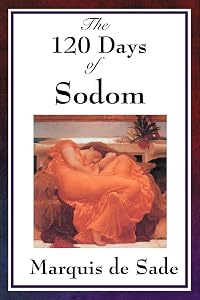
If you are squeamish or prudish, you should avoid this book and anything else by the Marquis de Sade. He was imprisoned for his pornographic writings and is to this day considered dangerous. Having read his magnum opus, The 120 Days of Sodom, I can assure you that his work can go beyond pornographic. He is responsible for what is probably the most disturbing and vile piece of literature ever created.
Crimes of Love is not an evil book, nor is it by an evil author. As Wilde said, “There is no such thing as a moral or an immoral book. Books are well written or badly written.” Fortunately this one is well written, albeit the language is archaic at times. The arguments and philosophising of the characters and narrator are thought provoking. The stories are interesting, entertaining and gripping. It provides everything one should expect from a good book, although the plots are predictable, and overall similar. I would recommend this to anyone over 18. show less
The stories themselves are witty, moral, extremely tragic and bizarre, all at the same time. They contain murder, incest and intrigue. One involves a journey by Rodrigo, the King of Spain, to hell and back for money. The young girls he has murdered and raped haunt him throughout his journey. As well as that, he soars through the solar system on an eagle who gives him advice and words of wisdom. Sade’s villains stop at nothing to fulfil show more their evil plans, and have no motivation other than to cause suffering. The contrast between the villainous and virtuous characters is fascinating. The endings of these stories are moral, but not moral enough, as the damage caused is irreparable and the antagonists merely repent. They rarely receive their just desserts.
Also, reading the author’s footnotes is intriguing, as Sade discusses dreams and states how long it would take a cannonball to reach the sun. His writing is archaic but still accessible to the modern reader.
If you are squeamish or prudish, you should avoid this book and anything else by the Marquis de Sade. He was imprisoned for his pornographic writings and is to this day considered dangerous. Having read his magnum opus, The 120 Days of Sodom, I can assure you that his work can go beyond pornographic. He is responsible for what is probably the most disturbing and vile piece of literature ever created.
Crimes of Love is not an evil book, nor is it by an evil author. As Wilde said, “There is no such thing as a moral or an immoral book. Books are well written or badly written.” Fortunately this one is well written, albeit the language is archaic at times. The arguments and philosophising of the characters and narrator are thought provoking. The stories are interesting, entertaining and gripping. It provides everything one should expect from a good book, although the plots are predictable, and overall similar. I would recommend this to anyone over 18. show less
Marquês de Sade é uma personagem especial em vários sentidos na história francesa. Nunca pensaste de onde vem a palavra "sadismo"? Exacto!
Este livro é difícil de ler. Escrito nos séculos XVII e XVIII, tem uma escrita clássica. Os contos são bastante grandes e todos eles complexos, mas que mesmo assim torna a leitura bastante interessante.
Como refere o título, são contos sobre o amor, mas amor nos vários sentidos da palavra! São quase todos com personagens odiosas, más, horríveis, com histórias de vida piores ainda. Pais casados com filhas; filhas apaixonadas por irmãos... Eu acho que "Os Maias" foram inspirados nestes contos!
São tragédias familiares atrás de tragédias, e o seu destino é do mais cruel que podes show more imaginar.
Sade não tinha medo de mostrar que, por vezes, o mal vence. É uma leitura crua, sobre manipulação e poder.
Negativamente, torna-se repetitivo no sentido em que a pessoa boa tenta fazer o bem e acaba castigada. Ficamos sempre com aquele sentimento de injustiça.
Mas é um bom livro, aconselho a quem gosta do gótico, crime e literatura clássica. show less
Este livro é difícil de ler. Escrito nos séculos XVII e XVIII, tem uma escrita clássica. Os contos são bastante grandes e todos eles complexos, mas que mesmo assim torna a leitura bastante interessante.
Como refere o título, são contos sobre o amor, mas amor nos vários sentidos da palavra! São quase todos com personagens odiosas, más, horríveis, com histórias de vida piores ainda. Pais casados com filhas; filhas apaixonadas por irmãos... Eu acho que "Os Maias" foram inspirados nestes contos!
São tragédias familiares atrás de tragédias, e o seu destino é do mais cruel que podes show more imaginar.
Sade não tinha medo de mostrar que, por vezes, o mal vence. É uma leitura crua, sobre manipulação e poder.
Negativamente, torna-se repetitivo no sentido em que a pessoa boa tenta fazer o bem e acaba castigada. Ficamos sempre com aquele sentimento de injustiça.
Mas é um bom livro, aconselho a quem gosta do gótico, crime e literatura clássica. show less
Mar 3, 2026Portuguese (Portugal)
' Faxelange ' qui se signale par l'intérêt de sa fiction et la netteté de son style; ' Florville et Courval' où l'héroïne la plus vertueuse et la plus aimable est portée à de multiples crimes dont un seul suffirait à faire d'elle un monstre; 'La comtesse de Sancerre', cette phèdre sans remords, au paroxysme du drame sombre ; ' Eugénie de Franval ' enfin, l'une des oeuvres de Sade les plus fortes et les plus hardies : ces quatres nouvelles permettent d'embrasser d'un seul regard la surprenante variété du génie de notre auteur, dans un domaine où la littérature française n'offre rien d'aussi vigoureux ni d'aussi parfaitement original. Gilbert Lely
Aug 14, 2010French
Ratings
Members
- Recently Added By
Author Information

529+ Works 12,354 Members
The Marquis De Sade was born in Paris, France on June 2, 1740. He fought in the French Army during the Seven Years War before being tried and sentenced to death in 1772 for a series of sexual crimes. He escaped to Italy but upon his return to France in 1777, he was recaptured and thrown into the prison at Vincennes. De Sade spent six years at show more Vincennes before being transferred first to the Bastille and then to Charenton lunatic asylum in 1789. He was released from the asylum in 1790 but was arrested again in 1801. He was moved from prison to prison before returning to Charenton in 1803, where he later died on December 2, 1814. A French novelist and playwright, he is largely known for his pathological sexual views and ethical nihilism. His works include Justine, Philosophy in the Bedroom, Juliette, and Aline and Valcourt or The Philosophic Novel. (Bowker Author Biography) show less
Marquis de Sade has a Legacy Library. Legacy libraries are the personal libraries of famous readers, entered by LibraryThing members from the Legacy Libraries group.
Some Editions
Series
Belongs to Publisher Series
Work Relationships
Is contained in
Contains
Common Knowledge
- Canonical title
- The Crimes of Love
- Original title
- Les crimes de l'amour : historiettes, contes et fabliaux
- Alternate titles*
- Liefde's misdaden : heroïsche en tragische verhalen
- Original publication date
- 1800
- People/Characters
- Madame de Faxelange; Mademoiselle de Faxelange; Monsieur de Goé; Monsieur de Belleval; Baron de Franlo; Dorgeville (show all 25); Virginie Dorgeville; Cécile Duperrier; Saint-Surin; Rodrigo King of Spain; Anagilda; Sancho; Florinda; Musa; Antonio Strozzi; Lorenza Pazzi; Carlo Strozzi; Urbino; Carmilla; Comtesse de Sancerre; Amélie de Sancerre; Châtelain de Monrevel; Charles the Bold, Duke of Burgundy; Lucenai; Châtelain de Salins
- Original language*
- Frans
*Some information comes from Common Knowledge in other languages. Click "Edit" for more information.
Classifications
Statistics
- Members
- 609
- Popularity
- 47,732
- Reviews
- 3
- Rating
- (3.34)
- Languages
- 11 — Catalan, Dutch, English, Esperanto, French, German, Italian, Polish, Portuguese (Brazil), Spanish, Turkish
- Media
- Paper, Ebook
- ISBNs
- 50
- ASINs
- 30