Yellow Blue Tibia
by Adam Roberts
On This Page
Description
Russia, 1946, the Nazis recently defeated. Stalin gathers half a dozen of the top Soviet science fiction authors in a dacha in the countryside somewhere. Convinced that the defeat of America is only a few years away, and equally convinced that the Soviet Union needs a massive external threat to hold it together, to give it purpose and direction, he tells the writers: 'I want you to concoct a story about aliens poised to invade earth ... I want it to be massively detailed, and completely show more believable. If you need props and evidence to back it up, then we can create them. But when America is defeated, your story must be so convincing that the whole population of Soviet Russia believes in it--the population of the whole world!' The little group of writers gets down to the task and spends months working on it. But then new orders come from Moscow: they are told to drop the project; Stalin has changed his mind; forget everything about it. So they do. They get on with their lives in their various ways; some of them survive the remainder of Stalin's rule, the changes of the 50s and 60s. And then, in the aftermath of Chernobyl, the survivors gather again, because something strange has started to happen. The story they invented in 1946 is starting to come true ... A typically mind-blowing SF novel from one of the genre's literary stars. show lessTags
Recommendations

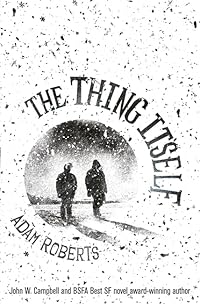








Member Recommendations

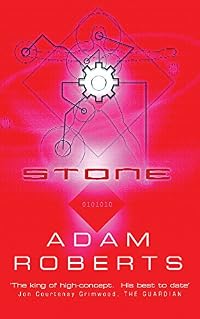
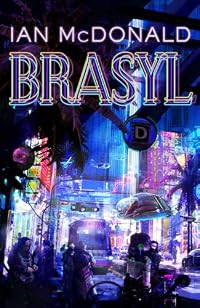
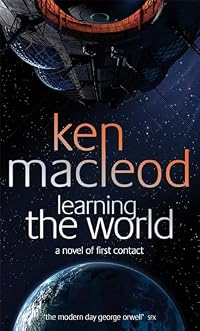
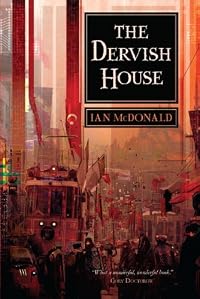
AlanPoulter The core of these two novels is how belief is created in aliens and UFOs, yet they present an entertaining contrast in the manner in which they deal with this theme.
20

AlanPoulter Both novels are 're-interpretations' of Soviet history, with a playful intent...
Member Reviews
In 1946, a group of Soviet SF authors are gathered together by Stalin and told to invent a credible threat from space that would bind together the Soviet people and give them an external threat to struggle against once capitalism had been finally defeated. Then, mysteriously, the project is disbanded and the participants scattered, with very strict instructions not to breathe a word of this to anyone.
But forty years later, one of the authors begins to suspect that the alien threat they invented might just be becoming real...
This is a highly entertaining book which for most of its length can't decide whether it's sf or a slightly dark absurdist Russian novel. Parts of it are laugh-out-loud funny; other parts are by turns frightening, show more chilling or revelatory. In the end, it turns out to be sf, though not in any way we imagined when the novel started.
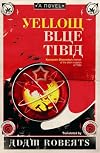
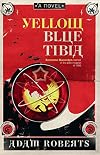
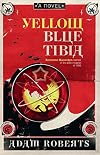
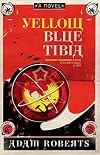
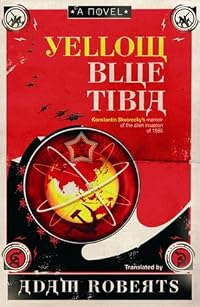
As someone who reads the Cyrillic alphabet, I get irritated when western designers mis-use that script as if they were Roman letters. Kudos to Gollancz and their designers, Blacksheep, then (in the UK edition) for producing one of the least worst examples of this on the UK trade paperback cover. show less
But forty years later, one of the authors begins to suspect that the alien threat they invented might just be becoming real...
This is a highly entertaining book which for most of its length can't decide whether it's sf or a slightly dark absurdist Russian novel. Parts of it are laugh-out-loud funny; other parts are by turns frightening, show more chilling or revelatory. In the end, it turns out to be sf, though not in any way we imagined when the novel started.
As someone who reads the Cyrillic alphabet, I get irritated when western designers mis-use that script as if they were Roman letters. Kudos to Gollancz and their designers, Blacksheep, then (in the UK edition) for producing one of the least worst examples of this on the UK trade paperback cover. show less
After the end of WWII, Josef Stalin secretly brought together a group of science fiction writers whom he invited to imagine an alien invasion scenario that could be used to unite the Soviet people against a supposed new enemy. Nothing ever seemed to come of it. So why, forty years later, are weird, inexplicable things happening to one of the writers? Why are things they imagined in their fictional scenario happening? Things like the explosions of an American space vehicle and a Ukrainian nuclear reactor? And what's going on with the KGB and the Scientologists and the UFOs that might or might not actually exist?
Yeah, this is a strange, strange novel. Like, however strange you think it is from that description, bump it up a notch or two. show more It's impossible to know what the hell is going on for most of it, either for the reader or the protagonist, and while things are sort of explained in the end, it's a weird and wild explanation. But it's a fun ride, full of droll humor and a bit of interesting food for thought. There are some individual elements I could take issue with. Like, there's a character who is very clearly autistic, and he and his "syndrome" are played for some absurd laughs. Should I be uncomfortable with this, given that everyone is played for absurd laughs? Probably, yeah, but I find myself as unsure what to make of that as I am of everything else. Still, overall, it was quite engaging and entertaining, even if it was in that "What the heck am I even reading?" kind of a way most of the time, and I'm genuinely impressed by how well it worked for me. show less
Yeah, this is a strange, strange novel. Like, however strange you think it is from that description, bump it up a notch or two. show more It's impossible to know what the hell is going on for most of it, either for the reader or the protagonist, and while things are sort of explained in the end, it's a weird and wild explanation. But it's a fun ride, full of droll humor and a bit of interesting food for thought. There are some individual elements I could take issue with. Like, there's a character who is very clearly autistic, and he and his "syndrome" are played for some absurd laughs. Should I be uncomfortable with this, given that everyone is played for absurd laughs? Probably, yeah, but I find myself as unsure what to make of that as I am of everything else. Still, overall, it was quite engaging and entertaining, even if it was in that "What the heck am I even reading?" kind of a way most of the time, and I'm genuinely impressed by how well it worked for me. show less
I was intrigued by the premise of this novel. In the 1930's, Stalin, fearing that the Soviet people would lose their unity once their common enemy, the West, was overcome, sought to create a new common enemy for the people to unite against. He brought together a group of respected science-fiction writers and asked them to create a credible scenario for an alien invasion.
The writers do as they are asked, but are abruptly disbanded and told to forget everything they have just done. Several of the writers disappear. Flash forward to the 1980's. One of the writers is working as a lowly translator when a series of events occur which mirror the events the group wrote about in the 1930's. Things start to move quickly, and the writer is show more hounded by the Moscow police, the KGB, a taxi driver with Aspbergers, a couple of Scientology adherents, and (perhaps???) aliens.
I would describe this book as madcap and surreal. It didn't always make sense and I didn't really connect with it, but if this sort of thing intrigues you, try it, you might like it.
By the way, one of the funniest parts of the book comes when we learn the significance of its title. You might be able to guess what that is if you speak Russian. I don't, and I was wondering most of the way through if the title had any meaning. show less
The writers do as they are asked, but are abruptly disbanded and told to forget everything they have just done. Several of the writers disappear. Flash forward to the 1980's. One of the writers is working as a lowly translator when a series of events occur which mirror the events the group wrote about in the 1930's. Things start to move quickly, and the writer is show more hounded by the Moscow police, the KGB, a taxi driver with Aspbergers, a couple of Scientology adherents, and (perhaps???) aliens.
I would describe this book as madcap and surreal. It didn't always make sense and I didn't really connect with it, but if this sort of thing intrigues you, try it, you might like it.
By the way, one of the funniest parts of the book comes when we learn the significance of its title. You might be able to guess what that is if you speak Russian. I don't, and I was wondering most of the way through if the title had any meaning. show less
Adam Roberts' latest novel superbly combines first-rate science fiction with laugh-aloud humor, both in the service of a story about the scars left on Russia by the twentieth century, and about a Big Picture of our place in the universe.
SF often skips over human concerns to bring us big ideas, like this: "If we succeed in establishing interplanetary communications, all our philosophies, moral and social views, will have to be revised." That's not Roberts, but V. I. Lenin, in the novel's epigraph. Lenin's grand ideas tended to leave out the individual; by contrast, Roberts' account of our place in the universe centers on the individual particulars of the life of his protagonist, fictional Russian SF writer Konstantin show more Skvorecky.
Immediately after World War II, Skvorecky and some fellow writers are conscripted by Stalin himself to brainstorm a fake account of a threat of alien invasion. It seems that communism always needs an external enemy, and Stalin thinks the capitalist world won't last long enough to supply a reliable one. The writers finish the job and are told never to speak of it again - advice they follow, happy still to be alive after encountering the great leader. Four decades later, in 1986, a weary, elderly Skvorecky learns that something like their scenario may actually be happening, as he is drawn into a fast-moving adventure.
I often think of humor as a sort of candy, pleasant but unserious. But a characteristic dry humor helped get the Russians through the horrendous history of the past century. English writer Roberts does a fine job emulating that wit here, in Skvorecky's encounters with various people involved with - well, whatever it is he has also become involved with. I cannot offer an example at any reasonable length, because the humor grows out of the situations Skvorecky lands in. The double meanings of humor, of puns, including interlingual puns, are the essence of Roberts' story, inextricably bound up with his SF Big Idea even as they embody Skvorecky's ordinary humanity and ironic sensibility. That SF idea is a fresh take on a common SF theme, one that needed new approaches, I think.
This novel is an example of the very best of modern science fiction. Kim Stanley Robinson has suggested that it should have won the 2009 Booker Prize. It is a fine novel of character, avoiding Roberts' occasional tendency to be emotionally chilly. Even the cover, using the standard trick of having cyrillic characters represent the latin characters they resemble ("ya" for a sort of backwards-R, for example) advances Roberts' purposes well. I am very pleased to have met Konstantin Skvorecky. show less
SF often skips over human concerns to bring us big ideas, like this: "If we succeed in establishing interplanetary communications, all our philosophies, moral and social views, will have to be revised." That's not Roberts, but V. I. Lenin, in the novel's epigraph. Lenin's grand ideas tended to leave out the individual; by contrast, Roberts' account of our place in the universe centers on the individual particulars of the life of his protagonist, fictional Russian SF writer Konstantin show more Skvorecky.
Immediately after World War II, Skvorecky and some fellow writers are conscripted by Stalin himself to brainstorm a fake account of a threat of alien invasion. It seems that communism always needs an external enemy, and Stalin thinks the capitalist world won't last long enough to supply a reliable one. The writers finish the job and are told never to speak of it again - advice they follow, happy still to be alive after encountering the great leader. Four decades later, in 1986, a weary, elderly Skvorecky learns that something like their scenario may actually be happening, as he is drawn into a fast-moving adventure.
I often think of humor as a sort of candy, pleasant but unserious. But a characteristic dry humor helped get the Russians through the horrendous history of the past century. English writer Roberts does a fine job emulating that wit here, in Skvorecky's encounters with various people involved with - well, whatever it is he has also become involved with. I cannot offer an example at any reasonable length, because the humor grows out of the situations Skvorecky lands in. The double meanings of humor, of puns, including interlingual puns, are the essence of Roberts' story, inextricably bound up with his SF Big Idea even as they embody Skvorecky's ordinary humanity and ironic sensibility. That SF idea is a fresh take on a common SF theme, one that needed new approaches, I think.
This novel is an example of the very best of modern science fiction. Kim Stanley Robinson has suggested that it should have won the 2009 Booker Prize. It is a fine novel of character, avoiding Roberts' occasional tendency to be emotionally chilly. Even the cover, using the standard trick of having cyrillic characters represent the latin characters they resemble ("ya" for a sort of backwards-R, for example) advances Roberts' purposes well. I am very pleased to have met Konstantin Skvorecky. show less
This novel was short-listed for the Arthur C Clarke Award for Science Fiction novels last year, but it’s really more of a philosophical thriller and a commentary on the fall of Communism than out and out science fiction. It’s dark, thoughtful, thrilling and hilarious by turns and I loved it.
It’s 1946 and the ‘Great Patriotic War’ (aka WWII) has ended. Stalin believes that the Soviet peoples need continued conflict to remain together under his thumb and he comes up with an idea. He gets a group of the top Soviet science fiction authors together and orders them to come up with a plan for an alien invasion that could be faked if necessary. They devise a race of ‘radiation aliens’ beings of pure energy who they decide should show more destroy the Ukraine…
"How could we plan such a monstrosity so very casually? This is not an easy question to answer, although in the light of what came later it is, of course an important one. Conceivably it is that we did not beleive, even in the midst of our work, that it would come to anything – that we felt removed from the possible consequences of our planning. But I suspect a more malign motivation. Writers, you see, daily inflict the most dreadful suffering upon the characters they create, and science fiction writers are worse than any other sort in this respect. A realist writer might break his protagonist’s leg, or kill his fiancee; but a science fiction writer will immolate whole planets, and whilst doing so he will be more concerned with the placement of commas than with the screams of the dying. He will do this every working day all through his life. How can this not prodce calluses on those tenderer portions of the mind that ordinary human beings use to focus their empathy?"
Nothing ever came of these plans (phew!), in fact the group were ordered never to talk about it. Years go by and our narrator, Konstantin Skvorecky, never wrote any more SF taking up the vodka bottle instead, but he pulled himself together enough to make a meagre living as a translator. Now it’s 1986, he’s in his early sixties and his life is about to take a very strange turn indeed, when one of his former colleagues turns up – now a KGB officer and he says he has proof that aliens are here …
‘Let’s be clear,’ I said. ‘The six of us concocted that story of space aliens.’
‘We did.’
‘We didn’t base it on anything factual at all. We invented radiation aliens. Crazy, really. I don’t believe a single one of us even approximately understood the physics of radiation.’
‘That’s right.’
‘It was fiction. It was our fiction. We made it up. It’s not real.’
‘Fictional and unreal are not synonyms,’ said Frenkel, smiling as if he had articulated a piece of profound wisdom.
‘Ivan, you’re saying that the story we invented is somehow, I don’t know, happening in the real world? That there’s proof that radiation aliens are invading?’
Then things start to get rather Monty Python as Konsty gives Frenkel the slip and ends up in front of an audience of UFO enthusiasts who see him as the prophet of the alien invasion, just like that scene in Life of Brian where his followers hang on every word and revere his gourd. An American whom Konstantin had been translating for earlier (wanting to establish the Church of Scientology in Russia), reappears and things get nasty – and Konsty ends up having to make a break for … Ukraine – and can you remember what happened in there in real life in 1986?
I loved this book on so many levels. Firstly it was a cracking good adventure with thrills, spills, cross and double-cross and even romance. Then there was the philosophical paradox in that UFOs don’t exist, but enough people believe that they do to create tremendous conspiracy theories which feed paranoia and keep the secret services busy. I loved how Roberts has taken many real facts and events and woven them into a rich sort of alternate history with these big ideas. The book also has a fantastic sense of farce – there’s a marvellous scene towards the end about Russians and queuing which had me guffawing with laughter. Konstantin, our unreliable narrator is not a typical Russian – he is known as an ironist and his skewed view on life pervades the story from the start; he can’t help but make wisecracks all the time, but is ultimately a rather loveable older man and his account of his great adventure was a brilliant read.
An absolutely brilliant read. (10/10) I bought this book and I want to read more of this exciting author’s books. show less
It’s 1946 and the ‘Great Patriotic War’ (aka WWII) has ended. Stalin believes that the Soviet peoples need continued conflict to remain together under his thumb and he comes up with an idea. He gets a group of the top Soviet science fiction authors together and orders them to come up with a plan for an alien invasion that could be faked if necessary. They devise a race of ‘radiation aliens’ beings of pure energy who they decide should show more destroy the Ukraine…
"How could we plan such a monstrosity so very casually? This is not an easy question to answer, although in the light of what came later it is, of course an important one. Conceivably it is that we did not beleive, even in the midst of our work, that it would come to anything – that we felt removed from the possible consequences of our planning. But I suspect a more malign motivation. Writers, you see, daily inflict the most dreadful suffering upon the characters they create, and science fiction writers are worse than any other sort in this respect. A realist writer might break his protagonist’s leg, or kill his fiancee; but a science fiction writer will immolate whole planets, and whilst doing so he will be more concerned with the placement of commas than with the screams of the dying. He will do this every working day all through his life. How can this not prodce calluses on those tenderer portions of the mind that ordinary human beings use to focus their empathy?"
Nothing ever came of these plans (phew!), in fact the group were ordered never to talk about it. Years go by and our narrator, Konstantin Skvorecky, never wrote any more SF taking up the vodka bottle instead, but he pulled himself together enough to make a meagre living as a translator. Now it’s 1986, he’s in his early sixties and his life is about to take a very strange turn indeed, when one of his former colleagues turns up – now a KGB officer and he says he has proof that aliens are here …
‘Let’s be clear,’ I said. ‘The six of us concocted that story of space aliens.’
‘We did.’
‘We didn’t base it on anything factual at all. We invented radiation aliens. Crazy, really. I don’t believe a single one of us even approximately understood the physics of radiation.’
‘That’s right.’
‘It was fiction. It was our fiction. We made it up. It’s not real.’
‘Fictional and unreal are not synonyms,’ said Frenkel, smiling as if he had articulated a piece of profound wisdom.
‘Ivan, you’re saying that the story we invented is somehow, I don’t know, happening in the real world? That there’s proof that radiation aliens are invading?’
Then things start to get rather Monty Python as Konsty gives Frenkel the slip and ends up in front of an audience of UFO enthusiasts who see him as the prophet of the alien invasion, just like that scene in Life of Brian where his followers hang on every word and revere his gourd. An American whom Konstantin had been translating for earlier (wanting to establish the Church of Scientology in Russia), reappears and things get nasty – and Konsty ends up having to make a break for … Ukraine – and can you remember what happened in there in real life in 1986?
I loved this book on so many levels. Firstly it was a cracking good adventure with thrills, spills, cross and double-cross and even romance. Then there was the philosophical paradox in that UFOs don’t exist, but enough people believe that they do to create tremendous conspiracy theories which feed paranoia and keep the secret services busy. I loved how Roberts has taken many real facts and events and woven them into a rich sort of alternate history with these big ideas. The book also has a fantastic sense of farce – there’s a marvellous scene towards the end about Russians and queuing which had me guffawing with laughter. Konstantin, our unreliable narrator is not a typical Russian – he is known as an ironist and his skewed view on life pervades the story from the start; he can’t help but make wisecracks all the time, but is ultimately a rather loveable older man and his account of his great adventure was a brilliant read.
An absolutely brilliant read. (10/10) I bought this book and I want to read more of this exciting author’s books. show less
This is not so much a science fiction book (the sci fi is crammed into the last thirty or so pages but I refuse to do a spoiler here) as a book about science fiction - the old Soviet science fiction tradition.
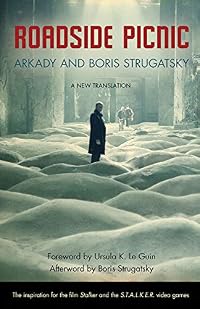
This Soviet tradition followed a different trajectory from that of the West with Zamyatin, Jules Verne and H.G. Wells as its masters. Its most well known writers outside the 'East; are probably Mikhail Bulgakov and the Strugatsky Brothers ('Roadside Picnic') to whom might be added the Polish writer Stanislas Lem ('Solaris'). There is plenty of good material on this on Wikipedia.
The book does not entirely convince as an evocation of Soviet life. It comes across, despite some very fine characterisation, and well researched period show more detail, as a very Western interpretation of local reality. Occasionally, we see ideas that could only have come from the contemporary West slip in, to be articulated by mildly stereotyped Russians. There is one scene that is pure X-Files - I mean 'pure', a nice lift of a key theme: see if you can identify it.
Nevertheless, the basic thesis is intriguing and well played. A group of science fiction writers are commissioned to write an alien invasion scenario by Stalin (mimicking a similar trope from cold war conspiracy theory surrounding Western UFOs). The story then jumps into the era of sclerosis and perestroika as the events postulated then become reality 'now'. To tell more would be to ruin the tale ...
What we can say is that Roberts is writing a book about the social construction of reality and there are some insights around pages 275 to 290 (in this edition) that show a mood of the moment that we have seen elsewhere - to say more would ruin the story.
The book is well written (very occasionally, we might do with more 'pace'), very entertaining and recommended. The end might boggle the mind a bit after what went before but that's what science fiction writers are supposed to do for us. show less
This Soviet tradition followed a different trajectory from that of the West with Zamyatin, Jules Verne and H.G. Wells as its masters. Its most well known writers outside the 'East; are probably Mikhail Bulgakov and the Strugatsky Brothers ('Roadside Picnic') to whom might be added the Polish writer Stanislas Lem ('Solaris'). There is plenty of good material on this on Wikipedia.
The book does not entirely convince as an evocation of Soviet life. It comes across, despite some very fine characterisation, and well researched period show more detail, as a very Western interpretation of local reality. Occasionally, we see ideas that could only have come from the contemporary West slip in, to be articulated by mildly stereotyped Russians. There is one scene that is pure X-Files - I mean 'pure', a nice lift of a key theme: see if you can identify it.
Nevertheless, the basic thesis is intriguing and well played. A group of science fiction writers are commissioned to write an alien invasion scenario by Stalin (mimicking a similar trope from cold war conspiracy theory surrounding Western UFOs). The story then jumps into the era of sclerosis and perestroika as the events postulated then become reality 'now'. To tell more would be to ruin the tale ...
What we can say is that Roberts is writing a book about the social construction of reality and there are some insights around pages 275 to 290 (in this edition) that show a mood of the moment that we have seen elsewhere - to say more would ruin the story.
The book is well written (very occasionally, we might do with more 'pace'), very entertaining and recommended. The end might boggle the mind a bit after what went before but that's what science fiction writers are supposed to do for us. show less
The story arc in Yellow Blue Tibia by Adam Roberts starts off conventionally enough and quickly evolves into something wholly unpredictable, with slapstick set pieces that would have been at home in Don Quijote or in a Vonnegut novel. It’s been a long time since I’ve laughed out loud reading a novel.
Reading the premise, you think Roberts is giving us a spy novel or SF thriller—and true enough there are several intense action sequences (most memorable is the one where our geriatric hero Konstantin manages to immobilize a KGB henchman). But the dominant narrative tone is that of absurdity along the lines of The Master and Margarita as Konstantin is flung from one ridiculous situation into another set against the backdrop of USSR show more Moscow on the verge of glasnost and perestroika reform.
On a deeper level, Yellow Blue Tibia is clever, self-aware satire aimed at provoking an exploration on the very nature of science fiction. This (ironic?) critique is often bleak and laced like poison with black humor. At one point, a doctor who saves Konstantin Andreiovich after he survives being blown up in a nuclear power plant dismissively says: "Science fiction is for adolescent boys and people who make models of aircraft from plastic and glue. I am a mature woman, which is to say, the opposite of a science fiction fan.” Hah. The general default position of so many readers, particularly those who read literary fiction and look down their noses at so-called genre work.
In another place, we see an even more grim comment on the science fiction writer’s craft:
This lack of empathy banner is made corporeal by a supporting character who seems to suffer from a "syndrome" centered around emotional indifference and a disastrous inability to detect sarcasm (perhaps some kind of Asperger/autism variant). The odd thing is that Yellow Blue Tibia has a pretty prominent love story in the mix that plays a pivotal role in the big reveal in the end about the “radiation aliens”—a kind of clever play on the ‘love conquers all’ idea.
Other reviewers have compared Roberts’s writing style here to Vonnegut and Bulgakov. With the heavy dose of satire, dry irony, and humor, that comparison is apt, I think. The only downside is that this high concept writing does meander a bit, and it can feel like the story isn’t really going anywhere. At least, by the end, you discover the significance of the title: Yellow Blue Tibia. show less
Reading the premise, you think Roberts is giving us a spy novel or SF thriller—and true enough there are several intense action sequences (most memorable is the one where our geriatric hero Konstantin manages to immobilize a KGB henchman). But the dominant narrative tone is that of absurdity along the lines of The Master and Margarita as Konstantin is flung from one ridiculous situation into another set against the backdrop of USSR show more Moscow on the verge of glasnost and perestroika reform.
”Christ, have the stupid grenade.” I held it out towards him.
Still aiming the gun straight at my chest, he reached up to take the grenade with this left hand. But he was still holding his suitcase in this hand. For a moment his face bore traces of a brain strenuously wrestling with a logic problem that was almost but not quite beyond his capacities (if I put the mouse and the dog in the boat, and leave the cat on the nearside bank, then paddle across to leave the dog on the far side of the river…) He lowered his arm. He put the suitcase on the floor and then reached out with this left hand, now empty. I handed him the grenade, and he took it. Then with as smooth a gesture as I could manage I reached down and picked up the suitcase.”
On a deeper level, Yellow Blue Tibia is clever, self-aware satire aimed at provoking an exploration on the very nature of science fiction. This (ironic?) critique is often bleak and laced like poison with black humor. At one point, a doctor who saves Konstantin Andreiovich after he survives being blown up in a nuclear power plant dismissively says: "Science fiction is for adolescent boys and people who make models of aircraft from plastic and glue. I am a mature woman, which is to say, the opposite of a science fiction fan.” Hah. The general default position of so many readers, particularly those who read literary fiction and look down their noses at so-called genre work.
In another place, we see an even more grim comment on the science fiction writer’s craft:
“A realist writer might break his protagonist's leg, or kill his fiancée; but a science fiction writer will immolate whole planets, and whilst doing so he will be more concerned with the placement of the commas than with the screams of the dying. He will do this every working day all through his life. How can this not produce calluses on those tenderer portions of the mind that ordinary human beings use to focus their empathy?”
This lack of empathy banner is made corporeal by a supporting character who seems to suffer from a "syndrome" centered around emotional indifference and a disastrous inability to detect sarcasm (perhaps some kind of Asperger/autism variant). The odd thing is that Yellow Blue Tibia has a pretty prominent love story in the mix that plays a pivotal role in the big reveal in the end about the “radiation aliens”—a kind of clever play on the ‘love conquers all’ idea.
Other reviewers have compared Roberts’s writing style here to Vonnegut and Bulgakov. With the heavy dose of satire, dry irony, and humor, that comparison is apt, I think. The only downside is that this high concept writing does meander a bit, and it can feel like the story isn’t really going anywhere. At least, by the end, you discover the significance of the title: Yellow Blue Tibia. show less
Members
- Recently Added By
Published Reviews
ThingScore 75
... in part a droll comedy of manners parodying the fall of Soviet communism, part an intellectual inquiry into the idea of multiple quantum realities and part an attempt to discover why, despite the ubiquity of reported sightings, UFOs have never been proved to exist. As ever with Roberts, the writing is impeccable and the ideas riveting.
added by andyl
Lists

Arthur C. Clarke Award Winners and Shortlisted Books
219 works; 14 members

O, those Russians (as Boney M sang)
16 works; 1 member

A Rainbow of Books: Colors in the Title
570 works; 24 members

Books Read in 2023
5,547 works; 145 members
Author Information

123+ Works 6,451 Members
Awards and Honors
Awards
Distinctions
Notable Lists
Common Knowledge
- Canonical title
- Yellow Blue Tibia
- Original publication date
- 2009
- People/Characters
- Konstantin Skvorecky
- Important places
- Russia; Chernobyl, Ukraine
Classifications
Statistics
- Members
- 527
- Popularity
- 56,488
- Reviews
- 37
- Rating
- (3.65)
- Languages
- English
- Media
- Paper, Audiobook, Ebook
- ISBNs
- 4
- ASINs
- 6