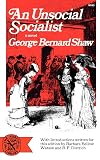
An Unsocial Socialist
by George Bernard Shaw
On This Page
Description
An Unsocial Socialist begins in an unruly girl's school, comically portraying their tricks and pranks. The narrative then moves to a seemingly ill-bred laborer, who is in fact a wealthy gentleman in disguise. He wishes, in part, to avoid his overly-affectionate wife, but also to preach socialism, of which he is a staunch convert. The story is then largely subsumed in a discussion of socialism and briefly concludes with the suitable marriages of the now-grown schoolgirls..
Tags
Recommendations

















Member Reviews
Having just purchased the complete works of Shaw from the digital publisher Delphi Classics, I began with this early novel (his fourth?) detailing the ambiguous career of a wealthy Englishman convinced of the monstrous injustice of the reigning economic system that leaves workers poor and the idle, rich. No heroic figure, however, he abandons his loving wife — arguably driving her to her early death — and continues hanging around with members of his own class, old acquaintances and new, to act as an irritant and provocateur. When asked to justify his outlandish behavior he delivers bitter and clever speeches that closely match the views of Shaw himself. Between speeches, he plays with the emotions of much younger women. He is a man show more to whom regret, much less apology, is a stranger. He feels no apparent responsibility to anyone or anything except the class struggle, including none to individual members of the working class which he ostensibly wants to benefit. At one point he admits that he has no intention of giving up his wealth and privilege, since such an effort would be a mere drop in the bucket of change.
Both the plot and, to some extent, the tone swerve unpredictably back and forth, and there is no satisfying resolution, although two pairs of lovers do marry appropriately to provide a happy ending Shakespeare-style. Despite all this, the writing sparkles in places, and the very unpredictability of it all keeps you reading. What was Shaw thinking by airing his views via a character who is a moral monster? Or did Shaw agree with his antihero's argument that he bears no moral responsibility for the pain he leaves in his wake? And why, despite my confusion, do I not regret the time I spent with this book? Is it just the dissonance that comes from reading a novel whose skillful author, in believing that its villain is its hero, seems to feel no dissonance at all? show less
Both the plot and, to some extent, the tone swerve unpredictably back and forth, and there is no satisfying resolution, although two pairs of lovers do marry appropriately to provide a happy ending Shakespeare-style. Despite all this, the writing sparkles in places, and the very unpredictability of it all keeps you reading. What was Shaw thinking by airing his views via a character who is a moral monster? Or did Shaw agree with his antihero's argument that he bears no moral responsibility for the pain he leaves in his wake? And why, despite my confusion, do I not regret the time I spent with this book? Is it just the dissonance that comes from reading a novel whose skillful author, in believing that its villain is its hero, seems to feel no dissonance at all? show less
Sometimes you see something you missed in your life of reading.
GBS was one of those. He was only an icon to me with a pointy beard, no longer popular, especially with the hip and then hippie set. I only knew of him thru references on Sesame Street –Miss Piggy-malion--and reading the credits to My Fair Lady.
So last week I ran into him lying on a shelf in the local library, an edition about 60 years old. Why not?
GBS was witty and could write dialogue for Bringing up Baby or any of the fast talking, screwball comedies. Oh, I forgot, they copied him, not the other way around.
How class-bound England was/is. Sometimes I forget about social class when I hang out in Silicon Valley (where they hide their fancy-pants au-pairs and yardmen). show more Those Victorians cemented class but left cracks for upward money. And you forget how eccentric and extreme-edge political those landed lords (and their lesser cousins) could be without disrupting upper class manners.
GBS writes polemics about mistreatment of the working class in the middle of snappy dialog. But readers skipped those pages to get to the characters spitting it out at each other as they danced around rituals of love and old fashioned hate, too.
You see how socialism was perceived b4 the communists took over Russia and hatched Stalin. GBS watched England losing its markets for manufactured goods because the rest of the world made things cheaper and predicted an England going broke. (sounds familiar?) , where they could only export workers. He didn’t forsee our overstuffed world and ad-driven continuous style-change buying that remade the world in its own image.
He sought a moral force that was rational. Religion was hocus-pocus; the church was just finishing up dealing with Galileo and the Pope declared himself infallible. GBS looked for non-revolutionary change to a more equitable world thru education. And he started the London School of Economics to explain it all.
In this book, GBS creates the rational man as hero, the anti-romantic, that would have been a detective if he were born in the 40’s, I bet. And the tough thinking woman could be played by Kate Hepburn or maybe Becky Sharpe if she gets incarnated in the computer game world. These two finally marry after his first wife sentimentally dies off and they accidentally get engaged in about a paragraph and realize love would only mess things up.
Hope I didn’t mess up the ending for you. show less
GBS was one of those. He was only an icon to me with a pointy beard, no longer popular, especially with the hip and then hippie set. I only knew of him thru references on Sesame Street –Miss Piggy-malion--and reading the credits to My Fair Lady.
So last week I ran into him lying on a shelf in the local library, an edition about 60 years old. Why not?
GBS was witty and could write dialogue for Bringing up Baby or any of the fast talking, screwball comedies. Oh, I forgot, they copied him, not the other way around.
How class-bound England was/is. Sometimes I forget about social class when I hang out in Silicon Valley (where they hide their fancy-pants au-pairs and yardmen). show more Those Victorians cemented class but left cracks for upward money. And you forget how eccentric and extreme-edge political those landed lords (and their lesser cousins) could be without disrupting upper class manners.
GBS writes polemics about mistreatment of the working class in the middle of snappy dialog. But readers skipped those pages to get to the characters spitting it out at each other as they danced around rituals of love and old fashioned hate, too.
You see how socialism was perceived b4 the communists took over Russia and hatched Stalin. GBS watched England losing its markets for manufactured goods because the rest of the world made things cheaper and predicted an England going broke. (sounds familiar?) , where they could only export workers. He didn’t forsee our overstuffed world and ad-driven continuous style-change buying that remade the world in its own image.
He sought a moral force that was rational. Religion was hocus-pocus; the church was just finishing up dealing with Galileo and the Pope declared himself infallible. GBS looked for non-revolutionary change to a more equitable world thru education. And he started the London School of Economics to explain it all.
In this book, GBS creates the rational man as hero, the anti-romantic, that would have been a detective if he were born in the 40’s, I bet. And the tough thinking woman could be played by Kate Hepburn or maybe Becky Sharpe if she gets incarnated in the computer game world. These two finally marry after his first wife sentimentally dies off and they accidentally get engaged in about a paragraph and realize love would only mess things up.
Hope I didn’t mess up the ending for you. show less
Shaw's main character certainly is unsocial. He says very pertinent things about the unfairness of the social order. He says reasonable things about the unimportance of romance. But he seems over all to say that emotions are unnecessary, art is a fraud, reason is the only thing that counts and humanity is hopeless. Read the first 2/3 of the book to get some great quotes about socialism, then feel free to go about your way elsewhere.
Schoolgirl hijinks in late 19th century England, linked via some love interest, to a bit of activism for socialism. The politics of a bygone era are now not much of a distraction from a good story, in the way they may have been at the time of its first publication, when said politics were more current.
Ratings
Members
- Recently Added By
Lists

The Non-Dramatic Works of Bernard Shaw
34 works; 1 member
Author Information

764+ Works 32,270 Members
Renowned literary genius George Bernard Shaw was born on July 26, 1856 in Dublin, Ireland. He later moved to London and educated himself at the British Museum while several of his novels were published in small socialist magazines. Shaw later became a music critic for the Star and for the World. He was a drama critic for the Saturday Review and show more later began to have some of his early plays produced. Shaw wrote the plays Man and Superman, Major Barbara, and Pygmalion, which was later adapted as My Fair Lady in both the musical and film form. He also transformed his works into screenplays for Saint Joan, How He Lied to Her Husband, Arms and the Man, Pygmalion, and Major Barbara. Shaw won the Nobel Prize for Literature in 1925. George Bernard Shaw died on November 2, 1950 at Ayot St. Lawrence, Hertfordshire, England. (Bowker Author Biography) show less
Awards and Honors
Series
Belongs to Publisher Series
Modern Library (15.1)
Work Relationships
Has the adaptation
Common Knowledge
- Canonical title
- An Unsocial Socialist
- Original title
- An Unsocial Socialist
- Original publication date
- 1884; 1887
- First words
- In the dusk of an October evening, a sensible-looking woman of forty came out through an oaken door to a broad landing on the first floor of an old English country-house.
When Shaw came to London in 1876 at the age of almost twenty, he believed that he had turned his back on failure, poverty, obscurity, ostracism and contempt - which was "all that Dublin offered to the enormity of my unconscio... (show all)us ambition." (Introduction)
Thus, the last Novels Of My Nonage, is, according to my original design, only the first chapter of a vast work depicting capitalist society in dissolution, with its downfall as the final grand catastrophe. (Foreword)
My Dear Sir - I find that my friends are not quite satisfied with the account you have given them in your clever novel entitled An Unsocial Socialist. (Appendix - Letter to the Author from Mr. Sidney Trefusis) - Quotations
- "Do you know what a pessimist is?" "A man who thinks everybody is as nasty as himself, and hates them for it."
- Last words
- (Click to show. Warning: May contain spoilers.)And so--
"'Jack shall have Jill,
Nought shall go ill,
The Man shall have his mare again;
And all shall be well.'"
(Click to show. Warning: May contain spoilers.)That Shaw was almost dead, and the journalist who was about to be born in his place would write anonymously, under various pseudonyms, and finally as G.B.S. (Introduction)
(Click to show. Warning: May contain spoilers.)In short, I had become, for better for worse, a different man. (Foreword)
(Click to show. Warning: May contain spoilers.)Don't tie yourself to it: it is fast wriggling into oblivion. -I am, dear sir, yours truly, SIDNEY TREFUSIS (Appendix - Letter to the Author from Mr. Sidney Trefusis) - Original language
- English
Classifications
Statistics
- Members
- 227
- Popularity
- 142,585
- Reviews
- 4
- Rating
- (3.40)
- Languages
- 6 — Dutch, English, German, Italian, Portuguese, Swedish
- Media
- Paper, Audiobook, Ebook
- ISBNs
- 64
- ASINs
- 13