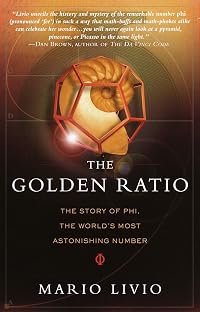
The Golden Ratio: The Story of Phi, the World's Most Astonishing Number
by Mario Livio
On This Page
Description
Throughout history, thinkers from mathematicians to theologians have pondered the mysterious relationship between numbers and the nature of reality. In this fascinating book, the author tells the tale of a number at the heart of that mystery: phi, or 1.6180339887 ... This curious mathematical relationship, widely known as "The Golden Ratio," was discovered by Euclid more than two thousand years ago because of its crucial role in the construction of the pentagram, to which magical properties show more had been attributed. Since then it has shown a propensity to appear in the most astonishing variety of places, from mollusk shells, sunflower florets, and rose petals to the shape of the galaxy. Psychological studies have investigated whether the Golden Ratio is the most aesthetically pleasing proportion extant, and it has been asserted that the creators of the Pyramids and the Parthenon employed it. It is believed to feature in works of art from Leonardo da Vinci's Mona Lisa to Salvador Dali's The Sacrament of the Last Supper, and poets and composers have used it in their works. It has even been found to be connected to the behavior of the stock market! This book is a captivating journey through art and architecture, botany and biology, physics and mathematics. It tells the human story of numerous phi-fixated individuals, including the followers of Pythagoras who believed that this proportion revealed the hand of God; astronomer Johannes Kepler, who saw phi as the greatest treasure of geometry; such Renaissance thinkers as mathematician Leonardo Fibonacci of Pisa; and such masters of the modern world as Goethe, Cezanne, Bartok, and physicist Roger Penrose. Wherever his quest for the meaning of phi takes him, the author reveals the world as a place where order, beauty, and eternal mystery will always coexist. show lessTags
Recommendations


Member Recommendations
Member Reviews
Non si poteva fare molto di più
In realtà la colpa del voto basso che ho dato al libro non è certo del povero Mario Livio, che ha fatto il possibile e ha anche infarcito il libro di divagazioni. Il guaio è che il rapporto aureo è importante matematicamente, ma ha avuto lo svantaggio di essere stato preso dai new age come numero onnipresente in natura e nell'arte, cosa che non è per nulla vera a meno che non si faccia come nella battuta che afferma che due più due fa tre per un valore sufficientemente grande di tre. Il libro è insomma più un'opera di debunking che di matematica vera e propria, il che però dovrebbe renderla più digeribile a chi matematico non è. Peccato che - almeno a un rapido controllo - la traduzione show more italiana BUR sia fuori commercio. show less
In realtà la colpa del voto basso che ho dato al libro non è certo del povero Mario Livio, che ha fatto il possibile e ha anche infarcito il libro di divagazioni. Il guaio è che il rapporto aureo è importante matematicamente, ma ha avuto lo svantaggio di essere stato preso dai new age come numero onnipresente in natura e nell'arte, cosa che non è per nulla vera a meno che non si faccia come nella battuta che afferma che due più due fa tre per un valore sufficientemente grande di tre. Il libro è insomma più un'opera di debunking che di matematica vera e propria, il che però dovrebbe renderla più digeribile a chi matematico non è. Peccato che - almeno a un rapido controllo - la traduzione show more italiana BUR sia fuori commercio. show less
Before I read this book, I'd heard about a lot of the astonishing mathematical properties of Φ, as well as the Golden Ratio's aesthetic appeal. What struck me reading Livio's book is not the math itself (as interesting as that was; I haven't studied math seriously in many years). No, what really caught my attention was the number of times that Φ has been cited as the basis for great works of art, that turned out to be pure B.S. Consider the following:
- Φ is not the ratio of the height of the Parthenon to its width.
- Φ has no role in the design of the Pyramids.
- While Da Vinci did illustrate a mathematical book on Φ (The Divine Proportion by Luca Pacioli), he did not use it as a guide to composing the Mona Lisa or anything else.
- show more Mozart and Mondrian didn't use it, either.
So, The Golden Ratio succeeds as a debunker's compendium. Livio makes the history of Golden Ratio fanaticism seem like so much Da Vinci Code-style overblown hokum. (All the more ironic that Dan Brown's praise for The Golden Ratio is given pride of place on the front cover.)
After that, the best part of the book for me was the end, where Livio digresses into fractal geometry and the enduring philosophical conundrum of why mathematics (a purely abstract human invention) mirrors the physical universe so precisely. These fundamental questions are more interesting to me than any laundry list of Φ trivia.
Original post on "All The Things I've Lost" show less
- Φ is not the ratio of the height of the Parthenon to its width.
- Φ has no role in the design of the Pyramids.
- While Da Vinci did illustrate a mathematical book on Φ (The Divine Proportion by Luca Pacioli), he did not use it as a guide to composing the Mona Lisa or anything else.
- show more Mozart and Mondrian didn't use it, either.
So, The Golden Ratio succeeds as a debunker's compendium. Livio makes the history of Golden Ratio fanaticism seem like so much Da Vinci Code-style overblown hokum. (All the more ironic that Dan Brown's praise for The Golden Ratio is given pride of place on the front cover.)
After that, the best part of the book for me was the end, where Livio digresses into fractal geometry and the enduring philosophical conundrum of why mathematics (a purely abstract human invention) mirrors the physical universe so precisely. These fundamental questions are more interesting to me than any laundry list of Φ trivia.
Original post on "All The Things I've Lost" show less
1.618033989... is a magic number. Its magic may not be as obvious as the most famous irrational, pi, nor as familiar as e (both of which are also transcendental), but its connection to the Fibonacci series (1, 1, 2, 3, 5, 8, ..., in which each element is the sum of the two previous) is a both intimate and surprising, and its role in the spiral of mollusc shells, inscribed pentagons, pineapple segments, fir cones, and the arrangement of seeds in a sunflower provides remarkable evidence that when nature speaks, she does so in the language of mathematics. Astrophysicist Mario Livio, who also wrote "The Equation That Couldn't Be Solved" (about group theory), takes a tempered approach to his subject. Claims have frequently been made that phi show more was the design principle of the Egyptian pyramids, the Parthenon, the works of Leonardo da Vinci, and in many other artistic creations. The evidence for most of them is weak - often based on a proportion that, when measured in a certain way, comes close to phi or its reciprocal. Livio is rightfully skeptical of most of these claims, but he also gives the Golden Ratio credit for works in which it is clearly implicated. This book provides a wonderful connection from science, art, music, and architecture to geometry and mathematics. show less
To write a whole book about the number zero requires a good deal of imagination and random association. That does not seem to be the case for the golden ratio. I've only gotten as far as Chapter 5, but there has been a good deal of interesting material presented. Chapter 2 introduces the Pythagoreans and many of their number theoretic discoveries. In this chapter the author gives a Babylonian formula for generating Pythagorean triples and argues that the existence of this formula and the fact that it generates a Pythagorean triple for every pair p, q where p > q proves that there are an infinite number of Pythagorean triples. I think that there are an infinite number, but the existence of the formula does not prove it. After all, the show more formula f(n) = (3 * n, 4 * n, 5 * n) yields an infinite number of Pythagorean triples, but they happen to be all in the same ratio, and therefore, essentially the same. Chapter 3 discusses assertions about the presence of the golden ratio in various ancient artifacts and buildings with scepticism. I liked the debunking, those pictures with a golden rectangle superimposed on the Parthenon always seemed questionable to me. Chapter 4 introduces lots of interesting properties of the ratio that were investigated before the dark ages.
For the interested reader there are a bunch of proofs of various theorems in the back, which is a nice touch. show less
For the interested reader there are a bunch of proofs of various theorems in the back, which is a nice touch. show less
This book was a bit of a mess. I appreciate the content debunking Golden Rectangle/Golden Ratio used by the ancients (Pyramids, etc.) or classic painters, etc. However it became rather tiring tearing down the core subject, in a way. There is plenty of great content about phi that rather balances that to lead to a final chapter that is really philosophy of mathematics with a rambling, inconclusive musings on Platonic and constructivist views of the nature of mathematical facts.
Well, I was expecting something a bit more exciting because of my natural love for Phi, simply because, you know... SPIRALS are EVERYWHERE, Dude.
Still, the author does a palatable job of giving me a fairly decent history of mathematics from the focus of the Golden Ratio, the Golden Triangle, the logarithmic spiral, the Fibonacci sequence... all of which is, of course, the same thing, expressed slightly different with a ton of additional cultural significances.
No surprise here. This is Phi.
However, I did take umbrage against some of the side explanations early on for why ancient or apparently unsophisticated tribes didn't have numbers that counted past four. I mean, sheesh, if we went purely by the mystical importance that the show more Pythagoreans placed upon the first couple of numbers, we might also believe they couldn't count past five. It's a mistake of the first order, taking a little bit of data and coming to enormous conclusions based on our own prejudices.
That's my problem, I suppose, and he does at least bring up the option that the ancient peoples might have been working on a base four mathematical system, but for me, it was too little, too late. I cultivated a little patience, waiting until we get further along the mathematical histories past the Greeks and into the Hindus and the Arabics where it got a lot more interesting, and then firmly into known territory with the Rennaisance.
Most interesting, but also rather sparse, was the Elliot wave and the modern applications of Phi. I wish we had spent a lot more time on that, honestly.
But as for the rest, giving us a piecemeal exploration of Phi in history, art, and math, this does its job rather well. show less
Still, the author does a palatable job of giving me a fairly decent history of mathematics from the focus of the Golden Ratio, the Golden Triangle, the logarithmic spiral, the Fibonacci sequence... all of which is, of course, the same thing, expressed slightly different with a ton of additional cultural significances.
No surprise here. This is Phi.
However, I did take umbrage against some of the side explanations early on for why ancient or apparently unsophisticated tribes didn't have numbers that counted past four. I mean, sheesh, if we went purely by the mystical importance that the show more Pythagoreans placed upon the first couple of numbers, we might also believe they couldn't count past five. It's a mistake of the first order, taking a little bit of data and coming to enormous conclusions based on our own prejudices.
That's my problem, I suppose, and he does at least bring up the option that the ancient peoples might have been working on a base four mathematical system, but for me, it was too little, too late. I cultivated a little patience, waiting until we get further along the mathematical histories past the Greeks and into the Hindus and the Arabics where it got a lot more interesting, and then firmly into known territory with the Rennaisance.
Most interesting, but also rather sparse, was the Elliot wave and the modern applications of Phi. I wish we had spent a lot more time on that, honestly.
But as for the rest, giving us a piecemeal exploration of Phi in history, art, and math, this does its job rather well. show less
If you divide a line so that the ratio of the smaller to the larger is equal to the ratio of the larger to the whole, you have the golden ratio, phi. There has been an abundance of literature on the presence of phi in a number of unexpected locations, and this book addresses many of these appearances intelligently. It is organized more or less historically, starting with the Pythagoreans' obsession with phi (due to its presence in the pentagon and other neat little number tricks) and continuing through the present. The author avoids doctoring numbers to fit phi into famous works of art and architecture, and indeed debunks several such cases. While some of the direct appearances of phi are pretty nifty (such as leaf growth patterns on show more plant stems), much of the book covers subjects that are only related to phi by a few generations, usually through the pentagon or the Fibonacci numbers. I do not fault the author for this; tangents are to be expected in books about such a narrow subject as a single number.
The final chapter, "Is God a Mathematician," includes leading theories in response to that question (yes, no, and sort of) and Livio's personal opinion. I understand the desire to address such a topic, since mathematics is pretty amazing and phi is no small example of this, but this chapter seemed sort of forced, like the author was at a loss on how to wrap up the book. The explanation of the dual nature of light was sort of random, and the rather unsubtle promotion of Stephen Wolfram's then-unpublished book (which was not well received by the math community) was sort of irritating. I imagine that Livio's desire was to instill a lingering thirst for knowledge in his reader, to encourage further study, but it felt more like an advertisement for a newfangled religion that will change the way you look at the world. Despite the final few pages, I found this book to be informative and quite readable, which is always high praise for a book about math. Perhaps if Livio had left out his personal opinion I would have finished it feeling more satisfied. show less
The final chapter, "Is God a Mathematician," includes leading theories in response to that question (yes, no, and sort of) and Livio's personal opinion. I understand the desire to address such a topic, since mathematics is pretty amazing and phi is no small example of this, but this chapter seemed sort of forced, like the author was at a loss on how to wrap up the book. The explanation of the dual nature of light was sort of random, and the rather unsubtle promotion of Stephen Wolfram's then-unpublished book (which was not well received by the math community) was sort of irritating. I imagine that Livio's desire was to instill a lingering thirst for knowledge in his reader, to encourage further study, but it felt more like an advertisement for a newfangled religion that will change the way you look at the world. Despite the final few pages, I found this book to be informative and quite readable, which is always high praise for a book about math. Perhaps if Livio had left out his personal opinion I would have finished it feeling more satisfied. show less
Members
- Recently Added By
Lists

A Rainbow of Books: Colors in the Title
570 works; 24 members
Author Information

33+ Works 4,898 Members
Mario Livio was born in 1945 in Romania. When he was 5 years old, he immigrated with his grandparents to Israel. He received undergraduate degrees in physics and mathematics from the Hebrew University in Jerusalem, a M.Sc. degree in theoretical particle physics at the Weizmann Institute, and a Ph.D. in theoretical astrophysics at Tel-Aviv show more University. He was a professor of physics at the Technion-Israel Institute of Technology from 1981 until 1991. He is a senior astrophysicist at the Hubble Space Telescope Science Institute. He has published over 400 scientific papers. He has also written several books including The Accelerating Universe, The Equation That Couldn't Be Solved, Is God a Mathematician?, and Brilliant Blunders: From Darwin to Einstein - Colossal Mistakes by Great Scientists That Changed Our Understanding of Life and the Universe. The Golden Ratio received the International Pythagoras Prize and the Peano Prize. (Bowker Author Biography) show less
Awards and Honors
Common Knowledge
- Canonical title
- The Golden Ratio: The Story of Phi, the World's Most Astonishing Number
- Original publication date
- 2002
- Dedication
- In memory of my father Robin Livio
- First words
- The famous British physicist Lord Kelvin (William Thompson; 1824-1907), after whom the degrees on the absolute temperature scale are named, once said in a lecture:"When you cannot express it in numbers, your knowledge is of t... (show all)he meager and unsatisfactory kind."
- Last words
- (Click to show. Warning: May contain spoilers.)It might have emerged as the output of a short computer program.
- Publisher's editor
- Holland, Rebecca
- Blurbers
- Penrose, Roger
Classifications
Statistics
- Members
- 2,560
- Popularity
- 7,494
- Reviews
- 26
- Rating
- (3.62)
- Languages
- 8 — Czech, Danish, English, French, Italian, Portuguese, Romanian, Spanish
- Media
- Paper, Audiobook, Ebook
- ISBNs
- 26
- UPCs
- 1
- ASINs
- 5