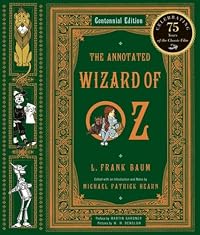
The Annotated Wizard of Oz
by L. Frank Baum (Author), Michael Patrick Hearn (Editor, Introduction and Notes)
On This Page
Description
A special edition of Dorothy's journey down the yellow brick road to the Emerald City of Oz containing detailed textual notes and eighty-two pages of introductory historical material.Tags
Recommendations










Member Reviews
Though it's not my favorite Oz book, The Wonderful Wizard of Oz is a brilliant start to a brilliant series. Hearn's annotated edition is a thing of beauty, not to mention highly informative.
added August 2021:
My eldest son has long been interested in The Wizard of Oz; one of the books a friend gave us when he was born was the improbably title Little Master Baum: The Wonderful Wizard of Oz: A Colors Primer: A BabyLit Book, which rearranges the story into a set of color-coded two-page spreads of objects. At some point—I don't remember how these days—he discovered my actual copy of The Wonderful Wizard of Oz and I must have "read" it to him a million time by just summarizing the story with reference to the pictures. (I have a nice Books show more of Wonder facsimile edition of the original 1900 edition.) He was into it enough that my mother bought him a set of Wizard of Oz dolls for Christmas. I began to wonder if he might want to read the actual novel, word by word, but an article I read suggested age 3 was more likely. As we neared his third birthday, I realized he was sitting through whole issues of My Little Pony in one sitting (something he hadn't been able to do a couple months prior), and he was also down for some long, text-dense picture books. So I offered to read him the whole thing in its entirety and he agreed.
At first I think he was a bit baffled—Dorothy used to get out of Kansas in thirty seconds, now it took ten minutes!—but he quickly became an enthusiastic devotee. We would do one chapter a day, often two or more, though I quickly worked out that more than two chapters in one sitting was not compatible with his attention span. Knowing the outline of the whole story from having read it in summary form before definitely helped him keep track of things, and fit with the advice that article gave me.
It's a fun book to read aloud, with lots of room for good voices. For Dorothy I just used my normal voice. For the Munchkins and Emerald City residents, I did my normal voice, but pitched upward at the end of sentences; I matched this with the Scarecrow but made it a bit hoarse. I was surprised by how the Tin Woodman ended up with an English accent, but it seemed to fit the character perfectly. The Cowardly Lion was of course very deep. One criticism people lob at the book is that it's episodic, but when you are reading it out loud a chapter at a time, that kind of thing doesn't really register—the Dainty China Country's is today's episode, rather than an irrelevant diversion. (Though I suspect it's one he won't really remember.)
On this reread—who knows how many times I've read it now—I was struck by how the Scarecrow, Tin Woodman, and Cowardly Lion already possess their desire qualities before they are gifted by the Wizard (something lost from the MGM film): the Scarecrow comes up with the best plans, the Woodman always acts with compassion, the Lion is always brave. But also that they actually kind of lose them once they receive them; they are kind of stupid and uncompassionate when visiting the Dainty China Country, and the Lion's means of killing the giant spider isn't exactly an act of bravery. I'm curious to see how this plays out going forward.
The novel's violence was also interesting, and somewhat jarring compared to modern children's literature sensibilities. But surely a child of 1900 would have much more contact with death than my own son—and the book is always so matter of fact about it that it cannot disturb.
I couldn't find my Books of Wonder facsimile, so I had to read him my Norton annotated edition. This has the complete text and illustrations, though the color plates are all in one spot, so every chapter we had to check there for any relevant pictures. The main problem it represented is that I would often get distracted from reading aloud by reading footnotes! show less
added August 2021:
My eldest son has long been interested in The Wizard of Oz; one of the books a friend gave us when he was born was the improbably title Little Master Baum: The Wonderful Wizard of Oz: A Colors Primer: A BabyLit Book, which rearranges the story into a set of color-coded two-page spreads of objects. At some point—I don't remember how these days—he discovered my actual copy of The Wonderful Wizard of Oz and I must have "read" it to him a million time by just summarizing the story with reference to the pictures. (I have a nice Books show more of Wonder facsimile edition of the original 1900 edition.) He was into it enough that my mother bought him a set of Wizard of Oz dolls for Christmas. I began to wonder if he might want to read the actual novel, word by word, but an article I read suggested age 3 was more likely. As we neared his third birthday, I realized he was sitting through whole issues of My Little Pony in one sitting (something he hadn't been able to do a couple months prior), and he was also down for some long, text-dense picture books. So I offered to read him the whole thing in its entirety and he agreed.
At first I think he was a bit baffled—Dorothy used to get out of Kansas in thirty seconds, now it took ten minutes!—but he quickly became an enthusiastic devotee. We would do one chapter a day, often two or more, though I quickly worked out that more than two chapters in one sitting was not compatible with his attention span. Knowing the outline of the whole story from having read it in summary form before definitely helped him keep track of things, and fit with the advice that article gave me.
It's a fun book to read aloud, with lots of room for good voices. For Dorothy I just used my normal voice. For the Munchkins and Emerald City residents, I did my normal voice, but pitched upward at the end of sentences; I matched this with the Scarecrow but made it a bit hoarse. I was surprised by how the Tin Woodman ended up with an English accent, but it seemed to fit the character perfectly. The Cowardly Lion was of course very deep. One criticism people lob at the book is that it's episodic, but when you are reading it out loud a chapter at a time, that kind of thing doesn't really register—the Dainty China Country's is today's episode, rather than an irrelevant diversion. (Though I suspect it's one he won't really remember.)
On this reread—who knows how many times I've read it now—I was struck by how the Scarecrow, Tin Woodman, and Cowardly Lion already possess their desire qualities before they are gifted by the Wizard (something lost from the MGM film): the Scarecrow comes up with the best plans, the Woodman always acts with compassion, the Lion is always brave. But also that they actually kind of lose them once they receive them; they are kind of stupid and uncompassionate when visiting the Dainty China Country, and the Lion's means of killing the giant spider isn't exactly an act of bravery. I'm curious to see how this plays out going forward.
The novel's violence was also interesting, and somewhat jarring compared to modern children's literature sensibilities. But surely a child of 1900 would have much more contact with death than my own son—and the book is always so matter of fact about it that it cannot disturb.
I couldn't find my Books of Wonder facsimile, so I had to read him my Norton annotated edition. This has the complete text and illustrations, though the color plates are all in one spot, so every chapter we had to check there for any relevant pictures. The main problem it represented is that I would often get distracted from reading aloud by reading footnotes! show less
Hearn's updated Annotated Wizard is a revelation; even if you've read all the major books on Baum and subscribe to The Baum Bugle, there's much to discover here. I particularly enjoy Hearn's ruminations on inspirations taken from Pilgrim's Progress, as well as the ways in which Baum deliberately satirized fairy tale traditions and reflected his own Theosophist beliefs. Even though some of the notes are deliberately speculative, they offer much food for thought.
After reading Gregory Maguire’s version of Oz in Wicked and Son of a Witch, I felt I needed to return to the original, which I hadn’t read before. Like many of us, my entire knowledge of the story is from the 1939 movie. I had purchased this centennial edition for my college’s children’s literature collection, and this was a great excuse to read it. The book incorporates facsimiles of Baum’s 1900 publication, including the original artwork by Denslow. Hearn has added extensive annotations to the text, as well as a 98-page introduction with background on the author and illustrator (and many relevant photographs and drawings). It’s a gorgeous book.
I learned, among other things, that the “ruby slippers” of the movie were show more actually “silver shoes” in the book (a detail that was correct in Wicked), and that the Tin Woodman was in fact the woodcutter upon whose ax Elphaba’s sister, Nessarose (aka the Wicked Witch of the East), casts an evil spell that resulted in his slowly but surely being turned into tin. Interestingly enough, in Wicked, Nessarose has no arms, an implication that she may be the product of her mother’s affair with the Quadling Turtle Heart. In the original Wizard of Oz, Dorothy and her friends encounter the armless Hammer-Heads in Quadling country, near the end of the book, after Dorothy has killed the Wicked Witch of the West. show less
I learned, among other things, that the “ruby slippers” of the movie were show more actually “silver shoes” in the book (a detail that was correct in Wicked), and that the Tin Woodman was in fact the woodcutter upon whose ax Elphaba’s sister, Nessarose (aka the Wicked Witch of the East), casts an evil spell that resulted in his slowly but surely being turned into tin. Interestingly enough, in Wicked, Nessarose has no arms, an implication that she may be the product of her mother’s affair with the Quadling Turtle Heart. In the original Wizard of Oz, Dorothy and her friends encounter the armless Hammer-Heads in Quadling country, near the end of the book, after Dorothy has killed the Wicked Witch of the West. show less
I read the Annotated WOZ by Michael Patrick Hearn, but it has a different cover than this, the only one I can find here on GR. ISBN doesn't help. I don't know if this green is different inside than the black that I read.
Anyway. Brilliant story that holds up well. In some ways even better than the Judy Garland movie (and undoubtedly much better than the contemporary productions). I always thought it sad that Baum didn't live to see that 1939 movie.
Read for a group discussion; lots of my notes of those bits of information from the annotation that I found interesting are there: https://www.goodreads.com/topic/show/20913622-the-wonderful-wizard-of-oz---buddy...
Anyway. Brilliant story that holds up well. In some ways even better than the Judy Garland movie (and undoubtedly much better than the contemporary productions). I always thought it sad that Baum didn't live to see that 1939 movie.
Read for a group discussion; lots of my notes of those bits of information from the annotation that I found interesting are there: https://www.goodreads.com/topic/show/20913622-the-wonderful-wizard-of-oz---buddy...
Three books in one. 1) The original story with all the original illustrations reproduced exactly as appeared in the first edition (this is the only re-production edition available). 2) A 102 page literary history with extensive biography of Baum and his works and illustrator Denslow. 3) Extensive annotated notes.
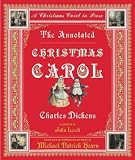
Michael Hearn is the master of annotation and this is just one in a series he has done including The Christmas Carol and Huckleberry Finn. The factual detail is dense, but always relevant and interesting. Oz may be a "kids story" but this is serious adult entertainment.
Michael Hearn is the master of annotation and this is just one in a series he has done including The Christmas Carol and Huckleberry Finn. The factual detail is dense, but always relevant and interesting. Oz may be a "kids story" but this is serious adult entertainment.
This centennial edition of the book reproduces the original text and illustrations of The Wonderful World of Oz with the original colors -- including a large section of full-color plates in the center of the book and dual-color drawings throughout that change colors as Dorothy and her friends travel through the land of Oz. In addition, there is a lengthy, nicely written, and thoroughly illustrated introduction that gives biographical information on Baum and Denslow, the history of their creative partnership, the popular reception of the first Oz book, and Baum's continued work with the Oz series.
The book itself is annotated by Hearn through a series of footnotes. These often interesting (although occasionally a little out in left field) show more notes include biographical information; connections between the original books and various movies, plays, and other artwork inspired by the Oz characters; critical receptions of the books; and the occasional nerdy highlighting of inconsistencies within or between different Oz stories. I found the majority of the annotations to be worthwhile and fun to read, although if you hadn't read the book before I would definitely give the original text a read-through before working through Hearn's digressions...
I love really nice books, and this book is physically just awesome -- it is big and heavy with thick paper, just like a children's fairy tale storybook. The illustrations and photographs are wonderful to look at, and make the book a joy to read.
[full review here: http://spacebeer.blogspot.com/2008/07/annotated-wizard-of-oz-2000.html ] show less
The book itself is annotated by Hearn through a series of footnotes. These often interesting (although occasionally a little out in left field) show more notes include biographical information; connections between the original books and various movies, plays, and other artwork inspired by the Oz characters; critical receptions of the books; and the occasional nerdy highlighting of inconsistencies within or between different Oz stories. I found the majority of the annotations to be worthwhile and fun to read, although if you hadn't read the book before I would definitely give the original text a read-through before working through Hearn's digressions...
I love really nice books, and this book is physically just awesome -- it is big and heavy with thick paper, just like a children's fairy tale storybook. The illustrations and photographs are wonderful to look at, and make the book a joy to read.
[full review here: http://spacebeer.blogspot.com/2008/07/annotated-wizard-of-oz-2000.html ] show less
Another wonderful annotated book, giving me the opportunity to read a book that I never read when I was younger, while placing it in its historical context and giving me the chance to see why it's become a classic.
Members
- Recently Added By
Lists

All Things Oz
32 works; 2 members

Books Read in 2020
4,379 works; 124 members
Author Information

Best known as the author of the Wizard of Oz series, Lyman Frank Baum was born on May 15, 1856, in New York. When Baum was a young man, his father, who had made a fortune in oil, gave him several theaters in New York and Pennsylvania to manage. Eventually, Baum had his first taste of success as a writer when he staged The Maid of Arran, a show more melodrama he had written and scored. Married in 1882 to Maud Gage, whose mother was an influential suffragette, the two had four sons. Baum often entertained his children with nursery rhymes and in 1897 published a compilation titled Mother Goose in Prose, which was illustrated by Maxfield Parrish. The project was followed by three other picture books of rhymes, illustrated by William Wallace Denslow. The success of the nursery rhymes persuaded Baum to craft a novel out of one of the stories, which he titled The Wonderful Wizard of Oz. Some critics have suggested that Baum modeled the character of the Wizard on himself. Other books for children followed the original Oz book, and Baum continued to produce the popular Oz books until his death in 1919. The series was so popular that after Baum's death and by special arrangement, Oz books continued to be written for the series by other authors. Glinda of Oz, the last Oz book that Baum wrote, was published in 1920. (Bowker Author Biography) show less

Michael Patrick Hearn's first Oz annotation, written when he was 21, was featured on the front page of the "New York Times Book Review." He lives in New York City. (Bowker Author Biography)
All Editions
Some Editions
Series
Belongs to Publisher Series
Work Relationships
Contains
Common Knowledge
- Canonical title
- The Annotated Wizard of Oz
- Original title
- The Wonderful Wizard of Oz
- Original publication date
- 1972
- People/Characters
- Dorothy Gale; Scarecrow [Oz]; Tin Woodman (Nick Chopper); Cowardly Lion; Wicked Witch of the West; Wizard of Oz (show all 7); L. Frank Baum
- Important places
- Oz; Kansas, USA
- Related movies
- The Wonderful Wizard of Oz (1910 | IMDb); The Wizard of Oz (1925 | IMDb); The Wizard of Oz (1939 | IMDb)
- Dedication
- For Cynthia, Coleen, and Christopher
- First words
- Dorothy lived in the midst of the great Kansas prairies, with Uncle Henry, who was a farmer, and Aunt Em, who was the farmer's wife.
Preface: Almost every great nation has its immortal work of juvenile fantasy. - Quotations
- When Dorothy stood in the doorway and looked around all she saw was the the great gray Prairie on every side.
- Last words
- (Click to show. Warning: May contain spoilers.)"Oh, Aunt Em, I am so happy to be at home again!"
- Blurbers
- Thurber, James; Styron, William; Rushdie, Salman
- Disambiguation notice
- This is the annotated version of The Wizard of Oz (annotations by Michael Patrick Hearn), not the original work.
Classifications
Statistics
- Members
- 1,088
- Popularity
- 23,288
- Reviews
- 20
- Rating
- (4.36)
- Languages
- English, German, Spanish
- Media
- Paper, Ebook
- ISBNs
- 6
- ASINs
- 17