
Michael Patrick Hearn
Author of The Annotated Wizard of Oz
About the Author
Michael Patrick Hearn's first Oz annotation, written when he was 21, was featured on the front page of the "New York Times Book Review." He lives in New York City. (Bowker Author Biography)
Works by Michael Patrick Hearn
Associated Works
The Art of Oz: Witches, Wizards, and Wonders Beyond the Yellow Brick Road (2021) — Afterword — 18 copies
Cricket Magazine, Vol. 4, No. 6, February 1977 — Contributor — 3 copies
The History of Tom Thumbe [and] Robins Hood's Garland [and] The History of Jack and the Giants [and] Traditional Fairy Tales (1977) — Preface — 1 copy
The Light Princess: Abridged [sound recording] — Abridger — 1 copy
Tagged
Common Knowledge
- Canonical name
- Hearn, Michael Patrick
- Birthdate
- 1950-04-24
- Gender
- male
- Occupations
- literary scholar
- Nationality
- USA
- Associated Place (for map)
- USA
Members
Reviews

Scrooge, Bob Cratchit, Tiny Tim. The spirits of Christmas past, present, and future. The knocker with Jacob Marley’s face. Yes, that Marley, dead as a doornail.
It’s a story so familiar to me, having seen at least three film adaptions, that somehow I never got around to reading the book. This year, that finally changed. I found, once again, that the experience of reading is different from that of watching. Although I’ve seen Scrooge depicted by marvelous actors, who clearly relished the show more role (Alastair Sim, George C. Scott, Michael Caine), the Scrooge evoked in my mind while reading was somehow not like any of them. And although I knew it would be part of the story, the scene when Scrooge foresees the forlorn Cratchit household, bereft of Tiny Tim, made my eyes film over.
Beyond that, the experience of reading is a chance to savor the writing. Dickens establishes a narrator from the start who makes it clear that his own opinion that Christmas is one of the great civilizing influences in the world, perhaps the greatest, will not prevent him from passing on what he observes with wry humor. The first two paragraphs, in which he asks whether a coffin nail might not be deader than a doornail, is one of the best openings I’ve read.
Yet, for all his writing skills, language has changed a bit in the past two centuries. Of course, there is the internet to quickly search for the meaning of an obscure word, or if you are curious about how to make a bowl of Bishop’s (or how the concoction got its name). An alternative is to read this annotated edition, edited by Michael Patrick Hearn. Beyond the meanings of obscure terms (and those recipes!), this edition features a 51-page introduction, which recounts the crucial role this slim volume played in Dickens’s career, its critical reception at the time and since, as well as the social and religious background. Also, there are several illustrations by Dickens’s contemporaries, including reproductions of John Leech’s hand-colored engravings from the first edition, the text of which is photomechanically reproduced in this edition, show less
It’s a story so familiar to me, having seen at least three film adaptions, that somehow I never got around to reading the book. This year, that finally changed. I found, once again, that the experience of reading is different from that of watching. Although I’ve seen Scrooge depicted by marvelous actors, who clearly relished the show more role (Alastair Sim, George C. Scott, Michael Caine), the Scrooge evoked in my mind while reading was somehow not like any of them. And although I knew it would be part of the story, the scene when Scrooge foresees the forlorn Cratchit household, bereft of Tiny Tim, made my eyes film over.
Beyond that, the experience of reading is a chance to savor the writing. Dickens establishes a narrator from the start who makes it clear that his own opinion that Christmas is one of the great civilizing influences in the world, perhaps the greatest, will not prevent him from passing on what he observes with wry humor. The first two paragraphs, in which he asks whether a coffin nail might not be deader than a doornail, is one of the best openings I’ve read.
Yet, for all his writing skills, language has changed a bit in the past two centuries. Of course, there is the internet to quickly search for the meaning of an obscure word, or if you are curious about how to make a bowl of Bishop’s (or how the concoction got its name). An alternative is to read this annotated edition, edited by Michael Patrick Hearn. Beyond the meanings of obscure terms (and those recipes!), this edition features a 51-page introduction, which recounts the crucial role this slim volume played in Dickens’s career, its critical reception at the time and since, as well as the social and religious background. Also, there are several illustrations by Dickens’s contemporaries, including reproductions of John Leech’s hand-colored engravings from the first edition, the text of which is photomechanically reproduced in this edition, show less

Though it's not my favorite Oz book, The Wonderful Wizard of Oz is a brilliant start to a brilliant series. Hearn's annotated edition is a thing of beauty, not to mention highly informative.
added August 2021:
My eldest son has long been interested in The Wizard of Oz; one of the books a friend gave us when he was born was the improbably title Little Master Baum: The Wonderful Wizard of Oz: A Colors Primer: A BabyLit Book, which rearranges the story into a set of color-coded two-page spreads show more of objects. At some point—I don't remember how these days—he discovered my actual copy of The Wonderful Wizard of Oz and I must have "read" it to him a million time by just summarizing the story with reference to the pictures. (I have a nice Books of Wonder facsimile edition of the original 1900 edition.) He was into it enough that my mother bought him a set of Wizard of Oz dolls for Christmas. I began to wonder if he might want to read the actual novel, word by word, but an article I read suggested age 3 was more likely. As we neared his third birthday, I realized he was sitting through whole issues of My Little Pony in one sitting (something he hadn't been able to do a couple months prior), and he was also down for some long, text-dense picture books. So I offered to read him the whole thing in its entirety and he agreed.
At first I think he was a bit baffled—Dorothy used to get out of Kansas in thirty seconds, now it took ten minutes!—but he quickly became an enthusiastic devotee. We would do one chapter a day, often two or more, though I quickly worked out that more than two chapters in one sitting was not compatible with his attention span. Knowing the outline of the whole story from having read it in summary form before definitely helped him keep track of things, and fit with the advice that article gave me.
It's a fun book to read aloud, with lots of room for good voices. For Dorothy I just used my normal voice. For the Munchkins and Emerald City residents, I did my normal voice, but pitched upward at the end of sentences; I matched this with the Scarecrow but made it a bit hoarse. I was surprised by how the Tin Woodman ended up with an English accent, but it seemed to fit the character perfectly. The Cowardly Lion was of course very deep. One criticism people lob at the book is that it's episodic, but when you are reading it out loud a chapter at a time, that kind of thing doesn't really register—the Dainty China Country's is today's episode, rather than an irrelevant diversion. (Though I suspect it's one he won't really remember.)
On this reread—who knows how many times I've read it now—I was struck by how the Scarecrow, Tin Woodman, and Cowardly Lion already possess their desire qualities before they are gifted by the Wizard (something lost from the MGM film): the Scarecrow comes up with the best plans, the Woodman always acts with compassion, the Lion is always brave. But also that they actually kind of lose them once they receive them; they are kind of stupid and uncompassionate when visiting the Dainty China Country, and the Lion's means of killing the giant spider isn't exactly an act of bravery. I'm curious to see how this plays out going forward.
The novel's violence was also interesting, and somewhat jarring compared to modern children's literature sensibilities. But surely a child of 1900 would have much more contact with death than my own son—and the book is always so matter of fact about it that it cannot disturb.
I couldn't find my Books of Wonder facsimile, so I had to read him my Norton annotated edition. This has the complete text and illustrations, though the color plates are all in one spot, so every chapter we had to check there for any relevant pictures. The main problem it represented is that I would often get distracted from reading aloud by reading footnotes! show less
added August 2021:
My eldest son has long been interested in The Wizard of Oz; one of the books a friend gave us when he was born was the improbably title Little Master Baum: The Wonderful Wizard of Oz: A Colors Primer: A BabyLit Book, which rearranges the story into a set of color-coded two-page spreads show more of objects. At some point—I don't remember how these days—he discovered my actual copy of The Wonderful Wizard of Oz and I must have "read" it to him a million time by just summarizing the story with reference to the pictures. (I have a nice Books of Wonder facsimile edition of the original 1900 edition.) He was into it enough that my mother bought him a set of Wizard of Oz dolls for Christmas. I began to wonder if he might want to read the actual novel, word by word, but an article I read suggested age 3 was more likely. As we neared his third birthday, I realized he was sitting through whole issues of My Little Pony in one sitting (something he hadn't been able to do a couple months prior), and he was also down for some long, text-dense picture books. So I offered to read him the whole thing in its entirety and he agreed.
At first I think he was a bit baffled—Dorothy used to get out of Kansas in thirty seconds, now it took ten minutes!—but he quickly became an enthusiastic devotee. We would do one chapter a day, often two or more, though I quickly worked out that more than two chapters in one sitting was not compatible with his attention span. Knowing the outline of the whole story from having read it in summary form before definitely helped him keep track of things, and fit with the advice that article gave me.
It's a fun book to read aloud, with lots of room for good voices. For Dorothy I just used my normal voice. For the Munchkins and Emerald City residents, I did my normal voice, but pitched upward at the end of sentences; I matched this with the Scarecrow but made it a bit hoarse. I was surprised by how the Tin Woodman ended up with an English accent, but it seemed to fit the character perfectly. The Cowardly Lion was of course very deep. One criticism people lob at the book is that it's episodic, but when you are reading it out loud a chapter at a time, that kind of thing doesn't really register—the Dainty China Country's is today's episode, rather than an irrelevant diversion. (Though I suspect it's one he won't really remember.)
On this reread—who knows how many times I've read it now—I was struck by how the Scarecrow, Tin Woodman, and Cowardly Lion already possess their desire qualities before they are gifted by the Wizard (something lost from the MGM film): the Scarecrow comes up with the best plans, the Woodman always acts with compassion, the Lion is always brave. But also that they actually kind of lose them once they receive them; they are kind of stupid and uncompassionate when visiting the Dainty China Country, and the Lion's means of killing the giant spider isn't exactly an act of bravery. I'm curious to see how this plays out going forward.
The novel's violence was also interesting, and somewhat jarring compared to modern children's literature sensibilities. But surely a child of 1900 would have much more contact with death than my own son—and the book is always so matter of fact about it that it cannot disturb.
I couldn't find my Books of Wonder facsimile, so I had to read him my Norton annotated edition. This has the complete text and illustrations, though the color plates are all in one spot, so every chapter we had to check there for any relevant pictures. The main problem it represented is that I would often get distracted from reading aloud by reading footnotes! show less

Hearn's updated Annotated Wizard is a revelation; even if you've read all the major books on Baum and subscribe to The Baum Bugle, there's much to discover here. I particularly enjoy Hearn's ruminations on inspirations taken from Pilgrim's Progress, as well as the ways in which Baum deliberately satirized fairy tale traditions and reflected his own Theosophist beliefs. Even though some of the notes are deliberately speculative, they offer much food for thought.
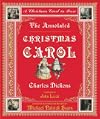
I've always had some issues with Dickens' Christmas Carol. The central messages - that people are more important than money, and that it's never too late to make changes in yourself - are timeless, and their presentation within a ghost story is very appealing (and a large part of what keeps the story living, I think). As a child, though, I found some of it massively over-sentimentalized, especially the role of Tiny Tim, who embodies a distasteful, pitying view of people with disabilities show more that doesn't (and shouldn't) fit the mores of today. As I've grown older, I've come to see the wish fulfillment aspect of the final pages - where Scrooge undoes decades of malignant behavior by throwing around a lot of money - as a bit troubling, too. But it's a story I want to like, even when it bothers me; there's a core to it that I think is important, and the ghosts are - to use an overplayed word - iconic.
Michael Patrick Hearn's The Annotated Christmas Carol goes a long way toward helping people like me put the story, and both its positive and negative aspects, in full context. This is the kind of "layman's acadame" volume that fulfills a desperately needed function: it treats the lay reader as smart and intelligent, and pulls together a lot of different historical and biographical strands that will help them understand a culturally meaningful work that probably only saw through the lens of entertainment. it's not a deep-dive or a truly academic text, but it points the way toward those deeper, denser materials if the reader chooses to go on and take the next step. If not, it at least leaves them with a more informed appreciation.
The one caveat here is that Hearn's perspective, and presumed audience, is distinctly American. That shouldn't come as a surprise, but it might - I was a little bit thrown how often he uses annotations to explain old British currency, or tell us where in London we might find a certain location. (It must be said, though, that this is a twenty-year-old book, and the internet has globalized a lot more day-to-day cultural information in the intervening years.) More intriguing is his repeated emphasis on Dickens' disastrous social standing in the United States preceding Christmas Carol, thanks mostly to criticisms he published following a visit. I'd never heard anything about this aspect to the failure of Martin Chuzzlewit and Dickens' need for a big hit, but it makes sense and Hearn provides solid grounding. I just don't think a British author, writing for a British audience, would have given it so much air. That's not a criticism - just an observation.
While the annotations are often very interesting, explaining words and phrases that have fallen out of fashion, making comparisons to Dickens' own life, and describing how some sequences were revised before publication or transformed by early stage adaptations, the "stars" of the book are the introduction and two appendices. The extensive introduction chronicles the development of A Christmas Carol (including the failure of Chuzzlewit), its publication, and its critical reception. It also fully describes his despair at the treatment of the poor, especially children, which largely sparked the creation of Christmas Carol and goes some way toward contextualizing the problematic Tiny Tim. The first appendix acts as a book-end, covering Dickens' decision to tour with Public Readings of Christmas Carol, taking us from his separation from his wife to the health issues he developed on the road and resultant early death. Together these two sections take up more than 100 pages of the book and are excellent, engaging reads. The second appendix is more of a curio - the full text of Dickens' reduced-length Christmas Carol utilized for the Public Readings - but a valuable inclusion nonetheless. The book is completed with an extensive bibliography of and on Dickens.
This is an excellent volume for anyone who has ever read A Christmas Carol, or even grown up watching one of the innumerable adaptations, and wants to better understand it. My only thought toward a reprint would be a chapter to overview film and TV adaptations, and their trends, especially as in the last 30 years we have moved much more fully away from "heritage" (text-authentic) productions to ones that reframe or modernize the story. Otherwise - this is an ideal "next step" for a personal library, and it would actually make an excellent Christmas gift in and of itself. show less
Michael Patrick Hearn's The Annotated Christmas Carol goes a long way toward helping people like me put the story, and both its positive and negative aspects, in full context. This is the kind of "layman's acadame" volume that fulfills a desperately needed function: it treats the lay reader as smart and intelligent, and pulls together a lot of different historical and biographical strands that will help them understand a culturally meaningful work that probably only saw through the lens of entertainment. it's not a deep-dive or a truly academic text, but it points the way toward those deeper, denser materials if the reader chooses to go on and take the next step. If not, it at least leaves them with a more informed appreciation.
The one caveat here is that Hearn's perspective, and presumed audience, is distinctly American. That shouldn't come as a surprise, but it might - I was a little bit thrown how often he uses annotations to explain old British currency, or tell us where in London we might find a certain location. (It must be said, though, that this is a twenty-year-old book, and the internet has globalized a lot more day-to-day cultural information in the intervening years.) More intriguing is his repeated emphasis on Dickens' disastrous social standing in the United States preceding Christmas Carol, thanks mostly to criticisms he published following a visit. I'd never heard anything about this aspect to the failure of Martin Chuzzlewit and Dickens' need for a big hit, but it makes sense and Hearn provides solid grounding. I just don't think a British author, writing for a British audience, would have given it so much air. That's not a criticism - just an observation.
While the annotations are often very interesting, explaining words and phrases that have fallen out of fashion, making comparisons to Dickens' own life, and describing how some sequences were revised before publication or transformed by early stage adaptations, the "stars" of the book are the introduction and two appendices. The extensive introduction chronicles the development of A Christmas Carol (including the failure of Chuzzlewit), its publication, and its critical reception. It also fully describes his despair at the treatment of the poor, especially children, which largely sparked the creation of Christmas Carol and goes some way toward contextualizing the problematic Tiny Tim. The first appendix acts as a book-end, covering Dickens' decision to tour with Public Readings of Christmas Carol, taking us from his separation from his wife to the health issues he developed on the road and resultant early death. Together these two sections take up more than 100 pages of the book and are excellent, engaging reads. The second appendix is more of a curio - the full text of Dickens' reduced-length Christmas Carol utilized for the Public Readings - but a valuable inclusion nonetheless. The book is completed with an extensive bibliography of and on Dickens.
This is an excellent volume for anyone who has ever read A Christmas Carol, or even grown up watching one of the innumerable adaptations, and wants to better understand it. My only thought toward a reprint would be a chapter to overview film and TV adaptations, and their trends, especially as in the last 30 years we have moved much more fully away from "heritage" (text-authentic) productions to ones that reframe or modernize the story. Otherwise - this is an ideal "next step" for a personal library, and it would actually make an excellent Christmas gift in and of itself. show less
Lists
Awards

You May Also Like


Associated Authors
Statistics
- Works
- 14
- Also by
- 13
- Members
- 2,162
- Popularity
- #11,888
- Rating
- 4.3
- Reviews
- 32
- ISBNs
- 30
- Languages
- 2