
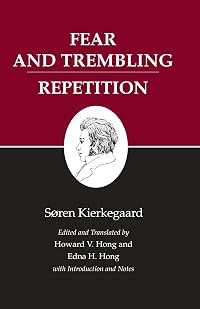
Fear and Trembling/Repetition : Kierkegaard's Writings, Vol. 6
by Søren Kierkegaard
On This Page
Description
Presented here in a new translation, with a historical introduction by the translators, Fear and Trembling and Repetition are the most poetic and personal of Søren Kierkegaard's pseudonymous writings. Published in 1843 and written under the names Johannes de Silentio and Constantine Constantius, respectively, the books demonstrate Kierkegaard's transmutation of the personal into the lyrically religious. Each work uses as a point of departure Kierkegaard's breaking of his engagement to show more Regine Olsen--his sacrifice of "that single individual." From this beginning Fear and Trembling becomes an exploration of the faith that transcends the ethical, as in Abraham's willingness to sacrifice his son Isaac at God's command. This faith, which persists in the face of the absurd, is rewarded finally by the return of all that the faithful one is willing to sacrifice. Repetition discusses the most profound implications of unity of personhood and of identity within change, beginning with the ironic story of a young poet who cannot fulfill the ethical claims of his engagement because of the possible consequences of his marriage. The poet finally despairs of repetition (renewal) in the ethical sphere, as does his advisor and friend Constantius in the aesthetic sphere. The book ends with Constantius' intimation of a third kind of repetition--in the religious sphere. show lessTags
Recommendations













Member Reviews
For those believing that God can resolves all of our ethical questionings (since our moral supposedly stemmed from Him) Kierkegaard is here throwing a brick in the wall.
Genesis. Chapter 22. Here is one of the supposedly most famous passage from the Bible, the one where Abraham is asked by God to sacrifice his son, Isaac. An angel will rescue the child, but how disconcerting is such story! God, asking a father, to murder his own child, simply to prove his faith...
For the philosopher, deeply Christian, it's a passage that raised serious questions. Abraham is presented as a role model, but was he? What to make of a man who wouldn't have hesitated to sacrifice his son? Should we follow his example, and abide to faith 'blindly'? These show more questions tortured him, and, he delves upon them in here.
The thing is, he was baffled by the many paradoxes contained in such a story. A sacrifice, first and foremost, is about giving something away to obtain something else. Yet, Abraham is here sacrificing his own child for no certain reward. Is Abraham a murderer? How would an average person react in his position? Would we blindly obey God and kill a child -*our* child? Or would we have ask God to take his life Himself, or, even, to take *our* life instead? And Isaac? What did he thought afterward about a father who had been ready to kill him at such a whim? What did he thought afterward of a God that demanded his death by murder? Yes, he survived... but here was a child who had a knife put under his throat! The whole gesture is also questionable: what differentiate here Abraham from a pagan king who, for example, sacrifices his own child too, but to save his people from a famine? The pagan, at least, do so out of concern for others (he is an individual negating his own feelings to serve his community); in the case of Abraham, it was purely selfish, as the purpose was just to prove his personal faith... And how such selfishness can, yet, be presented as being the more exemplary? And what about murder? If you should not kill, then why such command should be abolished? Because God demanded it? But what about personal responsibility? And can faith gives the right to do anything, even a cruel, horrible deed, even an irrational deed, simply because 'it's God's will'?
Kierkegaard had an answer to it all. For him -again, deeply Christian- Abraham wasn't a killer but a knight of the faith; and, as such, his deed was admirable precisely because he renounced to serve others but himself only, as per God's command in that particular situation. As an atheist, of course, I find that twist in reasoning too convenient to be a rational explanation (but, then again, it's not about being rational but faithful...). Yet, here is a must-read: if his answer is merely wishy-washy, his questions, nevertheless, are highly relevant. show less
Genesis. Chapter 22. Here is one of the supposedly most famous passage from the Bible, the one where Abraham is asked by God to sacrifice his son, Isaac. An angel will rescue the child, but how disconcerting is such story! God, asking a father, to murder his own child, simply to prove his faith...
For the philosopher, deeply Christian, it's a passage that raised serious questions. Abraham is presented as a role model, but was he? What to make of a man who wouldn't have hesitated to sacrifice his son? Should we follow his example, and abide to faith 'blindly'? These show more questions tortured him, and, he delves upon them in here.
The thing is, he was baffled by the many paradoxes contained in such a story. A sacrifice, first and foremost, is about giving something away to obtain something else. Yet, Abraham is here sacrificing his own child for no certain reward. Is Abraham a murderer? How would an average person react in his position? Would we blindly obey God and kill a child -*our* child? Or would we have ask God to take his life Himself, or, even, to take *our* life instead? And Isaac? What did he thought afterward about a father who had been ready to kill him at such a whim? What did he thought afterward of a God that demanded his death by murder? Yes, he survived... but here was a child who had a knife put under his throat! The whole gesture is also questionable: what differentiate here Abraham from a pagan king who, for example, sacrifices his own child too, but to save his people from a famine? The pagan, at least, do so out of concern for others (he is an individual negating his own feelings to serve his community); in the case of Abraham, it was purely selfish, as the purpose was just to prove his personal faith... And how such selfishness can, yet, be presented as being the more exemplary? And what about murder? If you should not kill, then why such command should be abolished? Because God demanded it? But what about personal responsibility? And can faith gives the right to do anything, even a cruel, horrible deed, even an irrational deed, simply because 'it's God's will'?
Kierkegaard had an answer to it all. For him -again, deeply Christian- Abraham wasn't a killer but a knight of the faith; and, as such, his deed was admirable precisely because he renounced to serve others but himself only, as per God's command in that particular situation. As an atheist, of course, I find that twist in reasoning too convenient to be a rational explanation (but, then again, it's not about being rational but faithful...). Yet, here is a must-read: if his answer is merely wishy-washy, his questions, nevertheless, are highly relevant. show less
Fear and Trembling is probably Kierkegaard's clearest and most vivid interpretation of faith, seen through the story of Abraham and Isaac. God has asked Abraham, who with his wife Sarah has waited and prayed for a son for 70 years, to sacrifice that son. Abraham obeys, but it is the tension within Abraham, the tension between ethical duty and the requirements of faith, that Kierkegaard focuses on. Faith emerges as what allows the individual to transcend the life of just anyone, the "universal", through an absolutely individual relationship with God.
Abraham's anguish is the anguish of a loving father, for whom the ethical duty of a father is inviolable. But his God demands it. Abraham doesn't simply obey -- in his actions, he must show more reconcile the irreconcilable. The victory of Abraham's faith is his resolution to carry out God's command, fully and intentionally preparing to give up Isaac, while at the same believing, by "virtue of the absurd", that Isaac will be returned to him, that he will lose Isaac and also regain him.
For Kierkegaard, this faith is the elevation of the individual, in the individual's own relationship to God, above the universal, the demands of secular, ethical life. In another essay, The Present Age, Kierkegaard complains that faith has become secularized in the church, in which faith is the duty of everyone, to be fulfilled by all in the same way. To him, this is a lowering of faith to something within the universal, what is demanded of everyone and explicable as the duty of man per se.
In faith, by contrast, the "individual is higher than the universal" in a way that is incomprehensible philosophically, precisely because the duty of the individual cannot be universalized and explained in the common terms of reason. Faith is a relationship between a particular individual and God. What God requires of Abraham, He requires of no one else -- it arises out of Abraham's individual, particular relationship to God, and only Abraham can understand it. In that relationship, Abraham is elevated above the universal, above the life of everyone and anyone, beyond the ethical and into the properly religious.
Kierkegaard's opponents here are both the common religious institutions of his own time and the dominant philosophy of Hegel. Hegel's system includes religion and faith, but religion is subsumed under the more complete and adequate philosophical knowledge and realization of "the absolute". For Hegel the universal is higher than the individual, and the individual's duty is to find his place in the universal -- to act in accordance with universal duty, what is required of everyone -- and to make that universal real in the political and civic life of a modern state. Much of the 19th century birth of existentialism, both religious and non-religious, comes in response to that requirement of the universal.
Kierkegaard's treatment of the individual in Fear and Trembling expands his much more abstract account of despair in The Sickness Unto Death, where religious faith per se, or faith specifically in the Christian God, seems at times separable from the abstract requirements of faith. Could we interpret him in a more secular way, as talking not just about religious faith but about meaningfulness in life altogether? There are passages in others of his writings, e.g., The Present Age, that suggest that what is missing in modern life is the condition of meaningfulness in life altogether -- the leveling of everyone's life into a kind of anyone's life (what goes as "das Man" in Heidegger or "the herd" in Nietzsche). And the abstract formulations from The Sickness Unto Death may seem only to require the self to relate itself to itself through an "other", not through God.
But I don't think that's what Kierkegaard means here -- the "other" seems necessarily to be God, in that only God can do what a god can do -- realize the absurd, the apparently impossible. This is why he is talking about "faith" and not "meaningfulness" (or why, if he is in fact also talking about "meaningfulness," he must believe that meaningfulness is really only possible through faith).
This newer edition and translation of Fear and Trembling is published with Repetition, a work completed and published at about the same time. (An earlier edition had published Fear and Trembling together with The Sickness Unto Death, tying the two accounts of despair and faith together).
This is my first reading of Repetition, and I can't really trust what I think about it -- Kierkegaard is very hard to understand in a first reading. But what I see is a kind of tightly focused evolution of the "exception" that appears also in Either/Or and provides the first glimpse of the individuality that flourishes in faith. The "young man" in Repetition becomes, through his relationship with "the girl", a "poet" -- not a "knight of faith" at all, but someone who was been tested by the ethical -- by the prospect of marriage -- and emerged as the "exception". The exception is an exception to the universal, the possibility of the individual who is higher than the universal, what the "knight of faith" realizes.
What's also interesting in Repetition is the cast of characters -- the pseudonymous author (Constantin Constantius, who sounds like the voice of Kierkegaard and places the story in the perspective of Kierkegaard's thought), the "young man" (who parallels Kierkegaard himself in his relationship with Regine Olsen), and "the girl" (parallel to Regine). Kierkegaard often splits himself into characters in order to find both the reflective and active aspects of the aesthetic, ethical, and religious lives he depicts, and Regine is an almost constant muse. show less
Abraham's anguish is the anguish of a loving father, for whom the ethical duty of a father is inviolable. But his God demands it. Abraham doesn't simply obey -- in his actions, he must show more reconcile the irreconcilable. The victory of Abraham's faith is his resolution to carry out God's command, fully and intentionally preparing to give up Isaac, while at the same believing, by "virtue of the absurd", that Isaac will be returned to him, that he will lose Isaac and also regain him.
For Kierkegaard, this faith is the elevation of the individual, in the individual's own relationship to God, above the universal, the demands of secular, ethical life. In another essay, The Present Age, Kierkegaard complains that faith has become secularized in the church, in which faith is the duty of everyone, to be fulfilled by all in the same way. To him, this is a lowering of faith to something within the universal, what is demanded of everyone and explicable as the duty of man per se.
In faith, by contrast, the "individual is higher than the universal" in a way that is incomprehensible philosophically, precisely because the duty of the individual cannot be universalized and explained in the common terms of reason. Faith is a relationship between a particular individual and God. What God requires of Abraham, He requires of no one else -- it arises out of Abraham's individual, particular relationship to God, and only Abraham can understand it. In that relationship, Abraham is elevated above the universal, above the life of everyone and anyone, beyond the ethical and into the properly religious.
Kierkegaard's opponents here are both the common religious institutions of his own time and the dominant philosophy of Hegel. Hegel's system includes religion and faith, but religion is subsumed under the more complete and adequate philosophical knowledge and realization of "the absolute". For Hegel the universal is higher than the individual, and the individual's duty is to find his place in the universal -- to act in accordance with universal duty, what is required of everyone -- and to make that universal real in the political and civic life of a modern state. Much of the 19th century birth of existentialism, both religious and non-religious, comes in response to that requirement of the universal.
Kierkegaard's treatment of the individual in Fear and Trembling expands his much more abstract account of despair in The Sickness Unto Death, where religious faith per se, or faith specifically in the Christian God, seems at times separable from the abstract requirements of faith. Could we interpret him in a more secular way, as talking not just about religious faith but about meaningfulness in life altogether? There are passages in others of his writings, e.g., The Present Age, that suggest that what is missing in modern life is the condition of meaningfulness in life altogether -- the leveling of everyone's life into a kind of anyone's life (what goes as "das Man" in Heidegger or "the herd" in Nietzsche). And the abstract formulations from The Sickness Unto Death may seem only to require the self to relate itself to itself through an "other", not through God.
But I don't think that's what Kierkegaard means here -- the "other" seems necessarily to be God, in that only God can do what a god can do -- realize the absurd, the apparently impossible. This is why he is talking about "faith" and not "meaningfulness" (or why, if he is in fact also talking about "meaningfulness," he must believe that meaningfulness is really only possible through faith).
This newer edition and translation of Fear and Trembling is published with Repetition, a work completed and published at about the same time. (An earlier edition had published Fear and Trembling together with The Sickness Unto Death, tying the two accounts of despair and faith together).
This is my first reading of Repetition, and I can't really trust what I think about it -- Kierkegaard is very hard to understand in a first reading. But what I see is a kind of tightly focused evolution of the "exception" that appears also in Either/Or and provides the first glimpse of the individuality that flourishes in faith. The "young man" in Repetition becomes, through his relationship with "the girl", a "poet" -- not a "knight of faith" at all, but someone who was been tested by the ethical -- by the prospect of marriage -- and emerged as the "exception". The exception is an exception to the universal, the possibility of the individual who is higher than the universal, what the "knight of faith" realizes.
What's also interesting in Repetition is the cast of characters -- the pseudonymous author (Constantin Constantius, who sounds like the voice of Kierkegaard and places the story in the perspective of Kierkegaard's thought), the "young man" (who parallels Kierkegaard himself in his relationship with Regine Olsen), and "the girl" (parallel to Regine). Kierkegaard often splits himself into characters in order to find both the reflective and active aspects of the aesthetic, ethical, and religious lives he depicts, and Regine is an almost constant muse. show less
"...continue to work out your salvation with fear and trembling." (Philippians 2:12)
Kierkegaard published Fear and Trembling in 1843 under the pen name of Johannes de Silentio, or John the Silent. He attempts to gain an understanding of the anxiety of faith through the biblical story of Abraham, who was instructed by God to offer up his only son as a sacrifice. Kierkegaard first explores the moment of choice; Abraham can choose to carry out the command or simply disregard it. In the end, Abraham chooses to embark on the long journey to the land of Moriah, where God will reveal to Abraham the mountain on which he is to sacrifice Isaac. Kierkegaard then explores Abraham's isolation; because he does not tell anyone, including Isaac, why he show more is going to Moriah, he suffers alone. Kierkegaard conceives Abraham as the type of person who lives within hope of the external, as contrasted with the person who lives in the inner reflection of memory. He speaks of Abraham's 'infinite resignation' as the last stage of the process towards faith. Abraham became a "knight of faith"; he surrendered everything in the hope that his faith in God would achieve something more universal than his earthly possessions and endeavors ever could.
Kierkegaard explores three problems concerned with this circumstance:
1. The choice to kill Isaac is an ethical decision. Kierkegaard asks, "Is there a teleological suspension of the ethical?" Does Abraham's obedience to God's command transcend ethics? Does a command from God that involves murder override one's ethical principles, which may derive from God's will? Kierkegaard concludes, against Hegel's ethical philosophy which he considers through this exploration, that the ethical must be suspended in favor of the universal. Only in this way can one become a true knight of faith.
2. The murder in this case is a religious sacrifice. In this way, Kierkegaard views the choice as a matter of spirituality. He asks, "Is there an absolute duty to God?" Must one obey God's will no matter what the circumstance or cost? Does the universal always transcend the individual? Can the individual ever become the universal? Kierkegaard explores the paradox inherent in this conflict: The act of resignation is not a true matter of faith itself, but one of acquiring 'eternal consciousness', which is love for God, love for the universal. This act of resignation does not require faith, but to transcend the eternal consciousness one must have faith. If one does not experience the fear and trembling that is necessarily involved in a true leap of faith, one can never become a true knight of faith.
3. Abraham concealed his intentions from everyone, including his wife, who is the mother of Isaac, and his son, who is to be sacrificed. Can this be ethically justified? Kierkegaard concludes that Abraham was both wrong and right; wrong according to ethics, which is a finite system of conduct, but right according to the Absolute, which is a matter of infinity, of transcendence of possibility and spiritual development. God stops Abraham from going through with the sacrifice just as he raises the knife, because at that point intention carried more weight than result. God knew that Abraham had faith, and that was the meaning behind the command. God wanted to see if Abraham had the faith to go through with such a horrible action commanded of him by the universal. When Abraham raises the knife in the intention of performing the sacrifice, he has proven his faith. There is no need to go through with it at that point, because Abraham's faith had already been confirmed.
Kierkegaard examines the ethical implications of faith in this biblical narrative with great emotive power. It is an immersive reading experience revealing new dimensions of thought with each encounter.
Repetition was originally published in 1843 under the pseudonym Constantin Constantius. It is an experimental exploration into the possibilities of repetition, including an analysis of his psychological patient "Young Man" who has changed his mind about marrying a girl with whom he is engaged. Kierkegaard/Constantius seems to be intellectually amusing himself while toying with the patience and philosophical assumptions of his readers. It is almost subconsciously humorous, although not quite as amusing to read as it probably was for the writer to compose. show less
Kierkegaard published Fear and Trembling in 1843 under the pen name of Johannes de Silentio, or John the Silent. He attempts to gain an understanding of the anxiety of faith through the biblical story of Abraham, who was instructed by God to offer up his only son as a sacrifice. Kierkegaard first explores the moment of choice; Abraham can choose to carry out the command or simply disregard it. In the end, Abraham chooses to embark on the long journey to the land of Moriah, where God will reveal to Abraham the mountain on which he is to sacrifice Isaac. Kierkegaard then explores Abraham's isolation; because he does not tell anyone, including Isaac, why he show more is going to Moriah, he suffers alone. Kierkegaard conceives Abraham as the type of person who lives within hope of the external, as contrasted with the person who lives in the inner reflection of memory. He speaks of Abraham's 'infinite resignation' as the last stage of the process towards faith. Abraham became a "knight of faith"; he surrendered everything in the hope that his faith in God would achieve something more universal than his earthly possessions and endeavors ever could.
Kierkegaard explores three problems concerned with this circumstance:
1. The choice to kill Isaac is an ethical decision. Kierkegaard asks, "Is there a teleological suspension of the ethical?" Does Abraham's obedience to God's command transcend ethics? Does a command from God that involves murder override one's ethical principles, which may derive from God's will? Kierkegaard concludes, against Hegel's ethical philosophy which he considers through this exploration, that the ethical must be suspended in favor of the universal. Only in this way can one become a true knight of faith.
2. The murder in this case is a religious sacrifice. In this way, Kierkegaard views the choice as a matter of spirituality. He asks, "Is there an absolute duty to God?" Must one obey God's will no matter what the circumstance or cost? Does the universal always transcend the individual? Can the individual ever become the universal? Kierkegaard explores the paradox inherent in this conflict: The act of resignation is not a true matter of faith itself, but one of acquiring 'eternal consciousness', which is love for God, love for the universal. This act of resignation does not require faith, but to transcend the eternal consciousness one must have faith. If one does not experience the fear and trembling that is necessarily involved in a true leap of faith, one can never become a true knight of faith.
3. Abraham concealed his intentions from everyone, including his wife, who is the mother of Isaac, and his son, who is to be sacrificed. Can this be ethically justified? Kierkegaard concludes that Abraham was both wrong and right; wrong according to ethics, which is a finite system of conduct, but right according to the Absolute, which is a matter of infinity, of transcendence of possibility and spiritual development. God stops Abraham from going through with the sacrifice just as he raises the knife, because at that point intention carried more weight than result. God knew that Abraham had faith, and that was the meaning behind the command. God wanted to see if Abraham had the faith to go through with such a horrible action commanded of him by the universal. When Abraham raises the knife in the intention of performing the sacrifice, he has proven his faith. There is no need to go through with it at that point, because Abraham's faith had already been confirmed.
Kierkegaard examines the ethical implications of faith in this biblical narrative with great emotive power. It is an immersive reading experience revealing new dimensions of thought with each encounter.
Repetition was originally published in 1843 under the pseudonym Constantin Constantius. It is an experimental exploration into the possibilities of repetition, including an analysis of his psychological patient "Young Man" who has changed his mind about marrying a girl with whom he is engaged. Kierkegaard/Constantius seems to be intellectually amusing himself while toying with the patience and philosophical assumptions of his readers. It is almost subconsciously humorous, although not quite as amusing to read as it probably was for the writer to compose. show less
Read Repetition again after 20-plus years. I think the humor/snark in Kierkegaard is all the more evident as I age. Some thoughts about it are featured in this essay: https://zwieblein.bearblog.dev/over-and-over-mortality-brings-me-home/.
100 KIE 5
Ratings
Members
- Recently Added By
Lists

Existentialism
90 works; 11 members
Author Information

627+ Works 33,074 Members
Born in Copenhagen, Denmark, Søren Kierkegaard was the son of a wealthy middle-class merchant. He lived all his life on his inheritance, using it to finance his literary career. He studied theology at the University of Copenhagen, completing a master's thesis in 1841 on the topic of irony in Socrates. At about this time, he became engaged to a show more woman he loved, but he broke the engagement when he decided that God had destined him not to marry. The years 1841 to 1846 were a period of intense literary activity for Kierkegaard, in which he produced his "authorship," a series of writings of varying forms published under a series of fantastic pseudonyms. Parallel to these, he wrote a series of shorter Edifying Discourses, quasi-sermons published under his own name. As he later interpreted it in the posthumously published Point of View for My Work as an Author, the authorship was a systematic attempt to raise the question of what it means to be a Christian. Kierkegaard was persuaded that in his time people took the meaning of the Christian life for granted, allowing all kinds of worldly and pagan ways of thinking and living to pass for Christian. He applied this analysis especially to the speculative philosophy of German idealism. After 1846, Kierkegaard continued to write, publishing most works under his own name. Within Denmark he was isolated and often despised, a man whose writings had little impact in his own day or for a long time afterward. They were translated into German early in the twentieth century and have had an enormous influence since then, on both Christian theology and the existentialist tradition in philosophy. (Bowker Author Biography) show less
Some Editions
Series
Belongs to Publisher Series
Common Knowledge
- Original title
- Frygt og Bæven; Gjentagelsen
- Original publication date
- 1843
Classifications
- Genres
- Philosophy, Religion & Spirituality, Nonfiction, General Nonfiction
- DDC/MDS
- 201 — Religion The Bible & Christianity Religious mythology, general classes of religion, interreligious relations and attitudes, social theology
- LCC
- BR100 .K52 — Philosophy, Psychology and Religion Christianity Christianity
- BISAC
Statistics
- Members
- 1,722
- Popularity
- 12,827
- Reviews
- 5
- Rating
- (4.08)
- Languages
- Danish, English, Spanish
- Media
- Paper, Ebook
- ISBNs
- 9
- ASINs
- 3