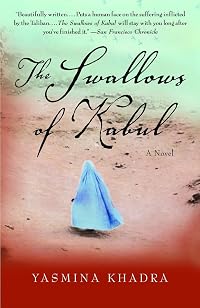
The Swallows of Kabul
by Yasmina Khadra
On This Page
Description
Set in Kabul under the rule of the Taliban, this extraordinary novel takes readers into the lives of two couples: Mohsen, who comes from a family of wealthy shopkeepers whom the Taliban has destroyed; Zunaira, his wife, exceedingly beautiful, who was once a brilliant teacher and is now no longer allowed to leave her home without an escort or covering her face. Intersecting their world is Atiq, a prison keeper, a man who has sincerely adopted the Taliban ideology and struggles to keep his show more faith, and his wife, Musarrat, who once rescued Atiq and is now dying of sickness and despair. Desperate, exhausted Mohsen wanders through Kabul when he is surrounded by a crowd about to stone an adulterous woman. Numbed by the hysterical atmosphere and drawn into their rage, he too throws stones at the face of the condemned woman buried up to her waist. With this gesture the lives of all four protagonists move toward their destinies. The Swallows of Kabul is a dazzling novel written with compassion and exquisite detail by one of the most lucid writers about the mentality of Islamic fundamentalists and the complexities of the Muslim world. Yasmina Khadra brings readers into the hot, dusty streets of Kabul and offers them an unflinching but compassionate insight into a society that violence and hypocrisy have brought to the edge of despair. show lessTags
Recommendations










Member Recommendations
juan1961 Muy interesante esta novela-reportaje de la periodista sueca que rebusca en las cenizas del mundo talibán
Member Reviews
Except for his wife's, Atiq hasn't seen a woman's face for many years. He's even learned to live without such sights. For him, woman are only ghosts, voiceless, charmless ghosts that pass practically unnoticed along the streets; flocks of infirm swallows—blue, yellow, often faded, several seasons behind—that make a mournful sound when they come into the proximity of men.
Yasmina Khadra is the pseudonym for Mohammed Moulessehoul, an Algerian army officer who writes about issues of fundamentalism and Islam. In [The Swallows of Kabul], he follows two couples in Kabul, Afghanistan over the period of a week or so. Atiq Shaukat is a jailor of woman who have been condemned of arbitrary crimes and sentenced to be executed the next day. His show more wife, Musarrat, is dying of an unnamed illness. Mohsen Ramat is a former professional, now destitute and unmoored, whose only remaining point of reference is his wife, the beautiful former magistrate, Zunaira. The Taliban overshadows all, dictating their public lives, and insidiously invading their personal relationships and inner selves. A damning condemnation of life under the Taliban made more poignant now that the Taliban is back in control after a period of personal freedom. show less
Yasmina Khadra is the pseudonym for Mohammed Moulessehoul, an Algerian army officer who writes about issues of fundamentalism and Islam. In [The Swallows of Kabul], he follows two couples in Kabul, Afghanistan over the period of a week or so. Atiq Shaukat is a jailor of woman who have been condemned of arbitrary crimes and sentenced to be executed the next day. His show more wife, Musarrat, is dying of an unnamed illness. Mohsen Ramat is a former professional, now destitute and unmoored, whose only remaining point of reference is his wife, the beautiful former magistrate, Zunaira. The Taliban overshadows all, dictating their public lives, and insidiously invading their personal relationships and inner selves. A damning condemnation of life under the Taliban made more poignant now that the Taliban is back in control after a period of personal freedom. show less
The Swallows of Kabul by Yasmina Khadra is a heart piercing book about two couples living under the Taliban in Kabul. In one chapter a husband begs his wife to go for a walk with him and she finally agrees, only to have a solider abuse her and physically force her husband to attend the mosque, leaving her to stand in the heat boiling under a burka. The helplessness of both of them to protect each other in the face of such random brutality haunts me. A second couple is struggling to survive her illness while the husband tries to succeed as a policeman in an arbitrary system. His work scenes contained the tension I feel when reading about working in royal courts where the king is a tyrant. The desperation of people trying to live under show more the radar in a Kabul ruled by the Taliban is gut wrenching. show less
GUT-PUNCH! (consider yourself warned.)
this is a harrowing novel, but absolutely beautifully written. it's a book everyone should read, particularly privileged people of the western world - those who enjoy freedom, democracy, personal rights and liberties. (not to sound scolding or finger-wagging. but...we really have no idea and get caught up in the smallest annoyances and pettinesses. things that are not life-and-death issues, yet are responded to as though they are.
if you are looking for a fictional, though believable, glimpse of lives in afghanistan under the taliban, read this novel.
this is a harrowing novel, but absolutely beautifully written. it's a book everyone should read, particularly privileged people of the western world - those who enjoy freedom, democracy, personal rights and liberties. (not to sound scolding or finger-wagging. but...we really have no idea and get caught up in the smallest annoyances and pettinesses. things that are not life-and-death issues, yet are responded to as though they are.
if you are looking for a fictional, though believable, glimpse of lives in afghanistan under the taliban, read this novel.
This short novel follows two couples in a Taliban-run Kabul. Mohsen comes from a family of wealthy shopkeepers; his wife, Zunaira, is a beautiful and brilliant teacher. The Taliban has destroyed their business and home, and Zunaira is no longer allowed to work. In contrast, we see Atiq, a jailer who has adopted the Taliban teachings, and his faithful and loving wife, Musarrat, who is dying of a debilitating illness.
Khadra writes with poetic detail about a city which the residents no longer recognize as their own. Frightened, confused, unsure, despairing, they struggle to make sense of a culture that is at once familiar and foreign:
“…hundreds of little kids … many barely old enough to walk, and all silently braiding the stout show more rope they’ll use, someday soon, to lynch their country’s last hope of salvation.”
“We had some privileges that we didn’t know how to defend, and so we forfeited them to the apprentice mullahs….It would be marvelous to stand in front of a shop window, leaning against you, or to sit at a table, just the two of us, chatting away or making fantastic plans. But that’s no longer possible.”
”How could he have believed that lovers’ promenades were still possible in a city that looks like a hospice for the moribund, overrun with repellent fanatics whose eyes stare out of the dark backward and abysm of time? How could he have lost sight of the horrors that punctuate daily life in a nation so contemptible its official language is the whip?”
“You’re happy, but you don’t know it. All your life, you’ve only listened to other people – your teachers and your holy men, your leaders and your demons – and they’ve spoken to you of nothing but wrongs and bitterness and war.”
There are some startlingly brutal images contained in this small volume. This is a tragedy, and things will not end well for all these characters. But I feel that I have gained a little understanding of the situation by reading this novel, and for that I’m grateful. show less
Khadra writes with poetic detail about a city which the residents no longer recognize as their own. Frightened, confused, unsure, despairing, they struggle to make sense of a culture that is at once familiar and foreign:
“…hundreds of little kids … many barely old enough to walk, and all silently braiding the stout show more rope they’ll use, someday soon, to lynch their country’s last hope of salvation.”
“We had some privileges that we didn’t know how to defend, and so we forfeited them to the apprentice mullahs….It would be marvelous to stand in front of a shop window, leaning against you, or to sit at a table, just the two of us, chatting away or making fantastic plans. But that’s no longer possible.”
”How could he have believed that lovers’ promenades were still possible in a city that looks like a hospice for the moribund, overrun with repellent fanatics whose eyes stare out of the dark backward and abysm of time? How could he have lost sight of the horrors that punctuate daily life in a nation so contemptible its official language is the whip?”
“You’re happy, but you don’t know it. All your life, you’ve only listened to other people – your teachers and your holy men, your leaders and your demons – and they’ve spoken to you of nothing but wrongs and bitterness and war.”
There are some startlingly brutal images contained in this small volume. This is a tragedy, and things will not end well for all these characters. But I feel that I have gained a little understanding of the situation by reading this novel, and for that I’m grateful. show less
A book of utter desolation -- beautifully written, but heartwrenching in the world it depicts. (And U have no cause to believe it is an untrue view. Kabul, once a city of so much wonder, has been utterly changed since wars and political climate there changes.) You cannot read this book, and then pretend to be unaware of what happens when a fundamentalist view takes over ordinary people.
The story roughly follows the lives of two couples in Kabul: Moshen and Zunaira, once part of the educated middle class, and Atiq and Misarrat, the jailer and his dying wife. Stories of love and devotion, but not played out like a fairy tale.
The writing is stark in places, luminescent in others. Though the book is small, it took me longer to read, because show more I had to ruminate on certain passages. This was not a quick, easy read. Some parts were chilling in the brutishness, others made my soul sing. (An example of the latter, which rang true to me: "Music is the true breath of life. We eat so we won't starve to death. We sing so we can hear ourselves live." (p 84). And at another point "Basically, being alive means keeping yourself ready for the sky to fall in on you at any time." (p118)
Legend has it that the women of Afghanistan were the most beautiful and beguiling in the world, and that the burqa was instituted to protect men from being driven mad by that beauty.
I read somewhere that the title refers to the flocks of women in burqas. show less
The story roughly follows the lives of two couples in Kabul: Moshen and Zunaira, once part of the educated middle class, and Atiq and Misarrat, the jailer and his dying wife. Stories of love and devotion, but not played out like a fairy tale.
The writing is stark in places, luminescent in others. Though the book is small, it took me longer to read, because show more I had to ruminate on certain passages. This was not a quick, easy read. Some parts were chilling in the brutishness, others made my soul sing. (An example of the latter, which rang true to me: "Music is the true breath of life. We eat so we won't starve to death. We sing so we can hear ourselves live." (p 84). And at another point "Basically, being alive means keeping yourself ready for the sky to fall in on you at any time." (p118)
Legend has it that the women of Afghanistan were the most beautiful and beguiling in the world, and that the burqa was instituted to protect men from being driven mad by that beauty.
I read somewhere that the title refers to the flocks of women in burqas. show less
Dans les ruines brûlantes de la cité millénaire de Kaboul, la mort rôde, un turban noir autour du crâne. Ici, une lapidation de femme, là des exécutions publiques, les Taliban veillent. La joie et le rire sont suspects. Atiq, le courageux moudjahid reconverti en geôlier, traîne sa peine. Le goût de vivre a également abandonné Mohsen, qui rêvait de modernité. Son épouse Zunaira, avocate, plus belle que le ciel, est désormais condamnée à l'obscurité grillagée du tchadri. Alors Kaboul, que la folie guette, n'a plus d'autres histoires à offrir que des tragédies. Le printemps des hirondelles semble bien loin encore...
This book is a 180 degree change of pace for me. It is the story of two couples, Atiq Shaukat and his wife Musarrat and Moshen Ramat and his wife Zunaira set in Kabul under the rule of the Taliban.
The setting is so foreign it could be science fiction. The poverty and misery of existence between the covers of this book is appalling. Moshen and Zunaira had good jobs and were respected educated people before the Russians invaded and the world turned upside down. Now we watch as their inner lives become distorted and destroyed.
Atiq is a jailer. He fought as a muhjadeen and after being wounded in the war was nursed for months by Musarrat who he then married. They were not able to have children and now she is dying from a disease that is show more beyond the skill of the doctors available. His soul is in constant torment and only she who truly loves him can see it.
The book is a depiction of misery and tragedy equal to the ancient Greeks. Everyone suffers in a primitive world run by the Taliban who are barely human and abuse everyone in the name of God.
There are brief moments of beauty such as Atiq watching the moon and remembering his father tell him where it came from.
Those brief moments only emphasize the bare, hot and dusty world that everyone moves in. To describe the story would give it away. Suffice it to say that the book ends in tragedy piled on tragedy until there is nothing.
It is not an uplifting book but this is life as it is lived by people I will never know. The people in the camps stayed alive so that there would be a memory of what happened. This book is that type of memory and it should be read if only to acknowledge how circumstances beyond our control can inflict ghastly misery on life's innocents. show less
The setting is so foreign it could be science fiction. The poverty and misery of existence between the covers of this book is appalling. Moshen and Zunaira had good jobs and were respected educated people before the Russians invaded and the world turned upside down. Now we watch as their inner lives become distorted and destroyed.
Atiq is a jailer. He fought as a muhjadeen and after being wounded in the war was nursed for months by Musarrat who he then married. They were not able to have children and now she is dying from a disease that is show more beyond the skill of the doctors available. His soul is in constant torment and only she who truly loves him can see it.
The book is a depiction of misery and tragedy equal to the ancient Greeks. Everyone suffers in a primitive world run by the Taliban who are barely human and abuse everyone in the name of God.
There are brief moments of beauty such as Atiq watching the moon and remembering his father tell him where it came from.
Those brief moments only emphasize the bare, hot and dusty world that everyone moves in. To describe the story would give it away. Suffice it to say that the book ends in tragedy piled on tragedy until there is nothing.
It is not an uplifting book but this is life as it is lived by people I will never know. The people in the camps stayed alive so that there would be a memory of what happened. This book is that type of memory and it should be read if only to acknowledge how circumstances beyond our control can inflict ghastly misery on life's innocents. show less
Members
- Recently Added By
Lists

International IMPAC Dublin Literary Award
179 works; 6 members

Literature in Translation
113 works; 5 members

Global Reads: Books Set in South Asia
30 works; 3 members

Afghanistan
42 works; 2 members

BBC World Book Club
267 works; 5 members

Donne e integralismo islamico
19 works; 1 member

World Book Club (BBC World Service)
212 works; 1 member
Author Information

56+ Works 5,094 Members
Some Editions
Awards and Honors
Common Knowledge
- Canonical title
- The Swallows of Kabul
- Original title
- Les Hirondelles de Kaboul
- Original publication date
- 2002 (original French) (original French)
- People/Characters
- Atiq; Musarrat; Moshen; Zunaira
- Important places
- Kabul, Afghanistan; Afghanistan
- First words
- Allá por el quinto infierno, un tornado abre los volantes de su vestido en la estrambótica danza de una bruja en trance; tanta histeria ni siquiera consigue sacudirle el polvo a las dos palmeras calcificadas que se alzan ha... (show all)cia el cielo como los brazos de un martirizado.
In the middle of nowhere, a whirlwind spins like a sorceress flinging out her skirts in a macabre dance; yet not even this hysteria serves to blow the dust off the calcified palm trees thrust against the sky like beseeching a... (show all)rms. - Last words
- (Click to show. Warning: May contain spoilers.)There follows a solemn, intense silence, and as he closes his eyes, Atiq entreats his ancestors that his sleep may be as unfathomable as the secrets of the night.
- Blurbers
- Coetzee, J.M.; Nafisi, Azar
- Original language
- French
Classifications
Statistics
- Members
- 1,426
- Popularity
- 16,628
- Reviews
- 70
- Rating
- (3.61)
- Languages
- 11 — Bulgarian, Danish, Dutch, English, Finnish, French, German, Italian, Lithuanian, Norwegian (Bokmål), Spanish
- Media
- Paper, Audiobook, Ebook
- ISBNs
- 38
- ASINs
- 9