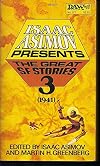
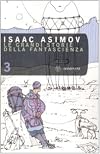
Isaac Asimov Presents : The Great SF Stories 3 (1941)
by Isaac Asimov (Editor, Preface), Martin H. Greenberg (Foreword)
On This Page
Tags
Recommendations







Member Reviews
We take a quantum leap forward with this volume in the series. An all-star group of authors make their first appearances: Alfred Bester, James Blish, Anthony Boucher, Frederic Brown, C. M. Kornbluth, and Eric Frank Russell (sadly underrated these days). And we've got at least two all-time classic stories -- Theodore Sturgeon's "Microcosmic God" and Isaac Asimov's "Nightfall."
As with the previous volume in the series, Asimov and Greenberg include their introductions to several Robert A. Heinlein stories that are not included because of rights issues. Of the four, I'm especially fond of "And He Built a Crooked House" and the indispensable time-travel story "By His Bootstraps."
Several themes pop up in multiple stories. There are robots show more from Asimov ("Liar!") and Russell ("Jay Score"), Adam-and-Eve tales from Robert Arthur ("Evolution's End") and Bester ("Adam and No Eve"), mischievious fantasy creatures from Boucher ("Snulbug") and the husband-wife team of Henry Kuttner & C. L. Moore ("A Gnome There Was"), and little shops that vanish after selling mysterious artifacts from Sturgeon ("Shottle Bop") and A. E. van Vogt ("The Seesaw"). That last story, by the way, is significantly better than van Vogt's earlier stories in this series; I didn't love it, but it's at least readable, and it's of historical significance as his first working through some of the ideas that will eventually become his novel "The Weapon Makers."
Highlights: "Microcosmic God" and "Nightfall" both hold up beautifully, and deserve their legendary reputations. "Snulbug" rings some clever variations on the idea of using tomorrow's newspaper to get rich. The delayed revelation at the end of "Jay Score" isn't entirely successful, but the main action is a lively disaster-in-space story. Brown's "Armageddon" is a very short tale -- a specialty of his -- that's all about its punchline, but it's a cute joke, and the getting there is nicely done.
On the down side, the general progress seen in most of the book leaves stories by Robert Arthur and Ross Rocklynne feeling even more old-fashioned than those authors felt in earlier volumes. Del Rey's "Hereafter, Inc." is a somewhat muddled "am I in heaven or hell?" story, and Kornbluth's "The Words of Guru" ends beautifully, but getting to those final paragraphs is a bit of a slog.
But the genre is changing quickly, and this is the first volume in the series that I might feel comfortable recommending to the average modern reader of SF. They'd still find it old fashioned, but the quality of the ideas and the writing has improved enough that it no longer feels archaic. show less
As with the previous volume in the series, Asimov and Greenberg include their introductions to several Robert A. Heinlein stories that are not included because of rights issues. Of the four, I'm especially fond of "And He Built a Crooked House" and the indispensable time-travel story "By His Bootstraps."
Several themes pop up in multiple stories. There are robots show more from Asimov ("Liar!") and Russell ("Jay Score"), Adam-and-Eve tales from Robert Arthur ("Evolution's End") and Bester ("Adam and No Eve"), mischievious fantasy creatures from Boucher ("Snulbug") and the husband-wife team of Henry Kuttner & C. L. Moore ("A Gnome There Was"), and little shops that vanish after selling mysterious artifacts from Sturgeon ("Shottle Bop") and A. E. van Vogt ("The Seesaw"). That last story, by the way, is significantly better than van Vogt's earlier stories in this series; I didn't love it, but it's at least readable, and it's of historical significance as his first working through some of the ideas that will eventually become his novel "The Weapon Makers."
Highlights: "Microcosmic God" and "Nightfall" both hold up beautifully, and deserve their legendary reputations. "Snulbug" rings some clever variations on the idea of using tomorrow's newspaper to get rich. The delayed revelation at the end of "Jay Score" isn't entirely successful, but the main action is a lively disaster-in-space story. Brown's "Armageddon" is a very short tale -- a specialty of his -- that's all about its punchline, but it's a cute joke, and the getting there is nicely done.
On the down side, the general progress seen in most of the book leaves stories by Robert Arthur and Ross Rocklynne feeling even more old-fashioned than those authors felt in earlier volumes. Del Rey's "Hereafter, Inc." is a somewhat muddled "am I in heaven or hell?" story, and Kornbluth's "The Words of Guru" ends beautifully, but getting to those final paragraphs is a bit of a slog.
But the genre is changing quickly, and this is the first volume in the series that I might feel comfortable recommending to the average modern reader of SF. They'd still find it old fashioned, but the quality of the ideas and the writing has improved enough that it no longer feels archaic. show less
Inasmuch as I am a born-again SF fan, it is only right, I think, to look backward as well as forward to find new material to read. You could hardly do better than looking toward a couple of old masters, Isaac Asimov and Martin Greenburg, for a collection of tales from the Golden Age. It must have been a mammoth project, 25 years of the best stories. I found this in a used book store somewhere, and figured it would be good reading. I tend to enjoy the older stories better than today's fare for some reason.
And what a collection! Even without the five entries of Robert Heinlein (left out for legal issues) it's still a pretty amazing grouping. Some of the more memorable would be Sturgeon's "Shottle Bop" and "Microcosmic God"…he was an show more incredible visionary and his stories cross genres with disdain. Astounding! Also hugely entertaining is the oh-so-short story "The Rocket of 1955" which packs so much tension in so few words that it left me breathless. I admit I went back and read it several times to savor the impact over and over.
The gem of the lot, though, is Asimov's own original version of "Nightfall". It was later expanded into a full length novel (with Robert Silverberg, if I'm not mistaken) and I reckon I'll have to read that too, but the basic premise is that a planet is, by its proximity to several stars, perpetually in daylight. Legends persist, however, of "stars" that will appear when darkness falls, and of how civilization crumbles. Your characters are based in an observatory, and are well aware that such an event is imminent, and what, if anything, they can do to prepare for it. Simple? Yes, and that's why it's so brilliant.
Stories like these are what made that age truly Golden, and Asimov and Greenburg are justly regarded as legends for having collected them all. Now I suppose it's up to me to locate the other 24 volumes…I have already located the 25th, publishing, sadly, just after Asimov's untimely death. If the present state of SF is built upon the Foundation (caps intended, if you've read Asimov, you understand) of the past, then the bedrock is solid, and it will endure. This stuff is timeless. My highest recommendation! show less
And what a collection! Even without the five entries of Robert Heinlein (left out for legal issues) it's still a pretty amazing grouping. Some of the more memorable would be Sturgeon's "Shottle Bop" and "Microcosmic God"…he was an show more incredible visionary and his stories cross genres with disdain. Astounding! Also hugely entertaining is the oh-so-short story "The Rocket of 1955" which packs so much tension in so few words that it left me breathless. I admit I went back and read it several times to savor the impact over and over.
The gem of the lot, though, is Asimov's own original version of "Nightfall". It was later expanded into a full length novel (with Robert Silverberg, if I'm not mistaken) and I reckon I'll have to read that too, but the basic premise is that a planet is, by its proximity to several stars, perpetually in daylight. Legends persist, however, of "stars" that will appear when darkness falls, and of how civilization crumbles. Your characters are based in an observatory, and are well aware that such an event is imminent, and what, if anything, they can do to prepare for it. Simple? Yes, and that's why it's so brilliant.
Stories like these are what made that age truly Golden, and Asimov and Greenburg are justly regarded as legends for having collected them all. Now I suppose it's up to me to locate the other 24 volumes…I have already located the 25th, publishing, sadly, just after Asimov's untimely death. If the present state of SF is built upon the Foundation (caps intended, if you've read Asimov, you understand) of the past, then the bedrock is solid, and it will endure. This stuff is timeless. My highest recommendation! show less
A cynic once said something like "The Golden Age of science fiction is about sixteen."
But they're wrong. 1941 was the heart of the Golden Age of science fiction. And this book is the proof.
If you've read a fair selection of classic SF, some of these stories will doubtless be familiar to you. Others probably won't be. In any case, these are some of the all-time classics of the genre.
Each story is introduced by Isaac Asimov, and he provides some interesting (and tantalizing) commentary. I can't help but wonder, for example, why he included Fredric Brown (one of my favorite writers) as an author whose personality was different from his stories (as opposed to authors who resembled their stories, some of whom he also lists). I was surprised show more and pleased to see that Asimov was, like me, a fan of Robert Arthur as well - although I have to admit that Arthur's story may be the weakest one in the book (though still worth reading!).
There are no stories by Robert Heinlein in this collection, apparently because he (or his wife) wouldn't allow it. Since this book was published in 1980 and Heinlein lived until 1988, Heinlein must have been aware of this. Nonetheless Asimov listed the titles of the Heinlein stories that he would have included in the book, and commented on them. I've often wondered about the relationship between Asimov and Heinlein, and this book only adds to the mystery.
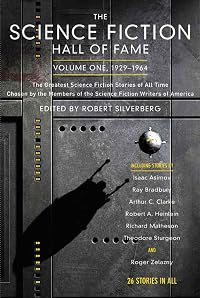
There's a tendency to think of old science fiction as being corny and simplistic. In fact, the best authors of the Golden Age had a sophistication and brilliance which is rarely seen in modern genre authors. If you're not familiar with Golden Age SF, I recommend The Science Fiction Hall of Fame, volume I, which is the definitive collection. But if you get a chance to buy any of The Great SF Stories, grab them! I know I will. show less
But they're wrong. 1941 was the heart of the Golden Age of science fiction. And this book is the proof.
If you've read a fair selection of classic SF, some of these stories will doubtless be familiar to you. Others probably won't be. In any case, these are some of the all-time classics of the genre.
Each story is introduced by Isaac Asimov, and he provides some interesting (and tantalizing) commentary. I can't help but wonder, for example, why he included Fredric Brown (one of my favorite writers) as an author whose personality was different from his stories (as opposed to authors who resembled their stories, some of whom he also lists). I was surprised show more and pleased to see that Asimov was, like me, a fan of Robert Arthur as well - although I have to admit that Arthur's story may be the weakest one in the book (though still worth reading!).
There are no stories by Robert Heinlein in this collection, apparently because he (or his wife) wouldn't allow it. Since this book was published in 1980 and Heinlein lived until 1988, Heinlein must have been aware of this. Nonetheless Asimov listed the titles of the Heinlein stories that he would have included in the book, and commented on them. I've often wondered about the relationship between Asimov and Heinlein, and this book only adds to the mystery.
There's a tendency to think of old science fiction as being corny and simplistic. In fact, the best authors of the Golden Age had a sophistication and brilliance which is rarely seen in modern genre authors. If you're not familiar with Golden Age SF, I recommend The Science Fiction Hall of Fame, volume I, which is the definitive collection. But if you get a chance to buy any of The Great SF Stories, grab them! I know I will. show less
Selección de relatos publicados en el año que da título al volumen. Ese año la ciencia ficción estadounidense produjo grandes cuentos de autores que empezaban a descollar entonces (Sturgeon, Heinlein, Asimov etc...) por lo que me parece un tomo imprescindible no sólo por su calidad (que es evidente) si no, también por su importancia como reflejo de la historia del género.
Maurice A. Hugi: Ratones mecánicos; C. M. Kornbluth: El cohete de 1955; Theodore Sturgeon: Dios microscópico; Eric Frank Russell: Jay Score; Robert A. Heinlein: Universo; Robert A. Heinlein: Solución insatisfactoria; C. M. Kornbluth: Las palabras de Guru; A. E. van Vogt: Visto y no visto; Alfred Bester: Adán sin Eva; Isaac Asimov: Anochecer; Henry Kuttner: Había una vez un gnomo; Robert A. Heinlein: Por sus propios medios; Anthony Boucher: Snulbug; Lester del Rey: Más allá, S. A.
Jul 13, 2019Spanish
Ratings
Members
- Recently Added By
Author Information

Isaac Asimov was born in Petrovichi, Russia, on January 2, 1920. His family emigrated to the United States in 1923 and settled in Brooklyn, New York, where they owned and operated a candy store. Asimov became a naturalized U.S. citizen at the age of eight. As a youngster he discovered his talent for writing, producing his first original fiction at show more the age of eleven. He went on to become one of the world's most prolific writers, publishing nearly 500 books in his lifetime. Asimov was not only a writer; he also was a biochemist and an educator. He studied chemistry at Columbia University, earning a B.S., M.A. and Ph.D. In 1951, Asimov accepted a position as an instructor of biochemistry at Boston University's School of Medicine even though he had no practical experience in the field. His exceptional intelligence enabled him to master new systems rapidly, and he soon became a successful and distinguished professor at Columbia and even co-authored a biochemistry textbook within a few years. Asimov won numerous awards and honors for his books and stories, and he is considered to be a leading writer of the Golden Age of science fiction. While he did not invent science fiction, he helped to legitimize it by adding the narrative structure that had been missing from the traditional science fiction books of the period. He also introduced several innovative concepts, including the thematic concern for technological progress and its impact on humanity. Asimov is probably best known for his Foundation series, which includes Foundation, Foundation and Empire, and Second Foundation. In 1966, this trilogy won the Hugo award for best all-time science fiction series. In 1983, Asimov wrote an additional Foundation novel, Foundation's Edge, which won the Hugo for best novel of that year. Asimov also wrote a series of robot books that included I, Robot, and eventually he tied the two series together. He won three additional Hugos, including one awarded posthumously for the best non-fiction book of 1995, I. Asimov. "Nightfall" was chosen the best science fiction story of all time by the Science Fiction Writers of America. In 1979, Asimov wrote his autobiography, In Memory Yet Green. He continued writing until just a few years before his death from heart and kidney failure on April 6, 1992. (Bowker Author Biography) show less

Martin Harry Greenberg (March 1, 1941 - June 25, 2011) was an American academic and speculative fiction anthologist. In all, he compiled 1,298 anthologies. He founded Tekno Books, a packager of more than 2000 published books; he was also a co-founder of the Sci-Fi Channel. Some of his anthologies included: Past Imperfect (2001), Once Upon a Galaxy show more (2002) and Sirius: The Dog Star (2004). (Bowker Author Biography) show less
All Editions
Some Editions
Series
Belongs to Publisher Series
Work Relationships
Is contained in
Contains
Common Knowledge
- Canonical title
- Isaac Asimov Presents : The Great SF Stories 3 (1941) (1941)
- Original title
- Isaac Asimov Presents : The Great SF Stories 3 (1941) (1941)
- Original publication date
- 1980
- Original language*
- Englisch
*Some information comes from Common Knowledge in other languages. Click "Edit" for more information.
Classifications
- Genres
- Science Fiction, Fiction and Literature
- DDC/MDS
- 808.83 — Literature & rhetoric Literature, rhetoric & criticism Rhetoric and collections of literary texts from more than two literatures Literature Collections Collections of fiction
- LCC
- PS648 .S3 .A82 — Language and Literature American literature American literature Collections of American literature Prose (General)
- BISAC
Statistics
- Members
- 164
- Popularity
- 199,842
- Reviews
- 5
- Rating
- (3.71)
- Languages
- English, German, Italian, Spanish
- Media
- Paper
- ISBNs
- 6
- ASINs
- 10