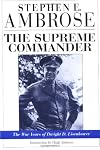
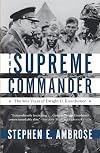
The Supreme Commander: The War Years of Dwight D. Eisenhower
by Stephen E. Ambrose
On This Page
Description
In this classic portrait of Dwight D. Eisenhower the soldier, bestselling historian Stephen E. Ambrose examines the Allied commander's leadership during World War II. nbsp; Ambrose brings Eisenhower's experience of the Second World War to life, showing in vivid detail how the general's skill as a diplomat and a military strategist contributed to Allied successes in North Africa and in Europe, and established him as one of the greatest military leaders in the world. Ambrose, then the show more Associate Editor of the General's official papers, analyzes Eisenhower's difficult military decisions and his often complicated relationships with powerful personalities like Churchill, de Gaulle, Roosevelt, and Patton. This is the definitive account of Eisenhower's evolution as a military leader--from its dramatic beginnings through his time at the top post of Allied command. show lessTags
Recommendations
















Member Reviews
Ambrose made his reputation on Eisenhower. This hagiography reveals the paradoxes of supreme command. While Eisenhower was vital to victory, he never commanded troops in battle. Nominally an apolitical soldier, his main task was maintaining the alliance against Nazi Germany, charting a middle course between domineering personalities like Montgomery, Patton, de Gaulle, and Churchill. The role of the supreme commander involved deciding when and where the battle should be fought, not when, and preparing the logistics, intelligence, and command structure necessary to win.
In one sense, Eisenhower's ultimate triumph is assured by history. He conquered. The road there was far from smooth. Eisenhower's first subcommander in North Africa, show more General Fredendall, proved incompetent. The Italian campaign turned into a grinding attritional slog that missed opportunities for comprehensive victory. Even in Western Europe, the final lines could have been drawn to better favor the Americans.
As a commander, Eisenhower's greatest virtues were his optimism and his universalism. The one thing he would not stand were subordinates who acted in national interest, rather than the interests of the alliance. Yet a good manager is self-effacing, and this book is best when it draws from British Chief of Staff General Alan Brooke' memoirs, which salaciously depicted Brooke's personal assessment of key figures.
50 years on, Ambrose's early work has become the core conventional wisdom of Eisenhower's historical legacy. You probably should read them. show less
In one sense, Eisenhower's ultimate triumph is assured by history. He conquered. The road there was far from smooth. Eisenhower's first subcommander in North Africa, show more General Fredendall, proved incompetent. The Italian campaign turned into a grinding attritional slog that missed opportunities for comprehensive victory. Even in Western Europe, the final lines could have been drawn to better favor the Americans.
As a commander, Eisenhower's greatest virtues were his optimism and his universalism. The one thing he would not stand were subordinates who acted in national interest, rather than the interests of the alliance. Yet a good manager is self-effacing, and this book is best when it draws from British Chief of Staff General Alan Brooke' memoirs, which salaciously depicted Brooke's personal assessment of key figures.
50 years on, Ambrose's early work has become the core conventional wisdom of Eisenhower's historical legacy. You probably should read them. show less
This was a hefty book I put off for a long time due to its size. I thought 670 pages had to be excessive as a biography of only one person over a period of only 4 years. It was. This was much more than merely a biography. This was an excellent birds-eye view of the entire portion of WWII during American involvement in North Africa, the Mediterranean, and Europe. It was a very good and often surprising account of the war.
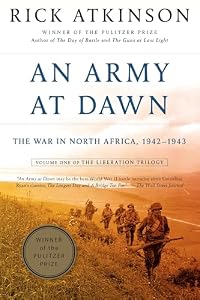
Although I enjoy war books that include perspectives of the soldiers in the line, too narrow a focus leaves out the context. Likewise, leaving out the experience of the people doing the fighting, the killing, the bleeding and the dying gives a less-than-complete story. Of course, at the end of the day, no single book--no show more number of books no matter how large--will transmit the totality of the thing. Still, the very best, I feel, transition from command to front-line and back. I think Rick Atkinson's Army at Dawn and Day of Battle are the best balanced I've read.
So this one did give a great view of the war, but it was very much, even sometimes disturbingly, separated and isolated from the horror and suffering of those giving their lives to execute the decisions made at AFHQ and SHAEF. It was often chilling but, I think, realistic, to see the depersonalized processes of directing war at high levels; the disconnect between that and the intimacy of the act of taking a man's life face-to-face was a real and unvarnished aspect of this account of war.
Ambrose was an advocate for Eisenhower throughout, but of course all biographers tend to err on the side of serving the subject as their "relationship" with their subject develops through their writing and research. Ambrose's bias is not bold or blind--he does acknowledge mistakes and counter-arguments--but it is at least visible enough that the reader does not have to wonder and guess at how the author's bias is entering his work. It's better that way sometimes, so that you can account for the bias rather than having to wonder.
All in all this was a very worthwhile read despite its length, and its length contributed to a very satisfying feeling at having finished it. I average about 3 to 7 days for a typical nonfiction war book 300-500 pages. This one took me 14 days exactly.
Overall, this was excellent, but not among the very very best. show less
Although I enjoy war books that include perspectives of the soldiers in the line, too narrow a focus leaves out the context. Likewise, leaving out the experience of the people doing the fighting, the killing, the bleeding and the dying gives a less-than-complete story. Of course, at the end of the day, no single book--no show more number of books no matter how large--will transmit the totality of the thing. Still, the very best, I feel, transition from command to front-line and back. I think Rick Atkinson's Army at Dawn and Day of Battle are the best balanced I've read.
So this one did give a great view of the war, but it was very much, even sometimes disturbingly, separated and isolated from the horror and suffering of those giving their lives to execute the decisions made at AFHQ and SHAEF. It was often chilling but, I think, realistic, to see the depersonalized processes of directing war at high levels; the disconnect between that and the intimacy of the act of taking a man's life face-to-face was a real and unvarnished aspect of this account of war.
Ambrose was an advocate for Eisenhower throughout, but of course all biographers tend to err on the side of serving the subject as their "relationship" with their subject develops through their writing and research. Ambrose's bias is not bold or blind--he does acknowledge mistakes and counter-arguments--but it is at least visible enough that the reader does not have to wonder and guess at how the author's bias is entering his work. It's better that way sometimes, so that you can account for the bias rather than having to wonder.
All in all this was a very worthwhile read despite its length, and its length contributed to a very satisfying feeling at having finished it. I average about 3 to 7 days for a typical nonfiction war book 300-500 pages. This one took me 14 days exactly.
Overall, this was excellent, but not among the very very best. show less
I love Ambrose works, and I like Ike, so for me well worth the heft of this book. Biased as some biographers tend to be, but not awkwardly so. Arguments and re-thinking is included in the text, although dare I say a little on the scarce or under thought side. Perhaps purposely.
A very enjoyable read, like I said above, it is a thick book 650+ pages. Even those people wishing to familiarize themselves with Dwight Eisenhower for the first time will enjoy this book and find it informative and pleasant. All the acronyms in the book could easily get confusing for people with no military or war history experience, so be sure to pay close attention and familiarize yourself with them early when they are introduced. Be sure to enjoy this book!
A very enjoyable read, like I said above, it is a thick book 650+ pages. Even those people wishing to familiarize themselves with Dwight Eisenhower for the first time will enjoy this book and find it informative and pleasant. All the acronyms in the book could easily get confusing for people with no military or war history experience, so be sure to pay close attention and familiarize yourself with them early when they are introduced. Be sure to enjoy this book!
Ratings
Members
- Recently Added By
Author Information

71+ Works 43,698 Members
Historian Stephen E. Ambrose grew up in Wisconsin and attended the University of Wisconsin and the University of Louisiana. Ambrose is considered to be one of the foremost historical scholars of recent times and has been a professor for over three decades. He is also the founder and president of the National D-Day Museum in New Orleans. His works show more include D-Day: June 6, 1944: The Climactic Battle of World War II, Citizen Soldiers: The U. S. Army from Normandy Beaches to the Bulge to the Surrender of Germany, June 7, 1944-May 7, 1945, Band of Brothers: E Company, 506th Regiment, 101st Airborne from Normandy to Hitler's Eagle's Nest and Undaunted Courage: Meriwether Lewis, Thomas Jefferson and the Opening of the American West. Abrose served historical consultant on the motion picture Saving Private Ryan. (Bowker Author Biography) show less
Common Knowledge
- People/Characters
- Dwight D. Eisenhower
- Important events
- World War II (1939 | 1945)
Classifications
- Genres
- History, Nonfiction, Biography & Memoir, General Nonfiction
- DDC/MDS
- 355.0092 — Society, Government, and Culture Public administration & military science The Military - Land, Air & Sea / Warfare Biography And History Biography
- LCC
- E836 .A83 — History of the United States United States Twentieth century Eisenhower's administrations, 1953-1961
- BISAC
Statistics
- Members
- 327
- Popularity
- 96,542
- Reviews
- 3
- Rating
- (4.16)
- Languages
- English
- Media
- Paper, Audiobook, Ebook
- ISBNs
- 7
- ASINs
- 7