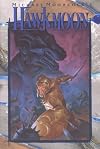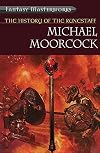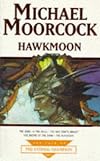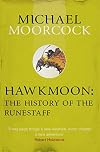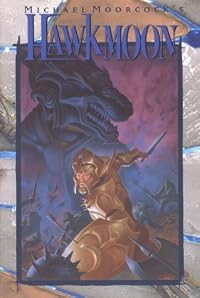
Hawkmoon: The History of the Runestaff
by Michael Moorcock
The History of the Runestaff (Collections and Selections — Omnibus 1-4), Hawkmoon (Collections and Selections — Omnibus 1-4), The Eternal Champion (Collections and Selections — Hawkmoon novels 1-4)
On This Page
Description
In Michael Moorcock's vast and imaginative multiverse, Law and Chaos wage war in a never-ending struggle over the fundamental rules of existence. Here, in this universe, Dorian Hawkmoon traverses a world of antique cities, scientific sorcery, and crystalline machines as he pulled unwillingly into a war that pits him against the ruthless and dominating armies of Granbretan.Tags
Recommendations




















Member Reviews
http://www.infinityplus.co.uk/nonfiction/runestaff.htm
This is a collection of Moorcock's series of four mid-1960s novels, The Jewel in the Skull, The Mad God's Amulet, The Sword of the Dawn and The Runestaff, originally collected in 1992 as Hawkmoon and now repackaged as part of Gollancz' Fantasy Masterworks series. It comes with a foreword to the 1992 edition by the author which aims to lower the reader's expectations: he modestly dismisses any idea that there is a "sophisticated political message in the book" and claims merely that "the books were written in the hope that they would help readers pass their time without feeling they were wasting it".
Well, it's a bit better than that. Our hero, Dorian Hawkmoon, Duke of Köln, is show more captured by the evil forces of Granbretan who implant a sinister jewel in his skull; he is liberated by the friendly rulers of Kamarg, and finds himself to be an incarnation of the Eternal Champion, charged with finding and implementing the will of the Runestaff, a magical item which preserves the Equilibrium (between what and what? Never mind). Along the way he has to collect two more magical items, the Red Amulet held by a mad god and the Sword of the Dawn, winning many battles in which he is (of course) hopelessly outnumbered, but helped by loyal companions, by mysterious allies who arrive in the nick of time, and by dissension in the ranks of his foes.
Moorcock chose a German hero and British villains, "consciously at odds with the jingoism of the day". The setting is basically our geographical Europe, Middle East and North America, augmented by a couple of long bridges to the Crimea and across the English Channel, but far in our future, centuries after the "death and malformation" brought by the "poisons" of the "Tragic Millennium". Swords and armour are popular; so are "baroque" flame-lances, ornithopters and magic. However electricity and feminism seem to be completely unknown.
Perhaps fantasy novels set in a recognisable version of our own familiar geography tend to be more successful than those which try inventing a completely new setting. Compare for instance the altered Spain of Guy Gavriel Kay's Al-Rassan, the converted France of Jacqueline Carey's Kushiel trilogy or indeed the Mediterranean of the Aeneid, with the forgettable, if carefully mapped, landscapes of Shannara, the Belgariad or Robert Jordan. There are exceptions of course -- Tolkien being the most obvious, though for him the culture and geography of Middle Earth were a lifetime's work. And there is another alternative, best exemplified these days by Terry Pratchett, of not working too hard on the specifics of the map in the hope that other elements of the story will carry the reader along and someone else may come along to try and draw the map for you. I guess that not thinking too hard about the landscape can free up the creative mind to work on other aspects.
What makes the History of the Runestaff a little more than just another quest narrative is that, unlike Frodo and Aeneas, who accept their destiny without doubting the motivations of those who have sent them, Hawkmoon actively tries to run away from his mission in order to get back to the woman he loves, and makes it clear that he is acting largely out of self-interest when inevitably compelled to return. In return, the quest itself turns out to be less about the ultimate defeat of evil and the victory of good than the restoration of the Equilibrium. Hawkmoon, much to his annoyance, is frequently ordered around by the mysterious Warrior in Jet and Gold and his brother who have a habit of appearing out of nowhere to deliver commands on behalf of the Runestaff, and one comes to sympathise with his frustration.
One aspect of the Hawkmoon stories which has dated badly over the last four decades is the treatment of women. The evil Baron Meliadus is served by naked girl-slaves because "he allowed no men into his tower for fear of treachery" -- a rather odd rationale which presupposes that women are incapable of treachery, especially when nude. The beautiful yet innocent Yisselda of Kamarg is saved from Meliadus' attempt at rape, and is thenceforth the object of his plots; she falls at one point into the hands of the Mad God of Ukrania, whose greatest perversion appears to be that he turns women into warriors (using of course the Amulet). Yisselda does achieve a small triumph for her gender in the end by fighting in the final battle, but in the meantime we have encountered the temptress Flana Mikosevaar of Granbretan, who isn't much interested in the male realm of politics as long as she can continue to play female games of seduction. I can't imagine a mature fantasy novelist -- a category which undoubtedly includes Michael Moorcock -- writing such stuff today.
However, apart from that it's well worth the ride. The four books mesh efficiently into a single extended narrative. Mutant flamingos, lost temples, hidden desert citadels, sanguinary pirate cults, brutal warriors, treacherous courtiers, chivalry and poetry, all helped this reader at least to pass the time without feeling I was wasting it. I did wince at a gratuitous throwaway reference towards the end to Churchill, Harold Wilson and the Beatles (and perhaps also J.G. Ballard and Jim Sallis?) as ancient deities of Granbretan, but I suppose the author is allowed his little bit of fun. This is the 36th in the series of Gollancz Fantasy Masterworks and a worthy addition to the bookshelf. show less
This is a collection of Moorcock's series of four mid-1960s novels, The Jewel in the Skull, The Mad God's Amulet, The Sword of the Dawn and The Runestaff, originally collected in 1992 as Hawkmoon and now repackaged as part of Gollancz' Fantasy Masterworks series. It comes with a foreword to the 1992 edition by the author which aims to lower the reader's expectations: he modestly dismisses any idea that there is a "sophisticated political message in the book" and claims merely that "the books were written in the hope that they would help readers pass their time without feeling they were wasting it".
Well, it's a bit better than that. Our hero, Dorian Hawkmoon, Duke of Köln, is show more captured by the evil forces of Granbretan who implant a sinister jewel in his skull; he is liberated by the friendly rulers of Kamarg, and finds himself to be an incarnation of the Eternal Champion, charged with finding and implementing the will of the Runestaff, a magical item which preserves the Equilibrium (between what and what? Never mind). Along the way he has to collect two more magical items, the Red Amulet held by a mad god and the Sword of the Dawn, winning many battles in which he is (of course) hopelessly outnumbered, but helped by loyal companions, by mysterious allies who arrive in the nick of time, and by dissension in the ranks of his foes.
Moorcock chose a German hero and British villains, "consciously at odds with the jingoism of the day". The setting is basically our geographical Europe, Middle East and North America, augmented by a couple of long bridges to the Crimea and across the English Channel, but far in our future, centuries after the "death and malformation" brought by the "poisons" of the "Tragic Millennium". Swords and armour are popular; so are "baroque" flame-lances, ornithopters and magic. However electricity and feminism seem to be completely unknown.
Perhaps fantasy novels set in a recognisable version of our own familiar geography tend to be more successful than those which try inventing a completely new setting. Compare for instance the altered Spain of Guy Gavriel Kay's Al-Rassan, the converted France of Jacqueline Carey's Kushiel trilogy or indeed the Mediterranean of the Aeneid, with the forgettable, if carefully mapped, landscapes of Shannara, the Belgariad or Robert Jordan. There are exceptions of course -- Tolkien being the most obvious, though for him the culture and geography of Middle Earth were a lifetime's work. And there is another alternative, best exemplified these days by Terry Pratchett, of not working too hard on the specifics of the map in the hope that other elements of the story will carry the reader along and someone else may come along to try and draw the map for you. I guess that not thinking too hard about the landscape can free up the creative mind to work on other aspects.
What makes the History of the Runestaff a little more than just another quest narrative is that, unlike Frodo and Aeneas, who accept their destiny without doubting the motivations of those who have sent them, Hawkmoon actively tries to run away from his mission in order to get back to the woman he loves, and makes it clear that he is acting largely out of self-interest when inevitably compelled to return. In return, the quest itself turns out to be less about the ultimate defeat of evil and the victory of good than the restoration of the Equilibrium. Hawkmoon, much to his annoyance, is frequently ordered around by the mysterious Warrior in Jet and Gold and his brother who have a habit of appearing out of nowhere to deliver commands on behalf of the Runestaff, and one comes to sympathise with his frustration.
One aspect of the Hawkmoon stories which has dated badly over the last four decades is the treatment of women. The evil Baron Meliadus is served by naked girl-slaves because "he allowed no men into his tower for fear of treachery" -- a rather odd rationale which presupposes that women are incapable of treachery, especially when nude. The beautiful yet innocent Yisselda of Kamarg is saved from Meliadus' attempt at rape, and is thenceforth the object of his plots; she falls at one point into the hands of the Mad God of Ukrania, whose greatest perversion appears to be that he turns women into warriors (using of course the Amulet). Yisselda does achieve a small triumph for her gender in the end by fighting in the final battle, but in the meantime we have encountered the temptress Flana Mikosevaar of Granbretan, who isn't much interested in the male realm of politics as long as she can continue to play female games of seduction. I can't imagine a mature fantasy novelist -- a category which undoubtedly includes Michael Moorcock -- writing such stuff today.
However, apart from that it's well worth the ride. The four books mesh efficiently into a single extended narrative. Mutant flamingos, lost temples, hidden desert citadels, sanguinary pirate cults, brutal warriors, treacherous courtiers, chivalry and poetry, all helped this reader at least to pass the time without feeling I was wasting it. I did wince at a gratuitous throwaway reference towards the end to Churchill, Harold Wilson and the Beatles (and perhaps also J.G. Ballard and Jim Sallis?) as ancient deities of Granbretan, but I suppose the author is allowed his little bit of fun. This is the 36th in the series of Gollancz Fantasy Masterworks and a worthy addition to the bookshelf. show less
Collected in one of the magnificent White Wolf editions, here is the omnibus edition of Hawkmoon's original adventures.
Not quite a comic book, but not truly novels, in this period of his career Moorcock's work reads almost like later-day serials in the best tradition of Doc Savage- quick action scenes, dramatic action, short interstitials between action- in short, action, action, action.
Notable in this incarnation of the Eternal Champion are- in addition to the Easter eggs of the history of Granbretan- the introduction of the quasi-character of the Empire of Granbretan, with its ornithopters, animal masks, military orders, immortal Emperor with a stolen voice- weirdly insane in a way that could only be envisaged in Mod London.
Hawkmoon show more himself, though one of the prominent incarnations in the canon, is a fairly straightforward character. The strength of this series surrounds Hawkmoon- D'Averc, the nihilistic romantic optimist, the larger-than-life Count Brass, the Warrior in Jet and Gold, and above all the Runestaff.
This series is a delight for the genre fan, but not for something with pretensions towards great literature nor looking to find fault with straightforward good and evil stories. show less
Not quite a comic book, but not truly novels, in this period of his career Moorcock's work reads almost like later-day serials in the best tradition of Doc Savage- quick action scenes, dramatic action, short interstitials between action- in short, action, action, action.
Notable in this incarnation of the Eternal Champion are- in addition to the Easter eggs of the history of Granbretan- the introduction of the quasi-character of the Empire of Granbretan, with its ornithopters, animal masks, military orders, immortal Emperor with a stolen voice- weirdly insane in a way that could only be envisaged in Mod London.
Hawkmoon show more himself, though one of the prominent incarnations in the canon, is a fairly straightforward character. The strength of this series surrounds Hawkmoon- D'Averc, the nihilistic romantic optimist, the larger-than-life Count Brass, the Warrior in Jet and Gold, and above all the Runestaff.
This series is a delight for the genre fan, but not for something with pretensions towards great literature nor looking to find fault with straightforward good and evil stories. show less
My reactions to reading this omnibus in 1999. Spoilers follow.
“Introduction” -- Short introduction where Moorcock says this series of four novels was written as popular entertainment with no profundity despite some allusions to “The Beatles or well-known politicians”.
The Jewel in the Skull -- I liked the character of Hawkmoon with his emotional detachment, near catatonia, awakening to become an enemy of Granbretan. I liked the Black Jewel threatening to eat his mind. I liked the villains Granbretan (Great Britain of a far future Europe), the emotional reserve and fascination for eccentric behavior, animals, and heraldry of the British is here satirized by the Orders who constantly go about in animal masks. I liked the knight in show more Jet and Gold.
The Mad Gods’ Amulet -- Hawkmoon’s fight against the Dark Empire continues with a classic fantasy ploy – the diversion to quest after a magical item necessary for the main fight/quest. (Though here, Hawkmoon is unaware, for a long time, that the Runestaff has manipulated him into seeking the Mad God’s Amulet. He thinks he’s pursuing his betrothed Yisselda.) I liked the Mad God and his minions (particularly the army of naked woman). I also liked the ambitious villain D’Averc with his affected illness. Hawkmoon warily accepts him as an ally. I also liked the ethereal city of Soryandum. I also liked the far future setting of this series with is antique cites and forgotten cities.
The Sword of the Dawn -- I liked this novel too with treacherous, dishonored playwright Elvereza Tazer who constantly alludes to his own work (which includes a play on “Chirshil and Adulf” – Churchill and Adolf. I liked the weird Flana who has a mind only for love – however, she can’t remain in love with the proudly mad, insane men of Granbretan and abandons (and sometimes kills) her lovers. I liked Meliadus growing dissatisfaction with the Emperor. I liked the trip to Wales (“Yel” here) and, particularly, the voyage to legendary America (Amerkh). My favorite bit was the Legion of the Dawn who seem to be supernatural Amerindian warriors called by the supernatural Sword of the Dawn.
The Runestaff -- The Hawkmoon saga closes with a finish much more upbeat than I expect from a manifestation of The Eternal Champion. (Not every incarnation comes to a bad end evidently, but I expect them to since I read the Elric books first.) Yes, Count Brass, Olabahn, and Flana’s love, D’Averc all die, but Hawkmoon lives as does his wife Yisselda. Flana, a woman whose ethereal love usually comes to a bad end for her lovers, seems rehabilitated by D’Averc’s love since he is not an insane decadent of the Granbretan variety, and seems about to reform the Granbretan empire to make it more humane. The style of this novel was different, in its short chapters, than the others in the series. I liked the ethereal inhabitants of Dnark (New York) One Jehamia Cohnahlias is the embodiment of the Runestaff. Since I haven’t read any of the Moorcock tales with Jerry Cornelius, I don’t know what to make of this. The Runestaff, in the reformed Granbretan Empire, seems to have struck a balance between Chaos and Law. (This is never mentioned as a goal, but is a theme of the Eternal Champion cycle.) I liked the fleet of Granbretan ships named after its Gods. I caught the names of the Beatles and many authors (most sf): Churchill, Brian Aldiss, and J. G. Ballard. The other names, if allusions to real people, I didn’t understand. show less
“Introduction” -- Short introduction where Moorcock says this series of four novels was written as popular entertainment with no profundity despite some allusions to “The Beatles or well-known politicians”.
The Jewel in the Skull -- I liked the character of Hawkmoon with his emotional detachment, near catatonia, awakening to become an enemy of Granbretan. I liked the Black Jewel threatening to eat his mind. I liked the villains Granbretan (Great Britain of a far future Europe), the emotional reserve and fascination for eccentric behavior, animals, and heraldry of the British is here satirized by the Orders who constantly go about in animal masks. I liked the knight in show more Jet and Gold.
The Mad Gods’ Amulet -- Hawkmoon’s fight against the Dark Empire continues with a classic fantasy ploy – the diversion to quest after a magical item necessary for the main fight/quest. (Though here, Hawkmoon is unaware, for a long time, that the Runestaff has manipulated him into seeking the Mad God’s Amulet. He thinks he’s pursuing his betrothed Yisselda.) I liked the Mad God and his minions (particularly the army of naked woman). I also liked the ambitious villain D’Averc with his affected illness. Hawkmoon warily accepts him as an ally. I also liked the ethereal city of Soryandum. I also liked the far future setting of this series with is antique cites and forgotten cities.
The Sword of the Dawn -- I liked this novel too with treacherous, dishonored playwright Elvereza Tazer who constantly alludes to his own work (which includes a play on “Chirshil and Adulf” – Churchill and Adolf. I liked the weird Flana who has a mind only for love – however, she can’t remain in love with the proudly mad, insane men of Granbretan and abandons (and sometimes kills) her lovers. I liked Meliadus growing dissatisfaction with the Emperor. I liked the trip to Wales (“Yel” here) and, particularly, the voyage to legendary America (Amerkh). My favorite bit was the Legion of the Dawn who seem to be supernatural Amerindian warriors called by the supernatural Sword of the Dawn.
The Runestaff -- The Hawkmoon saga closes with a finish much more upbeat than I expect from a manifestation of The Eternal Champion. (Not every incarnation comes to a bad end evidently, but I expect them to since I read the Elric books first.) Yes, Count Brass, Olabahn, and Flana’s love, D’Averc all die, but Hawkmoon lives as does his wife Yisselda. Flana, a woman whose ethereal love usually comes to a bad end for her lovers, seems rehabilitated by D’Averc’s love since he is not an insane decadent of the Granbretan variety, and seems about to reform the Granbretan empire to make it more humane. The style of this novel was different, in its short chapters, than the others in the series. I liked the ethereal inhabitants of Dnark (New York) One Jehamia Cohnahlias is the embodiment of the Runestaff. Since I haven’t read any of the Moorcock tales with Jerry Cornelius, I don’t know what to make of this. The Runestaff, in the reformed Granbretan Empire, seems to have struck a balance between Chaos and Law. (This is never mentioned as a goal, but is a theme of the Eternal Champion cycle.) I liked the fleet of Granbretan ships named after its Gods. I caught the names of the Beatles and many authors (most sf): Churchill, Brian Aldiss, and J. G. Ballard. The other names, if allusions to real people, I didn’t understand. show less
Great stuff. Moorcock's amazing imagination at its best. All of the High History of the Runestaff in one volume. In my opinion this is a tour de force in fantasy wrting. Back in a time when fantasy was a very niche genre, Moorcock produced these sweeping vistas of incredible, gothic settings and immensely exotic characters. Strange, brooding heroes, deliciously evil villains and, running through it all, the enigmatic Runestaff. I loved it when I first read it (too many decades ago) and I still do. What more can I say?
Moorcock once believed that if a story couldn't be finished in 24 hours, it wasn't worth writing. There are some of his complete novels that were written in this way, and some of them he wrote without looking back.
Hawkmoon is an omnibus released by White Wolf, featuring the four novels pertaining to Dorian Hawkmoon, a German Eternal Champion who must rise over the evil British empire.
Moorcock wrote each of these four novels in a very short time (I believe it was without even sleeping), and then spent the rest of the week asleep. And, wow, if I were to have done that, my end result would be nothing near the skill and mastery that Moorcock has given his work.
If you know nothing about Moorcock, then know this now: Each of his worlds is show more connected on some level through something he's called "the Multiverse," which is, effectively, the next abstraction above the universe. You will see characters that are familiar, and characters you know, and characters that seem like you've seen them before. This is how the multiverse works.
But not every story by Moorcock has to be a lesson in quantum mechanics. Sometimes, the story is just a story, and the characters are just these characters, and if they seem familiar, it's not necessary, in order to enjoy the story, to believe that they are a new incarnation of someone you've already met in one of his other books. Hawkmoon is one of those such books.
If you're familiar with Moorcock, but not with Dorian Hawkmoon, you may enjoy this Sword and Sorcery tale, complete with mighty artifacts, and a cursed black jewel, which may or may not be related to a certain black runesword. show less
Hawkmoon is an omnibus released by White Wolf, featuring the four novels pertaining to Dorian Hawkmoon, a German Eternal Champion who must rise over the evil British empire.
Moorcock wrote each of these four novels in a very short time (I believe it was without even sleeping), and then spent the rest of the week asleep. And, wow, if I were to have done that, my end result would be nothing near the skill and mastery that Moorcock has given his work.
If you know nothing about Moorcock, then know this now: Each of his worlds is show more connected on some level through something he's called "the Multiverse," which is, effectively, the next abstraction above the universe. You will see characters that are familiar, and characters you know, and characters that seem like you've seen them before. This is how the multiverse works.
But not every story by Moorcock has to be a lesson in quantum mechanics. Sometimes, the story is just a story, and the characters are just these characters, and if they seem familiar, it's not necessary, in order to enjoy the story, to believe that they are a new incarnation of someone you've already met in one of his other books. Hawkmoon is one of those such books.
If you're familiar with Moorcock, but not with Dorian Hawkmoon, you may enjoy this Sword and Sorcery tale, complete with mighty artifacts, and a cursed black jewel, which may or may not be related to a certain black runesword. show less
Hawkmoon was much more straightforward, and thus somewhat less interesting but also less annoying, than Von Bek or The Eternal Champion. It's a four-part novel, and very much a straight lone-hero-against-evil-empire adventure. One of the problems I have with Moorcock in general (at least in this multiverse) is that because the villain is always Chaos, it has zero subtlety - the villains rape and torture and perform hideous experiments because they're the villains, not out of any sort of serious characterization. That's less of a problem when the story is as twisty and multilayered as the Von Bek stories (although it's still a problem) but Hawkmoon has none of that and it just grew tedious.
That's not to say I totally dislike it - it's show more still a fast-moving adventure and it held my interest to the end - but it's pretty badly flawed as anything other that straight-up pulp fantasy.
(I'm plowing through the American collections very, very slowly, because Moorcock is not quite to my taste but he's interesting and also tremendously influential in the genre.) show less
That's not to say I totally dislike it - it's show more still a fast-moving adventure and it held my interest to the end - but it's pretty badly flawed as anything other that straight-up pulp fantasy.
(I'm plowing through the American collections very, very slowly, because Moorcock is not quite to my taste but he's interesting and also tremendously influential in the genre.) show less
Very well done post-apocalyptic Fantasy novel. Hawkmoon is a much better, and much more likable protagonist then Elric of Melnibone is.
Members
- Recently Added By
Lists

Fantasy Masterworks
66 works; 5 members

Books Read in 2007
323 works; 8 members
Author Information

Michael Moorcock, 1939 - Writer Michael Moorcock was born December 18, 1939 in Mitcham, Surrey, England. Moorcock was the editor of the juvenile magazine Tarzan Adventures from 1956-58, an editor and writer for the Sexton Blake Library and for comic strips and children's annuals from 1959-61, an editor and pamphleteer for Liberal Party in 1962, show more and became editor and publisher for the science fiction magazine New Worlds in 1964. He has worked as a singer-guitarist, has worked with the rock bands Hawkwind and Blue Oyster Cult and is a member of the rock band Michael Moorcock and the Deep Fix. Moorcock's writing covers a wide range of science fiction and fantasy genres. "The Chronicles of Castle Brass" was a sword and sorcery novel, and "Breakfast in the Ruins: A Novel of Inhumanity" uses the character Karl Glogauer as a different person in different times. Karl participates in the political violence of the French Revolution, the Paris Commune, and a Nazi concentration camp. Moorcock also wrote books and stories that featured the character Jerry Cornelius, who had no consistent character or appearance. "The Condition of Muzak" completed the initial Jerry Cornelius tetralogy and won Guardian Literary Prize in 1977. "Byzantium Endures" and "The Laughter of Carthage" are two autobiographical novels of the Russian emigre Colonel Pyat and were the closest Moorcock came to conventional literary fiction. "Byzantium Endures" focuses on the first twenty years of Pyat's life and tells of his role in the Russian revolution. Pyat survives the revolution and the subsequent civil war by working first for one side and then another. "The Laughter of Carthage" covers Pyat's life from 1920-1924 telling of his escape from Communist Russia and his travels in Europe and America. It's a sweeping picture of the world during the 1920's because it takes the character from living in Constantinople to Hollywood. Moorcock returned to the New Wave style in "Blood: A Southern Fantasy" (1994) and combined mainstream fiction with fantasy in "The Brothel of Rosenstrasse," which is set in the imaginary city of Mirenburg. MoorCock won the 1967 Nebula Award for Behold the Man and the 1979 World Fantasy Award for his novel, Gloriana. (Bowker Author Biography) show less
All Editions
Some Editions
Series

The History of the Runestaff
4 works (Collections and Selections — Omnibus 1-4)

Hawkmoon
7 works (Collections and Selections — Omnibus 1-4)

The Eternal Champion
63 works (Collections and Selections — Hawkmoon novels 1-4)
Belongs to Publisher Series
Work Relationships
Common Knowledge
- Canonical title
- Hawkmoon: The History of the Runestaff
- Original title
- The History of the Runestaff
- Alternate titles
- The History of the Runestaff; Hawkmoon
- Original publication date
- 1974 (omnibus) (omnibus); 1969 (The Jewel in the Skull) (The Jewel in the Skull); 1969 (The Mad God's Amulet) (The Mad God's Amulet); 1969 (The Sword of the Dawn) (The Sword of the Dawn); 1969 (The Runestaff) (The Runestaff)
- People/Characters
- Dorian Hawkmoon; Bowgentle; Count Brass; Kalan of Vitall; Baron Meliadus; Oladahn (show all 11); Yisselda; The Warrior in Jet and Gold; Taragorm; Huillam D'Averc; Flana Mikosevaar (Countess of Kanbery)
- Important places
- London, England, UK ('Londra'); Dark Empire of Granbretan; Camargue, Provence-Alpes-Côte d'Azur, France ('the Kamarg'); New Orleans, Louisiana, USA ('Narleen'); New York, New York, USA ('Dnark'); Baghdad, Iraq ('Soryandum') (show all 9); Hamadan, Iran; Aigues-Mortes, Gard, Occitanie, France; Wales, UK ('Yel')
- Original language
- English
- Disambiguation notice
- Contents:
The Jewel in the Skull
The Mad God's Amulet
The Sword of the Dawn
The Runestaff.
Note that a single-volume omnibus or a multi-volume box set are the same LibraryThing Work if they have the same co... (show all)ntents.
Classifications
Statistics
- Members
- 969
- Popularity
- 27,073
- Reviews
- 12
- Rating
- (3.68)
- Languages
- English, German, Russian
- Media
- Paper, Ebook
- ISBNs
- 15
- ASINs
- 6