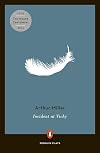
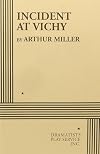
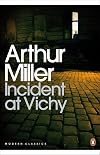
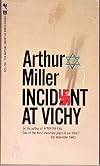
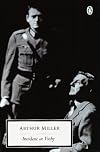
Incident at Vichy
by Arthur Miller
On This Page
Description
In Vichy, France in 1942 nine men are detained under a shadowy pretext. As the tension builds, the men are questioned--are they the sort of people whom the new Nazi regime considers "inferiors"?Tags
Recommendations

















Member Reviews
First staged in 1964, Arthur Miller’s Incident at Vichy remains as up to date as Donald Trump’s latest tweet. A group of men have been rounded up by the Vichy police soon after the German occupation begins. It’s early yet in World War II, and the vast majority of the French have no idea what’s already begun in Poland. The men — one Gypsy, a gentile nobleman and the rest Jews — nervously try to come up with excuses of why it’s only a papers check or a possible mistake. But one by one, they’re taking for interrogation.
Miller explores who has the right to life and what can an individual do when an entire society turns to authoritarianism. In the Age of Trump, Incident at Vichy is more relevant than ever. And L.A. Theatre show more Works’ dramatization makes the play really come alive. show less
Miller explores who has the right to life and what can an individual do when an entire society turns to authoritarianism. In the Age of Trump, Incident at Vichy is more relevant than ever. And L.A. Theatre show more Works’ dramatization makes the play really come alive. show less
I can’t see that we are ever so good that this play can be missed. At its most obvious it’s about what the Germans and their collaborators did to Jews and other inferior types. But even to extrapolate to present day is an inadequate representation of what it’s about.
It is a discussion of the human condition, its wretchedness, and the capacity of a few to rise above it. The amazing Hora, who did much to see to the shaping of the philosopher Raimond Gaita in Gaita’s younger years, believed that always
…even in the most appalling circumstances, there has been a handful of men and women who redeemed humanity by the nobility of their vision and their courage to be true to it. He told me this often. Each time he paused, visibly show more moved….
Hora and his migrant friends had lived through WWII in Europe. This play, Incident at Vichy, captures one of these moments. An Austrian aristocrat, caught in a roundup meant for not the likes of him, is sitting with Jews and a Gypsy waiting to be interrogated. We know that most, if not all of them, will never be let out. Whilst waiting, they share their various views on the nature of the Germans and whether it is really possible that the things they don’t want to mention are really happening. One says it’s a ridiculous idea, that the Germans would want to kill them. The Germans are rational. Of course they simply want them for labour. No biggie.
The Austrian prince passionately explains what is really happening. How could you be so stupid as to think it is about being rational. These people are nothing and they make themselves something by what they do, by what they believe in. What they are doing, the mass murdering of Jews is a moral principle.
At some point he gives a great speech where he too says the same as Hora. It is a tiny number of people who redeem the rest of us. Unfortunately I don’t have the play, or I’d share it. And then, at the end, and I didn’t see this coming though I should have, he turns out to be that man. He goes in second to last, reappears with a get out of gaol free card and gives it to the waiting French Jew so that he can escape. We assume that the prince will be killed in his place.
And all this made me remember a book I have, a book of little consequence I expect.
Rest here:
https://alittleteaalittlechat.wordpress.com/2017/06/23/incident-at-vichy-by-arth... show less
It is a discussion of the human condition, its wretchedness, and the capacity of a few to rise above it. The amazing Hora, who did much to see to the shaping of the philosopher Raimond Gaita in Gaita’s younger years, believed that always
…even in the most appalling circumstances, there has been a handful of men and women who redeemed humanity by the nobility of their vision and their courage to be true to it. He told me this often. Each time he paused, visibly show more moved….
Hora and his migrant friends had lived through WWII in Europe. This play, Incident at Vichy, captures one of these moments. An Austrian aristocrat, caught in a roundup meant for not the likes of him, is sitting with Jews and a Gypsy waiting to be interrogated. We know that most, if not all of them, will never be let out. Whilst waiting, they share their various views on the nature of the Germans and whether it is really possible that the things they don’t want to mention are really happening. One says it’s a ridiculous idea, that the Germans would want to kill them. The Germans are rational. Of course they simply want them for labour. No biggie.
The Austrian prince passionately explains what is really happening. How could you be so stupid as to think it is about being rational. These people are nothing and they make themselves something by what they do, by what they believe in. What they are doing, the mass murdering of Jews is a moral principle.
At some point he gives a great speech where he too says the same as Hora. It is a tiny number of people who redeem the rest of us. Unfortunately I don’t have the play, or I’d share it. And then, at the end, and I didn’t see this coming though I should have, he turns out to be that man. He goes in second to last, reappears with a get out of gaol free card and gives it to the waiting French Jew so that he can escape. We assume that the prince will be killed in his place.
And all this made me remember a book I have, a book of little consequence I expect.
Rest here:
https://alittleteaalittlechat.wordpress.com/2017/06/23/incident-at-vichy-by-arth... show less
I can’t see that we are ever so good that this play can be missed. At its most obvious it’s about what the Germans and their collaborators did to Jews and other inferior types. But even to extrapolate to present day is an inadequate representation of what it’s about.
It is a discussion of the human condition, its wretchedness, and the capacity of a few to rise above it. The amazing Hora, who did much to see to the shaping of the philosopher Raimond Gaita in Gaita’s younger years, believed that always
…even in the most appalling circumstances, there has been a handful of men and women who redeemed humanity by the nobility of their vision and their courage to be true to it. He told me this often. Each time he paused, visibly show more moved….
Hora and his migrant friends had lived through WWII in Europe. This play, Incident at Vichy, captures one of these moments. An Austrian aristocrat, caught in a roundup meant for not the likes of him, is sitting with Jews and a Gypsy waiting to be interrogated. We know that most, if not all of them, will never be let out. Whilst waiting, they share their various views on the nature of the Germans and whether it is really possible that the things they don’t want to mention are really happening. One says it’s a ridiculous idea, that the Germans would want to kill them. The Germans are rational. Of course they simply want them for labour. No biggie.
The Austrian prince passionately explains what is really happening. How could you be so stupid as to think it is about being rational. These people are nothing and they make themselves something by what they do, by what they believe in. What they are doing, the mass murdering of Jews is a moral principle.
At some point he gives a great speech where he too says the same as Hora. It is a tiny number of people who redeem the rest of us. Unfortunately I don’t have the play, or I’d share it. And then, at the end, and I didn’t see this coming though I should have, he turns out to be that man. He goes in second to last, reappears with a get out of gaol free card and gives it to the waiting French Jew so that he can escape. We assume that the prince will be killed in his place.
And all this made me remember a book I have, a book of little consequence I expect.
Rest here:
https://alittleteaalittlechat.wordpress.com/2017/06/23/incident-at-vichy-by-arth... show less
It is a discussion of the human condition, its wretchedness, and the capacity of a few to rise above it. The amazing Hora, who did much to see to the shaping of the philosopher Raimond Gaita in Gaita’s younger years, believed that always
…even in the most appalling circumstances, there has been a handful of men and women who redeemed humanity by the nobility of their vision and their courage to be true to it. He told me this often. Each time he paused, visibly show more moved….
Hora and his migrant friends had lived through WWII in Europe. This play, Incident at Vichy, captures one of these moments. An Austrian aristocrat, caught in a roundup meant for not the likes of him, is sitting with Jews and a Gypsy waiting to be interrogated. We know that most, if not all of them, will never be let out. Whilst waiting, they share their various views on the nature of the Germans and whether it is really possible that the things they don’t want to mention are really happening. One says it’s a ridiculous idea, that the Germans would want to kill them. The Germans are rational. Of course they simply want them for labour. No biggie.
The Austrian prince passionately explains what is really happening. How could you be so stupid as to think it is about being rational. These people are nothing and they make themselves something by what they do, by what they believe in. What they are doing, the mass murdering of Jews is a moral principle.
At some point he gives a great speech where he too says the same as Hora. It is a tiny number of people who redeem the rest of us. Unfortunately I don’t have the play, or I’d share it. And then, at the end, and I didn’t see this coming though I should have, he turns out to be that man. He goes in second to last, reappears with a get out of gaol free card and gives it to the waiting French Jew so that he can escape. We assume that the prince will be killed in his place.
And all this made me remember a book I have, a book of little consequence I expect.
Rest here:
https://alittleteaalittlechat.wordpress.com/2017/06/23/incident-at-vichy-by-arth... show less
I can’t see that we are ever so good that this play can be missed. At its most obvious it’s about what the Germans and their collaborators did to Jews and other inferior types. But even to extrapolate to present day is an inadequate representation of what it’s about.
It is a discussion of the human condition, its wretchedness, and the capacity of a few to rise above it. The amazing Hora, who did much to see to the shaping of the philosopher Raimond Gaita in Gaita’s younger years, believed that always
…even in the most appalling circumstances, there has been a handful of men and women who redeemed humanity by the nobility of their vision and their courage to be true to it. He told me this often. Each time he paused, visibly show more moved….
Hora and his migrant friends had lived through WWII in Europe. This play, Incident at Vichy, captures one of these moments. An Austrian aristocrat, caught in a roundup meant for not the likes of him, is sitting with Jews and a Gypsy waiting to be interrogated. We know that most, if not all of them, will never be let out. Whilst waiting, they share their various views on the nature of the Germans and whether it is really possible that the things they don’t want to mention are really happening. One says it’s a ridiculous idea, that the Germans would want to kill them. The Germans are rational. Of course they simply want them for labour. No biggie.
The Austrian prince passionately explains what is really happening. How could you be so stupid as to think it is about being rational. These people are nothing and they make themselves something by what they do, by what they believe in. What they are doing, the mass murdering of Jews is a moral principle.
At some point he gives a great speech where he too says the same as Hora. It is a tiny number of people who redeem the rest of us. Unfortunately I don’t have the play, or I’d share it. And then, at the end, and I didn’t see this coming though I should have, he turns out to be that man. He goes in second to last, reappears with a get out of gaol free card and gives it to the waiting French Jew so that he can escape. We assume that the prince will be killed in his place.
And all this made me remember a book I have, a book of little consequence I expect.
Rest here:
https://alittleteaalittlechat.wordpress.com/2017/06/23/incident-at-vichy-by-arth... show less
It is a discussion of the human condition, its wretchedness, and the capacity of a few to rise above it. The amazing Hora, who did much to see to the shaping of the philosopher Raimond Gaita in Gaita’s younger years, believed that always
…even in the most appalling circumstances, there has been a handful of men and women who redeemed humanity by the nobility of their vision and their courage to be true to it. He told me this often. Each time he paused, visibly show more moved….
Hora and his migrant friends had lived through WWII in Europe. This play, Incident at Vichy, captures one of these moments. An Austrian aristocrat, caught in a roundup meant for not the likes of him, is sitting with Jews and a Gypsy waiting to be interrogated. We know that most, if not all of them, will never be let out. Whilst waiting, they share their various views on the nature of the Germans and whether it is really possible that the things they don’t want to mention are really happening. One says it’s a ridiculous idea, that the Germans would want to kill them. The Germans are rational. Of course they simply want them for labour. No biggie.
The Austrian prince passionately explains what is really happening. How could you be so stupid as to think it is about being rational. These people are nothing and they make themselves something by what they do, by what they believe in. What they are doing, the mass murdering of Jews is a moral principle.
At some point he gives a great speech where he too says the same as Hora. It is a tiny number of people who redeem the rest of us. Unfortunately I don’t have the play, or I’d share it. And then, at the end, and I didn’t see this coming though I should have, he turns out to be that man. He goes in second to last, reappears with a get out of gaol free card and gives it to the waiting French Jew so that he can escape. We assume that the prince will be killed in his place.
And all this made me remember a book I have, a book of little consequence I expect.
Rest here:
https://alittleteaalittlechat.wordpress.com/2017/06/23/incident-at-vichy-by-arth... show less
The later works of Arthur Miller for the most part did not find the popular acceptance as Death Of A Salesman or The Crucible. Incident At Vichy examines the docility at which people just allowed themselves to be shipped like cattle to the camps. This is a one act play set in an interrogation room of a police station in Vichy where a form of independence was left the French as opposed to Occupied France which covered the Atlantic coast and the northeastern border. But it was reasoned that in order to keep even that the French had to cooperate with the Nazi version of ethnic cleansing. Several people have been seemingly hauled in at random and for the first part of the play they wonder why this cross section of France has been brought in show more for interrogation. They reason it out that most are Jews, there's a Communist in the group, a gypsy, a titled nobleman, and an actor who is Jewish, but is likely to be gay. An inability to conceive of such a vile action plus a general paralysis in terms of translating conception to action is at the heart of these people who rationalize the irrational.
Incident At Vichy is a thought provoking play which taps into a kaleidoscope of both rational thinking and hindsight emotion as we the audience know what a horrible fate is in store for these people. It ought to be shown. show less
Incident At Vichy is a thought provoking play which taps into a kaleidoscope of both rational thinking and hindsight emotion as we the audience know what a horrible fate is in store for these people. It ought to be shown. show less
Jan 24, 2026English (UK)
Ratings
Members
- Recently Added By
Lists

Next Plays / 2025
352 works; 1 member

Next Plays to Watch
50 works; 1 member

Plays I Saw / 2025
37 works; 1 member

Fav. Stage Plays / First-Time Watched / Listened To / 2025
20 works; 1 member
Author Information

194+ Works 43,229 Members
The son of a well-to-do New York Jewish family, Miller graduated from high school and then went to work in a warehouse. He was born on October 17, 1915, in Harlem, New York City. His plays have been called "political," but he considers the areas of literature and politics to be quite separate and has said, "The only sure and valid aim---speaking show more of art as a weapon---is the humanizing of man." The recurring theme of all his plays is the relationship between a man's identity and the image that society demands of him. After two years, he entered the University of Michigan, where he soon started writing plays. All My Sons (1947), a Broadway success that won the New York Drama Critics Circle Award in 1947, tells the story of a son, home from the war, who learns that his brother's death was due to defective airplane parts turned out by their profiteering father. Death of a Salesman (1949), Miller's experimental yet classical American tragedy, received both the Pulitzer Prize and the New York Drama Critics Circle Award in 1949. It is a poignant statement of a man facing himself and his failure. In The Crucible (1953), a play about bigotry in the Salem witchcraft trials of 1692, Miller brings into focus the social tragedy of a society gone mad, as well as the agony of a heroic individual. The play was generally considered to be a comment on the McCarthyism of its time. Miller himself appeared before the Congressional Un-American Activities Committee and steadfastly refused to involve his friends and associates when questioned about them. His screenplay for The Misfits (1961), from his short story, was written for his second wife, actress Marilyn Monroe (see Vol. 3); After the Fall (1964) has clear autobiographical overtones and involves the story of this ill-fated marriage as well as further dealing with Miller's experiences with McCarthyism. In the one-act Incident at Vichy (1964), a group of men are picked off the streets one morning during the Nazi occupation of France. The Price (1968) is a psychological drama concerning two brothers, one a police officer, one a wealthy surgeon, whose long-standing conflict is explored over the disposal of their father's furniture. The Creation of the World and Other Business (1973) is a retelling of the story of Genesis, attempted as a comedy. The American Clock (1980) explores the impact of the Depression on the nation and its individual citizens. Among Miller's most recent works is Danger: Memory! (1987), a study of two elderly friends. During the 1980s, almost all of Miller's plays were given major British revivals, and the playwright's work has been more popular in Britain than in the United States of late. Miller died of heart failure after a battle against cancer, pneumonia and congestive heart disease at his home in Roxbury, Connecticut. He was 89 years old. (Bowker Author Biography) Arthur Miller, American playwright, was born on October 17, 1915, in New York City. He earned an AB from the University of Michigan and began to write plays while still a student. He won the first of his many awards, the Avery Hopwood Prize of the University of Michigan, for his first play, Honors at Dawn. This was followed by many other award-winning plays. One of the best-known of these, Death of a Salesman, won the Pulitzer Prize in Drama in 1949 as well as a Drama Critics Circle Award; it continues to be one of the most frequently performed and adapted plays of this century. Some of his other titles include The Crucible, A View From the Bridge, The Misfits, After the Fall, and Vichy. Miller also wrote several travel pieces, including In Russia and Chinese Encounters (both in collaboration with his third wife, Ingeborg Morath); a novel, Focus; and the autobiography, Timebends: A Life. Arthur Miller was married to Mary Grace Slattery in 1940. They had two children and were divorced in 1952. In 1956, he married actress Marilyn Monroe and they divorced in 1961. He married Morath in 1962 and they have two children together. (Bowker Author Biography) show less
Work Relationships
Common Knowledge
- Canonical title
- Incident at Vichy
- Original publication date
- 1964
- People/Characters
- Lebeau; Bayard; Marchand; Monceau; Leduc; Von Berg (show all 8); Professor Hoffman; Ferrand
- Important events
- Holocaust
- Related movies
- Incident at Vichy (1973 | IMDb); Incident at Vichy (2016 | IMDb)
Classifications
Statistics
- Members
- 283
- Popularity
- 113,500
- Reviews
- 5
- Rating
- (3.75)
- Languages
- English, French, German, Spanish
- Media
- Paper, Audiobook, Ebook
- ISBNs
- 14
- UPCs
- 1
- ASINs
- 16