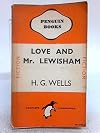
Love & Mr. Lewisham : The Story of a Very Young Couple
by H. G. Wells
On This Page
Description
One of H. G. Wells' first ventures outside of the science fiction realm, the novel Love and Mr. Lewisham was published in the year 1900. Seeking love rather than his youthful hopes of fame and glory, Mr. Lewisham moves to the city of London where he becomes convinced of the merits of socialism and gets involved in the spiritual charlatanism of that later Victorian era..
Tags
Recommendations


















Member Reviews
'Natural Selection – it follows . . . this way is happiness . . . must be. There can be no other.'
He sighed 'To last a lifetime, that is.
'And yet – it is almost as if Life had played me a trick – promised so much – given so little! . . .
'No! One must not look at it in that way! That will not do! That will not do.' (207)
This is the earliest (I think) of Wells's umpteen novels about scientists and marriage; it would be followed by Ann Veronica (1909) and Marriage [duh] (1911-12). Like a lot of Wells's literary novels, it tracks Wells's own life fairly well in some regards: George Edgar Lewisham is a science student trying to rise through the social classes and also maintain a marriage and also advance show more the cause of socialism. He also teaches, and he falls in love with a student's cousin, Ethel, and has to figure out how to balance the needs of a spouse with those of career. Also he's got a classmate who might be more his intellectual match than Ethel, and is clearly in love with him. So, similar ground to both Ann Veronica and Marriage (like the Traffords in Marriage, the Lewishams struggle even more because of the artificial requirements society places on them, like the need to by certain kinds of nice things and so on).
Wells will never be the world's most moving writer. He's good at depicting the interiority of aspiration in conflict with the exteriority of the social world, but it's always more of an intellectual feeling, as opposed to how Thomas Hardy or George Eliot can hit you in the gut with similar subject matter. But it is a pleasant read, and there's some black humour, and some familiar problems to anyone who's ever gone on the job market, and some real-feeling awkwardness of early married life. Lewisham is a scientist (or he would be one, anyway), and there's this weird subplot about Ethel's involvement in faking séances, though Wells kind of sews this all together with pointing out that there are different kinds of cheating, and different kinds of belief.
An interesting book, I thought it was less good and polished than Wells's later literary fiction, but it's still heart-rending in its own way. My quotation above comes from the final chapter, where Lewisham realizes that he and Ethel are having a baby, and thus his scientific and political career aspirations will probably go unfulfilled. I don't know what to make of it, and I like that I don't know. Lewisham is desperately trying to convince himself that it's a good thing to have a child, even though it appears nowhere in his "Schema," but even as he keeps repeating to himself that the coming child means "the end of empty dreams" (208), you can tell he doesn't believe it, and that he will miss those dreams. He tears up his Schema and thus his past self-- and something dies in him in that moment, and that's where the book ends. Lewisham has reproductive success, but nothing else. Evolution is the thing he studies, but its methods (i.e., reproduction) will foreclose his ability to study it, and destroy the other kinds of success he had valued. But at the same time, you (probably) want him to have a child because it's what so many of us value! So Lewisham's values conflict with yours even as you empathize with him, and they conflict with the world he seeks to change, but he never can. It's a quietly tragic end to a genial book. show less
He sighed 'To last a lifetime, that is.
'And yet – it is almost as if Life had played me a trick – promised so much – given so little! . . .
'No! One must not look at it in that way! That will not do! That will not do.' (207)
This is the earliest (I think) of Wells's umpteen novels about scientists and marriage; it would be followed by Ann Veronica (1909) and Marriage [duh] (1911-12). Like a lot of Wells's literary novels, it tracks Wells's own life fairly well in some regards: George Edgar Lewisham is a science student trying to rise through the social classes and also maintain a marriage and also advance show more the cause of socialism. He also teaches, and he falls in love with a student's cousin, Ethel, and has to figure out how to balance the needs of a spouse with those of career. Also he's got a classmate who might be more his intellectual match than Ethel, and is clearly in love with him. So, similar ground to both Ann Veronica and Marriage (like the Traffords in Marriage, the Lewishams struggle even more because of the artificial requirements society places on them, like the need to by certain kinds of nice things and so on).
Wells will never be the world's most moving writer. He's good at depicting the interiority of aspiration in conflict with the exteriority of the social world, but it's always more of an intellectual feeling, as opposed to how Thomas Hardy or George Eliot can hit you in the gut with similar subject matter. But it is a pleasant read, and there's some black humour, and some familiar problems to anyone who's ever gone on the job market, and some real-feeling awkwardness of early married life. Lewisham is a scientist (or he would be one, anyway), and there's this weird subplot about Ethel's involvement in faking séances, though Wells kind of sews this all together with pointing out that there are different kinds of cheating, and different kinds of belief.
An interesting book, I thought it was less good and polished than Wells's later literary fiction, but it's still heart-rending in its own way. My quotation above comes from the final chapter, where Lewisham realizes that he and Ethel are having a baby, and thus his scientific and political career aspirations will probably go unfulfilled. I don't know what to make of it, and I like that I don't know. Lewisham is desperately trying to convince himself that it's a good thing to have a child, even though it appears nowhere in his "Schema," but even as he keeps repeating to himself that the coming child means "the end of empty dreams" (208), you can tell he doesn't believe it, and that he will miss those dreams. He tears up his Schema and thus his past self-- and something dies in him in that moment, and that's where the book ends. Lewisham has reproductive success, but nothing else. Evolution is the thing he studies, but its methods (i.e., reproduction) will foreclose his ability to study it, and destroy the other kinds of success he had valued. But at the same time, you (probably) want him to have a child because it's what so many of us value! So Lewisham's values conflict with yours even as you empathize with him, and they conflict with the world he seeks to change, but he never can. It's a quietly tragic end to a genial book. show less
This is not a great novel but it is a very good novel. It is little more than a love story and must have seemed like a change of pace from Wells' previous books which had delighted the public with their imaginative fiction: [The Time Machine], [The Invisible Man] and [The war of the worlds]. There is no time travel, science fantasy, or aliens in [Love and Mr Lewisham] which is the story of a poor young man trying to make good through his efforts to educate himself. Wells uses his own life experiences to create a scenario that is both authentic and poignant, peopled with characters that would have resonated with his readers. It is very much a novel of it's time; set in the 1890's when a young man took substantial risks in meeting a girl show more to whom he had not been introduced. Mr Lewisham's meeting with Ethel Henderson and their subsequent unchaperoned walks, leads him having to sacrifice his position as an assistant teacher and later when he meets her again in different circumstances he must sacrifice his potential career for her.
When we meet Mr Lewisham at the start of the book he is a young man with a mission. His rigorous self imposed timetable is designed to fill all his waking hours with study and self improvement. He is already the proud owner of a number of certificates and he can look forward to possible scholarships to finance his further education. An accidental meeting with Ethel and his subsequent romantic infatuation with her takes him to areas of human feelings for which he is totally unprepared. The dialogue between the naïve diffident young man and the inexperienced Ethel is both naturally sure-footed and humorous without resorting to the clever-clever witticisms that authors of today may be tempted to employ. Wells never loses sight of the fact that this novel is told from Mr Lewisham's POV and his awareness grows as the novel develops. Ethel is sent away to Clapham in South West London and Mr Lewisham loses touch with her and it is a chance meeting at a séance that rekindles his passion. He is a little more mature now and is forging a way for himself at a London College, but love again stops him in his tracks as he struggles to come to terms with his situation which does not permit him to support Ethel and himself. His studies suffer again and he comes to realise he cannot have the career he dreamt of and Ethel as well. He again is forced to make a sacrifice but a life of poverty in a hostile world leads to problems with his relationship with Ethel and Wells once again shows his mastery of dialogue in the arguments and fighting between the two young lovers.
Wells seizes on the opportunity to introduce two issues that were of intense interest to him; by making Mr Lewisham a young socialist and an advocate of a scientific explanation for life's mysteries. There are heated debates on the advantages and disadvantages of a socialist society and Wells avoids preaching on the subject and leaves Mr Lewisham disillusioned of his earlier ideals at the end of the novel. The craze for séances and the use of mediums to get in touch with the spirit world also features, with the young Lewisham determined to expose the trickery, but later having to concede that much of it does very little actual harm. Mr Lewisham learns harsh lessons about the ways of the world, lessons which gradually make him a somewhat wiser man. H G Wells had himself learnt these lessons and while it would be inaccurate to say that Mr Lewisham represents Wells as a young man the author certainly uses all his knowledge to make Mr Lewisham a thoroughly believable character. He also does a good job with his two major female characters; Ethel and the studious Miss Heddingly.
This novel was a critical success for Wells and the reasons are obvious. This well crafted novel with its sincerity and character development shows how Wells was able to use his own life experiences to create a thoroughly satisfying read. It is pitched just right and although it might have seemed a little depressing at the time it rings true enough today. The novel has its limitations and perhaps seems more of a novella in length, but there is no denying the quality of the writing. A four star read show less
When we meet Mr Lewisham at the start of the book he is a young man with a mission. His rigorous self imposed timetable is designed to fill all his waking hours with study and self improvement. He is already the proud owner of a number of certificates and he can look forward to possible scholarships to finance his further education. An accidental meeting with Ethel and his subsequent romantic infatuation with her takes him to areas of human feelings for which he is totally unprepared. The dialogue between the naïve diffident young man and the inexperienced Ethel is both naturally sure-footed and humorous without resorting to the clever-clever witticisms that authors of today may be tempted to employ. Wells never loses sight of the fact that this novel is told from Mr Lewisham's POV and his awareness grows as the novel develops. Ethel is sent away to Clapham in South West London and Mr Lewisham loses touch with her and it is a chance meeting at a séance that rekindles his passion. He is a little more mature now and is forging a way for himself at a London College, but love again stops him in his tracks as he struggles to come to terms with his situation which does not permit him to support Ethel and himself. His studies suffer again and he comes to realise he cannot have the career he dreamt of and Ethel as well. He again is forced to make a sacrifice but a life of poverty in a hostile world leads to problems with his relationship with Ethel and Wells once again shows his mastery of dialogue in the arguments and fighting between the two young lovers.
Wells seizes on the opportunity to introduce two issues that were of intense interest to him; by making Mr Lewisham a young socialist and an advocate of a scientific explanation for life's mysteries. There are heated debates on the advantages and disadvantages of a socialist society and Wells avoids preaching on the subject and leaves Mr Lewisham disillusioned of his earlier ideals at the end of the novel. The craze for séances and the use of mediums to get in touch with the spirit world also features, with the young Lewisham determined to expose the trickery, but later having to concede that much of it does very little actual harm. Mr Lewisham learns harsh lessons about the ways of the world, lessons which gradually make him a somewhat wiser man. H G Wells had himself learnt these lessons and while it would be inaccurate to say that Mr Lewisham represents Wells as a young man the author certainly uses all his knowledge to make Mr Lewisham a thoroughly believable character. He also does a good job with his two major female characters; Ethel and the studious Miss Heddingly.
This novel was a critical success for Wells and the reasons are obvious. This well crafted novel with its sincerity and character development shows how Wells was able to use his own life experiences to create a thoroughly satisfying read. It is pitched just right and although it might have seemed a little depressing at the time it rings true enough today. The novel has its limitations and perhaps seems more of a novella in length, but there is no denying the quality of the writing. A four star read show less
Although this was a rapid departure from what I am used to with H.G Wells (mainly his science fiction) I was quite impressed at what this short novel has to offer. The writing is good, the story thorough and appealing, and the characters full of sentiment, regrets, hopes, and wishes. They are mixed all together in a palatable way and the story felt fluid all the way through. For those interested in H.G Wells, English literature, and novels like these I recommend it. You won't be disappointed.
4 stars.
4 stars.
This is a grim, tedious piece of work... It follows Mr. Lewisham through his young manhood, in which he has great ambitions and shows great promise. All of which is derailed when he falls in love with the rather common Ethel Henderson. This love must be a purely animal attraction because little else is offered to support the romance - Their courtship reads like a laundry list. Lewisham and Ethel are unmatched in ambition and intellect and yet, circumstances and desire lead them to marriage.
The marriage is kept somewhat secret from Lewisham's academic peers as it poses a threat to his scholarship. Unfortunately, Lewisham's romantic preoccupation does it's own dirty work and his grades rapidly decline, tossing out any chance of obtaining show more a challenging job with a decent salary. The money troubles and academic problems only fuel the already turbulent relations at home - Ethel and Lewisham bicker endlessly and find little that they like about each other after all.
In his desperation for intelligent debate, Lewisham rekindles his friendship with a female student, Alice. The friendship is perfectly innocent - No romantic moves are ever made. None the less, Ethel finds letters from Alice and demands that Lewisham give her up in what becomes the pivotal fight in the book - Which rages on for several chapters. After Lewisham finally storms from the apartment, he spends several more chapters on working the whole thing out in his own head. Lewisham decides that what's really important is that he loves Ethel with all his heart and it doesn't matter a whit that they don't have one single thing in common... He decides he must make amends to Ethel, cut his ties with Alice, give up all his ambitions and dreams, and generally resign himself to a common, tedious existence (with a girl he loves but will never be able to have a stimulating conversation with) in poverty.
End book.
Can you tell that I thought this was a colossal waste of time? I found the characters to be petulant and annoying. I just had to take it on faith that there was some chemical attraction going on because there was little else to support their romance. Lewisham's decision to devote himself to Ethel seemed to be pulled out of thin air and Wells' final paragraphs in the book left me looking for torn out pages.
I suppose I should appreciate that the book explores the unexplainable phenomenon of chemical attraction and the real life struggles one must face when one marries on that alone - No "happily ever after". I suppose I should, but it was such an unpleasant journey, I find myself unable to care enough to give it that much credit. And, in an extremely abstract and sanitized way, Wells does deal with the issue of infidelity - Perhaps that was the whole point of the piece? But then, so have other authors - Far more effectively - No points there, either.
Convince me I'm missing something really important here - I *want* to know if I'm missing something: http://agentxpndble.livejournal.com/113457.html show less
The marriage is kept somewhat secret from Lewisham's academic peers as it poses a threat to his scholarship. Unfortunately, Lewisham's romantic preoccupation does it's own dirty work and his grades rapidly decline, tossing out any chance of obtaining show more a challenging job with a decent salary. The money troubles and academic problems only fuel the already turbulent relations at home - Ethel and Lewisham bicker endlessly and find little that they like about each other after all.
In his desperation for intelligent debate, Lewisham rekindles his friendship with a female student, Alice. The friendship is perfectly innocent - No romantic moves are ever made. None the less, Ethel finds letters from Alice and demands that Lewisham give her up in what becomes the pivotal fight in the book - Which rages on for several chapters. After Lewisham finally storms from the apartment, he spends several more chapters on working the whole thing out in his own head. Lewisham decides that what's really important is that he loves Ethel with all his heart and it doesn't matter a whit that they don't have one single thing in common... He decides he must make amends to Ethel, cut his ties with Alice, give up all his ambitions and dreams, and generally resign himself to a common, tedious existence (with a girl he loves but will never be able to have a stimulating conversation with) in poverty.
End book.
Can you tell that I thought this was a colossal waste of time? I found the characters to be petulant and annoying. I just had to take it on faith that there was some chemical attraction going on because there was little else to support their romance. Lewisham's decision to devote himself to Ethel seemed to be pulled out of thin air and Wells' final paragraphs in the book left me looking for torn out pages.
I suppose I should appreciate that the book explores the unexplainable phenomenon of chemical attraction and the real life struggles one must face when one marries on that alone - No "happily ever after". I suppose I should, but it was such an unpleasant journey, I find myself unable to care enough to give it that much credit. And, in an extremely abstract and sanitized way, Wells does deal with the issue of infidelity - Perhaps that was the whole point of the piece? But then, so have other authors - Far more effectively - No points there, either.
Convince me I'm missing something really important here - I *want* to know if I'm missing something: http://agentxpndble.livejournal.com/113457.html show less
https://fromtheheartofeurope.eu/love-and-mr-lewisham-by-h-g-wells/
Another unexpectedly enjoyable Wells novel, a young man who finds that he has to make a choice between two women having already married one of them (not a situation that Wells himself was unfamiliar with), at the same time as dealing with embourgeoisement and the tension between ideals and reality. Quite short, totally credible, would probably make a terrible film.
Another unexpectedly enjoyable Wells novel, a young man who finds that he has to make a choice between two women having already married one of them (not a situation that Wells himself was unfamiliar with), at the same time as dealing with embourgeoisement and the tension between ideals and reality. Quite short, totally credible, would probably make a terrible film.
I liked this little known Wells very much. Such a sense of being poor in 1890s London.
Excellent story of a young scholar whose prospects are derailed by love and marriage.
Members
- Recently Added By
Lists

Trinity College Booklist (1951): Class Ten, English Literature
358 works; 5 members

For Further Reading: A List of 160 Novels from 15 Literatures
160 works; 4 members

Just Kids by Patti Smith
43 works; 1 member
Author Information

1,562+ Works 109,309 Members
H. G. Wells was born in Bromley, England on September 21, 1866. After a limited education, he was apprenticed to a draper, but soon found he wanted something more out of life. He read widely and got a position as a student assistant in a secondary school, eventually winning a scholarship to the Royal College of Science in South Kensington, where show more he studied biology. He graduated from London University in 1888 and became a science teacher. He also wrote for magazines. When his stories began to sell, he left teaching to write full time. He became an author best known for science fiction novels and comic novels. His science fiction novels include The Time Machine, The War of the Worlds, The Wonderful Visit, The Island of Doctor Moreau, The Invisible Man, The First Men in the Moon, and The Food of the Gods. His comic novels include Love and Mr. Lewisham, Kipps: The Story of a Simple Soul, The History of Mr. Polly, and Tono-Bungay. He also wrote several short story collections including The Stolen Bacillus, The Plattner Story, and Tales of Space and Time. He died on August 13, 1946 at the age of 79. (Bowker Author Biography) show less
Some Editions
Series
Belongs to Publisher Series
Work Relationships
Common Knowledge
- Canonical title
- Love and Mr. Lewisham; Love & Mr. Lewisham : The Story of a Very Young Couple
- Original title
- Love and Mr. Lewisham
- Original publication date
- 1900
- Important places
- Imperial College of Science, Technology and Medicine, London, England, UK
- Related movies
- Love and Mr Lewisham (1959 | IMDb); Love and Mr Lewisham (1972 | IMDb)
Classifications
Statistics
- Members
- 334
- Popularity
- 95,420
- Reviews
- 8
- Rating
- (3.62)
- Languages
- 5 — English, Estonian, French, Hungarian, Swedish
- Media
- Paper, Audiobook, Ebook
- ISBNs
- 65
- ASINs
- 27