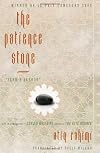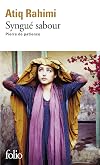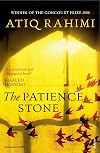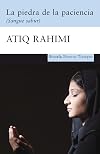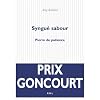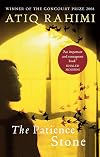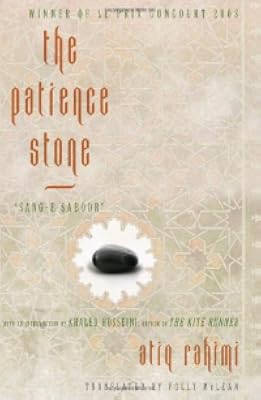
The Patience Stone
by Atiq Rahimi
On This Page
Description
In Persian folklore, Syngue Sabour is the name of a magical black stone, a patience stone, which absorbs the plight of those who confide in it. It is believed that the day it explodes, after having received too much hardship and pain, will be the day of the Apocalypse. But here, the Syngue Sabour is not a stone but rather a man lying brain-dead with a bullet lodged in his neck. His wife is with him, sitting by his side. But she resents him for having sacrificed her to the war, for never show more being able to resist the call to arms, for wanting to be a hero, and in the end, after all was said and done, for being incapacitated in a small skirmish. show lessTags
Recommendations


































Member Recommendations
Member Reviews
The Patience Stone is a story-poem about an unnamed Afghani woman (everywoman) who reveals her identity as a messenger of God. Like Mohammed, she fights off her fear of possession by demons to get to the more frightening but liberating personal truth within her. She learns by self-exploration, with the help of the Koran, that revelation is the foundation of Mohammed's teachings and the teachings of hundreds of thousands of other prophets across religions and across times who have spoken of the human spirit.
Rahimi presents the reader with a dilemma: How can a Muslim woman who is subjugated by patriarchal tribal Muslim law, identifies with her mother's submission to a morality of inferiority, and uses repression to create a degrading show more self regard learn the power of the revelation of her own truth? It is as simple as the recurring cycle of the lives of prophets. She must reject the tribal laws of the father, deny the false morality of the mother, and give up her own socially distorted self regard. The novel describes how she solves this dilemma.
The woman's husband, a casualty of jihad, gives her the opportunity to experience the wisdom of folklore concerning sang-e saboor, the patience stone. The fable describes a smooth black stone that absorbs the words, thoughts and emotions of a person describing her personal trials, pain, disappointments, guilt, denials of the body, hatred of war, helplessness, abandonment, and victimization. Absolute trust in the privileged acceptance by the stone is required. When the catharsis is complete and the stone has actively absorbed all, it explodes revealing to the person not just the name of God, but the truth of God. The woman's wounded husband is her sang-e saboor.
The novel also puts the reader in the position of the patience stone absorbing the confessions of the woman and allows us to reach a point of disintegration, allowing us to accept God's truth in her. This is not possible for tribal Muslim men who focus only on the soul, denying in themselves and in their women the sexual demands of the body. They can blindly fight a jihad without regard for the life of the body on earth. Women must try to live a soulless life of the body to create sons who can continue the propagation of the faith. They are impure unless they deny their own independent satisfactions and focus only on the performance of the man's ability to play his part in conception. This suppression is harmful because clues about the truth are given through the body.
We learn in the novel that it is through the integration of body and soul that revelation of truth occurs for Muslim women. This is the teaching of the Koran for all people, and it is not an authorization for the abuse of women by fathers and husbands. With this interpretation, comes the understanding that the body will out, repression is a denial of the teachings of Mohammed. It is not immoral to have bodily desires in addition and connected to desires of the soul. In speaking to the patience stone all utterances and thoughts are meaningful and relevant to truth.
I strongly recommend this short novel to all readers devoted to the inner life. It shows us that as with all prophets, the woman in the story teaches us to look within ourselves for the recurring themes of life and to discover the absolute truths of existence, to become instruments of God. Muslim women (and all people) must be free to speak, think, and experience their emotions without repression. We must have unconditional acceptance of an understanding God to reject the misconceptions taught to us in the past and find the path to enlightened identities. show less
Rahimi presents the reader with a dilemma: How can a Muslim woman who is subjugated by patriarchal tribal Muslim law, identifies with her mother's submission to a morality of inferiority, and uses repression to create a degrading show more self regard learn the power of the revelation of her own truth? It is as simple as the recurring cycle of the lives of prophets. She must reject the tribal laws of the father, deny the false morality of the mother, and give up her own socially distorted self regard. The novel describes how she solves this dilemma.
The woman's husband, a casualty of jihad, gives her the opportunity to experience the wisdom of folklore concerning sang-e saboor, the patience stone. The fable describes a smooth black stone that absorbs the words, thoughts and emotions of a person describing her personal trials, pain, disappointments, guilt, denials of the body, hatred of war, helplessness, abandonment, and victimization. Absolute trust in the privileged acceptance by the stone is required. When the catharsis is complete and the stone has actively absorbed all, it explodes revealing to the person not just the name of God, but the truth of God. The woman's wounded husband is her sang-e saboor.
The novel also puts the reader in the position of the patience stone absorbing the confessions of the woman and allows us to reach a point of disintegration, allowing us to accept God's truth in her. This is not possible for tribal Muslim men who focus only on the soul, denying in themselves and in their women the sexual demands of the body. They can blindly fight a jihad without regard for the life of the body on earth. Women must try to live a soulless life of the body to create sons who can continue the propagation of the faith. They are impure unless they deny their own independent satisfactions and focus only on the performance of the man's ability to play his part in conception. This suppression is harmful because clues about the truth are given through the body.
We learn in the novel that it is through the integration of body and soul that revelation of truth occurs for Muslim women. This is the teaching of the Koran for all people, and it is not an authorization for the abuse of women by fathers and husbands. With this interpretation, comes the understanding that the body will out, repression is a denial of the teachings of Mohammed. It is not immoral to have bodily desires in addition and connected to desires of the soul. In speaking to the patience stone all utterances and thoughts are meaningful and relevant to truth.
I strongly recommend this short novel to all readers devoted to the inner life. It shows us that as with all prophets, the woman in the story teaches us to look within ourselves for the recurring themes of life and to discover the absolute truths of existence, to become instruments of God. Muslim women (and all people) must be free to speak, think, and experience their emotions without repression. We must have unconditional acceptance of an understanding God to reject the misconceptions taught to us in the past and find the path to enlightened identities. show less
An unnamed woman attends to her husband in a room of their house somewhere in Afghanistan. He has been shot in the neck by a fellow fighter and is unconscious. Shells from tanks fall around their house and gunfire erupts even during a purported ceasefire. At first the woman is tender in her ministrations and prays continually for his deliverance. But as the days pass with no change in her husband, she begins to find relief in confessing all her secrets to him, as though he were the fabled patience stone, which according to Persian folklore absorbs all the speaker's grievances until it explodes, taking all the speaker's worries with it.
Although the writing is very sparse (some have likened it to a play script), the emotions evoked by the show more woman's revelations are complex and layered. Like many Afghani woman, her life has been subjugated to the strictures of her father, her husband, society, and religious politics. Her attempts to exert control over her life, even by giving voice to her feelings and thoughts, have met with violence, so she has learned to remain silent. It is only now, with her husband unconscious and hostage to her ministrations, does she feel free to reveal her innermost secrets. show less
Although the writing is very sparse (some have likened it to a play script), the emotions evoked by the show more woman's revelations are complex and layered. Like many Afghani woman, her life has been subjugated to the strictures of her father, her husband, society, and religious politics. Her attempts to exert control over her life, even by giving voice to her feelings and thoughts, have met with violence, so she has learned to remain silent. It is only now, with her husband unconscious and hostage to her ministrations, does she feel free to reveal her innermost secrets. show less
This is an appalling book. It's about a woman who nurses her husband, who is in a coma. He won't wake up, and that drives her to speak more and more candidly about her life. She reveals an entire dictionary of the mistreatment of women by Afghan men. In the course of the book she is also threatened with rape; she masturbates in front of him; she describes how she made her menstrual blood apear to be the blood from her hymen; she recounts the times she was beaten; she reveals he wouldn't let her kiss him; and in the end she talks about his infertility.
The book isn't appalling because of any of that. It's awful because it uses literature to tell those stories. People apparently read Rahimi to know about the situation of Afghan women. One show more reviewer on the back cover says "we know so little about the day-to-day life of people in Afghanistan..." But this isn't what literature should be. What kind of reader feels she needs to get her news about Afghanistan from novels and plays? What sense of literature do such readers have?
Then there's the question of the literary form. "The Patience Stone" is written as a stage play: it calls out, on every page, to the potential director or playwright, giving instructions. Everything takes place in one room. All sorts of artifices are arranged so that the action never needs to leave the room. Footsteps are heard dying away and approaching. A gun barrel comes through a window. A tank, offstage, shatters a window. What does any of that stage machinery have to do with the situation of women in Afghanistan? One reviewer on Amazon says the author "keeps the props simple": they're minimal, but unremitting, and all of them are clichés. The idea of the man who never moves, and the woman who soliloquizes, owes something to Beckett, but it owes nothing to any play written more recently than 1950. The staginess of "The Patience Stone" would be awkward and intrusive even if it didn't have to do with truths about Afghanistan. Staginess also explains some of the infelicities in the narration (this despite the fact that a number of reviewers think it is beautifully written). One reviewer on Amazon notes that "Rahimi uses a third-person point of view to keep us out of the protagonist's head and make her revelations to her husband more powerful (I think this was a smart decision). But in several passages, the narrator tries to intrude on her thoughts by interpreting her actions for the reader." That's a good example of the sort of artificial construction that Rahimi needed in order to sustain his implausible premise -- that the woman tells all her stories to the man, whom she thinks isn't listening. It's hard for me to imagine Rahimi's reasons for setting this entire novel as a one-scene play, especially given that he's working on a film adaptation. I can only think that he understands minimalist or absurdist theater as a kind of optimal expressive vehicle. But how could that be an adequate understanding of theater?
This book is an excellent example of the misuse of literature for the purpose of revealing truths about the world. There's hardly a worthier subject, or a less appropriate vehicle. show less
The book isn't appalling because of any of that. It's awful because it uses literature to tell those stories. People apparently read Rahimi to know about the situation of Afghan women. One show more reviewer on the back cover says "we know so little about the day-to-day life of people in Afghanistan..." But this isn't what literature should be. What kind of reader feels she needs to get her news about Afghanistan from novels and plays? What sense of literature do such readers have?
Then there's the question of the literary form. "The Patience Stone" is written as a stage play: it calls out, on every page, to the potential director or playwright, giving instructions. Everything takes place in one room. All sorts of artifices are arranged so that the action never needs to leave the room. Footsteps are heard dying away and approaching. A gun barrel comes through a window. A tank, offstage, shatters a window. What does any of that stage machinery have to do with the situation of women in Afghanistan? One reviewer on Amazon says the author "keeps the props simple": they're minimal, but unremitting, and all of them are clichés. The idea of the man who never moves, and the woman who soliloquizes, owes something to Beckett, but it owes nothing to any play written more recently than 1950. The staginess of "The Patience Stone" would be awkward and intrusive even if it didn't have to do with truths about Afghanistan. Staginess also explains some of the infelicities in the narration (this despite the fact that a number of reviewers think it is beautifully written). One reviewer on Amazon notes that "Rahimi uses a third-person point of view to keep us out of the protagonist's head and make her revelations to her husband more powerful (I think this was a smart decision). But in several passages, the narrator tries to intrude on her thoughts by interpreting her actions for the reader." That's a good example of the sort of artificial construction that Rahimi needed in order to sustain his implausible premise -- that the woman tells all her stories to the man, whom she thinks isn't listening. It's hard for me to imagine Rahimi's reasons for setting this entire novel as a one-scene play, especially given that he's working on a film adaptation. I can only think that he understands minimalist or absurdist theater as a kind of optimal expressive vehicle. But how could that be an adequate understanding of theater?
This book is an excellent example of the misuse of literature for the purpose of revealing truths about the world. There's hardly a worthier subject, or a less appropriate vehicle. show less
It was difficult for me to think of a good word to describe this short novel, but "unsettling" seems to capture it. Great works of literature are great because they make us uncomfortable, challenge us, and broaden our horizons. "The Patience Stone" accomplishes this in a surprisingly short, but impactful book. I read through it in one sitting; it was so intense at times I wanted to pull away from it, but couldn't.
It's the story of a nameless Afghan woman who is tending to her husband. He is suffering from a wound he endured, apparently, in one of the ongoing tribal conflicts in the country. He is considered a hero, a soldier of jihad. His wound has left him alive, but silent and unmoving. His wife tends to him and prays for him, but show more progressively becomes more frustrated with the hopelessness of her situation.
The novel never leaves the room in which the man lies. The setting captures the narrow world of the Afghan woman as she is largely confined to the home. As the woman begins to lose her patience, she starts to confide in her husband as he becomes an embodiment of the legendary patience stone. She gradually unfastens the chains of expectation as she reveals her true thoughts and feelings to her husband for the first time-- sometimes sad, sometimes rageful, and sometimes with surprising secrets that she has kept. The volume of her emotion rises to a powerful crescendo and a climax that is ambiguous and thought-provoking.
The author wastes no words; each sentence is written with grace and precision. It's a powerful novel that seeks to give voice to women in Afghanistan. Very highly recommended. show less
It's the story of a nameless Afghan woman who is tending to her husband. He is suffering from a wound he endured, apparently, in one of the ongoing tribal conflicts in the country. He is considered a hero, a soldier of jihad. His wound has left him alive, but silent and unmoving. His wife tends to him and prays for him, but show more progressively becomes more frustrated with the hopelessness of her situation.
The novel never leaves the room in which the man lies. The setting captures the narrow world of the Afghan woman as she is largely confined to the home. As the woman begins to lose her patience, she starts to confide in her husband as he becomes an embodiment of the legendary patience stone. She gradually unfastens the chains of expectation as she reveals her true thoughts and feelings to her husband for the first time-- sometimes sad, sometimes rageful, and sometimes with surprising secrets that she has kept. The volume of her emotion rises to a powerful crescendo and a climax that is ambiguous and thought-provoking.
The author wastes no words; each sentence is written with grace and precision. It's a powerful novel that seeks to give voice to women in Afghanistan. Very highly recommended. show less
The Persian legend of the sang-e sabur, the Patience Stone, is that it absorbs all confessions until it bursts and frees you from all your torments. An Afghan woman sits beside her wounded, comatose husband and slowly begins to tell him her secret resentments and confessions. With each thing she reveals, she feels freer.
It seems clear to me that Rahimi means this, as Khaled Hosseini says in the introduction, to be a voice for marginalized Afghan women...or, in fact, for all women who have been suppressed and silenced. The universality of the narrator's feelings is a matter for each woman to decide for herself but I think there's no question this story will evoke a reaction: outrage, affront, discomfort, empathy, whatever...depending show more upon the moral/social/religious makeup (and, perhaps, the gender) of the reader.
What keeps it from a topmost rating is that there's an air of staginess about the story. Everything from the detailed descriptions of the set, to the noises heard offstage that give the actor something to which they respond, to the paced dialog feels as if it was written as a script rather than a novel.
Yet, well worth reading. The Prix Goncourt committee agreed, if their taste tends to coincide with yours. Personally, I found it a single-sitting read. show less
It seems clear to me that Rahimi means this, as Khaled Hosseini says in the introduction, to be a voice for marginalized Afghan women...or, in fact, for all women who have been suppressed and silenced. The universality of the narrator's feelings is a matter for each woman to decide for herself but I think there's no question this story will evoke a reaction: outrage, affront, discomfort, empathy, whatever...depending show more upon the moral/social/religious makeup (and, perhaps, the gender) of the reader.
What keeps it from a topmost rating is that there's an air of staginess about the story. Everything from the detailed descriptions of the set, to the noises heard offstage that give the actor something to which they respond, to the paced dialog feels as if it was written as a script rather than a novel.
Yet, well worth reading. The Prix Goncourt committee agreed, if their taste tends to coincide with yours. Personally, I found it a single-sitting read. show less
I have read a few Prix Goncourt winners, most of which have been pretty good. It has become one of those awards I take notice of, if not actually rushing out to buy. The Patience Stone is by Afghan writer Atiq Rahimi. He now resides in France and writes in French, making him eligible for the Goncourt.
The Patience Stone is the story of a woman who tends to her seriously injured husband (they are never named in the book), shot during street fighting in their town. In her flashbacks to their relationships it becomes clear that he has been a bully and a distant husband. Now that he is in a coma, she is able to speak to him honestly for the first time. She tells him her views of their life together, her views of him as a husband and her show more secrets. He becomes her 'sang-e saboor' ('patience stone'), a mythical immobile object into which thoughts and prayers can be poured and which absorbs them before exploding under their pressure.
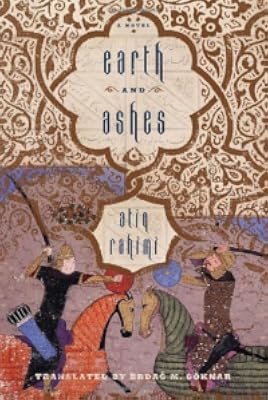
I enjoyed my previous Rahimi (Earth and Ashes), and The Patience Stone was not a disappointment. Having the woman talking to a comatose body was a device that worked really well, allowing her to express her anger and her guilt towards the man. Her story was disturbing and touching, but without unnecessary excesses, making it both believable and accessible. There was a slightly absurd denouement, which really didn't need to be there, but generally, this was another good book from a really interesting writer. show less
The Patience Stone is the story of a woman who tends to her seriously injured husband (they are never named in the book), shot during street fighting in their town. In her flashbacks to their relationships it becomes clear that he has been a bully and a distant husband. Now that he is in a coma, she is able to speak to him honestly for the first time. She tells him her views of their life together, her views of him as a husband and her show more secrets. He becomes her 'sang-e saboor' ('patience stone'), a mythical immobile object into which thoughts and prayers can be poured and which absorbs them before exploding under their pressure.
I enjoyed my previous Rahimi (Earth and Ashes), and The Patience Stone was not a disappointment. Having the woman talking to a comatose body was a device that worked really well, allowing her to express her anger and her guilt towards the man. Her story was disturbing and touching, but without unnecessary excesses, making it both believable and accessible. There was a slightly absurd denouement, which really didn't need to be there, but generally, this was another good book from a really interesting writer. show less
An Afghani wife tends to her comatose husband in an unnamed city devastated by the war. After finding a relative with whom to leave her two small daughters, she returns to her husband and continues to tend him, dripping sugar water into his mouth just as surely as she drips the story of herself and her secrets into his ears. Using the unconscious body of her husband to unburden herself as to the patience stone of legend, she tells a tale of powerlessness and woman's lot in life. She tells the truths that she would never have dared tell her jihadist husband had he been alert; she asks for forgiveness and explains necessity.
But this short and affecting tale is not just the wife's recollections and history but a record of her pain and show more degradations, one that must be told to another living being. The story itself is fairly simplistic and the method of telling her tale comes off as a bit mechanical. Perhaps this distance is a deadened way of relaying the numbness that horror bestows on victims. But in this case, it also serves to keep the reader from making much of an emotional connection with the wife of the story. The lack of empathy doesn't help in the end when the tale takes an unfortunate turn I rather expected from early on. Verging on melodramatic, there are also several plot points that I found completely unbelievable given the nature of the main character and while these plot points might in fact have been intended symbolically, the fact that they actually occur in the novella lessened the impact of the book over all. Many, many people disagree with my take on this one and despite my reservations, it is a book likely to inspire good discussions amongst readers. Those interested in the Middle East and the effect the war is having on plain folk, especially regular women, will find an arresting example here. show less
But this short and affecting tale is not just the wife's recollections and history but a record of her pain and show more degradations, one that must be told to another living being. The story itself is fairly simplistic and the method of telling her tale comes off as a bit mechanical. Perhaps this distance is a deadened way of relaying the numbness that horror bestows on victims. But in this case, it also serves to keep the reader from making much of an emotional connection with the wife of the story. The lack of empathy doesn't help in the end when the tale takes an unfortunate turn I rather expected from early on. Verging on melodramatic, there are also several plot points that I found completely unbelievable given the nature of the main character and while these plot points might in fact have been intended symbolically, the fact that they actually occur in the novella lessened the impact of the book over all. Many, many people disagree with my take on this one and despite my reservations, it is a book likely to inspire good discussions amongst readers. Those interested in the Middle East and the effect the war is having on plain folk, especially regular women, will find an arresting example here. show less
Members
- Recently Added By
Published Reviews
Although Rahimi creates a specific person, he never attempts to create much empathy. The woman pays a terrible price for self-revelation and the reader gains no more insight than might be gleaned from a garbled nightmare inspired by a late night-news item about the atrocities in Afghanistan.
added by lkernagh
It explores fundamental questions: love, sex, marriage, war and the repression entailed by a demanding religion. Rahimi gives his heroine a voice to speak the woes and indignities suffered by tens of thousands of women in the Muslim world, who have been marginalised, maltreated, and condemned to silence and endurance.
added by lkernagh
Lists

Translingualism
191 works; 4 members

Afghanistan
42 works; 2 members
Author Information

15+ Works 1,304 Members
Some Editions
Awards and Honors
Awards
Series
Belongs to Publisher Series
Work Relationships
Is contained in
Has the adaptation
Common Knowledge
- Canonical title*
- Stein der Geduld
- Original title
- Syngué Sabour. La pierre de patience
- Original publication date
- 2008
- Important places
- Afghanistan
- Epigraph
- From the body by the body with the body
Since the body and until the body.
-Antonin Artaud - Dedication
- This tale, written in memory of N.A. - an Afghan poet savagely murdered by her husband - is dedicated to M.D.
- First words
- The room is small. Rectangular.
- Last words
- (Click to show. Warning: May contain spoilers.)The breeze rises, sending the migrating birds into flight over her body.
- Blurbers
- Nafisi, Azar; Khadra, Yasmina
- Original language
- French
*Some information comes from Common Knowledge in other languages. Click "Edit" for more information.
Classifications
- Genres
- Fiction and Literature, General Fiction
- DDC/MDS
- 891.563 — Literature & rhetoric Literatures of other languages East Indo-European and Celtic literatures Iranian literatures Ossetic Fiction
- LCC
- PK6878.9 .R34 .S9613 — Language and Literature Indo-Iranian languages and literatures Indo-Iranian philology and literature Iranian philology and literature
- BISAC
Statistics
- Members
- 639
- Popularity
- 45,404
- Reviews
- 41
- Rating
- (3.55)
- Languages
- 18 — Arabic, Catalan, Danish, Dutch, English, Finnish, French, German, Galician, Greek, Italian, Norwegian (Bokmål), Farsi/Persian, Polish, Portuguese, Spanish, Swedish, Turkish
- Media
- Paper, Audiobook, Ebook
- ISBNs
- 48
- UPCs
- 1
- ASINs
- 9