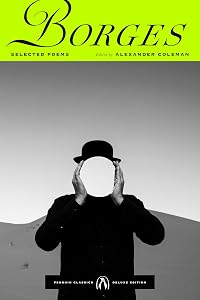
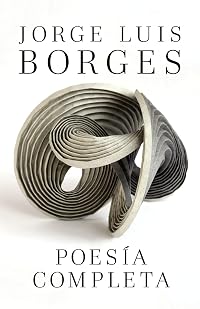
Jorge Luis Borges: Selected Poems
by Jorge Luis Borges
On This Page
Description
"This new bilingual selection brings together some two hundred poems - the largest collection of Borges's poetry ever assembled in English, including scores of poems never previously translated. Edited by Alexander Coleman, the selection draws from a lifetime's work - from Borges's first published volume of verse, Fervor de Buenos Aires (1923), to his final work, Los conjurados, published just a year before his death in 1986. Throughout this unique collection the brilliance of the Spanish show more originals is matched by luminous English versions rendered by a remarkable cast of translators."--BOOK JACKET. show lessTags
Recommendations






Member Reviews
I am so glad that the first book of 2016 I read is a poetry collection by Borges. I have long admired him for his lyrical language and although it is his translated works, I feel awed by his imagination. He writes poems dedicated to Robert Browning, Walt Whitman, Herman Melville, about his love for the sea, nature and seasons, sunsets, about streets with stores, Don Quixote, happiness, on death, dreams and to his father. His words have singularly influenced my horizon of understanding and appreciating poetry.
I am also able to read a bit of spanish so the bilingual edition feel like such a treasure to behold. I read these poems on the train while returning home late last night so, the calm of the night and the breeze made their way show more through my heart. His words seemed to float in the air I breathed. I kept reading throughout the night and only kept the book down at dawn. One look outside the window at that hour looked like a page out of the poetry book. It felt magical and so surreal. I felt like I was in a haze of poetry all around me. How wonderful it made me to be surrounded by emotions as lively as Borges expresses through his poetry. After acquainting myself with Borges words, I have stumbled upon a new world of lyrical majesty and would prance in its eternity as long as words stay afloat. A beautiful copy to own for life. show less
I am also able to read a bit of spanish so the bilingual edition feel like such a treasure to behold. I read these poems on the train while returning home late last night so, the calm of the night and the breeze made their way show more through my heart. His words seemed to float in the air I breathed. I kept reading throughout the night and only kept the book down at dawn. One look outside the window at that hour looked like a page out of the poetry book. It felt magical and so surreal. I felt like I was in a haze of poetry all around me. How wonderful it made me to be surrounded by emotions as lively as Borges expresses through his poetry. After acquainting myself with Borges words, I have stumbled upon a new world of lyrical majesty and would prance in its eternity as long as words stay afloat. A beautiful copy to own for life. show less
Prior to first reading something by Borges in 2019, I had thought I would never again come across a writer who could fundamentally surprise and enthral me. By that point, I had read hundreds of creditable books and identified a number of favourite authors; from a baseline of zero, I had developed idiosyncratic tastes and preferences in a deep pool of literature. I had exhausted the entire corpuses of some of my favoured writers, and thought nothing would ever again have that sort of newness and originality I found in my initial explorations. Nothing compares to the excitement of your first loves.
Then I found Borges, even though he'd never been hidden. This was, remarkably, something new and original, and I've been delighted by each of show more his stories I've read since. Even so, I was a bit wary of picking up his Selected Poems. I can't really explain why, as I enjoy poetry, including Spanish-language poetry, but something in me told me that his careful, laconic writing style and inverted metaphysical fantasies threatened to come across as archaic, indulgent and obtuse in a poem.
This assumption proved so ridiculously wide of the mark that Borges' Selected Poems has been one of the most enjoyable reading experiences since… well, since my last Borges collection. In fact, his poems here are so closely aligned to his incredible short stories that they're all but interchangeable. In one of the prologues to the collections anthologised here (yes, even his prologues are fascinating), Borges declares that "the differences between prose and verse are slight" (pg. 267), and that's certainly the case for his own offerings in each medium. Selected Poems even includes a few additions that might be better classified as short stories, including, as the second-to-last selection, a rather cool metaphysical ghost story.
Part of the reason for the writer's success as a poet is his erudition and craft; Selected Poems covers his entire 60+ year career, and were it not for the chronological order of the book you would not necessarily be able to tell the years apart. The only difference with the later poems – aside from perhaps, to more astute eyes than mine, a better grasp of form – is that new themes of "old age and ethics" have been added to "the mirrors, mazes and swords that my resigned reader expects" (pg. 265). Rather than plot or character or lyric, Borges leads with the idea, and his consistency across the decades confirms something I've long believed: that there are some ideas which can only be delivered in a poem, others that can only be told in a short story, and some which deserve a novel. It is the medium that must be found that best fits the idea.
And Borges' ideas are among the best. Contrary to his self-deprecating observation quoted above, he writes about more than mirrors, mazes and swords. There are deep metaphysical concepts, arresting characters and wine-dark imagery, all rendered in that cool, laconic style which will be deeply familiar to readers of his short stories. Selected Poems has a number of different translators, not only from collection to collection but from poem to poem, but Borges' voice is the dominant one. Aptly enough, for a bilingual poet, you easily forget that they have been translated. Borges resonates strangely but powerfully in English, and while I will continue to explore his work, I'm glad I've taken this lucrative diversion into his poetry. Never doubt Borges – not one of his labyrinths will ever lead you astray. show less
Then I found Borges, even though he'd never been hidden. This was, remarkably, something new and original, and I've been delighted by each of show more his stories I've read since. Even so, I was a bit wary of picking up his Selected Poems. I can't really explain why, as I enjoy poetry, including Spanish-language poetry, but something in me told me that his careful, laconic writing style and inverted metaphysical fantasies threatened to come across as archaic, indulgent and obtuse in a poem.
This assumption proved so ridiculously wide of the mark that Borges' Selected Poems has been one of the most enjoyable reading experiences since… well, since my last Borges collection. In fact, his poems here are so closely aligned to his incredible short stories that they're all but interchangeable. In one of the prologues to the collections anthologised here (yes, even his prologues are fascinating), Borges declares that "the differences between prose and verse are slight" (pg. 267), and that's certainly the case for his own offerings in each medium. Selected Poems even includes a few additions that might be better classified as short stories, including, as the second-to-last selection, a rather cool metaphysical ghost story.
Part of the reason for the writer's success as a poet is his erudition and craft; Selected Poems covers his entire 60+ year career, and were it not for the chronological order of the book you would not necessarily be able to tell the years apart. The only difference with the later poems – aside from perhaps, to more astute eyes than mine, a better grasp of form – is that new themes of "old age and ethics" have been added to "the mirrors, mazes and swords that my resigned reader expects" (pg. 265). Rather than plot or character or lyric, Borges leads with the idea, and his consistency across the decades confirms something I've long believed: that there are some ideas which can only be delivered in a poem, others that can only be told in a short story, and some which deserve a novel. It is the medium that must be found that best fits the idea.
And Borges' ideas are among the best. Contrary to his self-deprecating observation quoted above, he writes about more than mirrors, mazes and swords. There are deep metaphysical concepts, arresting characters and wine-dark imagery, all rendered in that cool, laconic style which will be deeply familiar to readers of his short stories. Selected Poems has a number of different translators, not only from collection to collection but from poem to poem, but Borges' voice is the dominant one. Aptly enough, for a bilingual poet, you easily forget that they have been translated. Borges resonates strangely but powerfully in English, and while I will continue to explore his work, I'm glad I've taken this lucrative diversion into his poetry. Never doubt Borges – not one of his labyrinths will ever lead you astray. show less
When Florencia shared a poem by Jorge Luis Borges in her review, I was inspired enough to track down more of his work. Luckily, I happened upon this lengthy compellation of poems that spanned most of his career. Never heard of the guy? Me neither, but I’m telling you, if you are at all interested in 20th century literature, you should have or should rectify it. He also wrote short stories, essays and translations, and was hugely influential, quite possibly the genesis of magic realism in Spanish literature. This book is ginormous, about 500 pages, fitting an illustrious career.
I wonder where my life is, the one that could
have been and never was, the daring one
or the one of gloomy dread, that other thing
which could as well have been show more the sword or shield
but never was?
from What Is Lost
A man that traveled the world, shared the first Formentor Prize with Samuel Beckett and was director of the Argentine National Public Library, he was often focused on themes of place and life paths. Labyrinths, myths, dreams and books also frequently appear, along with meditations on seeing. These are all the more poignant as I realized he was gradually losing vision until he went blind at 55.
Old age (the name that others give it)
can be the time of our greatest bliss.
The animal has died or almost died.
The man and his spirit remain.
I live among vague, luminous shapes
that are not darkness yet.
from In Praise of Darkness
He also drew on references to classical literature, which were more likely to miss me in his works, but some of them moved me nonetheless:
In my life there were always too many things.
Democritus of Abdra plucked out his eyes in order to think:
Time has been my Democritus.
from In Praise of Darkness
What I loved most about this collection is that each poem had the Spanish version on the facing page.
La vejez (tal es el nombre que los otros le dan)
puede ser el tiempo de nuestra dicha.
El animal ha muerto o casi ha muerto.
Quedan el hombre y su alma.
Vivo entre formas luminosas y vagas
que no son aún la tiniebla.
And the second:
Siempre en mi vida fueron demasiadas las cosas;
Demócrito de Abdera se arrancó los ojos para pensar:
el tiempo ha sido mi Demócrito.
There’s something really beautiful about his writing and it’s seeming simplicity in Spanish. Of course, it wasn’t long before I started wandering down the translation accuracy philosophy, and wondering about how well that works in poetry, where I feel the poets work very deliberately at word choice. On a couple of occasions after reading the original, I felt myself wondering at the translator. In this edition, there was a collection of translators, so their initials were under the translated versions.
While I attempted to do my skim-until-a-poem-noticed-me approach, I found myself stopping quite often, despite the length of the book. So much spoke to me.
When sorrow lays us low
for a second we are saved
by humble windfalls
of mindfulness or memory:
the taste of a fruit, the taste of water,
that face given back to us by a dream,
the first jasmine of November,
the endless yearning of the compass,
a book we thought was lost
Cuando nos anonada la desdicha,
durante un sequndo nos salvan
las aventuras infimas
de la atención o de las memoria:
el sabor de una fruta, el sabor del agua,
esa cara que un sueno no devuelve,
los primos jazmines de noviembre,
el anhelo infinito de la brújula,
un libro que creíamos perdido
from Shinto
It was about five hundred pages; there were so many works that it became overwhelming at times. Each section was from one of his collections and had a very short description of the book. I think I would have liked a little more context, as a Borges newbie. Arranged chronologically, I didn’t have as much understanding as to where it fell in this personal history; his awards, his brief marriage, his blindness, his career. But I’m very glad for such an introduction into an extremely interesting and moving writer. show less
I wonder where my life is, the one that could
have been and never was, the daring one
or the one of gloomy dread, that other thing
which could as well have been show more the sword or shield
but never was?
from What Is Lost
A man that traveled the world, shared the first Formentor Prize with Samuel Beckett and was director of the Argentine National Public Library, he was often focused on themes of place and life paths. Labyrinths, myths, dreams and books also frequently appear, along with meditations on seeing. These are all the more poignant as I realized he was gradually losing vision until he went blind at 55.
Old age (the name that others give it)
can be the time of our greatest bliss.
The animal has died or almost died.
The man and his spirit remain.
I live among vague, luminous shapes
that are not darkness yet.
from In Praise of Darkness
He also drew on references to classical literature, which were more likely to miss me in his works, but some of them moved me nonetheless:
In my life there were always too many things.
Democritus of Abdra plucked out his eyes in order to think:
Time has been my Democritus.
from In Praise of Darkness
What I loved most about this collection is that each poem had the Spanish version on the facing page.
La vejez (tal es el nombre que los otros le dan)
puede ser el tiempo de nuestra dicha.
El animal ha muerto o casi ha muerto.
Quedan el hombre y su alma.
Vivo entre formas luminosas y vagas
que no son aún la tiniebla.
And the second:
Siempre en mi vida fueron demasiadas las cosas;
Demócrito de Abdera se arrancó los ojos para pensar:
el tiempo ha sido mi Demócrito.
There’s something really beautiful about his writing and it’s seeming simplicity in Spanish. Of course, it wasn’t long before I started wandering down the translation accuracy philosophy, and wondering about how well that works in poetry, where I feel the poets work very deliberately at word choice. On a couple of occasions after reading the original, I felt myself wondering at the translator. In this edition, there was a collection of translators, so their initials were under the translated versions.
While I attempted to do my skim-until-a-poem-noticed-me approach, I found myself stopping quite often, despite the length of the book. So much spoke to me.
When sorrow lays us low
for a second we are saved
by humble windfalls
of mindfulness or memory:
the taste of a fruit, the taste of water,
that face given back to us by a dream,
the first jasmine of November,
the endless yearning of the compass,
a book we thought was lost
Cuando nos anonada la desdicha,
durante un sequndo nos salvan
las aventuras infimas
de la atención o de las memoria:
el sabor de una fruta, el sabor del agua,
esa cara que un sueno no devuelve,
los primos jazmines de noviembre,
el anhelo infinito de la brújula,
un libro que creíamos perdido
from Shinto
It was about five hundred pages; there were so many works that it became overwhelming at times. Each section was from one of his collections and had a very short description of the book. I think I would have liked a little more context, as a Borges newbie. Arranged chronologically, I didn’t have as much understanding as to where it fell in this personal history; his awards, his brief marriage, his blindness, his career. But I’m very glad for such an introduction into an extremely interesting and moving writer. show less
This is the book I have always known in the back of my head existed and that I needed to read. Even before I knew who Borges was, or even had read his short stories. When I wrote poetry in undergrad I was trying to imitate him without even knowing it (I was trying to write the poetic equivalent of a Rivette film, but Rivette sprung from Borges). Before this I had read "Poems of the Night" and "The Sonnets", but those are just small samplings. This is the holy grail.
I don't like poetry that much, in fact I hardly read it. Perhaps I should give it a chance but everything I've ever read I never really liked all that much, so why read it at all? I REALLY try to avoid poetry in translation. I just don't see how you can bring the essence of what is a poem across into a completely different language. The little I've read of poetry that originated in English I just can't imagine finding precisely the right words in another language (Ihave taken German, Spanish, and French so I know a little about what I'm talking about). That is why I avoid poetry in translation even more than in English. Even the grammatical structure is so different in languages like German, for instance. I can't imagine reading all show more those Nobel laureate poets that wrote in Czech, Polish, Swedish, unless I knew their native languages; like reading a prose summary of each poem.
Okay, so obviously I made an exception here. I love Borges fiction, where even his prose must lose a lot of meaning and nuance in translation. He comes across as a master of language even in English translation. At least this book does it right: Spanish on one page and English on the facing page. Unfortunately my Spanish is slightly above rudimentary, mostly high school language classes and the bit I picked up from living in Texas for 8 years (anyone who lives in the southwest US and doesn't pick up at least a smattering of Spanish is stupid or ethnocentric or both). I can pick up major differences but can't really say I "enjoy" the Spanish version.
However, this book was marvelous to me. Borges poetry was immediately accessible to me, moreso even than his fiction. His poems are lyrical and his references for the most part straightforward. I'm not an Argentine scholar so some things were definitely over my head, but I even got the sense, I think, in most cases. I'm still suspicious of poetry in translation especially when still rhyming (how can these words be the correct ones?). I will always tend to avoid it in favor poetry written natively in the English language. I avoid most poetry anyway. But I would recommend this to anyone interested in Borges writings.
He should have won a Nobel Prize but politics being what they are he was consistently snubbed. Did I mention I hate literary prizes as well? show less
Okay, so obviously I made an exception here. I love Borges fiction, where even his prose must lose a lot of meaning and nuance in translation. He comes across as a master of language even in English translation. At least this book does it right: Spanish on one page and English on the facing page. Unfortunately my Spanish is slightly above rudimentary, mostly high school language classes and the bit I picked up from living in Texas for 8 years (anyone who lives in the southwest US and doesn't pick up at least a smattering of Spanish is stupid or ethnocentric or both). I can pick up major differences but can't really say I "enjoy" the Spanish version.
However, this book was marvelous to me. Borges poetry was immediately accessible to me, moreso even than his fiction. His poems are lyrical and his references for the most part straightforward. I'm not an Argentine scholar so some things were definitely over my head, but I even got the sense, I think, in most cases. I'm still suspicious of poetry in translation especially when still rhyming (how can these words be the correct ones?). I will always tend to avoid it in favor poetry written natively in the English language. I avoid most poetry anyway. But I would recommend this to anyone interested in Borges writings.
He should have won a Nobel Prize but politics being what they are he was consistently snubbed. Did I mention I hate literary prizes as well? show less
Borges isn't the best poet, but he isn't the worst by far. I once read somewhere that if Borges had never published a short story, he would still be remembered as a fine poet (at least in Latin America). I can agree with that assessment.
Borges poems are presented in Spanish and in English translation on the facing page. That's the best way to do any translation of poetry. It allows someone like me, with a good working knowledge of español, to translate the poems myself line-by-line and compare them with the translated words.
Some of Borges's poems are playful with mysteries, mirrors, and time, like his short stories. Some of his standard wordplay is there, twisting phrases and meanings. Many of the poems are quite heartfelt and good. show more Some are ho-hum. Included are Borges's prologues and some prose poems.
An essential addition to any Borges collection and any poetry bookshelf.
4.5 of 5 stars. show less
Borges poems are presented in Spanish and in English translation on the facing page. That's the best way to do any translation of poetry. It allows someone like me, with a good working knowledge of español, to translate the poems myself line-by-line and compare them with the translated words.
Some of Borges's poems are playful with mysteries, mirrors, and time, like his short stories. Some of his standard wordplay is there, twisting phrases and meanings. Many of the poems are quite heartfelt and good. show more Some are ho-hum. Included are Borges's prologues and some prose poems.
An essential addition to any Borges collection and any poetry bookshelf.
4.5 of 5 stars. show less
Borges is my favorite writer. His understanding of the world is breath-takingly large, and he is able to give complex ideas visceral, emotional weight. The feel of his poetry and stories is the feeling you have when you wake up from a disturbing, exhilerating dream. He was a librarian in Argentina for most of his life. Although he became blind in later life, he was able to recite passages from his favorite books from memory, even identifying the page numbers from which he recited. Amazing man.
Members
- Recently Added By
Lists

Latin America
26 works; 9 members

Spanish Language in English Translation
19 works; 2 members
Author Information

868+ Works 58,868 Members
Born in Buenos Aires, Argentina, in 1899, Jorge Borges was educated by an English governess and later studied in Europe. He returned to Buenos Aires in 1921, where he helped to found several avant-garde literary periodicals. In 1955, after the fall of Juan Peron, whom he vigorously opposed, he was appointed director of the Argentine National show more Library. With Samuel Beckett he was awarded the $10,000 International Publishers Prize in 1961, which helped to establish him as one of the most prominent writers in the world. Borges regularly taught and lectured throughout the United States and Europe. His ideas have been a profound influence on writers throughout the Western world and on the most recent developments in literary and critical theory. A prolific writer of essays, short stories, and plays, Borges's concerns are perhaps clearest in his stories. He regarded people's endeavors to understand an incomprehensible world as fiction; hence, his fiction is metaphysical and based on what he called an esthetics of the intellect. Some critics have called him a mystic of the intellect. Dreamtigers (1960) is considered a masterpiece. A central image in Borges's work is the labyrinth, a mental and poetic construct, that he considered a universe in miniature, which human beings build and therefore believe they control but which nevertheless traps them. In spite of Borges's belief that people cannot understand the chaotic world, he continually attempted to do so in his writing. Much of his work deals with people's efforts to find the center of the labyrinth, symbolic of achieving understanding of their place in a mysterious universe. In such later works as The Gold of the Tigers, Borges wrote of his lifelong descent into blindness and how it affected his perceptions of the world and himself as a writer. Borges died in Geneva in 1986. (Bowker Author Biography) show less
All Editions
Some Editions
Series
Belongs to Publisher Series
Common Knowledge
- Canonical title
- Jorge Luis Borges: Selected Poems
- People/Characters
- Jorge Luis Borges; Miguel de Cervantes; Don Quixote de la Mancha; Dante Alighieri; John Milton; Alexander Selkirk (show all 28); Odysseus; Beowulf; Emanuel Swedenborg; Jonathan Edwards; Ralph Waldo Emerson; Oedipus; Baruch Spinoza; James Joyce; Death; Satan; Susana Bombal; Pedro Henríquez Ureña; Robert Browning; Manuel Mujica Lainez; Herman Melville; Johannes Brahms; Gunnar Thorgilsson; René Descartes; Lord Byron; Jesus Christ; Joseph Conrad; Leopoldo Lugones
- Important places
- Buenos Aires, Argentina; Argentina
Classifications
Statistics
- Members
- 1,302
- Popularity
- 18,672
- Reviews
- 14
- Rating
- (4.19)
- Languages
- English, Spanish
- Media
- Paper
- ISBNs
- 4
- ASINs
- 3